Spotlight
From AI Pilots to AI-Native: Saudi Arabia’s Next Technology Leap

As Saudi Arabia moves AI from experimentation into large-scale deployment, Federico Pienovi, CEO APAC & MENA at Globant, explains why the Kingdom is emerging as a proving ground for agentic AI, AI-native business models and a new generation of connected experiences spanning sports, tourism, financial services and giga-projects.
Saudi Arabia is investing heavily in AI infrastructure and adoption. What is the Kingdom doing differently that could make it a global blueprint for moving AI from experimentation into large-scale business deployment?
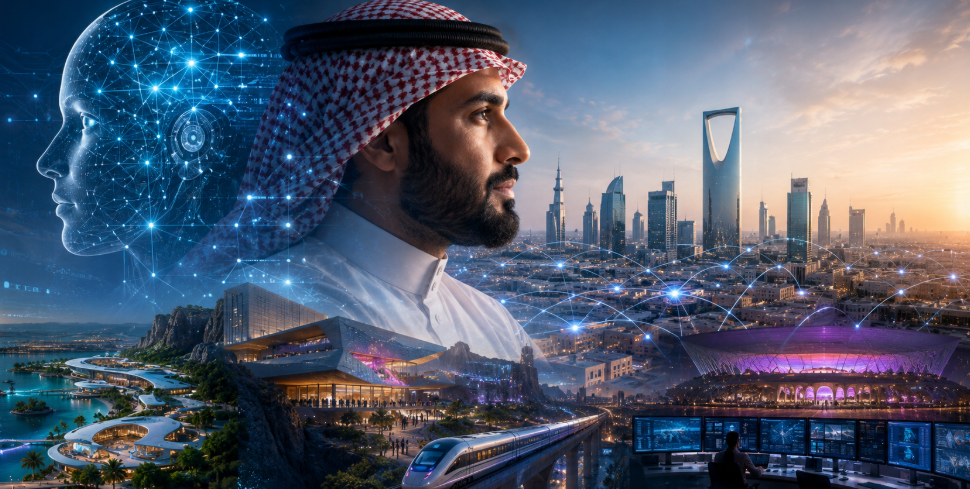
What distinguishes Saudi Arabia’s approach is the alignment between national ambition and institutional execution. The Kingdom is embedding AI directly into the infrastructure of its giga-projects, financial institutions, and national sports ecosystems from day one. When you look at projects like Qiddiya, Red Sea Global, Diriyah, and New Murabba, these are greenfield developments where AI-native technology can be architected into the foundation rather than bolted on afterward.
Saudi Arabia is simultaneously transforming multiple sectors, tourism, sports, aviation, entertainment, real estate, and financial services, which creates a unique ecosystem effect. For instance, the world’s first Agent-to-Agent Tourism Corridor, connecting Red Sea Global and AlUla through sovereign AI destination agents, demonstrates how different entities can share AI infrastructure while maintaining data sovereignty. The Kingdom has also created conditions where global technology partners want to establish a deep local presence. Our own experience establishing a regional headquarters in Riyadh as a Center of Excellence for AI, creativity, and digital solutions reflects this pull, serious institutions want serious partners embedded alongside them, working on problems that matter at national scale.
Agentic AI is quickly becoming the next major enterprise conversation. Where are you already seeing organisations move beyond copilots towards AI agents that can independently execute tasks and make operational decisions?
The shift from copilots to autonomous agents is happening fastest where the business case is clearest and the tolerance for transformation is highest. In the Middle East, we’re seeing three sectors lead this transition: tourism and hospitality, financial services, and real estate development.
In tourism, the Agentic Tourism Corridor we’re launching at LEAP represents what we believe is the world’s first live Agent-to-Agent network, sovereign AI destination agents for Red Sea Global and AlUla that can communicate with each other to orchestrate guest journeys across multiple destinations. These are agents that can independently execute booking decisions, coordinate logistics, and personalize experiences based on real-time behavioral data.
Financial services institutions in the region, including banks like FAB, Emirates NBD, and Commercial Bank of Dubai, are deploying agentic AI that goes beyond customer service automation. We’re talking about agents that can independently manage risk assessment workflows, execute compliance checks, detect fraud patterns, and personalize customer journeys without human intervention at each step. Globant Financial Services AI Studio is specifically designed to refactor operations through agentic AI, not just add conversational interfaces.

In real estate, our PropTech ecosystem demonstrates the full agentic potential: AI agents handling lead qualification, property discovery through AR/VR, construction progress tracking via digital twins, and automated booking, payments, and service management. For giga-projects like Diriyah and New Murabba, is operational necessity given the scale and timeline ambitions.
The proof that this model works at global scale came in August 2026 when FIFA selected us to build their continuous, year-round fan experience ecosystem using AI Pods. Initial pilots showed a 20% efficiency increase in throughput generation while maintaining or improving quality. FIFA specifically described their move as embracing an AI-native, consumption-based model, a signal that major global institutions are ready to move past experimentation.
Many companies have spent years on digital transformation, yet AI is now forcing them to rethink entire operating models. What separates an organisation that simply adds AI to existing processes from one that genuinely reinvents the business around AI?
The difference lies in whether an organization treats AI as a feature or as an operating system. Adding AI to existing processes means layering chatbots onto customer service, adding predictive analytics to existing dashboards, or automating discrete tasks within unchanged workflows. Reinventing AI means changing the unit of delivery, the commercial model, and the fundamental process of how work gets done, all at once.
Technology services have moved through three eras. Traditional IT services sold labor, hours and full-time equivalents, delivered through projects, scaled by hiring more people. Digital-native services sold expertise and delivery, agile squads, human-built software with automation layered in. What we call AI-native technology services represents a third era, where the resource is people plus AI agents, delivery is agent-orchestrated, and the commercial model shifts from hours to outcomes, capacity, and tokens.
When FIFA engaged us to build their fan experience ecosystem, they didn’t ask for AI features added to their existing platforms. They embraced an AI-native, consumption-based model where they pay for outcomes rather than hours, where AI agents execute while human experts orchestrate, and where all institutional knowledge generated is secured in a proprietary token vault that FIFA owns. That’s reinvention, the entire relationship between client and technology partner has changed. Organizations that genuinely reinvent share several characteristics: they architect for AI from the beginning rather than retrofit, they measure success in business outcomes rather than technology deployment; they’re willing to change commercial relationships, not just internal processes, and critically, they maintain human expertise in an orchestration role rather than simply automating humans out of the equation. Expert supervision remains essential, anyone can prompt an AI tool, but shipping results to production requires governance, quality validation, and domain knowledge that only human experts can provide.
Saudi Arabia is simultaneously transforming sectors such as tourism, sports, aviation and entertainment through major projects. Which of these sectors do you believe could become the strongest showcase for AI-driven experiences, and what might those experiences look like over the next three to five years?
Sports has the strongest potential to become Saudi Arabia’s defining showcase for AI-driven experiences, and the evidence is already emerging. The Kingdom’s sports transformation, through the Saudi Pro League, preparations for the 2034 FIFA World Cup, and purpose-built sports infrastructure within giga-projects, creates a unique convergence of factors: massive capital investment, greenfield venues, a young and digitally native fan base, and explicit ambition to leapfrog existing global benchmarks.
What makes sports particularly powerful as a showcase is that fan experiences are inherently measurable and emotionally resonant. Through Sportian, we’ve built a single operating system that connects fan identity, behavioral data, content, venue operations, and performance intelligence. This platform already powers LALIGA clubs, the Belgian Pro League, and the U.S. Men’s National Soccer Team under Mauricio Pochettino. The Saudi Pro League represents an opportunity to deploy this at scale in venues designed from the ground up for AI integration.
Over the next three to five years, the experience could look like this: a fan’s journey begins before they leave home, with AI agents curating personalized content, managing ticket purchases, and coordinating travel logistics. In-venue, their identity travels seamlessly across every digital touchpoint, concessions, merchandise, interactive experiences, creating a continuous relationship rather than discrete transactions. Real-time performance data informs on-screen content that adapts to what individual fans care about. Post-match, that relationship continues through personalized content and engagement that keeps fans connected year-round, not just on match days.
Globant has established its regional headquarters in Riyadh and worked across several Vision 2030-linked sectors. After three years in the Middle East, what have you learned about the region that has changed Globant’s strategy, and where do you see the biggest opportunity for the company over the next phase of growth?
What we’ve learned has shaped how we operate here and influenced our global thinking. The first lesson was the speed of ambition. The timeline expectations in Saudi Arabia compress what would be multi-year transformation programs elsewhere into months. This has pushed us to evolve our delivery models, the subscription-based This has pushed us to deploy our most advanced delivery models here from the outset. The subscription-based AI Pods approach, where clients can unlock modular teams of AI agents supervised by human experts from day one, reflects where the entire technology services industry is heading globally. The region’s pace and ambition mean that clients here are among the earliest and most demanding adopters of that model, making the Middle East a natural proving ground for AI-native delivery at scale.
The second lesson was the seriousness of partnership expectations. Our client roster in the region, Qiddiya, Red Sea Global, the Saudi Pro League, represents institutions that aren’t looking for vendors. They’re looking for partners willing to stake their own reputation on joint outcomes. Every flagship client represents an institution betting its own transformation on us.
The third lesson was about talent. The Kingdom’s investment in developing local technology talent aligned with our decision to position Riyadh as a Center of Excellence for AI, creativity, and digital solutions. This isn’t a satellite office supporting work done elsewhere, it’s a hub where innovation happens.
Looking ahead, the biggest opportunity lies in the interconnection between sectors. Saudi Arabia isn’t transforming tourism, sports, entertainment, aviation, and finance as separate initiatives, these are interlocking systems that will increasingly need to share data, coordinate experiences, and operate as a unified ecosystem. The technology partner that can operate across all these sectors, understanding both the vertical depth and horizontal connections, will be positioned to support the Kingdom’s next phase of growth.