Uncategorized
DO FISCAL STIMULUS MEASURES SUPPORT THE US MARKET GROWTH, AND IS A DEFAULT POSSIBLE?



Authored by Michael Smirnow, Chief Investment Officer, Arabian Capital Gulf
With the dirham pegged to the US dollar and UAE investors exposed to global markets, decisions made by the Federal Reserve and the US government can influence local borrowing costs, liquidity, and investment sentiment. Michael Smirnow, Chief Investment Officer, Arabian Capital Gulf After the global financial crisis, U.S. authorities tried to stimulate the economy primarily through monetary measures: the Federal Reserve cut interest rates to zero and launched quantitative easing (QE) for the first time, purchasing assets to provide market participants with liquidity.
As a result, the Fed’s balance sheet grew to USD 8 trillion by 2021. However, between 2008 and 2020, the U.S. economy did not experience rapid growth, and inflation regularly remained below the target level. Everything changed in 2020, when the government entered the stimulus fray for the first time in many years. While the Fed’s accommodative monetary policy primarily helped large banks and market participants, at the onset of the pandemic the U.S. government began distributing money to households and increasing budget expenditure across nearly all areas.

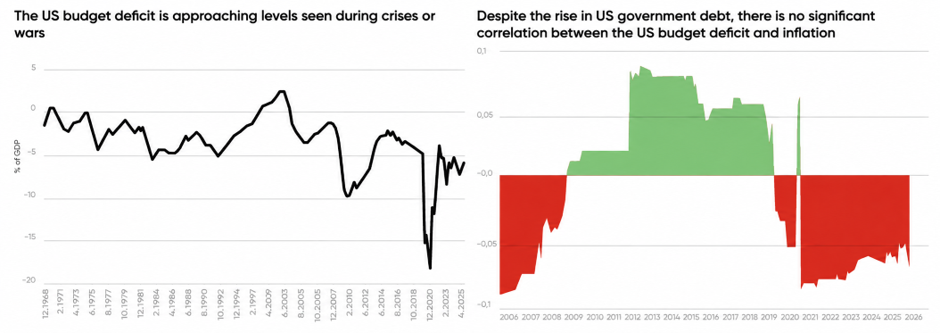
Compared with monetary measures, these fiscal stimulus measures proved to be a significantly more powerful tool for stimulating the economy; however, they increased government debt by the aforementioned 61%. Against this backdrop, we expect the next few years to be shaped primarily by fiscal stimulus, with government action, rather than the Federal Reserve, becoming the key factor for investors. Indeed, while the private sector ran large deficits before 2008, the deficit now lies with the government, while private-sector indebtedness is declining. In the years following the pandemic, the largest government deficits coincided with the strongest growth in financial markets. This is unsurprising, since a public-sector deficit becomes private-sector income. This dynamic enabled the U.S. economy to remain resilient in 2023-2024 despite the Fed’s record pace of interest-rate increases. Whichever U.S. political party is in power will continue along this path; Trump is also doing the same through legislation known as the “Big Beautiful Bill.”
As long as inflation in the United States remains under control, this race will continue. The current balance between monetary and fiscal stimulus vividly illustrates this argument. On the one hand, the U.S. Federal Reserve is adopting an increasingly neutral stance and is clearly in no hurry to cut interest rates or introduce new stimulus programmes. On the other hand, the Treasury is entering the fray: as yields on long-term U.S. bonds confidently exceed 5%, the Treasury has launched a program to buy back its long-term debt. In effect, this gives the bond market the same kind of stimulus the Fed previously delivered.
Thus, the balance of power is changing, but the direction remains the same: the United States still needs accommodative monetary conditions. If these are not achieved through monetary measures, they will be achieved through fiscal ones.
(Arabian Gulf Capital (AGC) holds a Category-1 Investment Firm license issued by the Central Bank of Bahrain and provides tailored investment solutions to individual, corporate, and institutional clients.)