Tech Interviews
TRACK24 UNVEILS ATLASNXT TO REDEFINE GLOBAL DUTY‑OF‑CARE AND RISK INTELLIGENCE


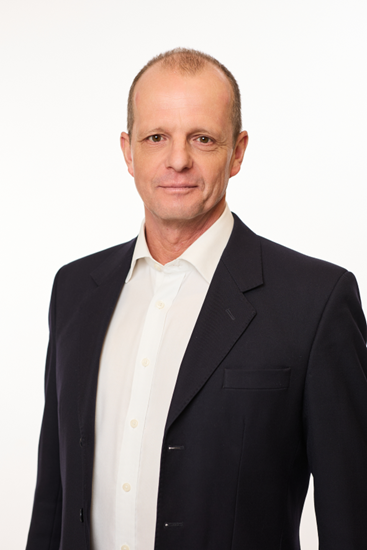
Exclusive interview with Andrew McInerney (CEO) and Ebad Abid (Head of Product), Track24
Can you introduce your company to us? What does AtlasNXT do?
AtlasNXT, from TRACK24, is a duty-of-care location services and communication system. So, it enables a business to know where its people are and relate those people to the risks and other information they might face and then enables them to make decisions and communicate about to ensure the duty-of-care of their teams.
So, what inspired the founding of AtlasNXT and how does its mission differ from other duty-of-care and operational communication platforms?
TRACK24 was formed in 2004 as a location services company in high-risk environments, principally using satellite locations and satellite communication devices. And that remains one of our key differentiators, the ability to integrate satellite communications and satellite devices from any of the competitors. Since then, the world and the technology has moved on.
And in the last five years, we at TRACK24 have integrated lots of different, divergent bits of our software into AtlasNXT as a single software offering. And that provides those location services, not just to high-risk environments, but to GSM-capable and GPS-capable devices across any environment. So, where risk moves across place and time, then any business can use this, not just those ones in high risks as well.
So, it helps with travel risk management, it helps with precision communications to people, it reduces the amount of noise compared to the amount of signal that individuals get. So, precision information to the right people at the right time.
In your view, what is the biggest misconception organizations still have about modern duty-of-care technology?
We’ve come from a high-risk environment, from the most high-risk, and bring with us that sort of ethos of protection. Many organizations have come from a travel risk management environment, and therefore that tends to be diary predictions of where your diary says you’re going to be traveling that day, rather than precision location. And so, a lot of people bring with them the expectation that they get a generic travel risk management update, rather than something precise for their own movements, which changes as their own movements change.
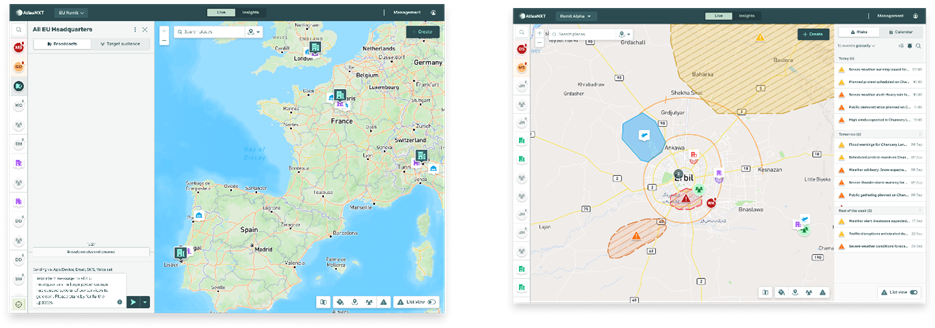
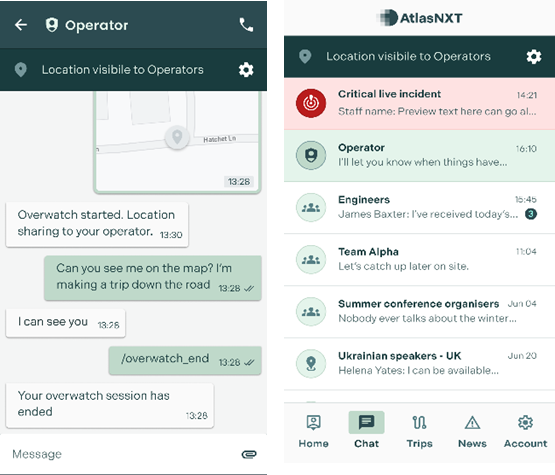
So, the adaptability of a live tracking system enables that. The other key differentiator is the ability to maintain privacy. I’ve done that quick demonstration of the system.
So, the individual knows when they’re able to be seen by their operation, by their operators, by their employer, and when they’re not, so they can maintain their privacy. And they only lose their privacy through consent. They press a button on the app and say, track me, or check me, overwatch me, or I’m in a panic mode, or by event, and they go inside a geofence, which their employer has put up on the map.
It might be their location, it might be a risk environment, and even then, the app tells the individual that you’re now visible to your operator. So, I think it’s key, the privacy element, and the live tracking, rather than any predictive element. Coming to the privacy part, AtlasNXT emphasizes privacy-first location-based communications.

How do you balance delivering critical information with user privacy concerns?
One of the challenges is, as you have said, is if you give the user the control, you won’t be able to actually support the user, because they’ll just switch it off. So, what we do is, we allow the system to share information, but we manage privacy through the visibility of the data that’s transferred, as opposed to switching it on and off, as most people do.
Because once you switch it off, the person’s MIA, and you can’t do anything to support them. They’re not going to get any notifications; we’re not going to know where they are. But if the system is always sharing, if their device is always sharing a location, or any form of notification with our system in the background, then we’re always able to reach them in the event something goes wrong.
The way we manage privacy is we essentially make them invisible, and they become visible by consent or event. So, one of the main things in data protection laws is legitimate interest. So, you should only ever have access to somebody’s information if you actually need it.
And so, you either give consent, that you can use my location data, or there’s a legitimate interest, such as they are in a potential area where there is a risk to them. At that point, we can reveal that location, and therefore, we’re always in control.

AtlasNXT integrates geofencing, precision messaging, and real-time operational intelligence. How do you see these capabilities?
Geofences themselves have evolved. First, they just used to be sort of a digital perimeter. Now, we’ve introduced smart geofences, which essentially allows you to track people coming in and out of that perimeter. What we also do is see what impacts that perimeter.
So, we have various intelligence feeds we integrate with, and you can see if a particular perimeter is impacted by that. Now, with AI, you can also then say, is that piece of intelligence relevant to the perimeter I’m monitoring? When you’re integrating with data providers, you’re probably getting a few thousand events a day. As humans, we can’t consume that much information, or if we can, we can’t comprehend what it means.
With the power of AI, we can summarize information and allow it to provide clarity. We can also use it to generate reports and deliver trend analysis.
For example, it can extrapolate that over X period of time, we’ve had X types of risk, which gives us the ability to predict future risk. So, if there is, for example, a civil conflict near a particular geofence, you’ll find that there are X amount of panic alarms pressed in the vicinity.
So, what AI will be able to do is allow us to forecast whether, you know, because of this event, we can expect this many people to be at risk. Which sends out early warnings automatically without human intervention being required.
From our engagement with customers, it’s clear that they want to maintain an operator in the decision loop. So, our approach to AI is that it does the heavy lifting, but only suggests options to the operator. This ensures a human remains in command and makes the critical decisions.
AI is powerful and can save a great deal of time, but we’re not at the point where life-and-death security decisions can be handed to a machine. It performs the groundwork while a human operator remains in control. One of its strengths is pattern recognition.
It can say to the operator, ‘we’re noticing this, do you want to take this action?’ It’s a co-pilot, not a pilot. It also improves efficiency, as AI can process large volumes of information instantly, reducing response times. The earlier an organisation can intervene, the safer its people are. AI summarises the situation, and the operator decides whether and how to act.
And how important was InterSec for you and this region, Middle East, for your company?
We’re headquartered in London with two subsidiary organizations in the Emirates and a country office in Iraq. The region is hugely important. It’s where we originated as a species and as a company. So, we started in 2004 in Baghdad, and we’ve always maintained a large presence in Iraq, Kurdistan and across the Middle East.
The world isn’t getting any easier. The world is not getting any less risky. The world is not getting any more certain. Risk is spreading and becoming quite unpredictable whether you’re the president of an independent nation or an independent nation that belongs to somebody else. Risk is coming to you around the globe.
Our services become more and more important and more relevant globally. The region of the Middle East is important because I think it’s a region that understands security in a very central way.
It was our first attendance at InterSec. We’re a software provider. From what I’ve seen so far, there’s lots of hardware providers.
And that means there’s lots of potential partners for us. We can integrate any of their systems into our system and make access control useful for decision support which is what we’re here to do.