Financial
WHY DIGITAL FINANCIAL LITERACY IS THE GROWTH ENGINE MENA’S FINTECHS HAVE BEEN MISSING


By Mayada Baydas, Ph.D., Vice President – Financial Inclusion, botim
For years, the story of fintech in MENA has been told through product launches: faster payments, cheaper remittances, advanced interfaces, enhanced experiences, micro-savings, and instant credit. But the next unlock for the region may not lie in new features or enhancements at all. It lies in something more foundational and far more powerful: Digital financial literacy (DFL).
Today, access is not the challenge. While over 68% of the world population is online, and the number of fintechs globally is rising, 1.3 billion adults remained unbanked globally in 2024. The picture in MENA is no different. The region hosts more than 1000 fintechs, and internet penetration is over 100%, yet 64% of adults remained unbanked in 2024. In other words, the ecosystem is rich with solutions, but the real gap lies in knowledge and ability.
This is where DFL becomes transformative. It equips users with the understanding and confidence to navigate digital financial tools in ways that genuinely serve their needs, whether that’s sending money home, paying bills, setting small budgets, investing, or avoiding scams. And while this capability may seem subtle, its impact is anything but. DFL is quickly becoming the most efficient route to building trust, increasing usage, and driving long-term adoption in a region where smartphone penetration is nearly universal, yet digital confidence remains uneven.
The GCC Leading Financial Inclusion
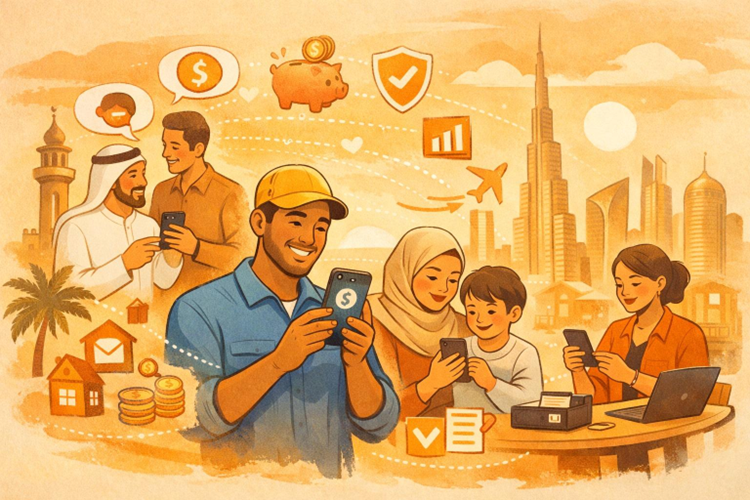
Let’s zoom into the GCC, the region leading the charge in MENA. It sits at the heart of one of the world’s largest remittance ecosystems. Migrant and low-income workers send millions of dollars home every year. In 2024, remittances to low-and middle-income countries reached $685 billion, surpassing both foreign direct investment and global aid.
Recognizing this strategic position, regulators and fintechs are working together to turn access into meaningful participation. In the UAE, the Central Bank (CBUAE) collaborates closely with fintechs through initiatives such as the FinTech Regulatory Laboratory and the National Financial Literacy Strategy. These frameworks expand access while guiding fintechs to design safe, inclusive, and user-friendly services. In Saudi Arabia, the Financial Sector Development Program (FSDP) and the Saudi Payments ecosystem combine access with behavioral frameworks that foster trust, responsible usage, and long-term adoption.
Regulators set the standards, provide oversight, and create the frameworks for safe and responsible digital finance. Fintechs take these frameworks and translate them into innovative products and services that meet real user needs. Together, they are shaping an environment where financial inclusion is not just a policy goal but a lived reality.
Digital financial literacy is the bridge between infrastructure and participation. Without it, the region risks building highways that millions do not feel safe enough to drive on.
From Access to Ability: What We Learned at botim
When I joined Botim, our hypothesis was simple: If an app can connect people, it can also build their financial capability. A year later, more than 2 million users on Botim are fully KYC-verified, and many are now using our financial features, from remittances to small lines of credit. But their adoption has never been the result of features alone. It has been the result of trust, clarity, and understanding.
Botim is a simple, familiar tool used daily by millions to stay connected. Its reach, especially among communities often overlooked by traditional financial systems, offered a unique opportunity. By unifying remittances, payments, salary tools, credit, savings, and multi-currency accounts under Botim Money, we created a single ecosystem that lets users manage their finances seamlessly within a platform they already trust.
As the platform transformed, one insight became clear: with its communications foundation, Botim is not just a tool for access but a vehicle to educate and empower users. By raising awareness about digital financial services and embedding knowledge and know-how, we enhance our users’ capability to make financial decisions and take actions, thereby increasing their confidence and resilience along their journey towards financial health.
Digital financial literacy is central to our mission. With our scale and reach, we are integrating technology responsibly to deliver a positive impact along the user financial journey.
DFL must be embedded, not added
People do not build financial capability by reading manuals; they learn by doing, seeing results, and repeating them. Behavioral science, from Fogg (2019) to Kolb (1984), shows that meaningful change comes from action, not theory. This is why digital financial literacy cannot sit outside the experience. It needs to be part of the user journey itself. Short, contextual prompts at the right moment can clarify a first remittance, flag a potential scam, explain fees, or help someone set a simple savings goal. GSMA findings show that these in-journey cues improve digital-task completion by 30 to 40 percent compared to passive instruction, proving that micro-moments matter.
Looking ahead, many platforms are extending this approach across core areas such as secure account practices, understanding fees, responsible borrowing, cross-border transfer basics, and fraud or scam awareness. These prompts work because they appear where decisions are made, helping users avoid mistakes, recognize risk, and understand the steps they are taking.
As digital finance continues to grow across the region, strengthening these practical, real-time touchpoints will be essential to making participation safer and more accessible.