Cover Story
BUILDING WITH DATA: A DEEP DIVE INTO CONSTRUCTION INTELLIGENCE WITH PLANRADAR



Dubai’s construction pipeline is moving at a pace that demands absolute execution discipline. We sit down with Ibrahim Imam, CEO and Co-founder of PlanRadar, to discuss how real-time tracking, digital templates, and AI are eliminating site ambiguity and setting a new benchmark for project delivery certainty in the region.
Dubai’s construction sector continues to grow despite evolving regional dynamics. From your perspective, how is digital transformation reshaping project execution and operational efficiency across construction sites in the region?
Dubai’s construction and real estate pipeline continues to move at pace, and that pace puts a spotlight on execution discipline. In practice, many performance issues don’t start as major failures—they start small: an unclear detail in the plans, an inspection requested too late, a change implemented before approval, or a delivery accepted without proper checks. These gaps often surface later as rework, delays, audit findings, or disputes—when time and cost impacts are already locked in.
Digital transformation is reshaping execution in two very practical ways: speed of decisions and quality of evidence. When inspections, approvals, and corrective actions are managed through consistent workflows—linked to the right location and supported by photos, markups, or test results—teams stop relying on individual habits and start relying on a system. That is why the Construction Site Templates Playbook frames templates as operational control points, not paperwork. When these controls are digitised and embedded into daily routines, operational efficiency improves because coordination becomes faster and issues are closed with verified evidence.
Platforms like PlanRadar are enabling teams to digitise on-site workflows. What role does real-time tracking of inspections, tasks, and approvals play in improving transparency and accountability across project teams?

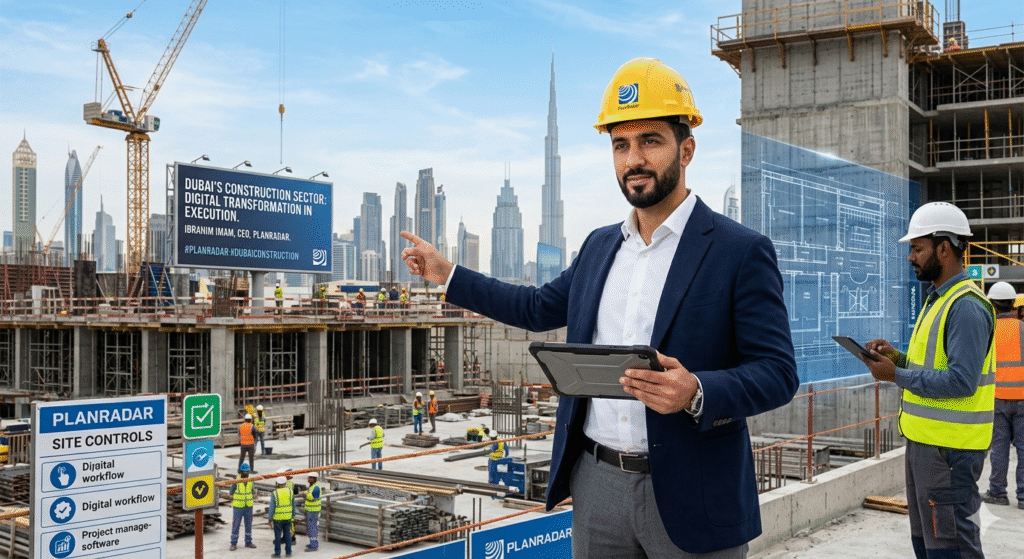
Real-time tracking changes daily site management from “What do we think happened?” to “What can we verify right now?” That shift is a major driver of transparency and accountability.
First, it makes ownership and deadlines explicit. When an inspection request, an RFI response, a non-conformance closure action, or an approval task is assigned to a named person or role with a due date, follow-up becomes structured. Leadership can see what is overdue without chasing updates across emails and messaging threads.
Second, it links records to the right location and supporting evidence.Construction is location-based. A record without a clear location (area/level/grid) and objective evidence can create ambiguity and slow decisions. Real-time workflows make it easier to capture evidence at the point of work—photos, markups, documents, test results—and link it directly to the site location and the relevant record.
Finally, it strengthens audit readiness and handover quality. Time-stamped, traceable records reduce reliance on reconstructed evidence during audits, handover, or dispute resolution. In regulated environments and high-value developments, this traceability increasingly matters.
Developers today are under pressure to deliver projects on time while maintaining quality standards. How are digital tools helping teams maintain delivery certainty despite increasing project complexity?
Developers today are under pressure to deliver projects on time while maintaining quality standards. Digital tools are helping teams maintain delivery certainty despite increasing project complexity by making issues visible earlier, improving coordination, and creating clearer control across execution.
Many delays begin as small blockers such as missing approvals, late materials, access constraints, sequencing clashes, or outstanding clarifications. If these constraints live only in meeting notes, they are easy to lose. Digital tools such as look-ahead planning and constraint logs make blockers visible, assigned, and tracked until closure so that intervention happens earlier.
A structured Change Order / Variation workflow also helps bring control to project changes. It captures what is changing and why, which areas and plans/specifications are impacted, the time and cost impact, the approval authority, and the final decision. Digitally, this creates a clear history from request to review to approval to implementation, reducing confusion and protecting commercial position.
Late approvals, incomplete documentation, and weak delivery checks often become downstream defects and replacement delays. Digitising material approvals and delivery inspection records helps ensure only compliant materials enter the works, and issues are identified before they affect installation.
Rework remains one of the biggest threats in construction. Structured QA/QC inspection checklists, defect and snag tracking with verified closure, and commissioning readiness checks help reduce late-stage quality surprises. Instead of quality becoming a handover fire drill, it becomes part of daily execution.
Construction has traditionally been slow to adopt new technologies. As a technology leader working closely with developers and contractors across the region, how do you see leadership mindsets evolving when it comes to embracing digital transformation on construction sites?
Construction has traditionally been slow to adopt new technologies. As a technology leader working closely with developers and contractors across the region, we see leadership mindsets becoming more practical and more execution-focused. The shift is from “Which tool should we buy?” to “What discipline do we need to enforce on site?”
Historically, adoption has been slowed by the fear of slowing site teams down, the difficulty of aligning subcontractors, and the belief that projects are too unique to standardise. What is changing now is the recognition that inconsistent execution controls create higher costs than standardisation, especially when leaders are managing multiple projects with tighter governance and higher scrutiny.
Projects can no longer depend on a few experienced people to hold everything together. Leadership increasingly wants consistent execution across teams and subcontractors, even when site resources change. As a result, there is growing demand for processes that are repeatable, with clear ownership, structured approvals, evidence captured at the point of work, and verified closure.
It is therefore becoming less about “going digital” and more about enforcing reliable workflows. Adoption succeeds when workflows are simple, mobile-friendly, and aligned with daily routines. If tools add effort without clear value, teams will bypass them. That is why template design, including triggers, required fields, and evidence capture, matters as much as the platform itself.
Looking ahead, how do you see technologies like AI, predictive analytics, and automation further transforming construction project management?
Looking ahead, technologies such as AI, predictive analytics, and automation are likely to have the biggest impact when they reduce manual follow-up and help teams act earlier. Their value, however, depends on having structured, consistent project data, which is another reason execution discipline and standardised templates are so foundational. This is becoming even more relevant in the UAE, where the national UAE Strategy for Artificial Intelligence 2031 is aimed at boosting government performance and embedding AI across priority sectors, while Dubai’s Economic Agenda D33 seeks to raise productivity by 50% through digital transformation and innovation.
If inspections, defects, non-conformances, constraints, and approvals are recorded consistently, analytics can identify patterns such as recurring defects by trade, bottlenecks in approval cycles, or increasing safety observations in specific zones. These predictive insights allow teams to intervene earlier, before delays or rework begin to escalate.
Automation can further improve project management by routing approvals to the right roles, escalating overdue inspections, generating reports from structured records, and triggering corrective actions based on inspection outcomes. This reduces administrative overhead and improves consistency without asking teams to do more.
The ability to quickly find the right record when it is needed is a common challenge. AI can help teams locate RFIs, approvals, and inspection records for a specific location, summarise change history, and highlight what is open versus closed. This supports faster decision-making and reduces ambiguity across stakeholders.
The key point is that AI accelerates teams that already have disciplined workflows and reliable data. Without that foundation, its value remains limited.
In this sense, digital transformation is reshaping construction execution in Dubai by strengthening clear approvals, verified inspections, controlled change, and traceable records linked to objective evidence. The Construction Site Templates Playbook was developed to help teams standardise these control points and apply them consistently, so projects can reduce ambiguity, improve compliance confidence, and deliver with greater predictability across construction and real estate portfolios.