
 Have a question? +971 56 404 0503





Tech Features
WHEN MEDICAL SCANS END UP ONLINE: THE QUIET RISK HOSPITALS CAN FIX FAST


Attributed by Osama Alzoubi, Middle East and Africa VP at Phosphorus Cybersecurity
As Saudi Arabia races ahead in digital healthcare transformation, a quieter vulnerability lingers in the background: medical imaging systems that can be found – and sometimes accessed – directly from the public internet. Imaging infrastructure, diagnostic platforms, and hospital information systems are being modernized at speed improving outcomes, accelerating workflows, and bringing advanced clinical capabilities to more communities. But beneath this progress lies a quieter risk that rarely makes headlines: medical imaging systems being exposed on the public internet due to simple configuration errors.
Not a dramatic cyberattack. Not a threat actor breaching a firewall. Just avoidable misconfigurations that leave sensitive patient data reachable by anyone who knows where to look.
Medical imaging systems in Saudi Arabia face a persistent security challenge that differs from dramatic cyberattacks. Patient data exposure often occurs through configuration errors that leave systems accessible on the public internet. These technical oversights represent a significant vulnerability in healthcare’s digital infrastructure.
The Kingdom’s Personal Data Protection Law (PDPL) establishes strict requirements for handling health data. This legislation, modeled after international standards, mandates enhanced protection for medical information and imposes penalties for unauthorized disclosure. Hospitals must implement organizational and technical measures to prevent data exposure.
Radiology departments increasingly use digital platforms for case discussions and second opinions. Without proper configuration, these systems might allow unintended access to patient records. Teleradiology services, which expanded significantly during the pandemic, require secure transmission protocols to protect data during remote consultations.
When we hear about data breaches, we often imagine skilled hackers penetrating security systems. The reality is often simpler and more preventable. “Exposed” typically means a system is reachable from the public internet due to setup choices, not a sophisticated intrusion.
This happens in real-world healthcare settings for straightforward reasons: rushed deployments to meet clinical deadlines, vendor-supplied default configurations that were never changed, remote support access left open for convenience, and legacy systems that were connected to modern networks without proper security reviews.
The scale is significant. Research has identified over 1.2 million reachable devices and systems globally, including MRI scanners, X-ray systems, and related medical infrastructure. These are not theoretical vulnerabilities. They represent actual systems that can be found and accessed from anywhere with an Internet connection.
What gets exposed is more than images
Medical imaging files are not simply pictures. They carry identifiers and metadata that can connect scans directly to real people. Patient names, dates of birth, identification numbers, and clinical details often travel alongside the diagnostic images themselves.
This matters for several reasons. Beyond the obvious privacy violation, exposed patient imaging data creates risks of identity fraud, potential coercion or blackmail, serious reputational damage to healthcare institutions, and erosion of the trust patients place in their medical providers.
Security monitoring platforms have documented cases where exposed systems allowed direct access to both images and patient data—offering a level of detail that should never be open to anyone outside the clinical team.
Why this keeps repeating worldwide
Hospitals everywhere use similar device types and manage comparable data flows. The result is that the same setup mistakes appear repeatedly across different countries and healthcare systems. What starts as one hospital’s misconfiguration becomes everyone’s common failure mode.
The medical devices themselves often come with similar default settings. Imaging servers, picture archiving systems, and diagnostic viewers are deployed in comparable ways. When basic security steps are skipped during installation, the exposure follows a predictable pattern.
Health sector cybersecurity guidance from international authorities emphasizes the need for repeatable baseline controls precisely because these patterns recur. Reducing exposure requires not innovation, but consistent application of known protective measures.
Healthcare organizations face a common vulnerability pattern. A major healthcare provider addressed similar challenges across hundreds of hospitals, discovering that default passwords, vulnerable firmware, and device misconfigurations created entry points that threatened patient care and hospital operations across more than 500,000 connected medical and operational devices.
The Saudi-specific layer: connectivity at cluster scale
Saudi Arabia’s healthcare transformation includes the expansion of health clusters that connect multiple facilities into integrated networks. This approach improves care coordination and resource sharing, but it also means that one weak link can affect multiple sites.
National interoperability initiatives support the sharing of imaging and diagnostic reports across the healthcare system. The Saudi health ministry has established specifications for imaging data exchange through the national health information exchange platform, enabling providers to access patient scans regardless of where they were originally performed.
This connectivity is essential for modern healthcare delivery. It allows specialists to review scans remotely, supports second opinions, and ensures continuity of care when patients move between facilities. However, it also increases the need for consistent configuration rules and security standards across all connected sites.
When imaging systems within a cluster are not uniformly secured, the exposure risk multiplies. A misconfigured system in one facility can potentially provide access to data from across the entire cluster network.
A practical checklist hospitals can act on
Healthcare institutions can take concrete steps to reduce exposure risk. These are not theoretical recommendations but proven measures that address the most common vulnerabilities.
First, create a complete inventory. Every hospital should maintain a current list of what is connected to its network, including imaging devices, storage servers, viewing stations, web portals, and remote access tools. You cannot protect what you do not know exists.
Second, check external exposure. Verify that nothing sensitive is reachable from the public internet. This requires technical scanning from outside the hospital network to identify systems that respond to external queries. Many organizations discover exposures they did not realize existed.
Third, restrict remote access properly. Remote connections for maintenance and support should be tightly controlled, require strong authentication methods, and be removed entirely when no longer needed. Convenience should never override security when patient data is involved.
Fourth, implement safe setup procedures. Develop standard build guides for imaging systems, change all default passwords and settings, clearly document who owns each system, and establish responsibility for applying security patches and updates. Industry experience shows that default credentials remain one of the lowest barriers for attackers seeking entry into healthcare networks.
Fifth, conduct continuous checks. Exposure scanning should happen after any network changes, not just once annually. Healthcare networks evolve constantly, and new vulnerabilities can appear whenever systems are added or reconfigured.
These steps align with guidance from international cybersecurity authorities and health sector regulators, which emphasize reducing exposed services and strengthening baseline controls as priority actions for healthcare organizations.
The governance fix: make secure setup part of how clusters run
Individual hospital efforts are necessary but not sufficient. At the cluster level, governance structures must embed security into standard operations.
This begins with cluster-wide minimum standards for imaging systems and remote access. Every facility within a cluster should follow the same baseline security requirements, ensuring consistent protection regardless of which site a patient visits.
Clear ownership must be established for every system. Someone specific should be responsible for applying patches, approving access requests, and regularly checking for exposure. When accountability is diffuse, critical tasks get overlooked.
Procurement processes offer another leverage point. Purchase agreements should require vendors to provide secure default configurations, enable comprehensive logging capabilities, and commit to supported update cycles for the life of the equipment. Security should be a selection criterion, not an afterthought.
These governance approaches reflect sector framework guidance that encourages structured programs and repeatable controls rather than ad hoc responses to individual incidents.
Saudi Arabia has invested heavily in national cybersecurity frameworks and regulatory oversight across critical sectors, including healthcare. The foundation exists. The next step is ensuring those protections extend fully to the expanding ecosystem of IoT and IoMT devices — where simple configuration gaps can undermine otherwise sophisticated digital progress.
Prevent avoidable incidents
The goal is not perfection. Healthcare systems are complex, and some level of risk will always exist. The goal is removing the easiest path for data exposure: systems sitting openly on the public internet waiting to be found.
In connected healthcare, the quickest wins come from two simple principles: visibility and access control. Know what you have connected, and shut the doors that do not need to be open.
For Saudi Arabia’s health clusters, this represents an achievable objective. The infrastructure investments being made across the Kingdom’s healthcare sector create an opportunity to build security into expansion rather than retrofitting it later.
Medical imaging systems serve an essential clinical purpose. They should not also serve as unintended windows into patient data. With practical steps and consistent governance, hospitals can fix this quiet risk before it becomes a public incident.
In digital healthcare, exposure is rarely a mystery. It is usually a configuration. The question is not whether hospitals can fix it, but whether they will do so before patients pay the price.

by Professor Hind Zantout, Programme Director, MSc Data Science, School of Mathematical and Computer Sciences, Heriot-Watt University Dubai
Women today have jobs across all sectors of the economy, and they are increasingly achieving breakthroughs as entrepreneurs, and progressing to running successful businesses in the UAE, the wider region and globally. The GEM 2025/2026 Women’s Entrepreneurship Report indicates that they represent 45% of founders of startups worldwide. Whilst this figure is promising, women still face obstacles and challenges down the line, as they face challenges in scaling their businesses. But the overall picture remains bright, from creative chocolate concepts, to beauty products to retail and cybersecurity, there are many stories of achievement and success to tell about women entrepreneurs.
The dominant theme that has been disrupting established organisations and providing opportunities for small organisations and start-ups for over 25 years has been computer and communication technology and software systems that deliver the needed functionality. The firstborn in that generation was the Internet, dramatically changing how and where buying and selling can happen, and e-commerce helped women, especially in developing countries, sell their goods.
Today this is further simplified, bypassing the need for a dedicated website that can be replaced by a much cheaper social media presence, hence the term social commerce. Traditional AI has been around for a very long time, but in that generation, it matured into a reliable technology capable of leveraging huge amounts of data. One example is using customer data to predict when an aeroplane engine is about to fail, so it can be serviced before the failure occurs, reducing the cost of time and money for maintenance. Models can also predict customer churn, for example in a telecom subscription environment, so companies can take action to prevent it. The Internet itself evolved into a huge and valuable source of information which then got exploited using large language models to deliver generative artificial intelligence (AI) again causing further disruption but opportunities as well.
Technology advances also facilitated innovations that impacted the monetary system for payments, with fintech and cryptocurrencies. So, the scene is one of increased complexity, evolving opportunities and challenges that need to be addressed. Looking at students enrolled in STEM programs for the region, female students have had a healthy participation for many years now, especially in computer science programs. Courses there often include data science and artificial intelligence, so when the next generation of entrepreneurs is considered that have a university degree, there is no shortage of women with strong relevant skills which are essential for an entrepreneur to appreciate the capabilities of technology but also the pitfalls.
For many businesses, the customer experience is an essential part of the business model and ensuring a positive one is critical. Up until recently, human agents, often supported by computer systems, were typically in charge of ensuring customer satisfaction that leads to customer loyalty. With recent technological advances such as generative AI, chatbots have seen a dramatic transformation in their ability, and they can now hold almost human-like conversations with the customer, but these still remain restricted to limited scenarios. Their implementation in customer-facing processes is not completely risk free and could lead to a frustrated customer who cannot have a query responded to or their problem resolved. An expanding landscape of technologies now features AI agents and the promise of offering the needed additional capability. And with such an accelerated pace of change, with the potential to continually proliferate and transform many business processes, it is essential that business leaders not only to have an understanding of what can be delivered, but also the risks that need to be mitigated.
Traditional customer relationship management puts the emphasis on tracking the customer lifecycle from marketing to sales through to customer service. But in an ecosystem offering a diversity of channels that a customer can engage with, it is essential to manage the whole customer experience (CX), tracking and measuring all interactions, not just the purchase of a product or service. For example, virtual fitting rooms are built on augmented reality / virtual reality platforms and can be one channel in retail, where the customer can superimpose the image of a piece of clothing over an image of themselves before making the purchase decision. A customer can also see how a sofa they are considering would appear in their living room. Such a personalised shopping experience can be valuable, as studies show a reduction in returns, around 25% – 40%. There is, however, a real danger that hyper-personalisation, where every interaction is logged, analysed and exploited, will lead to the customer feeling under surveillance.
For example, using a customer’s browsing history to make recommendations and offers will spook many, with the realisation that every online click was tracked. This sets off the so-called creep factor and customers then abruptly switch away from that product or service. A fine balance needs to be struck to bridge the personalisation-privacy paradox, not just to keep customers loyal, but also to avoid litigation. In the US, Neutrogena and Charlotte Tilbury faced separate class actions that were settled with a payout. The allegations were that the tools used processed user data that may include biometric data.
And any deployment of AI will have to give careful consideration to the risk of bias in the algorithms. As a result of using biased training data, some groups may be over-represented while other groups may be under-represented, leading to unfair treatment of customers. The impact can be wide-ranging, from missed revenue to developing flawed marketing strategies, to customers losing trust in a product or service.
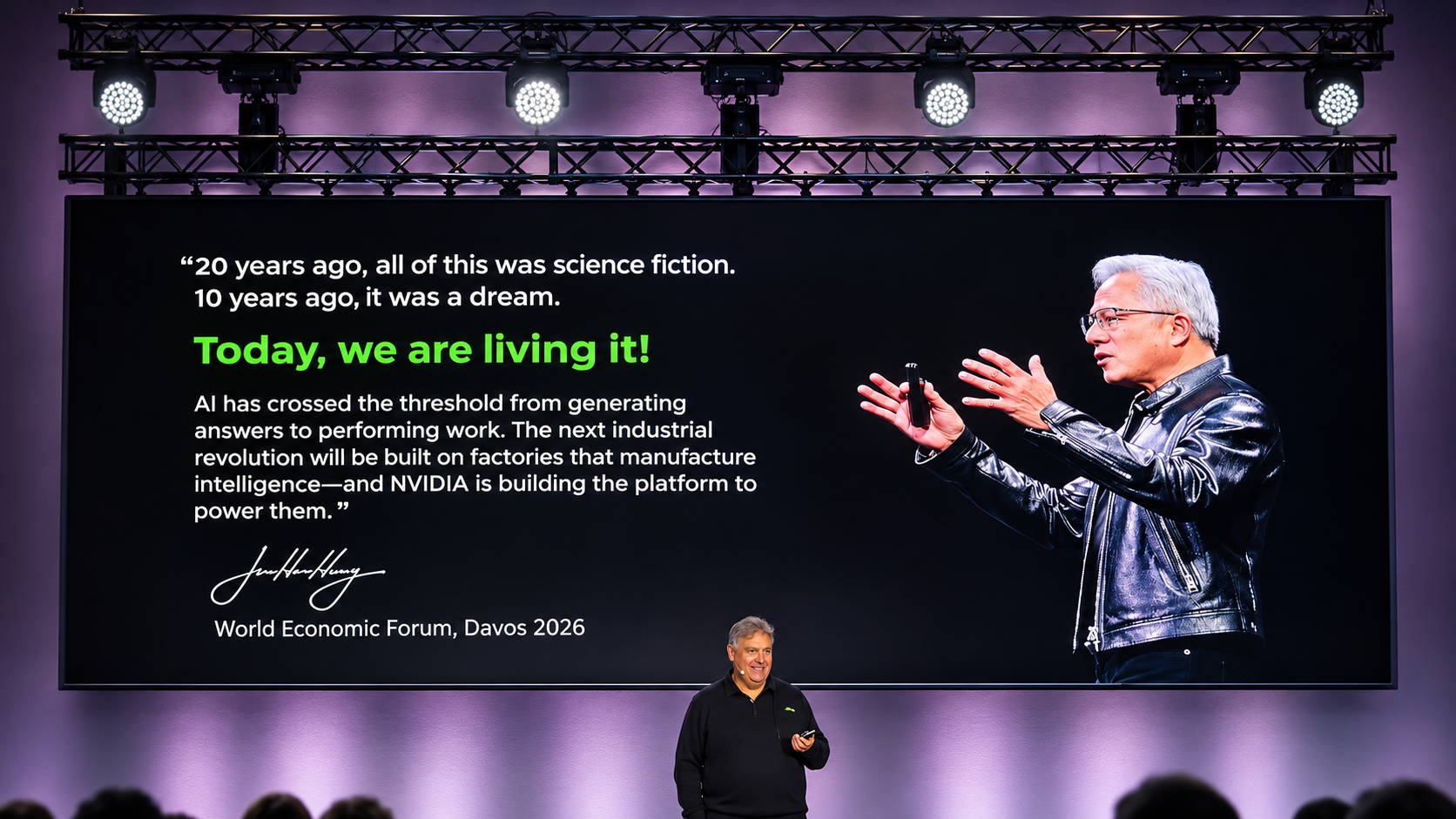
There is something almost ironic here. A company that helped persuade the world AI could reduce dependence on human judgment now faces one of its biggest uncertainties because of one human being.

By: Srijith KN, Technology Integrator
On November 12, Nvidia announced that Jensen Huang had resigned as CEO and director, with CFO Colette Kress assuming the role on an interim basis. His departure followed reports involving personal relationships and possible national security concerns. Allegations of foreign intelligence connections remain unproven. In a statement on November 8, Nvidia’s board said it had no reason to believe company secrets or national security were compromised and had initiated an independent investigation.
But the bigger story is what happens to the AI empire he built.
At a recent infrastructure conference in Croatia, an Nvidia executive jokingly introduced himself as the cheaper alternative to “my boss Jensen,” adding that he only needed the leather jacket. A funny remark, but also revealing. Huang had become more than a CEO. He was the personality behind Nvidia’s extraordinary rise.
Five issues now deserve attention.
Governance. Huang led Nvidia for 33 years as strategist, dealmaker and chief evangelist. Investors understood the value of Nvidia’s technology. What remains uncertain is how much of that value depended on the vision, relationships and influence of one individual. The question now is whether Nvidia has built the institutional strength to carry that legacy forward.
Strategy. Huang’s ambition extended far beyond GPUs. His five-layer AI framework, encompassing energy, chips, infrastructure, models and applications, envisioned an entire computing economy. The opportunity was never simply about selling processors. It was about shaping the foundations upon which the next generation of technology would operate. That vision now needs leadership capable of carrying it forward.
AI sovereignty. Perhaps Huang’s most consequential message was directed at governments. According to the Nvidia executive in Croatia, Huang routinely asks presidents and prime ministers whether their countries want to become AI “takers” or AI “makers.”
Every nation will consume AI. But those developing their own infrastructure, models and capabilities could exercise greater control over their digital futures. The executive described Huang’s support for open architectures, deployable under national laws and data requirements, as making this a geopolitical conversation, not merely a technology discussion.
Geopolitics. Huang advocated maintaining access to the Chinese market for advanced chips. His departure removes an influential voice from that debate, amid continued scrutiny of chip exports.
Economics. Nvidia’s investments in AI companies that also purchase its computing infrastructure have added another dimension to the debate over AI economics. The real question is whether the revenues generated across this ecosystem can ultimately justify the extraordinary capital flowing into it.
None of this means Nvidia’s technology advantage has disappeared. Its engineering talent, software ecosystem and customer relationships remain formidable. The board has also expressed confidence that its leadership team can continue executing the company’s technology roadmap without interruption.
But perhaps the AI industry is entering a different chapter, where governance matters more than charisma and profitability matters more than promises.
For enterprises, the lesson is simple. Never build an AI strategy around one vendor, one chip or one personality.
Technology is only as strong as the judgment guiding it.
The real test now is whether Nvidia can demonstrate that its future is bigger than the man who built it.


BY SRIJITH KN & SUBRATO BASU

As AI spending rises and experimentation gives way to accountability, the real challenge for business leaders is no longer access to technology, but proving value, controlling cost and redesigning how organisations work.
Every year, the technology industry promises a breakthrough that will change everything. New models arrive, computing capacity expands and investment reaches new highs. Then, somewhere between the product demonstration and the quarterly earnings call, someone asks the question that matters most:
What did all of this actually improve?
That question came into sharper focus in 2026.
Artificial intelligence moved deeper into everyday business. Companies deployed assistants, experimented with agents and embedded AI across customer service, software development, compliance, finance and operations.
Yet adoption turned out to be the easy part.
Installing an AI assistant is relatively straightforward. Redesigning an organisation around it is not.
Fragmented systems, poor-quality data, unclear ownership, weak governance and sceptical employees do not disappear because a company has purchased another software licence.
Businesses do not need another year of impressive demonstrations. They need to know whether AI is helping them make better decisions, serve customers more effectively and run their operations more reliably.
That shift is turning AI from primarily a technology question into a management one.
From experimentation to accountability
The adoption numbers appear impressive.
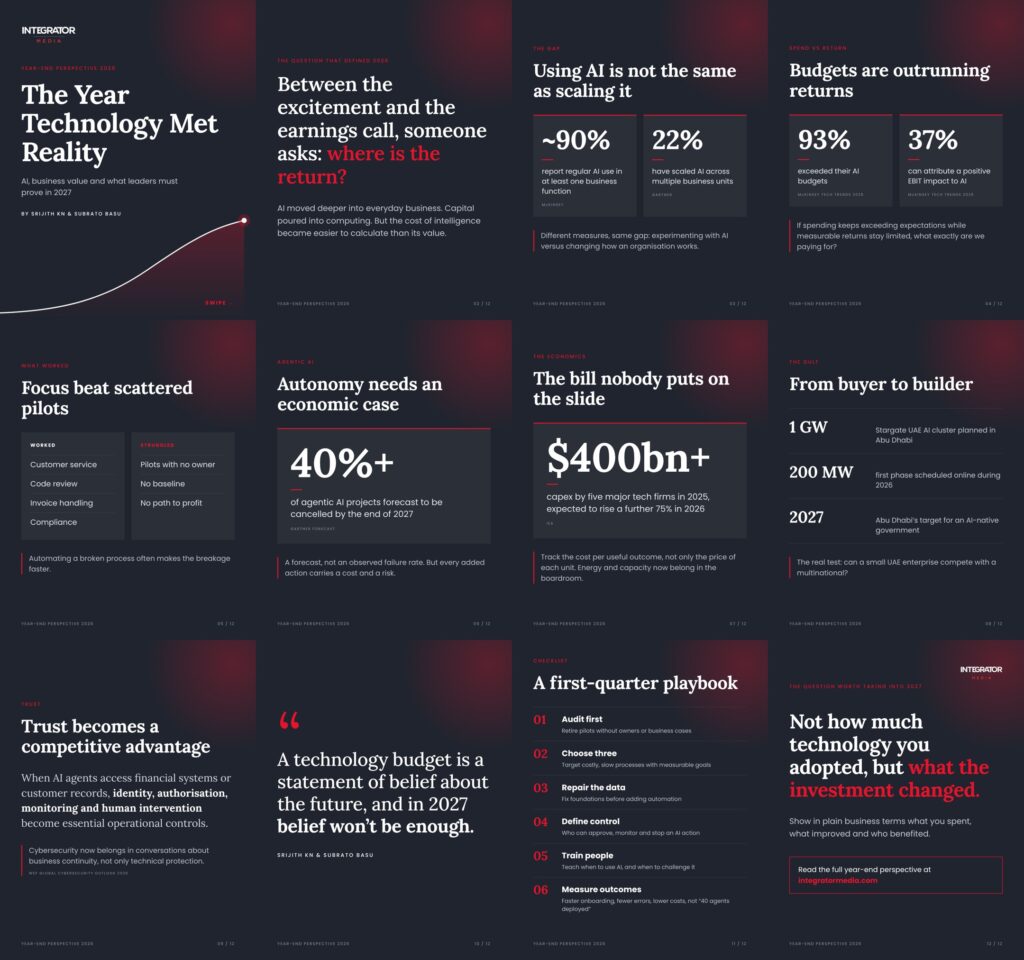
McKinsey found that nearly nine in ten survey respondents reported regular organisational use of AI in at least one business function. Gartner, using a different measure, found that only 22% of organisations had successfully scaled AI across multiple business units or adopted an AI-first approach.
The methodologies are different, but together they point to an important distinction: using AI is not the same as changing how a business operates.
The economics reinforce that concern.
In McKinsey’s Technology Trends Outlook 2026, one survey found that 93% of respondents had exceeded their AI budgets. Another found that only 37% of companies could attribute a positive EBIT impact to their AI programmes.
Those numbers create an uncomfortable boardroom question.
If spending continues to exceed expectations while measurable returns remain limited, what exactly are organisations paying for?
The clearest returns are likely to emerge where companies begin with a defined business problem: reducing customer-service resolution time, accelerating code review, simplifying invoice handling or strengthening compliance.
What becomes harder to justify is the proliferation of pilots with no accountable owner, no performance baseline and no clear route to economic value.
Automating a broken process can simply make the breakage happen faster.
Agentic AI raises the stakes
Agentic AI made this management challenge more significant in 2026.
Traditional generative AI largely responded to requests. Agents can increasingly perform multistep activities, interact with systems and execute actions.
That creates more opportunity, but it also introduces more cost, operational risk and responsibility.
Gartner has forecast that more than 40% of agentic AI projects will be cancelled by the end of 2027 because of escalating costs, unclear business value and inadequate risk controls.
It is a forecast rather than an observed failure rate, but the warning matters.
Giving software more autonomy only increases the need for organisations to define who owns the outcome, who monitors the process and who can intervene when something goes wrong.
The question for leaders is therefore becoming less about what an AI agent can do and more about what the organisation should allow it to do.
The economics nobody puts on the slide
AI is also forcing companies to think differently about technology costs.
The International Energy Agency reported that capital expenditure by five major technology companies exceeded $400 billion in 2025 and was expected to rise by another 75% in 2026.
The physical foundations of AI require enormous amounts of computing infrastructure, electricity, cooling, networking, land, semiconductors and highly specialised talent.
An individual AI task may become cheaper while the total technology bill continues to grow simply because usage expands.
That is not necessarily a problem if the additional activity creates measurable value.
But somebody needs to be able to explain what the extra expenditure produced.
Did it generate more revenue?
Did customers receive better service?
Did employees become more productive?
Did the organisation reduce risk?
Technology and finance leaders increasingly need to measure the cost per useful outcome, rather than concentrating only on the price of individual models, tokens or software licences.
Energy, computing capacity and infrastructure resilience now belong in the same boardroom conversation as digital transformation.
AI also creates a wider economic question
There is another issue that sits beyond corporate productivity.
A business may be able to reduce certain labour requirements through automation, but an economy still depends on people earning, consuming, creating businesses and paying taxes.
If productivity gains do not translate into new industries, new forms of employment or greater economic opportunity, the benefits become harder to sustain.
Reskilling cannot therefore be treated simply as a corporate social-responsibility programme.
It increasingly belongs at the centre of technology strategy.
The real measure of intelligent technology should not be how many jobs it eliminates or how many tasks it completes. It should be whether it creates durable value for enterprises while expanding economic opportunity around them.
The Gulf moves from technology buyer to builder
This is particularly relevant in the Gulf.
For years, the region was often described primarily as a major buyer of global technology. That description increasingly feels incomplete.
Across the UAE, Saudi Arabia and the wider Gulf, governments and businesses are investing in AI infrastructure, cloud capacity, digital government, data centres and technology ecosystems.
Stargate UAE, the planned one-gigawatt AI infrastructure cluster in Abu Dhabi, illustrates the scale of that ambition. Its first 200 megawatts were scheduled to come online during 2026.
Abu Dhabi’s ambition to build an AI-native government by 2027 and Dubai’s support for digital entrepreneurship point in the same direction.
But infrastructure alone does not create prosperity.
The more important question is whether that infrastructure lowers the cost of innovation and makes advanced technology accessible to the companies that drive the region’s everyday economy.
Can a UAE SME use AI to compete more effectively with a multinational?
Can a local healthcare provider deploy specialised intelligence without building an enormous internal technology operation?
Can a logistics company use automation to improve reliability rather than simply add another layer of software?
The Gulf has invested heavily in technological ambition. The next chapter will be about making that ambition useful.
That means moving from importing technology to developing capabilities, intellectual property, businesses and talent around it.
Innovation moves into the physical world
The technology conversation is also becoming broader than generative AI.
Physical AI is bringing intelligence into robotics, logistics, manufacturing, healthcare and mobility.
Digital twins, edge computing and intelligent energy systems are connecting digital decisions to physical operations. Smaller, specialised AI models may also offer better economics and governance than enormous general-purpose systems for narrowly defined industry tasks.
Quantum computing continues to advance, although business leaders should remain cautious about claims of immediate universal commercial impact.
The more urgent issue for many organisations is post-quantum cybersecurity.
Confidential information protected today could potentially become vulnerable as computing capabilities evolve, meaning organisations handling long-lived sensitive data need to begin thinking about cryptographic resilience well before large-scale quantum computing arrives.
Across these technologies, the competitive advantage is unlikely to come from collecting the greatest number of tools.
It will come from integrating the right technologies into an operation that works.
Trust becomes part of the business model
As AI systems gain access to more sensitive information and perform more consequential activities, cybersecurity becomes inseparable from business strategy.
The World Economic Forum’s Global Cybersecurity Outlook 2026 described an environment shaped by AI-enabled threats, geopolitical fragmentation and uneven cyber resilience.
AI agents interacting with financial systems, customer information or operational infrastructure raise the importance of identity controls, authorisation, monitoring and human intervention.
Cybersecurity can therefore no longer be treated simply as the responsibility of the security department.
It is increasingly about business continuity, reputation and customer trust.
The companies that can demonstrate that intelligent systems are secure, explainable and accountable may find that trust becomes a genuine competitive advantage.
2027: the numbers will have to add up
If 2026 was the year organisations experimented with how far AI could go, 2027 is likely to bring much tougher questions about whether those investments make economic sense.
A good demonstration will matter less than what a company can responsibly allow a system to do.
Agents will begin taking responsibility for defined activities, but each will require boundaries, monitoring and a human being who ultimately owns the consequences.
Boardroom conversations should shift from:
- How many AI tools have we deployed?
- to:
- What does this process cost now?
- How much faster is it?
- Has the error rate fallen?
- Are customers noticing the difference?
That scrutiny will extend beneath the software layer.
Energy availability, sovereign computing capacity, regulatory requirements and infrastructure resilience will increasingly influence where companies choose to invest.
The same scrutiny will reach the workforce.
Employees will need technical fluency, but they will also need business judgement: the ability to understand exceptions, question automated recommendations and take responsibility when systems get something wrong.
Access to another AI model will not be the defining advantage.
An organisation that operates better — at a cost that survives examination — will be.
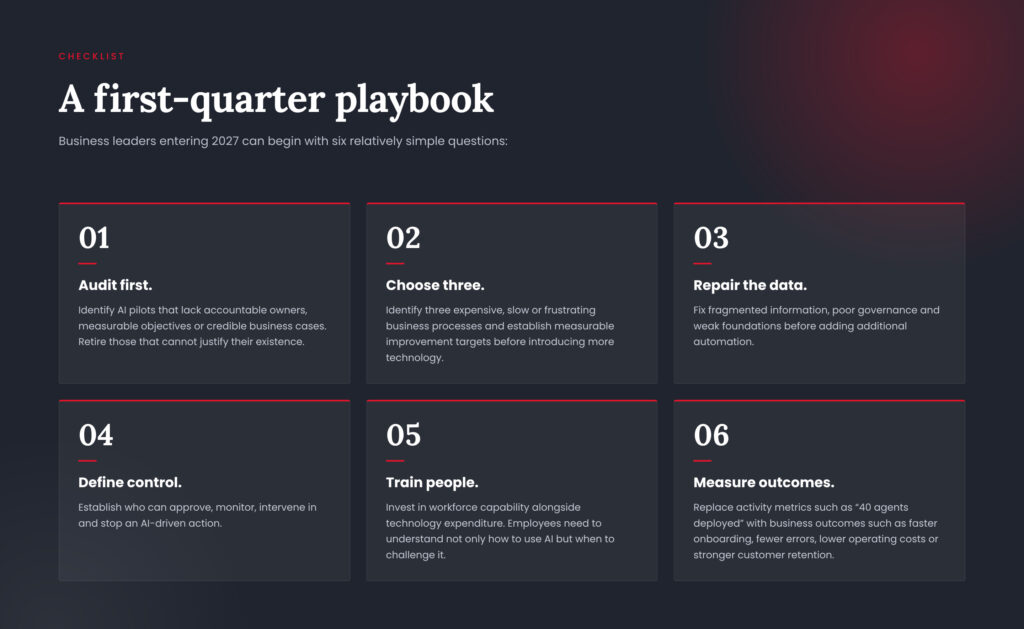
The question worth taking into 2027
As 2026 closes, business leaders should temporarily set aside the question of how much technology their organisations have adopted.
Instead, ask what the investment actually changed.
Did serving a customer become simpler?
Did an expensive process become more efficient without becoming less reliable?
Did employees gain the ability to spend more time on valuable work?
Can the improvement be seen in the numbers?
A technology budget is ultimately a statement of belief about the future.
In 2027, belief will not be enough.
AI adoption alone will no longer be impressive. The organisations that stand out will be those that can explain, in plain business terms, what they spent, what improved and who benefited.
And that may be the clearest indication yet that AI is becoming less of a technology problem — and much more of a management one.
Subrato Basu is an author, adviser and speaker on AI strategy and technology cost management. With nearly three decades of experience advising C-suite leaders, he helps organisations across North America, Asia Pacific and the Middle East turn technology investment into measurable business value.
Srijith KN is Senior Editor at Integrator Media, who is hands-on in covering enterprise technology, artificial intelligence, cybersecurity and the digital economy across the Middle East.
Bijou Patisserie Unveils a New Afternoon Tea Inspired by Travel and Precious Discovery
Time to Switch Off: Ways to Spend the Eid Al Etihad Break
Things to Do During the Eid Al Etihad Long Weekend in Dubai

OPPO A6 Pro 5G Review: Reliable Daily Driver

Denodo Bolsters Executive Team by Hiring Christophe Culine as its Chief Revenue Officer

Microsoft Launches New Surface Copilot+ PCs for Business

2026 in Review: Is AI Becoming More of a Management Problem Than a Technology Problem?

Inside XPENG Brand Night: AI Mobility Lands Centre Stage in Dubai

Chinese Cars Are Reshaping the GCC Market, but Resale Value Could Be the Next Battleground

-
 Trending1 year ago
OPPO A6 Pro 5G Review: Reliable Daily Driver
-
 Tech News2 years ago
Denodo Bolsters Executive Team by Hiring Christophe Culine as its Chief Revenue Officer
-
VAR2 years ago
Microsoft Launches New Surface Copilot+ PCs for Business
-

 Automotive2 years ago
AGMC Launches the RIDDARA RD6 High Performance Fully Electric 4×4 Pickup
-

 VAR11 months ago
Huawei Nova 14 Pro Review: Where Camera Excellence Meets Ecosystem Evolution
-
Tech Interviews3 years ago
Navigating the Cybersecurity Landscape in Hybrid Work Environments
-

 Hospitality2 years ago
Gulfood 2025 30th Edition Kicks Off Today, Setting New Benchmarks in F&B Growth and Innovation
-
News4 years ago
BenQ ZOWIE : First TN 360Hz DyAc+ Gaming Monitor