
 Have a question? +971 56 404 0503





Tech Features
Beyond the Transaction: Elevating the Standard for Customer Trust in the AI Era


By: Debo Zhang, CEO at HONOR GCC
In the hyper-competitive consumer technology sector, the launch of a flagship device is often treated as the finish line. However, true brand leadership is forged not in the showroom, but in the months and years that follow. At HONOR, we view the point of purchase not as a conclusion, but as day one of a long-term partnership with our users.
As we aggressively push the boundaries of intelligent hardware—from integrating Agentic OS to setting new benchmarks in physical durability and battery density—we recognize that advanced specifications represent only half of the premium equation. The other half is an unyielding commitment to the customer’s lifecycle experience. If a brand fails to support its users when they need it most, the underlying technological advancements lose their meaning.
Operationalizing Community Care
Our commitment to giving back to the GCC community dictates our operational investments. We do not just build resilient devices; we build resilient support networks designed to remove the friction of long-term ownership. Our recurring monthly Service Days are not promotional events—they are structural community investments.
By deliberately absorbing operational costs—such as completely waiving labor fees for expert repairs and offering complimentary professional device cleaning and disinfection—we ensure that maintaining a premium device remains accessible. We view ongoing device care, including free system upgrades and screen film replacements, as a fundamental responsibility rather than a secondary revenue stream.
Respecting the User’s Time and Individuality
True leadership in customer service also requires a profound respect for the user’s time and individuality. Recognizing that our customers’ lives are deeply integrated with their technology, we have designed our after-sales operations to adapt to the user, rather than forcing the user to adapt to us. Offering complimentary return shipping for repairs and providing complimentary gifts when repair timelines are extended are direct measures to eliminate inconvenience.
Furthermore, we understand that a smart device is a highly personal extension of the user. Incorporating free laser engraving and custom art back films into our regular service offerings transforms a standard maintenance visit into an opportunity for users to refresh and personalize their technology.
As the Middle East accelerates its digital transformation, consumers are demanding more than just innovation; they demand reliability, accountability, and respect. HONOR’s rapid growth across the region proves a fundamental business truth: when a technology brand prioritizes post-purchase empowerment and community care over short-term transactional gains, sustainable market leadership naturally follows.

By – Satyajit (Satya) Roy – Vice President Head of Product & Engineering-Cybersecurity and Threat Intelligence, Anomali
In late 2024, researchers at Harvard Kennedy School ran a phishing test on 101 volunteers using a tool that handled the whole job without a person in the loop. It scraped public sources to build a profile of each target, wrote a personalized email, sent it, and tracked who clicked. The fully automated emails drew a 54% click-through rate, matching messages hand-written by human experts and running more than four times the 12% rate of a generic phishing control, at a cost the authors put at roughly four cents per email.
Criminal tooling is assembling the same pieces. In September 2025, Varonis researchers described SpamGPT, a spam-as-a-service platform sold on underground forums that pairs an AI assistant for writing lures with campaign management and inbox-delivery testing. In April 2026 they documented Bluekit, a kit with automated domain registration, more than 40 brand templates, and session capture that stores the victim’s cookies after login, which lets an operator walk past MFA with a live session. Bluekit’s AI assistant still produced drafts full of placeholders when Varonis tested it, so the fully self-driving version isn’t here yet, but the direction is clear.
It breaks an assumption that has held up most phishing defense for a decade: a phishing campaign is something a person runs, at a pace a person can sustain, with the gaps a person leaves. Reset the password and kill the session, and you have usually outrun the attacker, because the human on the other end had to notice and come back. When the other end is software, that tempo advantage shrinks toward nothing.
What “Drives Itself” Actually Means
The old phishing economy ran on volume. Send a million emails, fool a few hundred people, then sell the credentials or cash out the ones that reached something valuable. Tooling in that world meant blasting more mail faster, and the work that mattered, deciding what to do with a credential once it landed, stayed manual.
The newer tooling goes after that manual part. Here is what a fully automated chain would do after a single Microsoft 365 credential falls, using techniques that are each documented today:
- It reads the mailbox to learn the victim. Who they email daily, which threads are open, how they sign off, which vendors send invoices. Software can build that model of a person’s normal correspondence far faster than a human reading the same inbox.
- It registers infrastructure that matches. Domains that resemble the victim’s real contacts, sometimes timed to an in-flight conversation it found in the inbox.
- It clones and inserts. Reply-chain injection lands the malicious message inside a thread the recipient already trusts, written in the sender’s own voice, because the tool has read enough of that voice to imitate it.
- It pivots. From one mailbox it reaches the contacts, the shared drives, the connected SaaS apps, and any other identity that mailbox can authenticate to. Each hop produces more material for the next one.
Reply-chain injection, lookalike domains, and lateral movement through a tenant have all been documented for years. What changes is that software can chain them with a speed and consistency no manual operator matches, starting the moment a credential lands instead of whenever the operator next logs in.
Why the Password Reset Stopped Working
Here is the operational problem for a security team. The standard containment play for a compromised account is to reset the credential and revoke active sessions. Against a human attacker, that often closes the door: the attacker comes back, finds the password changed, and has to start over.
An automated attacker treats the reset as one more event to route around. By the time you reset the password, it may have already set up persistence through a different mechanism: an OAuth app grant the user “approved” during the original compromise, a mailbox forwarding rule, an added authentication method, or a captured token it is replaying. The credential you just reset was only the entry point. The foothold sits somewhere else and survives the reset. Microsoft’s own guidance on illicit consent grants notes that once a malicious app holds a user’s consent, resetting the password or requiring MFA doesn’t cut off its access, because the app sits outside the organization.
Microsoft’s playbook for responding to a compromised email account reflects the same reality. The password reset is step one of several, followed by hunting down the forwarding addresses and inbox rules an attacker may have left behind as back doors. The question for the responder moves from “did we reset the account?” to “what did the account authorize, forward, or grant while it was out of our control?”
When the Attacker Behaves Like a Co-Worker
The hardest part of this for detection is that automated post-compromise activity looks, on the wire, a lot like an employee having a busy morning. The account logs in from a plausible location, reads mail, sends replies inside existing threads, and opens files it has legitimate permission to open. Every action is something the real user might do.
What gives it away is usually a pattern across events: a cadence that is slightly too fast and too even, access to a combination of resources the user only touches together when something is wrong, a new OAuth grant minutes after a login from an unfamiliar device, a reply sent at 3am to a vendor the user hasn’t written to in months. Catching that means correlating identity activity against a baseline of how the account normally behaves, and against intelligence about what current attacker infrastructure looks like. A reply-chain lure from a freshly registered domain is far more interesting if your intelligence flagged that domain an hour ago.
What This Asks of a CISO
Accepting that the attacker on the other end may be software running unattended changes three things.
- First, containment plans built around resetting a credential need a second half: a sweep of everything the compromised identity authorized, forwarded, granted, or enrolled during the window. The reset is still necessary, but it’s no longer enough on its own.
- Second, detection has to move from per-event rules toward behavioral correlation joined with current intelligence, because no single action in an automated takeover is unusual enough to trip a traditional alert.
- Third, the speed mismatch deserves an honest look. A tool that pivots in minutes can’t be answered by a process that escalates in hours. That is the practical case for letting governed, machine-speed response handle the first moves on the defensive side, with humans approving what carries real risk.
For most of phishing’s history, the attacker’s tightest constraint was their own attention. Someone had to be watching when the credential landed and willing to do the work that followed. Take that constraint away and defenders lose the overnight lulls and slow Monday mornings they’ve relied on, because a phishing kit running on a rented server keeps working at 3am. Machine Attacks Need Machine Defenders looks at what it takes to redesign the SOC for attacks that move at AI speed.
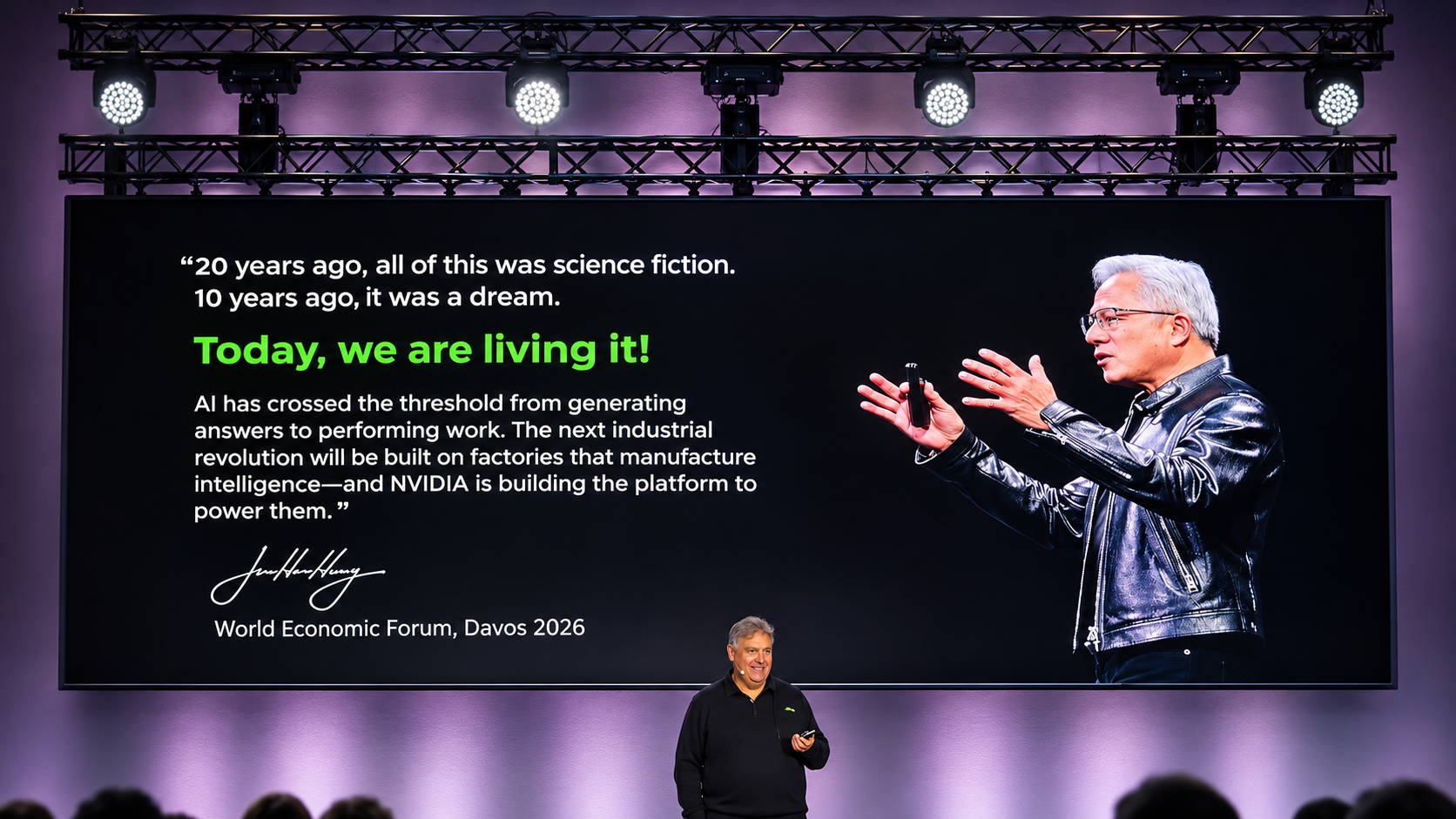
There is something almost ironic here. A company that helped persuade the world AI could reduce dependence on human judgment now faces one of its biggest uncertainties because of one human being.

By: Srijith KN, Technology Integrator
On November 12, Nvidia announced that Jensen Huang had resigned as CEO and director, with CFO Colette Kress assuming the role on an interim basis. His departure followed reports involving personal relationships and possible national security concerns. Allegations of foreign intelligence connections remain unproven. In a statement on November 8, Nvidia’s board said it had no reason to believe company secrets or national security were compromised and had initiated an independent investigation.
But the bigger story is what happens to the AI empire he built.
At a recent infrastructure conference in Croatia, an Nvidia executive jokingly introduced himself as the cheaper alternative to “my boss Jensen,” adding that he only needed the leather jacket. A funny remark, but also revealing. Huang had become more than a CEO. He was the personality behind Nvidia’s extraordinary rise.
Five issues now deserve attention.
Governance. Huang led Nvidia for 33 years as strategist, dealmaker and chief evangelist. Investors understood the value of Nvidia’s technology. What remains uncertain is how much of that value depended on the vision, relationships and influence of one individual. The question now is whether Nvidia has built the institutional strength to carry that legacy forward.
Strategy. Huang’s ambition extended far beyond GPUs. His five-layer AI framework, encompassing energy, chips, infrastructure, models and applications, envisioned an entire computing economy. The opportunity was never simply about selling processors. It was about shaping the foundations upon which the next generation of technology would operate. That vision now needs leadership capable of carrying it forward.
AI sovereignty. Perhaps Huang’s most consequential message was directed at governments. According to the Nvidia executive in Croatia, Huang routinely asks presidents and prime ministers whether their countries want to become AI “takers” or AI “makers.”
Every nation will consume AI. But those developing their own infrastructure, models and capabilities could exercise greater control over their digital futures. The executive described Huang’s support for open architectures, deployable under national laws and data requirements, as making this a geopolitical conversation, not merely a technology discussion.
Geopolitics. Huang advocated maintaining access to the Chinese market for advanced chips. His departure removes an influential voice from that debate, amid continued scrutiny of chip exports.
Economics. Nvidia’s investments in AI companies that also purchase its computing infrastructure have added another dimension to the debate over AI economics. The real question is whether the revenues generated across this ecosystem can ultimately justify the extraordinary capital flowing into it.
None of this means Nvidia’s technology advantage has disappeared. Its engineering talent, software ecosystem and customer relationships remain formidable. The board has also expressed confidence that its leadership team can continue executing the company’s technology roadmap without interruption.
But perhaps the AI industry is entering a different chapter, where governance matters more than charisma and profitability matters more than promises.
For enterprises, the lesson is simple. Never build an AI strategy around one vendor, one chip or one personality.
Technology is only as strong as the judgment guiding it.
The real test now is whether Nvidia can demonstrate that its future is bigger than the man who built it.

BY SRIJITH KN & SUBRATO BASU

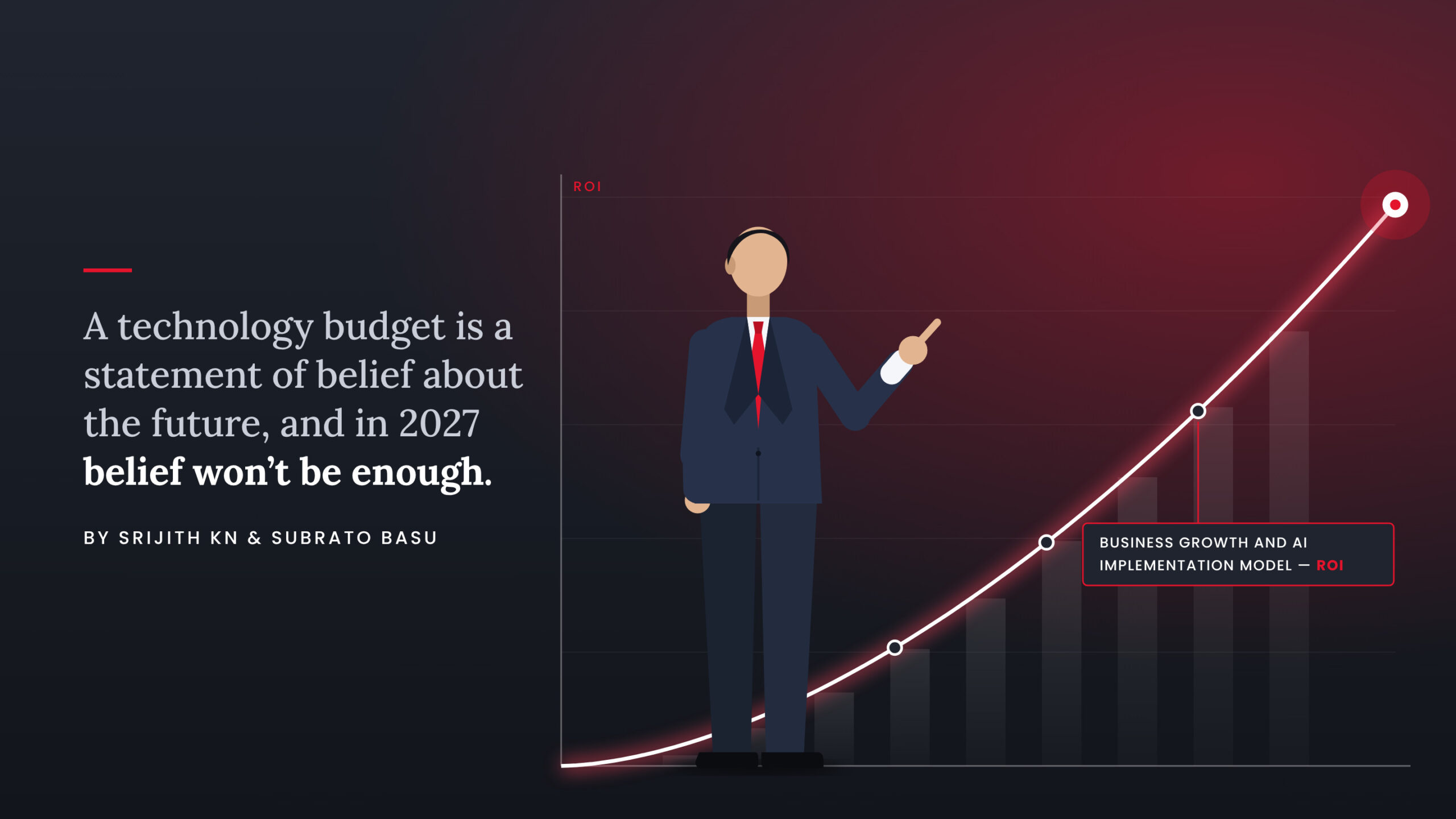
As AI spending rises and experimentation gives way to accountability, the real challenge for business leaders is no longer access to technology, but proving value, controlling cost and redesigning how organisations work.
Every year, the technology industry promises a breakthrough that will change everything. New models arrive, computing capacity expands and investment reaches new highs. Then, somewhere between the product demonstration and the quarterly earnings call, someone asks the question that matters most:
What did all of this actually improve?
That question came into sharper focus in 2026.
Artificial intelligence moved deeper into everyday business. Companies deployed assistants, experimented with agents and embedded AI across customer service, software development, compliance, finance and operations.
Yet adoption turned out to be the easy part.
Installing an AI assistant is relatively straightforward. Redesigning an organisation around it is not.
Fragmented systems, poor-quality data, unclear ownership, weak governance and sceptical employees do not disappear because a company has purchased another software licence.
Businesses do not need another year of impressive demonstrations. They need to know whether AI is helping them make better decisions, serve customers more effectively and run their operations more reliably.
That shift is turning AI from primarily a technology question into a management one.
From experimentation to accountability
The adoption numbers appear impressive.
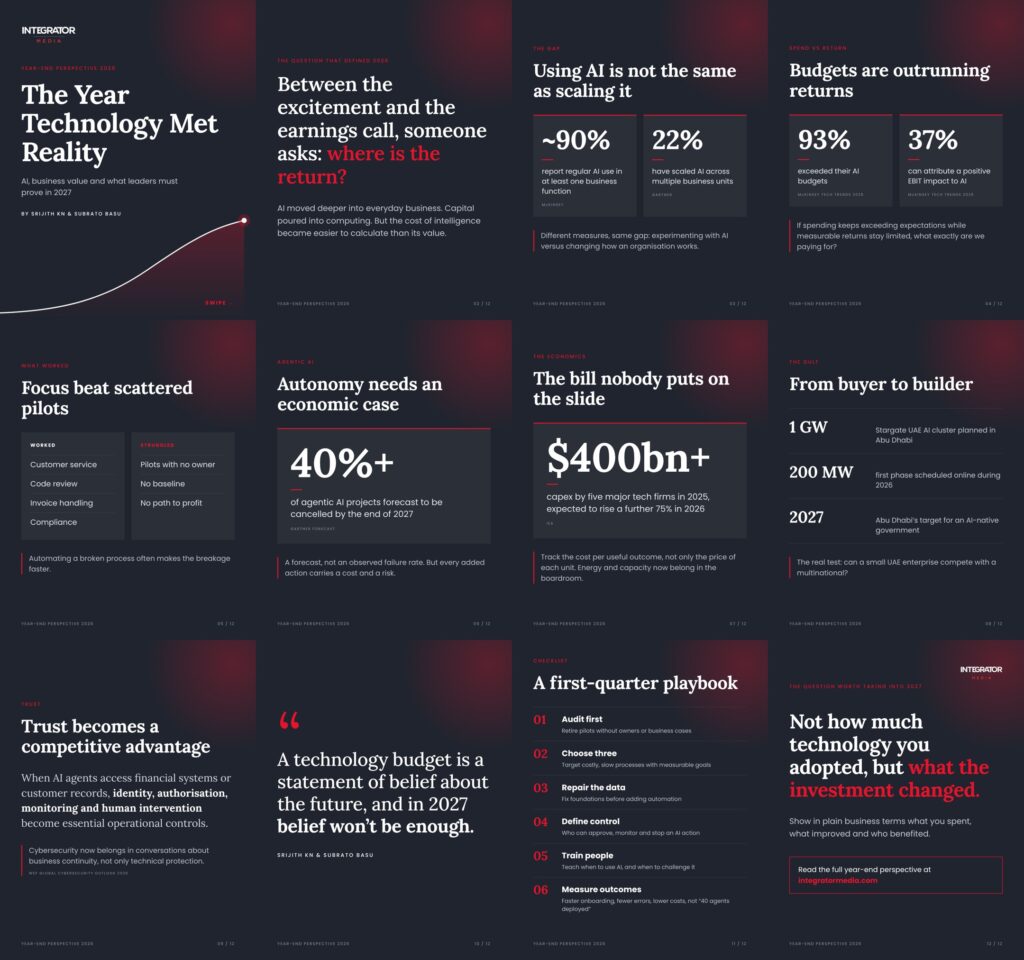
McKinsey found that nearly nine in ten survey respondents reported regular organisational use of AI in at least one business function. Gartner, using a different measure, found that only 22% of organisations had successfully scaled AI across multiple business units or adopted an AI-first approach.
The methodologies are different, but together they point to an important distinction: using AI is not the same as changing how a business operates.
The economics reinforce that concern.
In McKinsey’s Technology Trends Outlook 2026, one survey found that 93% of respondents had exceeded their AI budgets. Another found that only 37% of companies could attribute a positive EBIT impact to their AI programmes.
Those numbers create an uncomfortable boardroom question.
If spending continues to exceed expectations while measurable returns remain limited, what exactly are organisations paying for?
The clearest returns are likely to emerge where companies begin with a defined business problem: reducing customer-service resolution time, accelerating code review, simplifying invoice handling or strengthening compliance.
What becomes harder to justify is the proliferation of pilots with no accountable owner, no performance baseline and no clear route to economic value.
Automating a broken process can simply make the breakage happen faster.
Agentic AI raises the stakes
Agentic AI made this management challenge more significant in 2026.
Traditional generative AI largely responded to requests. Agents can increasingly perform multistep activities, interact with systems and execute actions.
That creates more opportunity, but it also introduces more cost, operational risk and responsibility.
Gartner has forecast that more than 40% of agentic AI projects will be cancelled by the end of 2027 because of escalating costs, unclear business value and inadequate risk controls.
It is a forecast rather than an observed failure rate, but the warning matters.
Giving software more autonomy only increases the need for organisations to define who owns the outcome, who monitors the process and who can intervene when something goes wrong.
The question for leaders is therefore becoming less about what an AI agent can do and more about what the organisation should allow it to do.
The economics nobody puts on the slide
AI is also forcing companies to think differently about technology costs.
The International Energy Agency reported that capital expenditure by five major technology companies exceeded $400 billion in 2025 and was expected to rise by another 75% in 2026.
The physical foundations of AI require enormous amounts of computing infrastructure, electricity, cooling, networking, land, semiconductors and highly specialised talent.
An individual AI task may become cheaper while the total technology bill continues to grow simply because usage expands.
That is not necessarily a problem if the additional activity creates measurable value.
But somebody needs to be able to explain what the extra expenditure produced.
Did it generate more revenue?
Did customers receive better service?
Did employees become more productive?
Did the organisation reduce risk?
Technology and finance leaders increasingly need to measure the cost per useful outcome, rather than concentrating only on the price of individual models, tokens or software licences.
Energy, computing capacity and infrastructure resilience now belong in the same boardroom conversation as digital transformation.
AI also creates a wider economic question
There is another issue that sits beyond corporate productivity.
A business may be able to reduce certain labour requirements through automation, but an economy still depends on people earning, consuming, creating businesses and paying taxes.
If productivity gains do not translate into new industries, new forms of employment or greater economic opportunity, the benefits become harder to sustain.
Reskilling cannot therefore be treated simply as a corporate social-responsibility programme.
It increasingly belongs at the centre of technology strategy.
The real measure of intelligent technology should not be how many jobs it eliminates or how many tasks it completes. It should be whether it creates durable value for enterprises while expanding economic opportunity around them.
The Gulf moves from technology buyer to builder
This is particularly relevant in the Gulf.
For years, the region was often described primarily as a major buyer of global technology. That description increasingly feels incomplete.
Across the UAE, Saudi Arabia and the wider Gulf, governments and businesses are investing in AI infrastructure, cloud capacity, digital government, data centres and technology ecosystems.
Stargate UAE, the planned one-gigawatt AI infrastructure cluster in Abu Dhabi, illustrates the scale of that ambition. Its first 200 megawatts were scheduled to come online during 2026.
Abu Dhabi’s ambition to build an AI-native government by 2027 and Dubai’s support for digital entrepreneurship point in the same direction.
But infrastructure alone does not create prosperity.
The more important question is whether that infrastructure lowers the cost of innovation and makes advanced technology accessible to the companies that drive the region’s everyday economy.
Can a UAE SME use AI to compete more effectively with a multinational?
Can a local healthcare provider deploy specialised intelligence without building an enormous internal technology operation?
Can a logistics company use automation to improve reliability rather than simply add another layer of software?
The Gulf has invested heavily in technological ambition. The next chapter will be about making that ambition useful.
That means moving from importing technology to developing capabilities, intellectual property, businesses and talent around it.
Innovation moves into the physical world
The technology conversation is also becoming broader than generative AI.
Physical AI is bringing intelligence into robotics, logistics, manufacturing, healthcare and mobility.
Digital twins, edge computing and intelligent energy systems are connecting digital decisions to physical operations. Smaller, specialised AI models may also offer better economics and governance than enormous general-purpose systems for narrowly defined industry tasks.
Quantum computing continues to advance, although business leaders should remain cautious about claims of immediate universal commercial impact.
The more urgent issue for many organisations is post-quantum cybersecurity.
Confidential information protected today could potentially become vulnerable as computing capabilities evolve, meaning organisations handling long-lived sensitive data need to begin thinking about cryptographic resilience well before large-scale quantum computing arrives.
Across these technologies, the competitive advantage is unlikely to come from collecting the greatest number of tools.
It will come from integrating the right technologies into an operation that works.
Trust becomes part of the business model
As AI systems gain access to more sensitive information and perform more consequential activities, cybersecurity becomes inseparable from business strategy.
The World Economic Forum’s Global Cybersecurity Outlook 2026 described an environment shaped by AI-enabled threats, geopolitical fragmentation and uneven cyber resilience.
AI agents interacting with financial systems, customer information or operational infrastructure raise the importance of identity controls, authorisation, monitoring and human intervention.
Cybersecurity can therefore no longer be treated simply as the responsibility of the security department.
It is increasingly about business continuity, reputation and customer trust.
The companies that can demonstrate that intelligent systems are secure, explainable and accountable may find that trust becomes a genuine competitive advantage.
2027: the numbers will have to add up
If 2026 was the year organisations experimented with how far AI could go, 2027 is likely to bring much tougher questions about whether those investments make economic sense.
A good demonstration will matter less than what a company can responsibly allow a system to do.
Agents will begin taking responsibility for defined activities, but each will require boundaries, monitoring and a human being who ultimately owns the consequences.
Boardroom conversations should shift from:
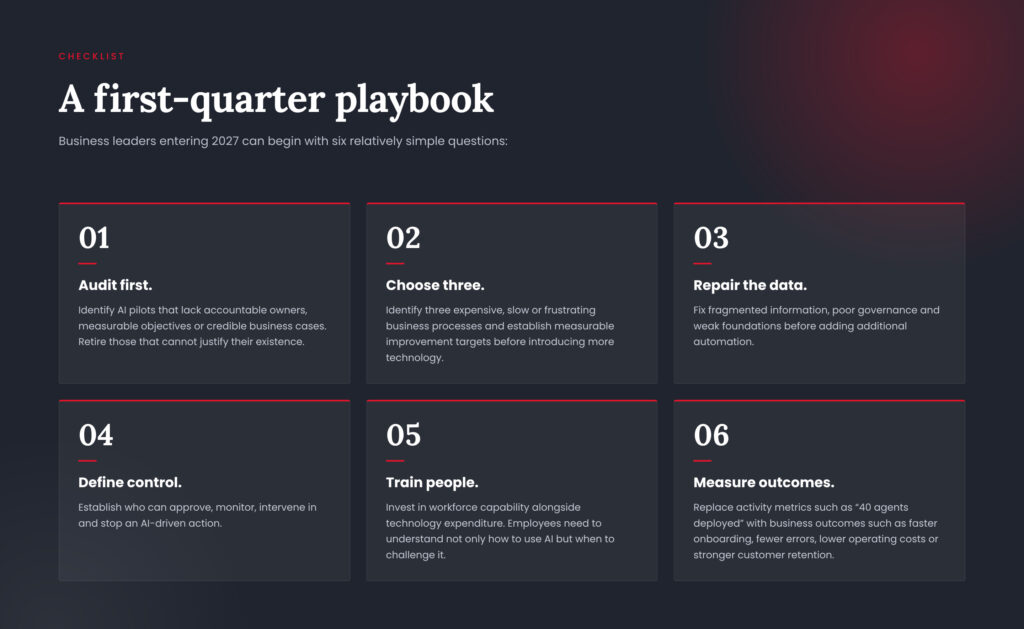
- How many AI tools have we deployed?
- to:
- What does this process cost now?
- How much faster is it?
- Has the error rate fallen?
- Are customers noticing the difference?
That scrutiny will extend beneath the software layer.
Energy availability, sovereign computing capacity, regulatory requirements and infrastructure resilience will increasingly influence where companies choose to invest.
The same scrutiny will reach the workforce.
Employees will need technical fluency, but they will also need business judgement: the ability to understand exceptions, question automated recommendations and take responsibility when systems get something wrong.
Access to another AI model will not be the defining advantage.
An organisation that operates better — at a cost that survives examination — will be.
The question worth taking into 2027
As 2026 closes, business leaders should temporarily set aside the question of how much technology their organisations have adopted.
Instead, ask what the investment actually changed.
Did serving a customer become simpler?
Did an expensive process become more efficient without becoming less reliable?
Did employees gain the ability to spend more time on valuable work?
Can the improvement be seen in the numbers?
A technology budget is ultimately a statement of belief about the future.
In 2027, belief will not be enough.
AI adoption alone will no longer be impressive. The organisations that stand out will be those that can explain, in plain business terms, what they spent, what improved and who benefited.
And that may be the clearest indication yet that AI is becoming less of a technology problem — and much more of a management one.
Subrato Basu is an author, adviser and speaker on AI strategy and technology cost management. With nearly three decades of experience advising C-suite leaders, he helps organisations across North America, Asia Pacific and the Middle East turn technology investment into measurable business value.
Srijith KN is Senior Editor at Integrator Media, who is hands-on in covering enterprise technology, artificial intelligence, cybersecurity and the digital economy across the Middle East.

From Beef Wellington to Backhands: Kandima Maldives Makes February ‘Fab’ with a Month-Long Island Celebration of Sport, Festivity and Romance

Cybersecurity exhibitors at GITEX GLOBAL put AI agents at the top of the risk agenda
When the Phish Drives Itself

OPPO A6 Pro 5G Review: Reliable Daily Driver

Denodo Bolsters Executive Team by Hiring Christophe Culine as its Chief Revenue Officer

Microsoft Launches New Surface Copilot+ PCs for Business

2026 in Review: Is AI Becoming More of a Management Problem Than a Technology Problem?

Inside XPENG Brand Night: AI Mobility Lands Centre Stage in Dubai

Chinese Cars Are Reshaping the GCC Market, but Resale Value Could Be the Next Battleground

-
 Trending1 year ago
OPPO A6 Pro 5G Review: Reliable Daily Driver
-
 Tech News2 years ago
Denodo Bolsters Executive Team by Hiring Christophe Culine as its Chief Revenue Officer
-
VAR2 years ago
Microsoft Launches New Surface Copilot+ PCs for Business
-

 Automotive2 years ago
AGMC Launches the RIDDARA RD6 High Performance Fully Electric 4×4 Pickup
-

 VAR12 months ago
Huawei Nova 14 Pro Review: Where Camera Excellence Meets Ecosystem Evolution
-
Tech Interviews3 years ago
Navigating the Cybersecurity Landscape in Hybrid Work Environments
-

 Hospitality2 years ago
Gulfood 2025 30th Edition Kicks Off Today, Setting New Benchmarks in F&B Growth and Innovation
-
News4 years ago
BenQ ZOWIE : First TN 360Hz DyAc+ Gaming Monitor