
 Have a question? +971 56 404 0503





Financial
Why Debt, Despite All Its Contradictions, Is One of the Most Beautiful Ideas in Finance


By Arash Jalali | Venture Builder | Revona
Most people hear the word “debt” and think of stress, bankruptcy and sleepless nights. It is the villain of personal-finance books and the scapegoat of every economic crisis. But after years of building ventures and, at Revona, structuring financing for developers and corporates every day, I have come to see debt very differently.
Debt is not merely a burden to be minimised. It is one of the most elegant, powerful and, yes, contradictory ideas humanity has ever invented.
That distinction matters especially now. Higher rates have made the cost of debt more visible, while a wall of maturities is turning yesterday’s cheap money into tomorrow’s refinancing decision. The response should not be to romanticise leverage. It should be to become more exacting about the work debt is asked to do.
Debt Is Older Than Money Itself
Long before coins and banknotes, communities ran on credit: promises recorded on clay tablets and in shared memory. Debt is, at its core, a technology for moving value through time. It lets tomorrow’s income fund today’s ambition. When a developer borrows to build a tower, or a founder raises venture debt to extend runway, they are pulling the future forward. That is not recklessness; it is one mechanism through which economies compound.
But the debt debate often starts in the wrong place. There is no magic ratio at which prudent borrowing becomes recklessness. A debt ratio is a snapshot; the real story is what the money is financing, whether cash flow can carry it and whether the borrower has time to adapt when conditions change. That is why the quality of the investment, the maturity profile and the resilience of the balance sheet matter more than the headline number alone.
In the architecture of the modern economy, debt does something even more subtle. It reduces the cost of financial oversight, helps create money through the banking system and smooths the path of economic growth. Every mortgage, every credit facility and every bond issue is a small act of coordinated trust between strangers. Trust, priced and packaged, is what capital markets actually trade.
The Debt That Never Dies
The numbers tell a more precise story than the usual rhetoric. Global debt reached a record nearly $353 trillion by the end of March 2026, according to the Institute of International Finance. That figure covers public, corporate and household debt. At the same time, the global debt-to-GDP ratio stood at about 305%, broadly stable since 2023. A record stock of debt, in other words, does not by itself tell us whether borrowers can carry it; the relationship between liabilities, income, assets and refinancing capacity does.
Nor should a stable global aggregate be mistaken for an all-clear. The IIF reported that debt in mature markets edged lower in the first quarter, while debt in emerging markets excluding China rose to a record $36.8 trillion. Debt is never one homogeneous thing. Its burden depends on who owes it, in what currency, at what rate, for how long, and against which cash flows.
The immediate market test is refinancing. The OECD expects governments and companies to borrow $29 trillion from bond markets in 2026 — 17% more than in 2024 and roughly double the amount ten years ago. Much of that activity is not fresh expansion; it is the constant work of renewing obligations. The OECD estimates that 78% of OECD government borrowing in 2026 will refinance existing debt. That is why the calendar can matter as much as the headline debt total.
The U.S. Lesson: Borrowing Can Stabilise Growth
The United States makes the point in unusually stark terms. The Office of Management and Budget’s fiscal-year-end measure of federal debt held by the public — the debt outside federal government accounts — rose from 25.2% of GDP in FY1981 to 99.5% in FY2025.
That is a profound change, but it was not a straight line and it cannot be explained by one White House. The ratio fell from 46.8% in FY1992 to 33.7% in FY2000, then rose through the financial crisis and jumped during the pandemic. The chart shows presidential terms as chronology, not as a scorecard: a fiscal year spans two calendar years, and debt reflects Congress, inherited commitments, recessions, interest costs and emergencies as well as executive choices.
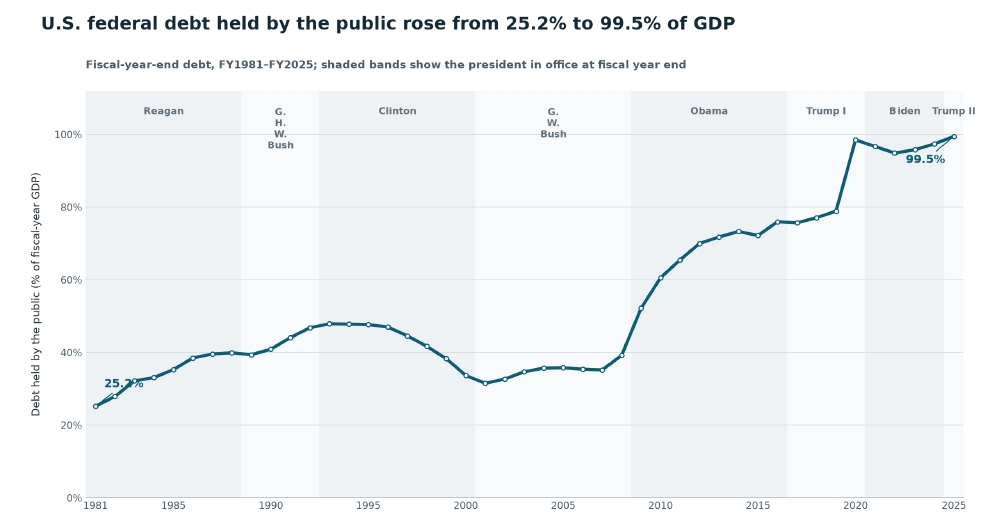
Figure 1. U.S. federal debt held by the public as a share of fiscal-year GDP. Source: Office of Management and Budget, Historical Tables, Table 7.1 (FY2027 release). Debt is measured at fiscal-year end. Administration bands identify the president in office on that date; they do not attribute causation.
The more useful lesson is not that a larger debt stock automatically produces prosperity. It is that, when private demand collapses, borrowing can prevent a deeper contraction. The Congressional Budget Office estimated that the major pandemic laws enacted in 2020 increased real GDP by 4.7% in 2020 and 3.1% in 2021, relative to an implied no-legislation baseline.
That is a concrete example of debt financing acting as a bridge: preserving household income, business liquidity and state and local services at a moment when the alternative was a sharper fall in economic activity.
But bridges must lead somewhere. CBO also projected that the additional debt would raise borrowing costs and reduce output and national income over the longer term. The point is not to celebrate the size of the U.S. debt pile. It is to recognise that borrowing can be a positive driver of growth when it is targeted at a productive investment or a defined emergency — and that its value erodes when cash flows, repayment capacity and the economic return are treated as afterthoughts.
The Beautiful Contradiction
Debt is a paradox, and that is precisely what makes it beautiful. It is simultaneously:
| Debt as… | For whom |
|---|---|
| An asset | The lender, bondholder or pension fund earning a contractual return. |
| A liability | The borrower who must service and ultimately repay it. |
| An engine of growth | The developer, founder or economy that applies it to a productive opportunity. |
| A source of crisis | Anyone who mistakes leverage for a substitute for fundamentals. |
The same instrument that funds a hospital can sink a household. The same leverage that lets a developer sell units before completion can, if mispriced, freeze an entire market. Debt does not care about intentions; it amplifies what is already there. Good projects can become great. Weak projects can fail faster. That amplification is the whole point.
The Revona Angle: Debt as Craft, Not Gamble
This is exactly where Revona operates, and why I find this space so compelling as a builder. If debt is a powerful but indifferent amplifier, the real value lies not in whether a client borrows, but in how the debt is engineered: the rate, the loan-to-value, the tenor, the covenants and the match between an asset’s cash flows and the facility that finances it.
Those are not cosmetic details. A lower headline rate can be a poor bargain if it comes with a refinancing date that arrives before the asset can reliably generate cash. A high loan-to-value ratio may look efficient until a change in valuations removes the borrower’s room for error. A fixed rate can buy time, but it does not eliminate the economics of refinancing.
That final distinction is becoming more important. The Federal Reserve reported in 2025 that long-term, fixed-rate liabilities had softened the initial pass-through of higher rates for large public companies. Yet about 15% of investment-grade bonds and 27% of high-yield bonds were due to mature within one to three years. The protection was real; it was also time-limited.
The OECD has similarly warned that, as higher long-term rates lead borrowers to issue at shorter maturities, near-term interest costs may fall while near-term refinancing risk rises.
At Revona, we treat financing as a craft. We map a client’s full balance sheet, identify untapped equity and structural inefficiencies, and match their profile against the lending criteria of more than sixty banks and institutions to find the optimal structure, not simply the fastest “yes.”
For developers, well-structured off-plan financing can mean buyers are pre-approved during construction, sales accelerate and project cash flow improves. Debt, structured properly, stops being merely a cost of doing business and becomes a competitive advantage.
The failures we associate with debt — the crashes, defaults and horror stories — are more often failures of structure and underwriting than evidence that debt is inherently flawed. They arise when there is too much leverage against too little cash flow; when short-term money funds long-term assets; when currency, revenue and debt-service obligations do not match; or when no one has stress-tested the downside.
The instrument gets blamed for the craftsmanship.
The Takeaway
Debt is usually framed as financial pressure and bankruptcy risk, but its role in the modern economy runs far deeper. It is a centuries-old technology for turning trust into growth, a nearly $353 trillion river of contractual claims, and a mirror that reflects the discipline — or indiscipline — of whoever wields it.
The world’s most sophisticated companies and governments do not avoid debt. They engineer it. As builders and investors, that should be our posture too: respect the contradiction, master the structure and let leverage do what it was invented to do — move the future forward.
AJ is a venture builder. Revona is a financing partner and portfolio manager providing institutional-grade credit and debt financing solutions for developers and corporates.




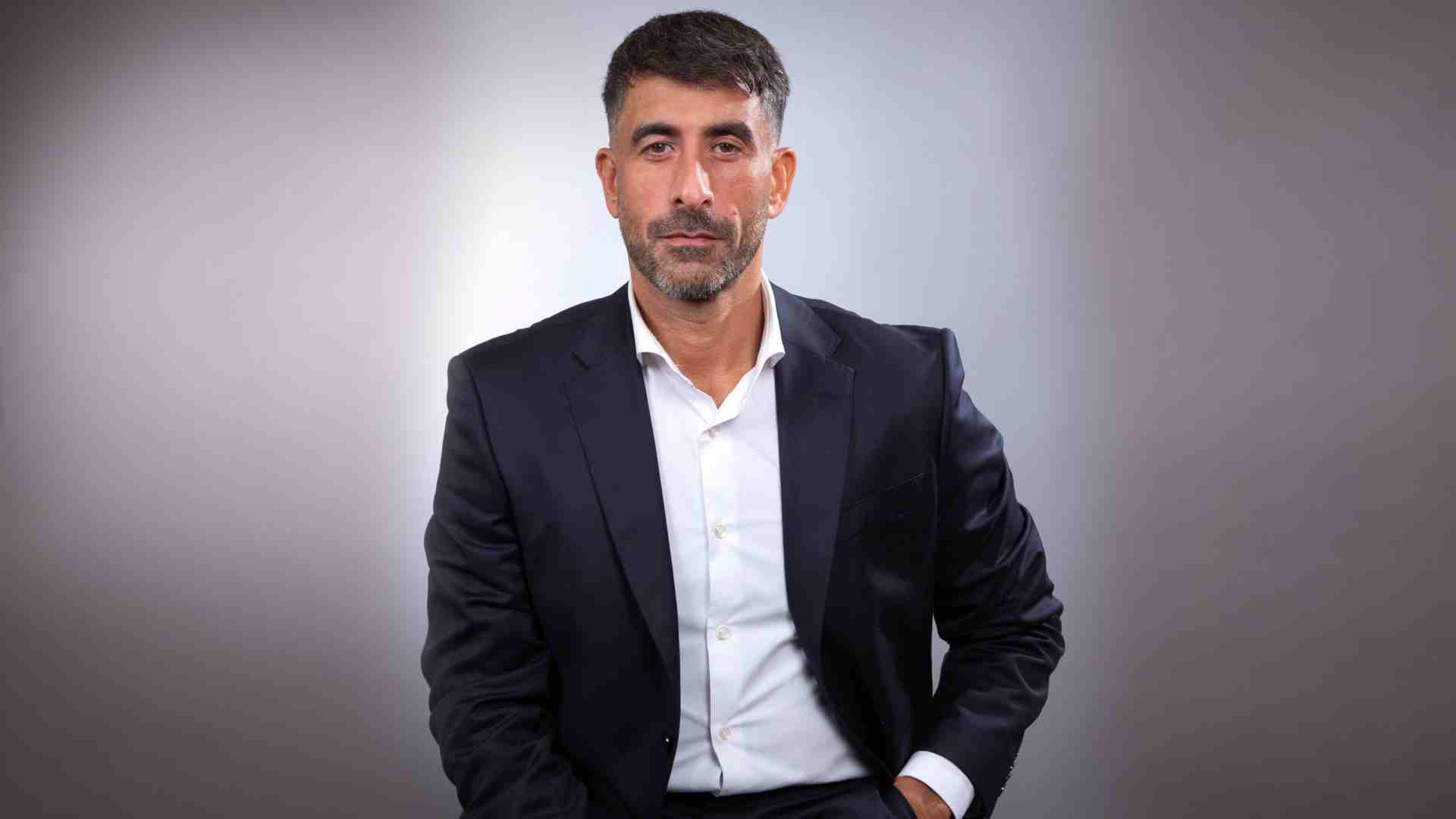
Henry Dannell, a specialist cross-border credit adviser, has announced its expansion into the Middle East with the opening of a representative office in Dubai International Financial Centre (DIFC), marking a significant milestone in the firm’s international growth strategy.
The move reflects rising demand for specialist advice among internationally mobile individuals whose financial interests increasingly span multiple jurisdictions, asset classes, and lending structures. As Dubai continues to strengthen its position as a global wealth and investment hub, attracting entrepreneurs, family offices, investors, and high-net-worth individuals from around the world, the complexity of managing wealth across borders has increased significantly. Many of these individuals now live, work, invest, and hold assets internationally, creating borrowing requirements that often extend beyond conventional lending frameworks.
Henry Dannell’s expansion into Dubai is designed to bring the firm’s specialist expertise closer to the region’s growing network of wealth advisers, family offices, tax specialists, legal professionals, and internationally connected clients.
Founded in 2019, Henry Dannell has built a reputation for delivering bespoke credit and lending solutions for clients with highly sophisticated financial circumstances. The firm’s advisers support a broad spectrum of clients, from business owners and entrepreneurs to ultra-high-net-worth individuals, helping them navigate complex borrowing scenarios that frequently involve multiple jurisdictions, unconventional income structures, and international assets. Unlike traditional mortgage providers, Henry Dannell operates as a specialist advisory business focused on structuring tailored credit solutions and working alongside trusted professional advisers to address complex financing requirements.
The establishment of the DIFC representative office represents the first phase of the company’s broader regional growth ambitions and will serve as a hub for relationship-building, market engagement, and collaboration with professional advisory communities across the Middle East.
Kem Kemal, CEO and Co-Founder of Henry Dannell, said: “Over the last decade, we have seen a fundamental shift in how wealth is created, managed, and deployed. Successful individuals are increasingly global in their outlook. They may operate businesses in one country, hold investments in another, and seek opportunities across several markets simultaneously. Yet lending has not always evolved at the same pace.”
He explained that too often, highly accomplished individuals with substantial assets and strong financial positions encounter challenges because their circumstances fall outside conventional frameworks. “Our role is to understand the complete picture and design bespoke solutions that reflect the realities of modern international wealth.”
“Dubai has become one of the most important centers for global capital, entrepreneurship and wealth advisory services,” he added. “Establishing a presence within DIFC allows us to be closer to the professional advisers and internationally connected clients we serve, while strengthening relationships across a region that continues to play an increasingly influential role in global finance.”
With over 165 years of combined industry experience across its advisory team, Henry Dannell has developed specialist expertise across residential, commercial, and specialist lending transactions. Through its Dubai presence, Henry Dannell aims to deepen engagement with the region’s professional advisory ecosystem while contributing to discussions around international wealth, investment, and cross-border financial planning.
Financial
The UAE’s Net Wealth Reaches $3.6 Trillion in 2025 and is Expected to Approach $6 Trillion by 2030, BCG Report Finds
The UAE’s net wealth grew by 12.7% between 2024 and 2025, rising from $3.2 trillion to $3.6 trillion, according to Boston Consulting Group’s (BCG) Global Wealth Report 2026: The Great Reordering. Total Net wealth is forecast to reach $6 trillion by 2030, with a CAGR of 10.6%. This represents an increase of more than $2.3 trillion over the next five years. The projected growth points to the UAE’s long-term wealth creation potential.
Financial wealth, including both investable and non-investable wealth, grew by 12.3% between 2024 and 2025, rising from $1.2 trillion to $1.4 trillion and is set to rise to $2.1 trillion by 2030 at a CAGR of 8.7%. Real assets reached $2.4 trillion in 2025 from $2.2 trillion in 2024, with projected growth to $4.2 trillion by 2030.
The findings show the resilience of the UAE wealth market amid a volatile global environment and heightened geopolitical uncertainty. “The ongoing conflict has introduced short-term volatility across Middle Eastern markets, with investor sentiment shaped by geopolitical uncertainty and oil-price movements,” said Lukasz Rey, Managing Director and Partner at BCG. “However, the region’s wealth development story remains structurally resilient over the five-year projection horizon. While we anticipate slightly lower growth over the next one to two years, a rebound is expected toward the latter part of the decade, supported by sovereign wealth strength, economic diversification agendas, family-business liquidity events, and continued private capital activity. We expect wealth managers to remain cautious in the near term; however, the long-term wealth opportunity in the Middle East remains intact.”
The report identifies a broader reordering underway across the global wealth-management industry, spanning geographic shifts, emerging-market wealth creation, intergenerational succession, and AI-driven operating model transformation.
Shifting Wealth Concentration Across UAE Population Segments
According to the report, the UAE’s financial wealth remains concentrated among high-net-worth individuals, with the composition of wealth expected to evolve by 2030 as more wealth accumulates within the lower high-net-worth segment. There are approximately 500 ultra-high-net-worth (UHNW) individuals, those with more than US$100 million in assets, in 2025, and they are expected to increase to around 800 by 2030, while their share of total financial wealth rises marginally from 26.3% to 26.5%. The upper high-net-worth segment (US$20–100 million) is forecasted to grow from approximately 2.7K to 4.2K individuals, with its share of wealth broadly stable at 7.4% in 2025 to 7.6% in 2030.
In contrast, the lower high-net-worth segment (US$1–20 million), which comprises approximately 200K individuals, is expected to increase its share of financial wealth from 29.3% in 2025 to 31.5% in 2030. The affluent segment (US$0.25–1 million) is expected to expand from approximately 500K to 600K individuals in 2030, while its share of wealth declines from 15.5% to 14.6% as wealth disperses across a larger base. The mass segment (below US$0.25 million) remains the largest by population, growing from roughly 8.6M to 9M individuals, but its share of financial wealth decreases from 21.5% to 19.8%.
The key UAE findings of BCG’s proprietary analysis are:
- Financial wealth reaches $1.4 trillion in 2025, with strong projected growth to $2.1 trillion by 2030 (CAGR: 8.7%)
- Real assets rose to $2.4 trillion in 2025 and are expected to hit $4.2 trillion by 2030 (CAGR: 11.5%)
- Liabilities climbed to $220 billion in 2025 from $210 billion in 2024, with projections indicating $340 billion by 2030 (CAGR: 8.9%)
- Cross-border financial wealth belonging to UAE residents and booked outside the UAE surged by 9.4% between 2024 and 2025 in the UAE, reaching $468.4 billion. It is forecasted to grow to $678.2 billion by 2030 with a CAGR of 7.7%.
- Separately, the UAE continues to strengthen its position as a global wealth booking center, with cross-border wealth belonging to international clients and booked in the country reaching $721 billion in 2025, up 11.1% year-on-year.
- Currency & Deposits, valued at $471.8 billion in 2025, is projected to grow to $778.9 billion by 2030, with a CAGR of 10.5%
- Bonds are expected to reach $27.8 billion by 2030 from $15.9 billion in 2025, with a CAGR of 11.8%
- Equities, valued at $419.4 billion in 2025, are expected to reach $591.9 billion by 2030 at a CAGR of 7.1%
- Life Insurance & Pensions are valued at $26.6 billion in 2025 and projected to grow to $48.4 billion by 2030 (CAGR: 12.7%)
AI Is Reshaping the Economics of Wealth Management
BCG’s report finds that AI is beginning to reshape wealth-management economics and operating models. AI-powered tools are already drafting financial plans, automating compliance documentation, generating portfolio rationales, and predicting client churn. According to BCG analysis, AI-first wealth managers could unlock 25%–30% capacity gains across key workflows while increasing revenue per advisor by 15%–20%. The report argues that the industry is approaching a structural divide between firms redesigning workflows around AI agents and those layering AI tools onto legacy processes.
“The UAE’s wealth pool is set to grow by more than $2 trillion over the next five years, and the constraint on capturing that growth is advisor capacity rather than client demand,” said Mohammad Khan, Managing Director and Partner at BCG. “Firms that are redesigning their workflows around AI agents are creating the headroom to serve a larger client base without diluting the quality of advice. Those layering AI onto legacy processes are paying for the technology without changing their economics, and that gap widens the longer it is left.”
Wealth managers face a choice between adapting incrementally and committing to an AI-first future, with the report identifying the latter as the more sustainable approach. Key priorities include:
- Map value chain exposure: Identify rules-based, templatized processes most vulnerable to automation. Distinguish truly bespoke, relationship-dependent work from structured, repeatable tasks to guide investment decisions.
- Attack high-cost workflows: Scale AI now in financial planning, portfolio management, and compliance, automated drafting, AI-generated rationales, knowledge assistants.
- Rebuild the advisor experience around AI: Integrate next-best-action prompts, retention alerts, automated documentation, and personalized outreach into a unified system.
- Encode institutional knowledge into agents: Pair top practitioners with engineers to build and refine AI agents. Embed advisor judgment into today’s agents, without centralized ownership and outcome-based evaluation, differentiation erodes.
- Prepare the tech stack for agents. Introduce a decoupled data layer separating operational systems from data consumption, delivering real-time, API-accessible data while maintaining deterministic control through transaction systems and rules engines.
Financial
UAE Ranks First Globally in Citizen Satisfaction with Government Digital Services at 89%, BCG Survey Finds

The UAE ranks first globally in citizen satisfaction with government digital services, with 89% of respondents rating them highly, according to Boston Consulting Group’s (BCG) sixth annual edition of its 2026 Digital Government Citizen Survey Report, which was launched on the first day of AI Everything Abu Dhabi, titled “After a Decade of Digital Gains, AI Is Reshaping Citizens’ Expectations in the GCC[SM1] [GU2] .” The finding underscores the strength of the UAE’s digital government experience and provides a strong foundation for the next phase of AI-enabled public services.
The survey, conducted across 44 countries, also highlights the depth of the UAE’s digital engagement, with the country ranking first globally in government digital service usage at 53%. More than three-quarters (76%) of UAE respondents say their latest online government transaction delivered a better experience than their typical private-sector interaction, reinforcing the strength of the country’s digital government ecosystem.
This strong digital foundation is increasingly extending into AI adoption, where 82% of UAE respondents reported using AI weekly. High levels of usage are accompanied by relatively positive attitudes toward AI in government, with 53% of UAE respondents believing its benefits outweigh the risks, compared with 49% across the GCC and 36% globally. At the same time, greater exposure to AI is bringing a broader set of considerations into focus for citizens. While GCC citizens remain more optimistic about AI in government than their global peers, overall optimism has declined by 21% since 2024.
This evolution points toward a more hybrid model of service delivery. GCC citizens increasingly favor AI for simpler services while retaining human involvement for more complex interactions, which assures a shift that reflects greater awareness of both the opportunities and considerations associated with AI. At the same time, only around 4% of GCC respondents prefer human-only services with no AI support, compared with almost one in ten globally.
“The UAE’s strong digital government experience reflects years of investment in making public services more accessible, seamless, and responsive to citizens’ needs,” said Rami Mourtada, Partner & Director, Digital Transformation, BCG. “As AI becomes more embedded in public services, governments have an opportunity to build on this foundation with more AI-enabled experiences and process re-engineering to continue focusing on quality and convenience. This next phase will be about deploying AI where it creates clear value, while maintaining human expertise for more complex citizen needs.”
GCC Citizens Embrace the Next Generation of AI-Enabled Services
The BCG report also reveals strong appetite among GCC citizens for the next generation of AI-enabled government services. The region is the most AI-receptive globally, with 79% of citizens open to AI-centered government interactions, compared with 66% globally. Notably, three of the four most strongly supported AI applications in government are agentic use cases, signaling a healthy launchpad for governments to explore services that can move beyond providing information to supporting or completing actions on citizens’ behalf.
This openness is already evident across practical applications: 82% are comfortable with AI providing 24/7 access to information and services; 81% with AI supporting government customer-service agents; 79% with AI detecting fraud and automatically following up; and 78% with AI identifying services citizens qualify for and taking action on their behalf. [SM3] [GU4] Yet citizens are not calling for AI alone. Preference for “AI for simple services, people for complex ones” has risen nine percentage points to 50% over the past two years, reinforcing a hybrid model that combines AI-enabled speed and availability with human judgment for more complex or higher-stakes interactions.
This opportunity builds on a strong track record in digital government service quality. In 2026, the GCC remained the only surveyed region where a majority of citizens rated government digital services above those of the private sector, at 72%. However, private-sector experiences are gaining ground: the net share of GCC respondents rating government services above private-sector services declined from 75% in 2024 to 69% in 2026. The shift creates both a learning opportunity and an impetus for governments to continue innovating as citizen expectations evolve.
As governments move toward more advanced AI-enabled services, citizen AI literacy will be equally important. GCC respondents with expert-level AI proficiency are around four times more likely than those without AI experience to believe that the benefits of AI in government outweigh the risks. At the same time, greater familiarity with AI is sharpening citizens’ expectations around how it is deployed. Job loss (33%) and accuracy (28%) now rank as the leading concerns, underscoring the importance of pairing AI literacy with safeguards that are visible and relevant to citizens.
“The GCC has a strong opportunity to translate its digital leadership into the next generation of AI-enabled government services,” said Dr. Lars Littig, Managing Director & Senior Partner, BCG. “As citizens become more familiar with AI, building literacy and trust will be critical to sustained adoption. The opportunity is to move forward with AI in ways that reflect how citizens want to engage, expanding automation and agentic capabilities where they create value, while retaining human judgment and embedding responsible safeguards where they matter most.”
Six Priorities for the Next Generation of Digital Government
To build on the region’s digital progress and maximize the potential of AI in government services, BCG’s report outlines six priorities for GCC governments:
- Rethink core services with AI, redesigning them end to end rather than layering AI onto existing processes.
- Learn from private-sector innovation as digital experiences improve and citizen expectations evolve.
- Embed responsible AI through governance, testing, and safeguards that strengthen citizen trust.
- Build the hybrid model citizens want, using AI for simpler interactions while retaining human expertise for complex or high-stakes needs.
- Expand agentic AI services beyond information toward services that can support complete journeys and act on citizens’ behalf.
- Advance AI literacy to build citizen understanding, confidence, and informed adoption.
Together, these priorities can help GCC governments build on a decade of digital progress and translate citizens’ openness to AI into the next generation of public services. By combining strong digital foundations with responsible AI adoption and continued access to human expertise, the region is well positioned to deliver services that are more proactive, personalized, and responsive to citizens’ evolving needs — while sustaining the trust that will be critical to long-term adoption
To access the full BCG Digital Government Citizen Survey2026, visit the link here.


Nolte Küchen Secures AED 90 Million in UAE Projects Following Direct Market Entry

Mango Jam Studios and The SMC Group Forge Strategic Partnership to Connect Middle Eastern Brands with Global Music and Entertainment Talent

AL HABTOOR GRAND RESORT, AUTOGRAPH COLLECTION APPOINTS CHRISTOPHE DELABARRE AS HOTEL MANAGER



-

 Trending12 months ago
OPPO A6 Pro 5G Review: Reliable Daily Driver
-

 Tech News2 years ago
Denodo Bolsters Executive Team by Hiring Christophe Culine as its Chief Revenue Officer
-
 VAR2 years ago
Microsoft Launches New Surface Copilot+ PCs for Business
-

 Automotive2 years ago
AGMC Launches the RIDDARA RD6 High Performance Fully Electric 4×4 Pickup
-
Tech Interviews3 years ago
Navigating the Cybersecurity Landscape in Hybrid Work Environments
-

 Hospitality2 years ago
Gulfood 2025 30th Edition Kicks Off Today, Setting New Benchmarks in F&B Growth and Innovation
-

 Tech News1 year ago
Nothing Launches flagship Nothing Phone (3) and Headphone (1) in theme with the Iconic Museum of the Future in Dubai
-

 VAR10 months ago
Huawei Nova 14 Pro Review: Where Camera Excellence Meets Ecosystem Evolution