
 Have a question? +971 56 404 0503





Financial
UAE primed to convert FDI inflows into economic velocity, says new report


The UAE has built one of the world’s most successful models for attracting foreign direct investment (FDI) and is now positioned to convert that capital into lasting innovation and skill development, according to a white paper from White Paper Media Consulting (WPM), a UAE-based strategic research house that is shaping business and policy conversations in the region using credible datasets and analytical tools.
Beyond the Numbers: The Transformative Intangible Impact of FDI argues that the real returns on FDI now lie in the intangible value it embeds within host economies, with the UAE a defining case study. The paper contends that the next phase will go beyond investment volumes, number of projects, and job creation and be measured also in patents generated, skills transferred, data ecosystems built, and clean technologies commercialized, among other things.
Official data shows that the UAE attracted more than $48.3 billion in FDI inflows in 2025, capturing 3.1% of global flows. Greenfield FDI reflected both volume and capital depth, with 1,562 projects announced for a combined $34.1 billion in capex, or 1.8% of the global total.
The country’s ability to attract investment reflects its competitiveness as a hub for operational efficiency, supply chain integration, and regional headquarters functions. The UAE has deliberately repositioned its FDI strategy toward knowledge-intensive and future-oriented sectors, recognizing that long-term competitiveness is increasingly driven by innovation, digital capabilities, and human capital. This approach aligns closely with the OECD FDI Qualities framework, with tangible examples across each dimension: including the innovation and competitiveness, digitalization and technology adoption, sustainability and clean energy investments for climate targets, and human capital and local expertise.
Drawing on the OECD framework and benchmarks from Ireland, Singapore, Israel, Costa Rica, and Malaysia, the report documents how leading economies have shifted focus from the volume of capital they attract to the long-term value it creates. In the context of UAE, this is visible in the shift in the country’s policies across phases that begin with the Foundation Phase from 1985 to 2005 of Market Liberalization and Infrastructure Creation, culminating in the current positioning as Global Capital and Technology Hub.
The shift to value in the UAE has made a huge difference to the job-creation intensity of FDI. Approximately 2,816 jobs were created in the UAE for every billion dollars received in greenfield FDI in the five years from 2019 to 2023, compared to 2,265 in the previous five years. This is higher than the OECD average of 2,318 and 1,880 respectively.
The paper identifies seven ongoing policy shifts that deepen the qualitative impact of FDI in the UAE, including extending spillovers from free zones into the mainland economy, prioritizing R&D-intensive investment, embedding skills transfer requirements in major projects, and positioning the country as a global leader in IP creation and data governance.
Yazad Darasha, co-founder and director, WPM, said: “As trusted partners of public and private sector clients, we have tracked the UAE’s investment story for years, and the pattern is unmistakable. The country has positioned itself at the front of the race for capital. What we set out to map in this paper is the harder, more valuable contest: converting investment into skills, technology, and economic velocity. It reflects what we do at White Paper Media, turning complex evidence into decisions leaders can act on.”
Dr. Joachim Arnold, CEO of OCO Global, which advises governments and businesses on attracting FDI, building competitiveness, and strengthening economic resilience, and contributed to the study, said: “The UAE’s infrastructure, free zones, and business-friendly environment helped attract companies and drive growth. The National Investment Strategy 2031 signals a more deliberate focus on investment that raises productivity and embeds benefits into the wider economy. The question is no longer only how to attract capital, but how investment creates lasting value, strengthens existing companies, and helps domestic businesses upgrade their capabilities.”
The paper highlights live examples of this transition already underway, among them the Space42 and ICEYE joint venture building satellites on UAE soil, Microsoft’s $15.2 billion investment plan with a commitment to skill one million people, and the UAE’s $30 billion pledge to the Alterra climate fund.

The Ukrainian Business Council in the UAE (UBC) elected a new Board at its General Assembly at Dubai Chamber, where members also approved a 2026–2028 strategy to strengthen trade and investment between the two countries.
Over the next three years, the Council plans to extend its trade delegation programme to new markets, deepen ties with international business councils and launch structured investment dialogues to connect UAE investors with opportunities in Ukraine. The UAE–Ukraine Comprehensive Economic Partnership Agreement (CEPA), Ukraine’s first agreement of its kind with a Gulf state, came into force in July 2026 and removes or reduces customs duties on most goods traded between the two countries.
“Ukrainian companies are achieving real results in the UAE, and we see significant untapped potential for Emirati business and investment in Ukraine. Our role is to build on this momentum: to connect the right partners, support companies at every stage of their growth and help investment flow with confidence in both directions.” commented Olena Shyrokova, President, Ukrainian Business Council in the UAE.
In 2025 and 2026, UBC led business delegations to Vienna, Qatar, Ras Al Khaimah, Fujairah, Oman and the Seychelles. It also ran webinars on UAE market entry for Ukrainian companies and business associations and supported the Ukrainian IT delegation at GITEX. Since its founding in 2016, the Council has established a dialogue with the Federation of UAE Chambers and chambers of commerce across the Emirates.
Under the new strategy, UBC will work with international business councils to give Ukrainian companies access to wider business networks in the Emirates and use the UAE as a base for trade missions to the Gulf, Asia and Africa. The Council will help Ukrainian companies in the UAE with registration, investment and expansion. It also plans to help Ukrainian investors find opportunities in the Emirates, attract Emirati investment to support Ukraine’s recovery and develop arbitration and investor protection mechanisms to build confidence in cross-border agreements.
The Council sees the strongest potential in sectors where Ukrainian strengths meet Emirati priorities: agri-food and food security, IT and digital services, renewable energy, logistics and port infrastructure, and post-war reconstruction. These are also the areas both governments have highlighted for future cooperation.
UBC works closely with the Embassy of Ukraine in the UAE and with H.E. Dr Oleksandr Balanutsa, Ambassador Extraordinary and Plenipotentiary of Ukraine to the UAE. The Council took part in the Cities Unite: Cultural and Business Exchange between the UAE and Ukraine dialogue at Expo City Dubai, initiated by H.E. Reem bint Ebrahim Al Hashimy, UAE Minister of State for International Cooperation, and the Embassy of Ukraine.
The Council will continue to support Ukrainian businesses and the wider community, helping companies expand into the UAE and encouraging UAE investment in Ukraine. Businesses, investors and potential partners interested in working with the Council can get in touch by reaching out to info@ukrainianbc.org.
Financial
Connecting Industries and Trade: Malakut Business Forum 2026 Brings Together 750+ Delegates and 300+ Companies
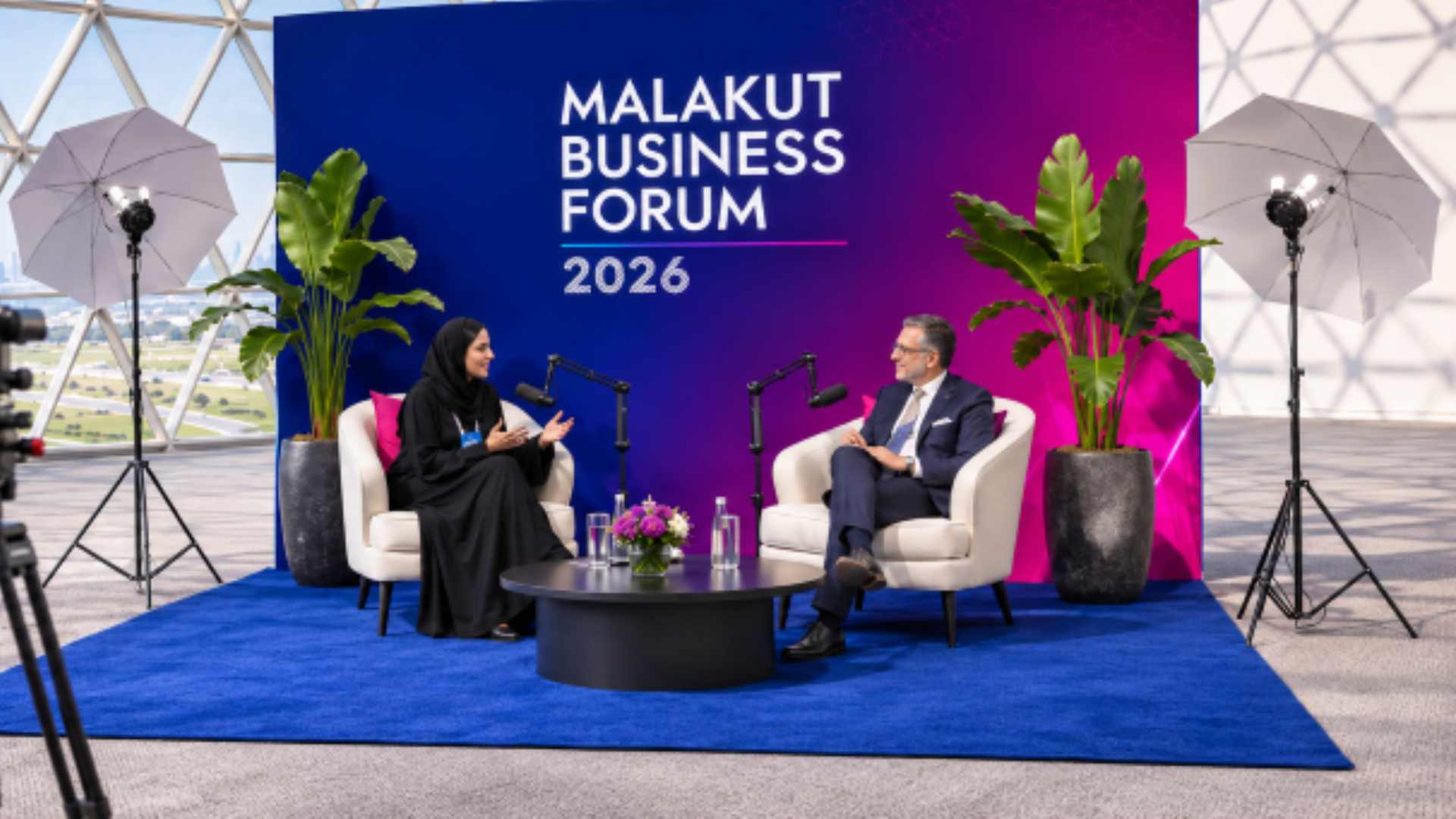
The Malakut Business Forum 2026 is set to bring more than 750 delegates and over 300 companies together at Sky Bubble, Meydan Hotel, Dubai, on 25 November 2026, with C-suite executives and directors accounting for 60 per cent of attendees.
The one-day forum will convene senior leaders from banking, trade, insurance, logistics and industry across five streams: Finance, Risk, Artificial Intelligence, Logistics and Technology.
The 2026 edition builds on the success of the inaugural forum with even greater scale and a more focused agenda. Organisers are lining up more than 25 industry speakers and over 20 partners, with a projected digital reach of 200,000+ online users, providing even more opportunities for partners to connect, engage and be seen. The key topics to be explored during this edition include business resilience, geopolitical challenges, innovation and the future of global trade.
“Business leaders are making critical decisions under pressure, across borders and with less certainty than ever. The Malakut Business Forum was created to bring the right people into the same room, so decisions are better informed and conversations turn into real opportunities. Our 2026 edition is bigger, bolder and built for impact, and we are proud to host it in Dubai, a global crossroads of trade,” said Alex Dolgopolov, CEO of Malakut, the Founding Partner of Malakut Business Forum 2026
The programme is built around real cases and candid discussion. Finance sessions will examine how companies protect liquidity under pressure and turn high-risk projects into bankable ones. The Risk stream will address securing political violence and war risk cover during active conflict, and what businesses can do when the insurance market will not take the risk. Artificial Intelligence sessions will look at AI savings that reached the P&L, the move from copilots to agents and what leaders refuse to automate. Logistics will tackle rerouting during conflicts and the question of who pays for resilience, while Technology will cover scaling across fragmented markets and modernising core systems without disrupting daily operations.
Beyond the main stage, delegates can expect a networking reception, a partner showcase, a live podcast studio, VIP hospitality and an evening cocktail and dinner experience. Private Skyboxes overlooking the Meydan race track will offer partners an exclusive setting for high-value meetings with clients, prospects and partners.

Imagine a business that pays an overseas supplier in stablecoins. The transfer is confirmed within minutes, but the supplier cannot access the funds in the currency needed to fulfil the order. A bank review holds up the conversion, the delivery date approaches, and neither party knows how long the delay will last.
The payment has worked as a blockchain transaction. As a business transaction, however, it has fallen short.

This distinction matters as stablecoins gain attention as a more efficient way to move money internationally. They offer genuine advantages, including faster settlement and the potential to reduce transfer costs. But businesses do not adopt payment methods simply because the technology works. They need to know that money will arrive when expected, that recipients can use it, and that problems can be resolved without leaving both parties in limbo.
For stablecoins to become a practical part of global commerce, the industry must address the parts of a payment journey that technology alone cannot fix.
The Real Cost Is More Than the Transfer Fee
Sending money across borders remains expensive, despite years of investment in digital payments. World Bank data puts the global average cost of remittances at approximately 6.36% per US$100, down from 8.89% in 2010. Progress has been uneven, with established corridors such as the UAE–India and US–Mexico benefiting from more developed financial networks, while some routes serving Africa, Latin America and Southeast Asia continue to face higher costs.
The UAE illustrates why this matters. With expatriates accounting for around 88% of its population, the country is a major centre for international remittances, particularly to South Asia. Improvements in payment infrastructure have implications not only for individuals sending money home but also for companies paying suppliers, contractors and employees abroad.
Stablecoins could help reduce some of the friction involved. Yet headline transaction volumes can obscure how much progress has actually been made in everyday payments. The $8.82 trillion in stablecoin transaction volume cited for the first half of 2026 includes activity that is not necessarily linked to purchasing goods, paying suppliers or settling commercial invoices. Estimates of real-world stablecoin payment activity, at approximately $390 billion, offer a different perspective on adoption.
The distinction is important. Moving a digital asset between wallets is not the same as completing a payment that meets a business’s commercial needs. The latter requires the entire process, from funding and settlement to conversion, reconciliation and confirmation, to work reliably.
Businesses Need Someone to Turn to When Payments Fail
Conventional payment systems have plenty of shortcomings, but businesses generally operate within established arrangements for investigating failed transfers, handling refunds and determining who is responsible for a loss. Stablecoin payments introduce a different set of participants and processes, and responsibility can become less clear when something goes wrong.
A cross-border transaction might involve a stablecoin issuer, a payment provider, an exchange and one or more banks. Each may have its own compliance obligations, operating procedures and timelines. A transaction can settle on-chain while remaining inaccessible to its intended recipient because a bank review, liquidity issue or other operational problem interrupts the next stage.
For a business, the consequences are tangible. A supplier may delay an order, a shipment may miss its window, or a contractual payment deadline may be breached. The savings achieved through faster settlement can quickly lose their value if the business cannot predict when the recipient will actually receive usable funds.
This is why dispute handling, refunds, transaction restrictions and clear escalation procedures need to be considered from the outset. A system designed for commercial use cannot rely on the assumption that every transaction will proceed as intended.
There is room for infrastructure that brings together blockchain-based payments and familiar financial risk controls. Such systems could help coordinate transaction monitoring, counterparty checks and the handling of disputed or interrupted payments.
The objective is not to recreate every layer of traditional banking, but to give businesses a clear process and an accountable party when a payment requires intervention.
International Payments Need International Coordination
The same issue arises at the regulatory level. A business making payments across several markets should not have to navigate a completely different set of operational expectations at every border.
Europe’s Markets in Crypto-Assets Regulation (MiCA), the US GENIUS Act, and frameworks developed by the UAE’s Virtual Assets Regulatory Authority (VARA) and Central Bank of the UAE (CBUAE) represent important efforts to establish rules for digital assets. However, they differ in their treatment of issuers, reserves, disclosures and permitted activities. Approval in one jurisdiction does not automatically establish acceptance in another.
Information-sharing requirements create another challenge. Where Travel Rule protocols are implemented differently, payment providers may struggle to exchange information about transaction participants consistently. This can introduce friction even when the underlying transfer is technically straightforward.
The answer is not necessarily a single global rulebook.
Countries have different legal systems and regulatory priorities. What the industry needs is greater compatibility between those systems: clearer expectations for cross-border transactions, more consistent information-sharing arrangements and practical ways for compliant providers to operate across jurisdictions.
For businesses, regulatory predictability is part of payment reliability. Companies need to understand the conditions under which funds can be transferred, held or released before committing to a payment method.
The Banking Relationship Still Matters
Stablecoins may change how value moves, but they do not eliminate the need to connect digital assets with conventional money. Businesses still need access to fiat currencies, dependable liquidity and banking services that support their operations.
That connection remains a weakness in parts of the market.
Liquidity can be spread across different issuers and blockchain networks, while some banks have chosen to reduce their exposure to digital asset companies rather than develop services for them.
The broader lesson is that blockchain infrastructure cannot operate in isolation. Its commercial usefulness depends partly on the strength of the institutions and services that connect it to the wider financial system.
Reliability Is What Will Make the Difference
None of this means that compliance controls should be weakened. Stablecoin issuers and payment providers must be able to respond to sanctions requirements, suspicious activity and other legitimate reasons to restrict transactions. But businesses also need transparency about why a payment has been held, what steps are required to resolve the issue and who is responsible for communicating the outcome.
Smart contracts can automate agreed payment conditions, but they cannot independently settle every legal dispute or reconcile conflicting requirements across jurisdictions. Those responsibilities must be addressed through contracts, institutions and operating procedures designed around the realities of cross-border commerce.
The next stage of stablecoin adoption will depend on how well the industry deals with these less visible parts of the payment experience. Better settlement technology is valuable, but it must be matched by dependable banking access, compatible regulatory arrangements and clear responsibility when transactions do not go to plan.
For businesses, the question is not simply whether stablecoins can move money faster. It is whether they can make international payments more predictable, easier to manage and less costly in practice.
That is the standard the industry must meet if stablecoins are to become more than an alternative way to transfer digital value.
(Author Info: Jack Tang is an accomplished fintech entrepreneur, at the intersection of payments infrastructure and digital assets. As Co-founder & CEO of London-based BoomFi, Jack leads the platform’s work in crypto payment infrastructure. He has over ten years of experience in entrepreneurship, building and scaling businesses across consumer and enterprise markets.)

Ukrainian Business Council elects new Board to advance Ukraine–UAE trade and investment

UAE primed to convert FDI inflows into economic velocity, says new report

Keeta Drone Launches New Drone Delivery Route Serving Dubai Silicon Oasis Headquarters



-

 Trending1 year ago
OPPO A6 Pro 5G Review: Reliable Daily Driver
-

 Tech News2 years ago
Denodo Bolsters Executive Team by Hiring Christophe Culine as its Chief Revenue Officer
-
 VAR2 years ago
Microsoft Launches New Surface Copilot+ PCs for Business
-

 Automotive2 years ago
AGMC Launches the RIDDARA RD6 High Performance Fully Electric 4×4 Pickup
-

 VAR11 months ago
Huawei Nova 14 Pro Review: Where Camera Excellence Meets Ecosystem Evolution
-
Tech Interviews3 years ago
Navigating the Cybersecurity Landscape in Hybrid Work Environments
-

 Hospitality2 years ago
Gulfood 2025 30th Edition Kicks Off Today, Setting New Benchmarks in F&B Growth and Innovation
-

 Tech News1 year ago
Nothing Launches flagship Nothing Phone (3) and Headphone (1) in theme with the Iconic Museum of the Future in Dubai