
 Have a question? +971 56 404 0503





Editorial
[EDITORIAL] Restoring the “Care” in Healthcare


Dr. Eric Topol, Cardiologist, Director of Scripps Research Translational Institute, once said, “what I am most excited about artificial intelligence (AI) is using the future to bring back the past: to restore the care in healthcare. But it will require substantial activism of the medical community to stand up for patients and not allow further upending the erosion of the doctor-patient relationship.”
Such observations eventually invite the judicious attention of the medical community to investigate and resolve the reeling issues in the sector. Whilst endorsing such important observations, The Integrator’s July issue explains several technological achievements in healthcare. As the intelligence of computer programs is used alongside the judgments of doctors and medical professionals, more certain diagnoses and treatments can be offered to patients. Similarly, the prediction of diseases (heart attacks, strokes, diabetes, etc.) helps medical practitioners give effective advice to people. If AI alone manages to create such buzz in the healthcare sector, the combination of disruptive technologies, including extended reality (VR, AR), AI, robotics, digital health, and metaverse in the sector would change our perspective on patient care.
We are thrilled to announce the launch of “eZkrt.com,” a B2C and B2B marketplace for electronics, apparel, and home furnishing. eZkrt.com is a pioneering initiative of One Pi (incorporated under OMA Group Company).
With an extensive range of product categories, eZkrtcom stands out as a unique and innovative marketplace. The platform is also configured to give customers splendid benefits besides offering totally a fresh experience in online purchases. Visit https://eZkrt.com today and experience the new-era shopping!
Thank you for the support and we are excited to receive your feedback on the publication.
Happy reading!
Murali Margassery
Assistant Editor







BY SRIJITH KN & SUBRATO BASU

As AI spending rises and experimentation gives way to accountability, the real challenge for business leaders is no longer access to technology, but proving value, controlling cost and redesigning how organisations work.

Every year, the technology industry promises a breakthrough that will change everything. New models arrive, computing capacity expands and investment reaches new highs. Then, somewhere between the product demonstration and the quarterly earnings call, someone asks the question that matters most:
What did all of this actually improve?
That question came into sharper focus in 2026.
Artificial intelligence moved deeper into everyday business. Companies deployed assistants, experimented with agents and embedded AI across customer service, software development, compliance, finance and operations.
Yet adoption turned out to be the easy part.
Installing an AI assistant is relatively straightforward. Redesigning an organisation around it is not.
Fragmented systems, poor-quality data, unclear ownership, weak governance and sceptical employees do not disappear because a company has purchased another software licence.
Businesses do not need another year of impressive demonstrations. They need to know whether AI is helping them make better decisions, serve customers more effectively and run their operations more reliably.
That shift is turning AI from primarily a technology question into a management one.
From experimentation to accountability
The adoption numbers appear impressive.
McKinsey found that nearly nine in ten survey respondents reported regular organisational use of AI in at least one business function. Gartner, using a different measure, found that only 22% of organisations had successfully scaled AI across multiple business units or adopted an AI-first approach.
The methodologies are different, but together they point to an important distinction: using AI is not the same as changing how a business operates.
The economics reinforce that concern.
In McKinsey’s Technology Trends Outlook 2026, one survey found that 93% of respondents had exceeded their AI budgets. Another found that only 37% of companies could attribute a positive EBIT impact to their AI programmes.
Those numbers create an uncomfortable boardroom question.
If spending continues to exceed expectations while measurable returns remain limited, what exactly are organisations paying for?
The clearest returns are likely to emerge where companies begin with a defined business problem: reducing customer-service resolution time, accelerating code review, simplifying invoice handling or strengthening compliance.
What becomes harder to justify is the proliferation of pilots with no accountable owner, no performance baseline and no clear route to economic value.
Automating a broken process can simply make the breakage happen faster.
Agentic AI raises the stakes
Agentic AI made this management challenge more significant in 2026.
Traditional generative AI largely responded to requests. Agents can increasingly perform multistep activities, interact with systems and execute actions.
That creates more opportunity, but it also introduces more cost, operational risk and responsibility.
Gartner has forecast that more than 40% of agentic AI projects will be cancelled by the end of 2027 because of escalating costs, unclear business value and inadequate risk controls.
It is a forecast rather than an observed failure rate, but the warning matters.
Giving software more autonomy only increases the need for organisations to define who owns the outcome, who monitors the process and who can intervene when something goes wrong.
The question for leaders is therefore becoming less about what an AI agent can do and more about what the organisation should allow it to do.
The economics nobody puts on the slide
AI is also forcing companies to think differently about technology costs.
The International Energy Agency reported that capital expenditure by five major technology companies exceeded $400 billion in 2025 and was expected to rise by another 75% in 2026.
The physical foundations of AI require enormous amounts of computing infrastructure, electricity, cooling, networking, land, semiconductors and highly specialised talent.
An individual AI task may become cheaper while the total technology bill continues to grow simply because usage expands.
That is not necessarily a problem if the additional activity creates measurable value.
But somebody needs to be able to explain what the extra expenditure produced.
Did it generate more revenue?
Did customers receive better service?
Did employees become more productive?
Did the organisation reduce risk?
Technology and finance leaders increasingly need to measure the cost per useful outcome, rather than concentrating only on the price of individual models, tokens or software licences.
Energy, computing capacity and infrastructure resilience now belong in the same boardroom conversation as digital transformation.
AI also creates a wider economic question
There is another issue that sits beyond corporate productivity.
A business may be able to reduce certain labour requirements through automation, but an economy still depends on people earning, consuming, creating businesses and paying taxes.
If productivity gains do not translate into new industries, new forms of employment or greater economic opportunity, the benefits become harder to sustain.
Reskilling cannot therefore be treated simply as a corporate social-responsibility programme.
It increasingly belongs at the centre of technology strategy.
The real measure of intelligent technology should not be how many jobs it eliminates or how many tasks it completes. It should be whether it creates durable value for enterprises while expanding economic opportunity around them.
The Gulf moves from technology buyer to builder
This is particularly relevant in the Gulf.
For years, the region was often described primarily as a major buyer of global technology. That description increasingly feels incomplete.
Across the UAE, Saudi Arabia and the wider Gulf, governments and businesses are investing in AI infrastructure, cloud capacity, digital government, data centres and technology ecosystems.
Stargate UAE, the planned one-gigawatt AI infrastructure cluster in Abu Dhabi, illustrates the scale of that ambition. Its first 200 megawatts were scheduled to come online during 2026.
Abu Dhabi’s ambition to build an AI-native government by 2027 and Dubai’s support for digital entrepreneurship point in the same direction.
But infrastructure alone does not create prosperity.
The more important question is whether that infrastructure lowers the cost of innovation and makes advanced technology accessible to the companies that drive the region’s everyday economy.
Can a UAE SME use AI to compete more effectively with a multinational?
Can a local healthcare provider deploy specialised intelligence without building an enormous internal technology operation?
Can a logistics company use automation to improve reliability rather than simply add another layer of software?
The Gulf has invested heavily in technological ambition. The next chapter will be about making that ambition useful.
That means moving from importing technology to developing capabilities, intellectual property, businesses and talent around it.
Innovation moves into the physical world
The technology conversation is also becoming broader than generative AI.
Physical AI is bringing intelligence into robotics, logistics, manufacturing, healthcare and mobility.
Digital twins, edge computing and intelligent energy systems are connecting digital decisions to physical operations. Smaller, specialised AI models may also offer better economics and governance than enormous general-purpose systems for narrowly defined industry tasks.
Quantum computing continues to advance, although business leaders should remain cautious about claims of immediate universal commercial impact.
The more urgent issue for many organisations is post-quantum cybersecurity.
Confidential information protected today could potentially become vulnerable as computing capabilities evolve, meaning organisations handling long-lived sensitive data need to begin thinking about cryptographic resilience well before large-scale quantum computing arrives.
Across these technologies, the competitive advantage is unlikely to come from collecting the greatest number of tools.
It will come from integrating the right technologies into an operation that works.
Trust becomes part of the business model
As AI systems gain access to more sensitive information and perform more consequential activities, cybersecurity becomes inseparable from business strategy.
The World Economic Forum’s Global Cybersecurity Outlook 2026 described an environment shaped by AI-enabled threats, geopolitical fragmentation and uneven cyber resilience.
AI agents interacting with financial systems, customer information or operational infrastructure raise the importance of identity controls, authorisation, monitoring and human intervention.
Cybersecurity can therefore no longer be treated simply as the responsibility of the security department.
It is increasingly about business continuity, reputation and customer trust.
The companies that can demonstrate that intelligent systems are secure, explainable and accountable may find that trust becomes a genuine competitive advantage.
2027: the numbers will have to add up
If 2026 was the year organisations experimented with how far AI could go, 2027 is likely to bring much tougher questions about whether those investments make economic sense.
A good demonstration will matter less than what a company can responsibly allow a system to do.
Agents will begin taking responsibility for defined activities, but each will require boundaries, monitoring and a human being who ultimately owns the consequences.
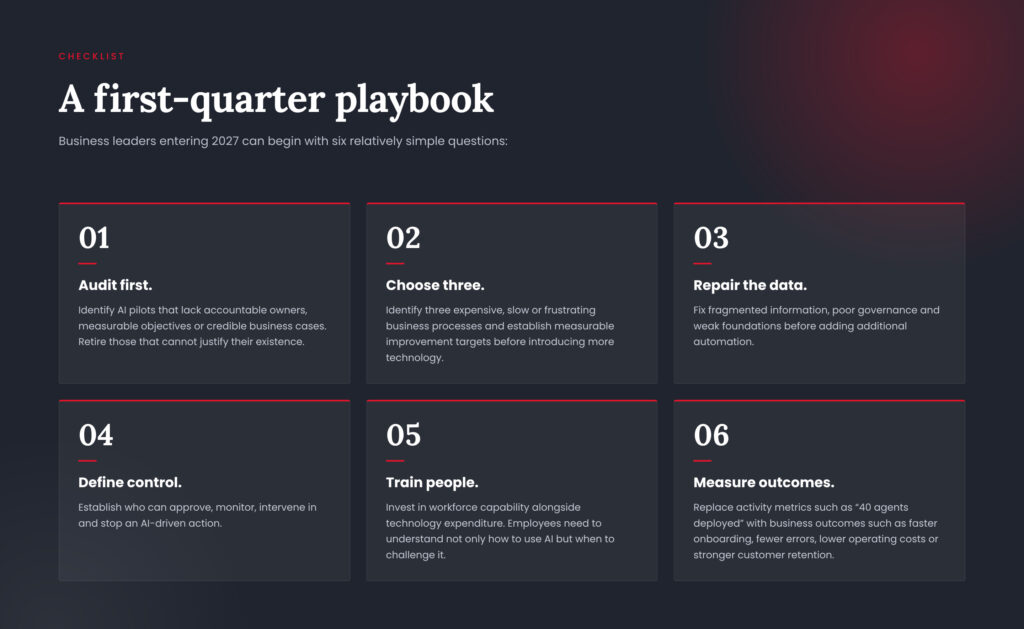
Boardroom conversations should shift from:
- How many AI tools have we deployed?
- to:
- What does this process cost now?
- How much faster is it?
- Has the error rate fallen?
- Are customers noticing the difference?
That scrutiny will extend beneath the software layer.
Energy availability, sovereign computing capacity, regulatory requirements and infrastructure resilience will increasingly influence where companies choose to invest.
The same scrutiny will reach the workforce.
Employees will need technical fluency, but they will also need business judgement: the ability to understand exceptions, question automated recommendations and take responsibility when systems get something wrong.
Access to another AI model will not be the defining advantage.
An organisation that operates better — at a cost that survives examination — will be.
The question worth taking into 2027
As 2026 closes, business leaders should temporarily set aside the question of how much technology their organisations have adopted.
Instead, ask what the investment actually changed.
Did serving a customer become simpler?
Did an expensive process become more efficient without becoming less reliable?
Did employees gain the ability to spend more time on valuable work?
Can the improvement be seen in the numbers?
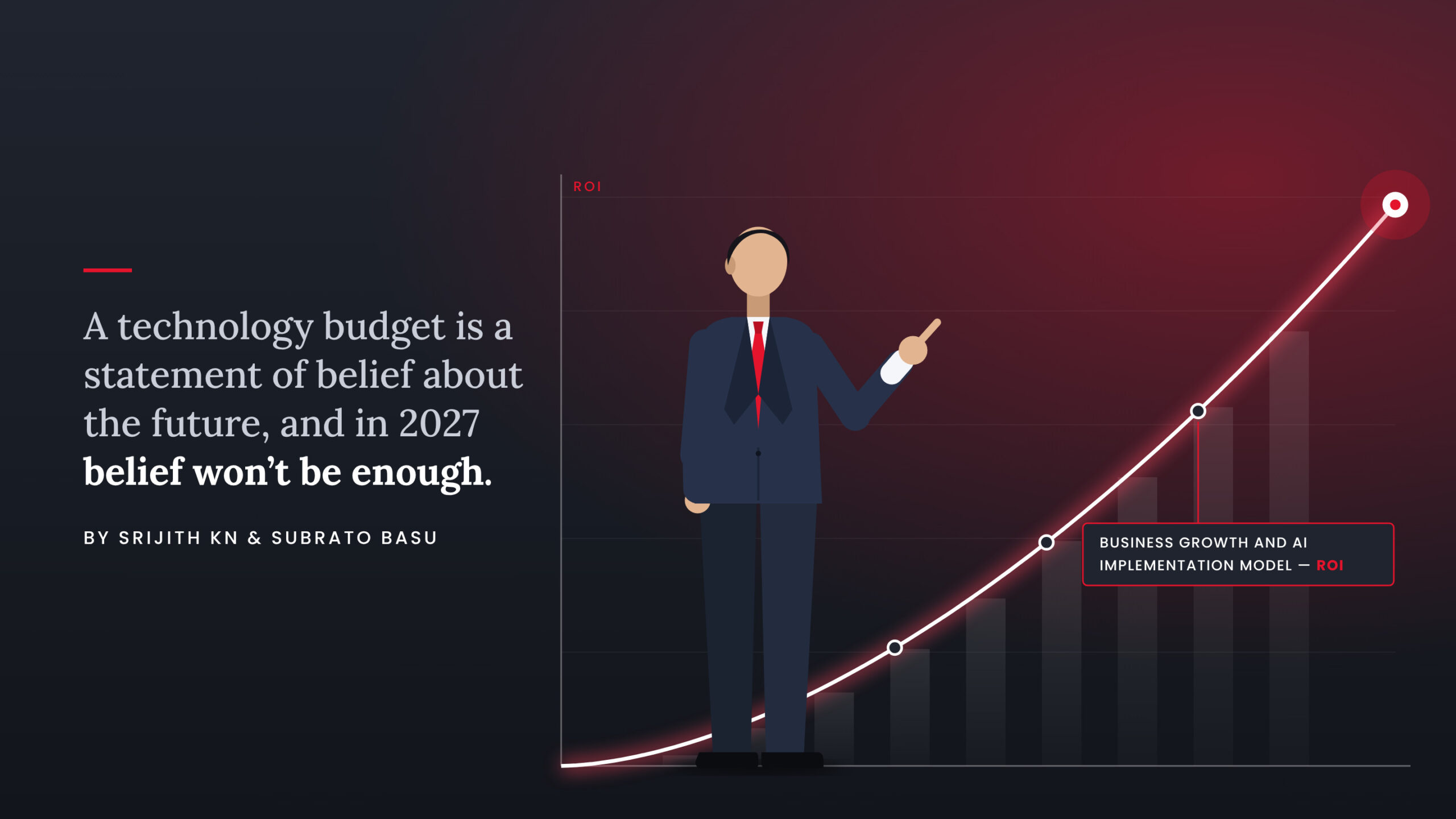
A technology budget is ultimately a statement of belief about the future.
In 2027, belief will not be enough.
AI adoption alone will no longer be impressive. The organisations that stand out will be those that can explain, in plain business terms, what they spent, what improved and who benefited.
And that may be the clearest indication yet that AI is becoming less of a technology problem — and much more of a management one.
Subrato Basu is an author, adviser and speaker on AI strategy and technology cost management. With nearly three decades of experience advising C-suite leaders, he helps organisations across North America, Asia Pacific and the Middle East turn technology investment into measurable business value.
Srijith KN is Senior Editor at Integrator Media, who is hands-on in covering enterprise technology, artificial intelligence, cybersecurity and the digital economy across the Middle East.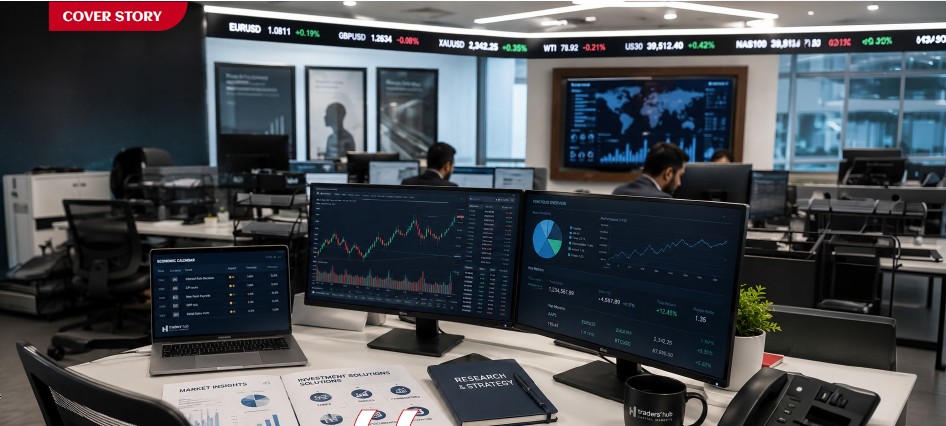
Traders’ Hub’s Michael Barbour on investor trust, technology, and the future of finance in the Gulf.
BY SRIJITH KN FOR FINANCIAL INTEGRATOR
Over the past few years, investor participation across the region has evolved beyond speculative trading activity into something far more structured, technology-driven, and institutionally aligned. Retail traders are becoming increasingly sophisticated, expectations around transparency and execution quality are rising, and financial platforms are under pressure to offer far more than simple market access.
The speculative frenzy that once defined large parts of retail trading is gradually giving way to a more measured investor mindset, shaped largely by regulation, financial awareness, and long-term wealth preservation rather than short-term market excitement.
In this changing landscape, brokerage firms are no longer positioning themselves purely as trading providers. Instead, many are beginning to evolve into broader financial ecosystems, combining infrastructure, education, technology, regulatory credibility, and long-term investment access into a single platform experience.
For UAE-based firms such as Traders’ Hub Capital Markets, this shift represents more than market expansion. It signals a transformation in how the region’s next generation of investors may engage with financial markets altogether.
Founded in 2022 and headquartered in Abu Dhabi, Traders’ Hub has rapidly positioned itself as a locally regulated, technology-enabled brokerage focused on transparency, multi-asset access, and client-centric trading infrastructure.
Today, the company offers access to more than 2,000 instruments across forex, commodities, equities, indices, and cryptocurrencies, while simultaneously preparing for a broader move into wealth management and long-term investment services.
But the story surrounding Traders’ Hub is not simply about growth.
It is also about the wider evolution of the UAE’s financial ecosystem itself.
THE SHIFT IN UAE INVESTOR CULTURE
Across the GCC, financial participation is changing shape.
The rapid rise of digital platforms, increasing financial literacy, regulatory modernization, and mobile-first investing have fundamentally altered how younger investors interact with markets.
In parallel, the UAE has continued strengthening its position as a regional financial hub, attracting capital, fintech innovation, institutional activity, and globally mobile investors seeking regulated access to international markets. This transformation has also created new expectations.
Today’s investors are increasingly prioritising transparency, regulatory protection, execution quality, multi-asset accessibility, and seamless digital experiences.
In many ways, expectations around trading platforms are beginning to resemble expectations traditionally associated with banking and wealth management institutions.
According to Michael Barbour, Head of Product Implementation at Traders’ Hub Capital Markets, these changes reflect a deeper transformation in investor behaviour itself.
“Investors increasingly seek integrated, trustworthy financial ecosystems prioritising long-term value, convenience, and institutional-grade service.”
Over the past five years, the psychological profile of the UAE investor has gradually shifted from short-term speculation toward a far more informed, disciplined, and globally aware mindset. Earlier retail participation was often driven primarily by leverage, speed, and short-term market movements. Today, however, younger investors across the UAE are becoming more research-driven, risk-conscious, and focused on long-term wealth creation rather than impulsive trading behaviour.

Modern traders are also seeking far more than market access alone. Transparency, educational support, analytical tools, platform stability, and institutional credibility are becoming increasingly important components of the investor experience itself.
FROM SCOTLAND TO GULF CAPITAL MARKETS
Long before helping shape the growth trajectory of Traders’ Hub Capital Markets, Michael Barbour’s early ambitions were far removed from financial markets.
Growing up in Stonehaven, a small Scottish town south of Aberdeen, he originally aspired to become a professional footballer, eventually playing semi-professionally before moving into finance.
His early exposure to financial systems came during the 2008 financial crisis while working within the legal and asset management sector in Scotland, assisting major UK banking institutions in managing distressed real estate portfolios during one of the most volatile periods in modern financial history.
That experience, combined with his later move to the Middle East in 2011 and subsequent years at the Dubai Gold and Commodities Exchange (DGCX), helped shape a perspective grounded not only in trading infrastructure, but in how markets behave under pressure, uncertainty, and rapid transformation.
Today, that institutional perspective continues influencing Traders’ Hub’s broader focus on operational credibility, technology infrastructure, and long-term investor engagement across the UAE market.
BUILDING A LOCALLY ROOTED TRADING PLATFORM
One of Traders’ Hub’s strongest positioning advantages lies in its status as a UAE-regulated Category 1 Capital Markets Authority (CMA) licensed broker, one of the highest licensing classifications within the country’s financial ecosystem.
In a market where offshore platforms have historically dominated retail participation, regulatory credibility has become increasingly significant, particularly as investors grow more conscious of operational risk, fund protection, execution transparency, and long-term platform reliability.
Rather than positioning itself through aggressive speculative messaging, Traders’ Hub appears to be building its identity around institutional-grade infrastructure, operational discipline, and client alignment.
Its trading environment is built around a Straight Through Processing (STP) execution model, meaning trades are routed directly to liquidity providers rather than internally warehoused by the broker itself.
In increasingly crowded financial markets, brokerage differentiation is no longer being shaped purely by leverage offerings or execution speed. Investors across the UAE are becoming far more conscious of pricing transparency, liquidity structures, operational credibility, and how trades are ultimately executed, particularly as financial literacy continues maturing across the region.
According to Michael Barbour, many investors still misunderstand how brokerage models differ operationally, particularly around spreads, slippage, pricing structures, and conflicts of interest between market-making and STP environments.
For Barbour, transparency itself is becoming a defining factor in long-term investor confidence.
Modern investors are also becoming more selective around how brokers disclose execution policies, fee structures, liquidity relationships, and client fund protections. In many ways, execution architecture itself is increasingly becoming part of the trust equation.
For regulated regional firms such as Traders’ Hub, this shift may ultimately represent a broader advantage. As investor sophistication continues evolving across the UAE, operational credibility and institutional transparency are beginning to matter as much as platform functionality itself.
FROM BROKERAGE TO FINANCIAL ECOSYSTEM
The transition from Traders’ Hub Currency Brokerage to Traders’ Hub Capital Markets reflects more than a naming evolution. It signals a broader ambition to position the company as a longer-term financial institution within the UAE’s evolving investment ecosystem.
Globally, the distinction between trading platforms, investment platforms, and wealth management ecosystems is beginning to blur. Increasingly, investors no longer want fragmented financial experiences spread across multiple platforms. Instead, they are seeking connected environments capable of combining active trading, long-term investing, financial planning, analytics, and educational support within a single ecosystem.
For Traders’ Hub, this transition also reflects an effort to solve a longstanding regional friction point: the difficulty many UAE investors face when moving between active trading and structured long-term wealth accumulation.
“The modern investor no longer wants isolated trading access. They want a complete financial environment,” says Barbour.
The company’s planned expansion into wealth management and broader investment services reflects a wider regional shift toward more integrated financial participation models.
TECHNOLOGY, AI, AND THE NEXT INVESTOR EXPERIENCE
As trading platforms become increasingly automated and algorithmically assisted, the financial industry is also confronting a deeper question: how much of investing should remain human?
Technology is rapidly becoming the defining layer of modern financial platforms, from AI-assisted analytics and mobile-first investing experiences to increasingly sophisticated execution infrastructure.
But while automation can enhance speed and efficiency, long-term investing still remains deeply shaped by human behaviour itself. Markets continue being influenced by fear, overconfidence, emotional reaction, and risk perception, factors technology alone cannot fully eliminate.
One potential differentiator for firms such as Traders’ Hub may therefore lie in how effectively they balance algorithmic intelligence with human judgement.
EDUCATION, TRUST, AND LONG-TERM ENGAGEMENT
As trading participation expands across the GCC, financial platforms are increasingly carrying responsibilities extending far beyond market access alone.
While digital platforms have lowered barriers into global financial markets, they have also intensified conversations around behavioural investing, financial literacy, emotional discipline, and long-term risk awareness.
Increasingly, sustainable platform growth may depend not only on user acquisition, but on trust, transparency, and investor education itself.
In the GCC particularly, where retail participation continues expanding rapidly, financial firms are beginning to recognise their role in shaping long-term investor behaviour and financial understanding.
THE NEXT PHASE OF REGIONAL FINANCE
The UAE’s financial landscape is evolving rapidly.
As regulation strengthens, investor sophistication increases, and technology continues reshaping how capital moves through markets, financial platforms and capital markets institutions are being forced to rethink what they represent within the broader financial ecosystem.
The company’s broader direction, spanning infrastructure investment, wealth management expansion, AI integration, mobile accessibility, and educational initiatives, reflects a wider regional transition toward more mature, technology-enabled financial participation.
Barbour believes the future of finance will increasingly belong to intelligent platforms capable of combining technology, trust, education, accessibility, and long-term wealth creation into a unified experience.
Whether this next generation of financial platforms ultimately succeeds will depend not only on execution speed or product breadth, but on something far more enduring: trust.
And in an increasingly crowded financial landscape, trust may ultimately become the most valuable asset of all.
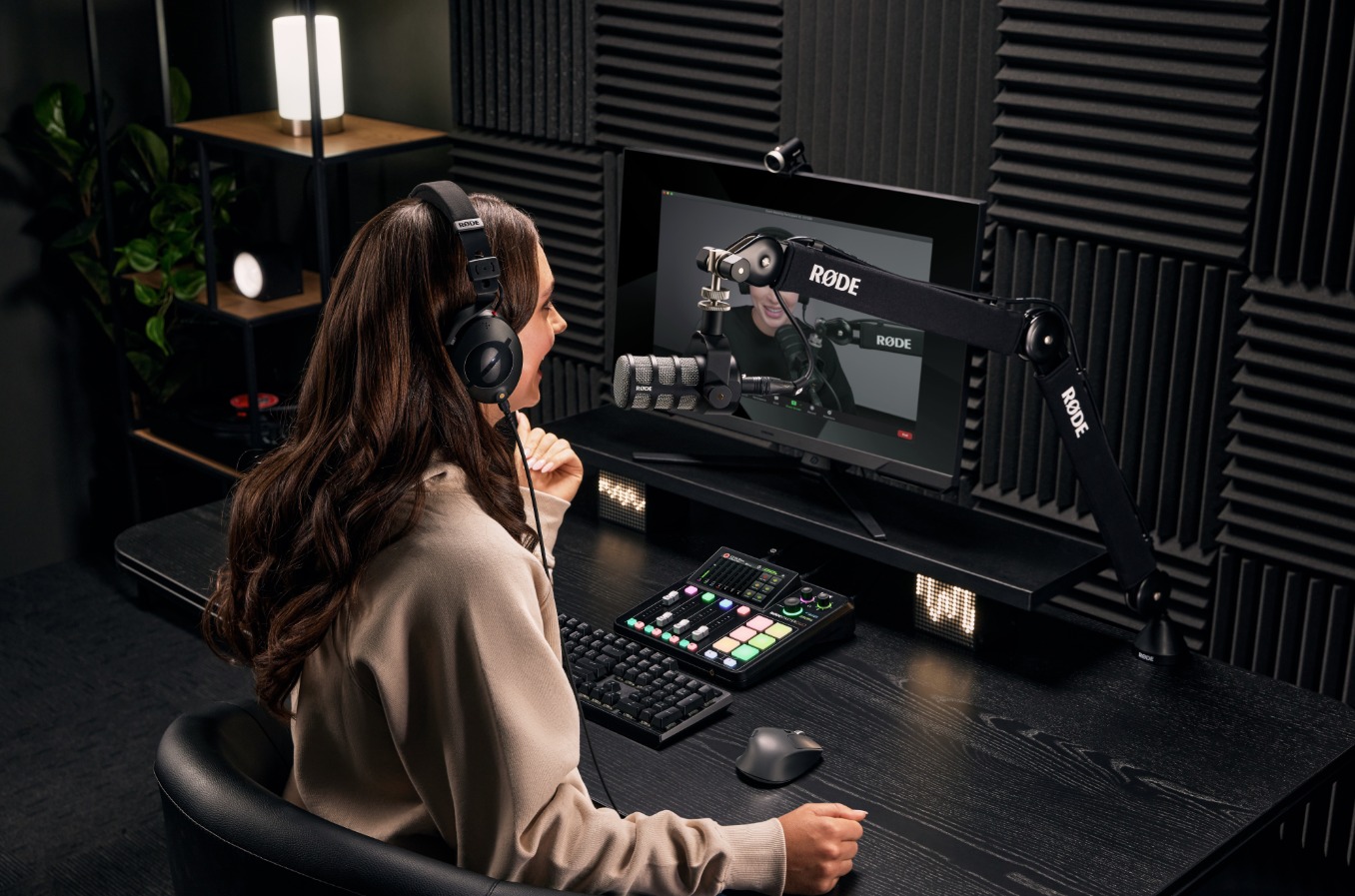
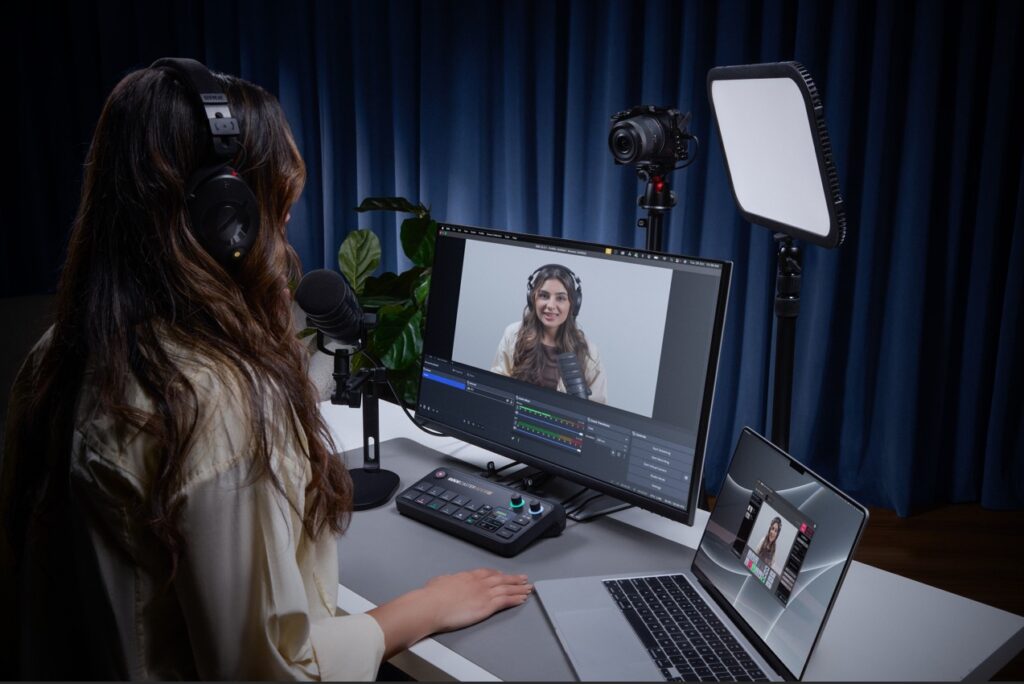
Walk into any modern content setup today, whether it’s a podcast studio, a corporate webinar room, or a hybrid event environment, and you’ll see a familiar pattern, one that reflects how fragmented the content production stack has become.
A microphone connected to an interface.
An interface connected to a laptop.
A laptop running multiple layers of software to mix, switch, stream, and record.
It works, but it’s rarely seamless.
Because the biggest challenge in content creation today isn’t access to tools, it’s understanding how they all fit together.
The Real Problem: Too Many Tools, Too Little Clarity
The rise of podcasting and video content has created a new kind of friction. Users are no longer asking what they can create; they are asking how to make the tools work together.
Recording audio separately, syncing video later, transferring large files to high-end machines, and relying on multiple software layers have become the default workflow. It works, but it is inefficient, expensive, and prone to failure.
The expanding ecosystem of devices, features, and formats has made even basic setup decisions unnecessarily complex.
When it comes to products from RØDE, users & creators already recognize the product’s potential to simply clarify and help elevate the overall workflow experience.
From Tools to Unified Systems
This is where the shift begins to stand out.
What we are seeing is not simply the addition of new features, but the consolidation of functions.
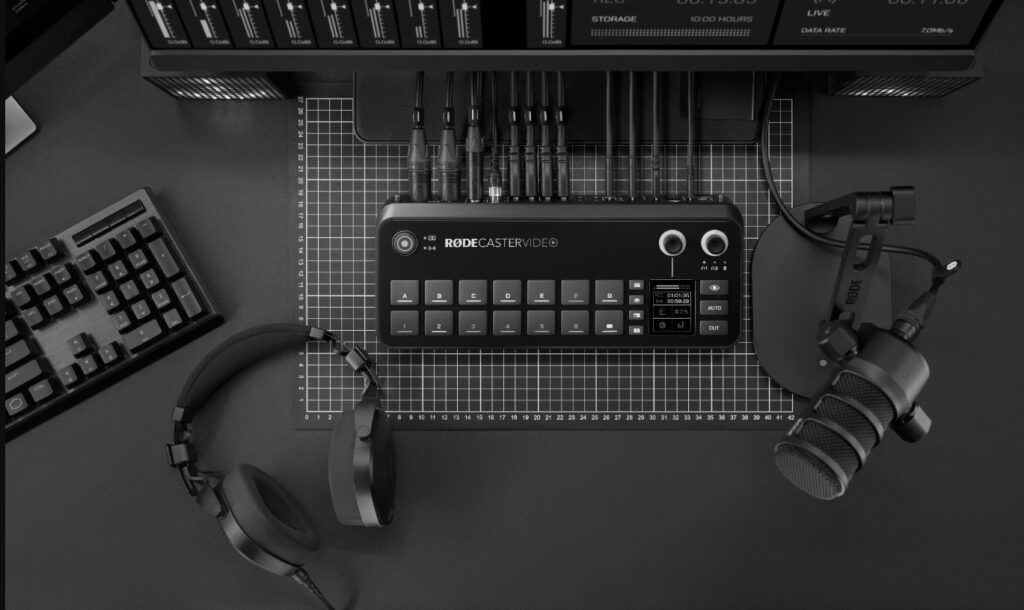
Mixer. Recorder. Audio interface. Video switcher. Stream encoder.
What traditionally required a stack of hardware and software is now being brought into a single console environment.
For creators, that simplifies production.
For enterprises, it changes how content infrastructure is designed.
As this shift gains momentum, it is also being acknowledged at a leadership level.

“Real innovation isn’t about adding more; it’s about removing friction and enhancing workflows.
Kalinda Atkinson,
With the introduction of platforms like the RØDECaster Video, we’re starting to see audio and video unified in one system, unlocking faster, more focused creative output.”
Global Marketing Director, RØDE
Why This Matters Beyond Creators
This shift is not limited to podcasters or streamers. Enterprises are increasingly building in-house content studios, executive communication channels, internal video platforms, and hybrid event capabilities as part of their broader communication strategy.
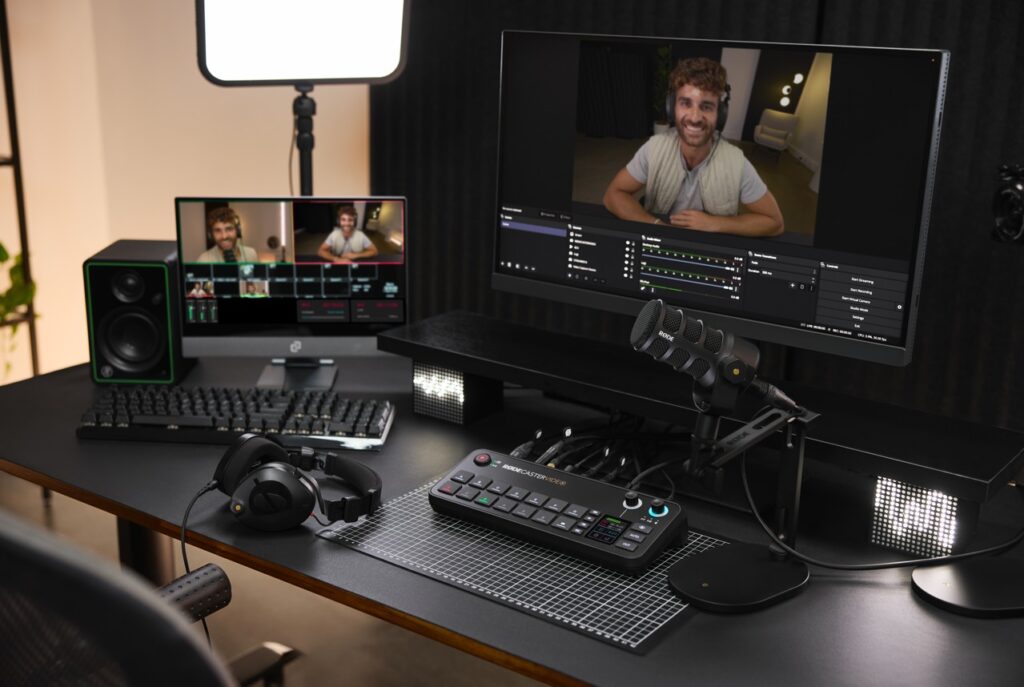
In these environments, complexity quickly becomes a bottleneck. Multiple tools often translate into longer setup times, increased points of failure, and a growing dependency on technical operators to manage what should ideally be straightforward workflows.
A unified system begins to reduce that friction, allowing teams to focus less on managing the process and more on the output itself.
The End of the Laptop-Centric Setup
One of the most significant changes is subtle: the laptop is no longer central.
With recording, streaming, and switching built directly into the console, content can now be produced without relying on external software or intermediary platforms. Audio and video routing happens natively within the system, removing the need to manage multiple layers of tools.
This, in turn, reduces reliance on tools like OBS Studio and lowers the need for high-performance machines in the production chain.
Broadcast Capabilities, Simplified
Features that were once limited to broadcast environments are now being integrated directly into compact systems. Capabilities such as multi-camera switching, ISO recording with separate tracks for each input, audio-based automatic switching between speakers, and network-driven video workflows like NDI are no longer confined to high-end production setups.
For enterprise teams, this translates into professional-grade production without the need for dedicated control rooms or complex broadcast infrastructure.
Modularity Signals Long-Term Thinking
Another important shift lies in how these systems evolve over time.
With expansion options such as adding video capabilities to existing audio consoles, RØDE is enabling a more modular approach to production. Instead of replacing entire systems, users can extend them based on their needs.
This becomes particularly relevant for organizations that may begin with audio-first content using consoles such as the RØDECaster Duo or RØDECaster Pro II, gradually expanding into video production with consoles such as RØDECaster Video, RØDECaster Video S, or even the RØDECaster Core, and scaling internal media capabilities over time. The result is a more flexible investment model that reduces upfront costs while supporting long-term growth.
A Shift in the Competitive Landscape
On the surface, this still appears to sit within the audio hardware category. In practice, however, it competes with something far broader.
As these systems begin to handle capture, processing, and output within a single environment, they start to overlap with production software ecosystems, video switching platforms, and content workflow tools.
The implication is clear: when orchestration happens within the system itself, the need for external layers begins to diminish.
The Opportunity Ahead
As the layers of complexity fade, creators will have more time for creative storytelling and less time worrying about the setup.
The new products and technology from RØDE not only remove setup barriers, but they also enable creators & enterprises to operate at a full professional standard, accelerating both the creativity and innovation ecosystems.
Srijith KN covers enterprise technology, media infrastructure, and digital transformation across the Middle East.

PEAQ Brings a New Era of Social Wellness to Dubai

2026 in Review: Is AI Becoming More of a Management Problem Than a Technology Problem?

MidChains and Standard Chartered establish strategic banking partnership

OPPO A6 Pro 5G Review: Reliable Daily Driver

Denodo Bolsters Executive Team by Hiring Christophe Culine as its Chief Revenue Officer

Microsoft Launches New Surface Copilot+ PCs for Business
2026 in Review: Is AI Becoming More of a Management Problem Than a Technology Problem?

Inside XPENG Brand Night: AI Mobility Lands Centre Stage in Dubai

Chinese Cars Are Reshaping the GCC Market, but Resale Value Could Be the Next Battleground

-
 Trending1 year ago
OPPO A6 Pro 5G Review: Reliable Daily Driver
-
 Tech News2 years ago
Denodo Bolsters Executive Team by Hiring Christophe Culine as its Chief Revenue Officer
-
VAR2 years ago
Microsoft Launches New Surface Copilot+ PCs for Business
-

 Automotive2 years ago
AGMC Launches the RIDDARA RD6 High Performance Fully Electric 4×4 Pickup
-

 VAR11 months ago
Huawei Nova 14 Pro Review: Where Camera Excellence Meets Ecosystem Evolution
-
Tech Interviews3 years ago
Navigating the Cybersecurity Landscape in Hybrid Work Environments
-

 Hospitality2 years ago
Gulfood 2025 30th Edition Kicks Off Today, Setting New Benchmarks in F&B Growth and Innovation
-

 Tech News1 year ago
Nothing Launches flagship Nothing Phone (3) and Headphone (1) in theme with the Iconic Museum of the Future in Dubai