
 Have a question? +971 56 404 0503




Technology
Dahua Technology Middle East elevates regional presence after landmark joint venture with Saudi Arabia tech firm ALAT

Dahua Technology Middle East has announced its strategic collaboration – a new joint venture – with Saudi Arabia tech firm ALAT, further solidifying its commitment to the region’s development and growth in the tech space. The partnership comes on the heels of Dahua’s recent expansion in the region.
The collaboration represents a significant milestone for Dahua Technology as it embarks on manufacturing AIoT products tailored for smart cities and enterprises in Saudi Arabia after its recent expansion in the region, according to Gary Li, Vice President of Dahua MENA and GM of Dahua Saudi Arabia. Anticipating the roll-out of the first product by the end of 2024, the joint venture signals a long-term commitment to enhancing local infrastructure and fostering economic growth, which contributes to realizing the vision of Saudi Arabia 2030. “As a key regional player, we make decisions based on the goals our key markets have. This latest collaboartion of ours is purely driven by Saudi Arabia’s grand plans to make its economy diverse, encourage new ideas, and create a brighter future. The government’s focus on smart cities and big projects fits perfectly with what we believe in, and at Dahua, we see it as a great opportunity for us to showcase our expertise in smart video solutions as we work together to make a positive and meaningful as part of Saudi Arabia’s push towards a safer, smarter future, All of these objectives constitute key pillars of the Vision 2030 of the Kingdom of Saudi Arabia. ” said Li in an exclusive interview, highlighting why the kingdom is one of Dahua MENA’s most “important markets.
Dahua’s Saudi Arabia subsidiary will continue to operate independently, ensuring seamless service delivery to clients. The establishment of the joint venture will bolster manufacturing capabilities in the region without compromising daily operations or branding strategies.
The Kingdom of Saudi Arabia is the logistics gate to all GCC and the three continents
Initially, the focus will be on manufacturing CCTV project-based products, with plans to expand into distribution products and other categories in the future. While negotiations regarding brand usage are ongoing, Dahua will remain committed to prioritising its brand presence in the Saudi Arabian market.
“The sales model will remain unchanged, ensuring continuity for local distributors, system integrators, and end-users. Clients across the region including our exisiting ones here in KSA and all MENA region can expect enhanced access to cutting-edge AIoT solutions tailored to their specific needs,” added Li. The joint venture’s manufacturing facility will streamline local supply chains, accelerating product delivery for projects in Saudi Arabia and neighbouring countries in the GCC and wider region.
Both Dahua Technology and ALAT, a recently formed PIF company, will support with technology enablement, testing labs and demo centres, manufacturing technology products in the region as part of the new joint venture to produce and market solutions for safety and surveillance use that are applicable in Intelligent Cities, as well as Intelligent Buildings and Enterprise Applications.
ALAT and Dahua Technology will invest $200 million (Dh734 million) to reach their targets.
Tech News
ParamountAssure launches inaugural CybHER Awards 2026 to recognise women’s contributions to cybersecurity


ParamountAssure, a UAE-headquartered cybersecurity company, has announced its inaugural ‘Paramount CybHER Awards’ to recognise the expertise and contributions of women protecting their organisations from cyber risk. Registrations are open for women working in cybersecurity and governance, risk and compliance across India, Australia, the UAE, Qatar, Oman, Bahrain, Kuwait and Saudi Arabia. Participants are invited to share practical knowledge that can contribute to the wider cybersecurity profession.
The initiative comes as women remain underrepresented in cybersecurity, with the Global Cybersecurity Forum and Boston Consulting Group’s Cybersecurity Workforce Report estimating their share of the global cybersecurity workforce at 24%. Paramount has unveiled CybHER to recognise women in the public and private sector who implement and oversee cybersecurity in practice and keep operations running.
Premchand Kurup, CEO of ParamountAssure, said: “Women in organisations understand how cybersecurity decisions affect the wider business. Through our interactions, we see women applying sound judgement to complex security and risk challenges every day. Their experience deserves greater visibility. CybHER gives them a platform to share their approaches and lessons, while showing women considering cybersecurity the range of skills and career paths within the profession.”
Five winners will each receive a citation and award recognition, bringing their expertise to a wider professional audience. Selected on the merit of their submissions, winners will gain recognition for the quality of their thinking and the contribution their ideas can make to the cybersecurity community.
Participants can choose the format that best communicates their thinking, submitting an original article or blog of up to 1,000 words, a presentation of up to 10 slides, or a one-minute video. Entries should offer practical insights or useful frameworks, explaining an approach to a cybersecurity challenge or sharing lessons that other professionals can apply. The emphasis is on communicating expertise clearly and giving readers or viewers ideas they can use in their own work.
Ashok Chandrasekharan, COO at ParamountAssure, said: “Women currently make up 25% of ParamountAssure’s workforce and leadership contributing across different functions within our business. We see first-hand the value of their expertise in supporting our work with clients. CybHER reflects our belief that the contributions of women in cybersecurity should be recognised and shared more widely across the industry.”
The awards are open to women whose roles involve protecting their employer’s systems and information, including professionals responsible for security, risk, compliance or privacy. Eligibility extends across technical, managerial and leadership positions, reflecting the different ways women help organisations prevent and respond to cyber threats. Participants can draw on experience in security operations or in setting and overseeing the policies that guide how their organisation manages digital risk.
The independent jury includes Sumayya Shafi, Information Technology Manager at Dubai Petroleum, Amna Al Balushi, Chief Information Security Officer and Head of IT Governance at a leading bank in Oman, and Mariam Ben Dhafari, Director of the Information Systems Center at the General Secretariat of the Supreme Council for Planning and Development in Kuwait. Together, they will assess submissions on demonstrated expertise and originality, considering their practical value, clarity, analytical thinking and potential industry impact.
Sumayya Shafi, Information Technology Manager at Dubai Petroleum, said: “There is still a perception that technical and cybersecurity roles are predominantly male, and many women working in these fields remain underrepresented in the wider industry conversation. Women are already leading in these fields across organisations, and recognising their work is an important step towards closing that gap. CybHER provides a platform to bring these contributions into greater focus.”
The application window will close on November 30, 2026 at 11:59 pm GST (UTC+4), with the announcement of five winners scheduled in January 2027. Eligible professionals can visit the website for further updates, including full participation criteria and submission guidance.

Varonis Systems, Inc. (Nasdaq: VRNS) (“Varonis”), the data and AI security leader, and Proofpoint, Inc. (“Proofpoint”), a global leader in human and agent cybersecurity, today announced entrance into a definitive agreement under which Varonis will be acquired by Proofpoint, a portfolio company of Thoma Bravo, in an all-cash transaction valued at approximately $6.3 billion.
Under the terms of the agreement, Varonis shareholders will receive $49.75 per share in cash. This purchase price represents a premium of 52% to Varonis’ closing stock price of $32.71 on June 22, 2026, the last full trading day prior to initial rumors about a potential sale of the Company, and a premium of 17% over Varonis’ closing stock price of $42.35 on September 1, 2026, the last trading day prior to additional media reports speculating about a potential sale of Varonis. The transaction values Varonis at approximately 53x LTM Free Cash Flow and 8.4x LTM Revenue.1
The combined company will serve more than 16,000 enterprises and millions of organizations globally, creating one of the world’s leading pure-play cybersecurity companies and establishing the industry’s largest data and AI cybersecurity organization. Together, the combined company intends to deliver a unified platform that helps organizations adopt AI with confidence: finding and protecting sensitive data, controlling what people and AI can access, and stopping data loss. Following closing, Proofpoint intends to move quickly to integrate the companies’ capabilities, align go-to-market efforts, and accelerate delivery of the combined platform to customers.
“Today begins an exciting new chapter for Varonis and our customers. It’s a testament to the incredible work of the Varonis team over two decades,” said Yaki Faitelson, Varonis CEO, Co-Founder and Chairman of the Board of Directors. “Our mission is to secure AI and the data that powers it. By joining forces with Proofpoint, we can achieve this mission faster than ever.”
Faitelson continued, “This announcement follows a comprehensive evaluation led by a committee of independent members of our Board of Directors, which included extensive outreach to a range of potential strategic and financial buyers. This transaction is an excellent outcome for the company and our shareholders, representing a realization of immediate, significant, and certain value well in excess of the risk-adjusted value of delivering against our standalone plan.”
“As AI becomes embedded across the enterprise, the data it can access determines both its value and its risk. AI agents are increasingly accessing sensitive information and taking action across systems, making it critical for organizations to understand not only what data needs protecting and who can access it, but how it is actually being used,” said Sumit Dhawan, CEO of Proofpoint. “By connecting communications, identities, permissions, data, and AI, we are creating an intelligence advantage that helps customers see risk more clearly, respond faster, and defend against the next generation of AI risks. This is a defining step in Proofpoint’s evolution into a cybersecurity platform built for the future of AI.”
Dr Ryad Soobhany, Deputy Academic Head of School of Mathematical & Computer Sciences, Heriot-Watt University Dubai

Camera systems, such as CCTV, are mainly used for video surveillance within organisations. Passive video surveillance has been part of the security ecosystem for years, providing organisations with the ability to monitor different areas simultaneously, while recorded footage can be inspected after an event occurs.
The evolution of computer chips and increased processing power has led to improved image quality, including better performance in low-light conditions, particularly at night. The advent of edge computing, with processing performed on edge devices within a network, has made object and scene recognition more readily accessible. This evolution has led to more active video surveillance through video analytics, where events can be identified and addressed in real time. Examples include number plate recognition systems and facial recognition for access control.
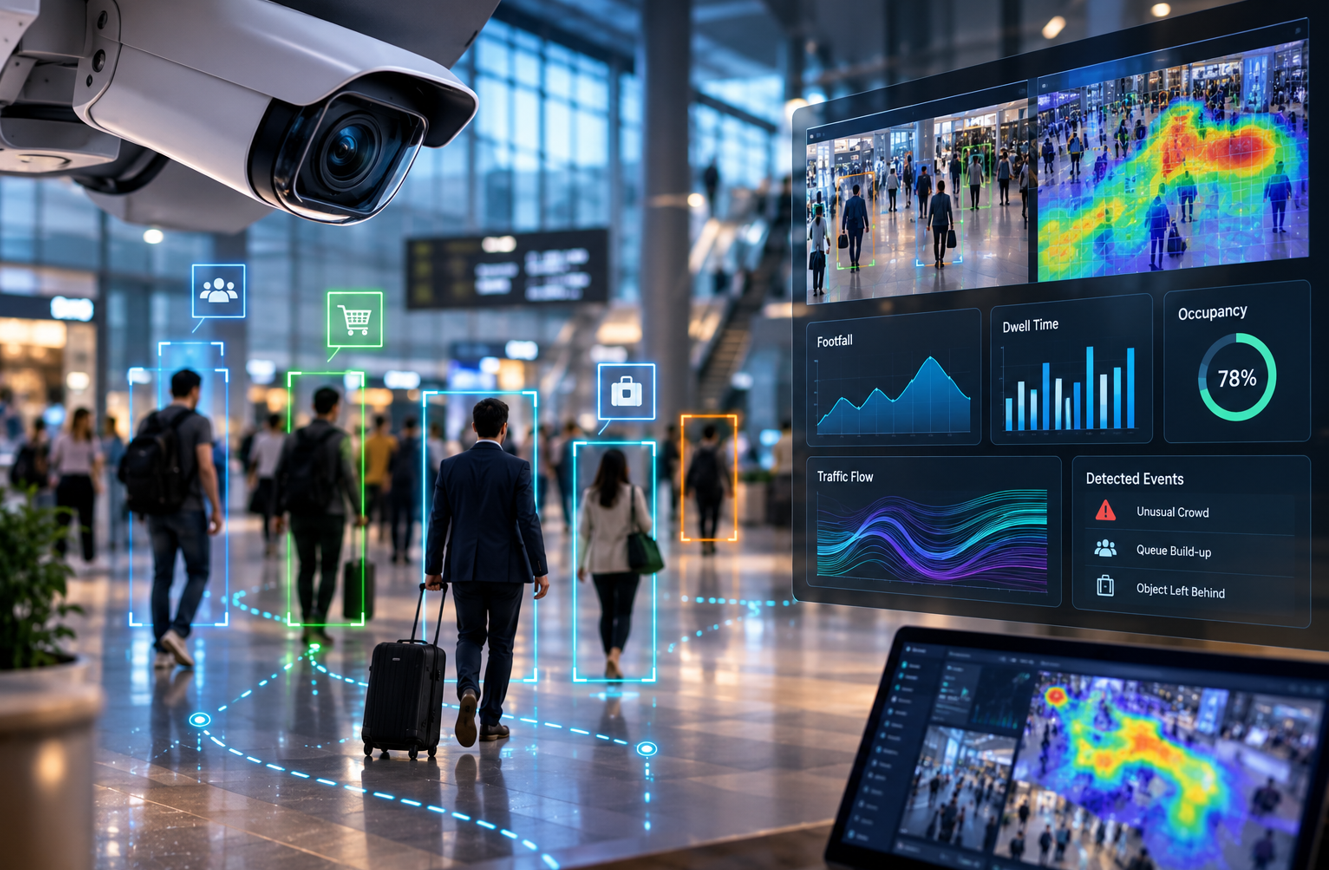
With the combination of AI and video data, computer vision can be integrated with business analytics to transform video surveillance from a security infrastructure into a business intelligence tool. Video surveillance is moving from passively recording events to sensing what is happening in the environment. This helps to answer questions such as which areas are congested, how customers are moving, how long they dwell in particular areas, and whether unusual events are occurring. Businesses can use this data to optimise their operations, such as improving the customer checkout process, monitoring asset or staff movement, and managing crowds or traffic flows. Organisations can also incorporate contextual business information to enhance the analytics by combining behavioural data with CRM or IoT data, providing additional context and insights for decision-making and improving the customer or visitor experience.
Video surveillance can be used to optimise operations, improve customer experiences, and support strategic decision-making across industries. Video itself does not create business intelligence; rather, its value increases when visual information is combined with other operational and contextual data, while computer vision is used to understand and enhance business operations. The pipeline from video to business intelligence can be represented as obtaining data from video sources such as fixed cameras, IoT-enabled cameras, or robots. Computer vision is then applied to the video to detect or track people, objects of interest, or activities. Behavioural data are taken into account, such as customer dwell time in particular product areas, occupancy of rooms or halls, movement of people across a building, and anomalies in behaviour. At this stage, operational data are also considered. The final stage is the business intelligence stage, where trends are identified and insights are inferred. At this stage, data visualisation plays an important role, with dashboards and data storytelling displaying correlations, predictions, and infographics that provide more than simple visual summaries of surveillance data. The camera becomes an operational sensor for the organisation. The important transformation occurs when visual data are combined with business data, such as sales, operational, and IoT data, to convert visual observations into business knowledge that informs operational, tactical, and strategic decision-making within an organisation.
The levels of business intelligence can be viewed as three analytical capabilities: descriptive intelligence, diagnostic intelligence, and combined predictive and prescriptive intelligence. Descriptive intelligence usually addresses what is happening. Visual analytics can identify footfall, occupancy, queue length, waiting time, dwell time, traffic flow, movement patterns, and detected events. Visualisation dashboards can present these indicators in real time or over historical periods, allowing managers to understand the current state of an operation. For example, a museum dashboard can show heat maps of visitor numbers, dwell time, and movement across different exhibition areas, while analysing visitor behaviour and providing insights into the optimal placement of exhibitions. An airport dashboard could display passenger volumes and queue lengths across terminals.


The Connected Home Is Evolving into an Intelligent Ecosystem

New Partnership Connects Residential Wellbeing With Preventive Healthcare

Dubai Ride-Hailing App Zed Strengthens Leadership with Appointment of Shobhit Singhal to Shape Its Future



-

 Trending12 months ago
OPPO A6 Pro 5G Review: Reliable Daily Driver
-

 Tech News2 years ago
Denodo Bolsters Executive Team by Hiring Christophe Culine as its Chief Revenue Officer
-
 VAR2 years ago
Microsoft Launches New Surface Copilot+ PCs for Business
-

 Automotive2 years ago
AGMC Launches the RIDDARA RD6 High Performance Fully Electric 4×4 Pickup
-
Tech Interviews3 years ago
Navigating the Cybersecurity Landscape in Hybrid Work Environments
-

 Hospitality2 years ago
Gulfood 2025 30th Edition Kicks Off Today, Setting New Benchmarks in F&B Growth and Innovation
-

 VAR10 months ago
Huawei Nova 14 Pro Review: Where Camera Excellence Meets Ecosystem Evolution
-

 Tech News1 year ago
Nothing Launches flagship Nothing Phone (3) and Headphone (1) in theme with the Iconic Museum of the Future in Dubai