
 Have a question? +971 56 404 0503




Financial
Wio Bank Redefines SME Banking with New Embedded Finance


Wio Bank PJSC is introducing a new embedded finance service designed especially for the UAE’s small and medium-sized enterprises (SMEs). This initiative includes strategic partnerships with leading accounting software platforms Zoho Books, Fiskl and Wafeq, aiming to embed banking services into daily business operations and simplify financial management.
Wio Business, the bank’s first digital banking application, caters to micro, small, and medium enterprises (MSMEs), as well as freelancers and entrepreneurs. By directly integrating with accounting and financial management systems through APIs, Wio Business facilitates seamless financial workflows, enhancing management and eliminating the need for third-party intermediaries. This integration automates bookkeeping, significantly reducing manual labor and allowing businesses to concentrate on their core activities.
Jayesh Patel, Chief Executive Officer of Wio Bank PJSC, shares his vision for the new service: “By adopting Embedded Finance, we are transforming how businesses manage their finances. Our direct integration initiative simplifies how financial services are delivered and managed, making it easier and more transparent for SMEs.”
With over 94% of UAE businesses categorized as SMEs and significant contributors to employment, Wio Bank’s new service is tailored to meet a vital market need. This initiative, along with its strategic partners, is designed to simplify business operations, allowing them to thrive by focusing on growth rather than administrative financial tasks.
A New Era of Financial Management
Through Wio Business, companies can now link their accounts with selected software platforms such as Zoho Books, Fiskl, and Wafeq, offering a holistic view of their financial health. This integration eliminates the dependency on third-party intermediaries, simplifies financial workflows, ensures real-time financial insights with automatic updates, and streamlines accounting tasks with features like auto-reconciliation of bank statement. Additionally, integrating Wio Business APIs into Corporate ERPs and payment platforms facilitates automated account payables and instant transaction reconciliation, thus reducing manual labor and errors, and enhancing cost efficiency and operational gains.
Wio Bank was established to redefine banking in the UAE for both businesses and consumers. Its second digital offering, Wio Personal, is a day-to-day banking platform that changes how individuals see, manage, and grow their money. It provides users with unprecedented financial visibility and flexibility, serving as a foundation for achieving personal financial goals with an engaging experience that includes smart cards and exciting rewards.
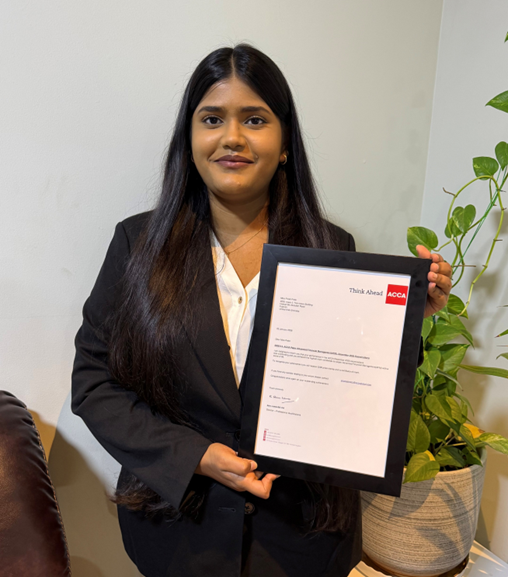
Preeti Peter, student – BCom ACCA – MAHE Dubai
Advanced Financial Management is a paper that separates theoretical knowledge from applied thinking. It tests your ability to make strategic decisions under uncertainty, weighs competing risks in real time, and defends your reasoning when there is not one right answer. The pass rates reflect that difficulty. When I sat for the exam, World Rank 1 was never the target, surviving the paper with credibility was. I scored 96 out of 100. But the number, on its own, tells you very little. What matters is what the journey demanded: a complete rewiring of how I approached preparation, pressure, and failure.
Treating preparation like a financial model
Early on, I made a decision that changed everything: I would stop following a generic study plan. Instead, I approached my preparation the way an analyst might approach a sensitivity analysis. I tested variables by studying at different times of the day, experimenting with visual mapping versus deep reading. Each iteration helped me identify what produced the best results for my learning style.
This was about precision, not volume. In finance, we talk about capital allocation, where you deploy resources matters more than the sheer amount available. I applied the same logic to my time. High-yield areas got the most attention. Weak spots got targeted effort. Comfortable topics got less.
Strategy is not a luxury reserved for boardrooms. It belongs in every decision you make.
The negative cash flow phase
There is a phase in every long-term project, financial or otherwise, where the output does not match the input. In corporate finance, we call this negative cash flow. You are investing, and the returns have not materialised yet.
My first few weeks of AFM preparation felt exactly like that. I was putting in the hours, but comprehension was patchy. It would have been easy to panic or abandon ship for a different approach.
Instead, I recognised the phase for what it was: temporary. Every business that reaches breakeven has survived this stage first. I leaned into discomfort, trusted the process, and kept showing up. Slowly, the fog lifted.
That early patience was critical. If I had changed course every time results lagged behind effort, I would never have built the understanding that carried me through the exam.
Discipline over motivation
There is a popular idea that success comes from being motivated. I found the opposite to be true. Motivation is unreliable, it fluctuates with your mood, your energy, a difficult question that throws you off balance.
What carried me was routine. I built a daily structure that operated regardless of how I felt on any given morning. Good days and bad days received the same treatment: sit down, open the material, work through the plan.
During my time at Manipal Academy of Higher Education Dubai, I learned to value consistency over intensity. Resilience, I realised, is not about gritting your teeth and pushing through pain. It is about designing a process robust enough to function even when you are running on empty.
Confronting discomfort deliberately
One of the more counterintuitive lessons AFM taught me was about comfort zones. When preparing for a high-stakes exam, there is a strong temptation to practise what you already understand. You move through questions quickly, confidence builds, and the work feels rewarding.
But that feeling is misleading. The topics I avoided, the ones that made me uneasy, the questions I got wrong repeatedly were precisely where the growth was. I started restructuring my study sessions to front-load the most difficult material. If a topic made me uncomfortable, it went to the top of the list.
Over time, those uncomfortable sessions became the foundation of my exam performance. The questions that would have caught me off guard were the ones I was most prepared for.
Managing pressure, not just content
I remember finishing a mock exam and feeling genuinely defeated. The time pressure had overwhelmed me. I knew the material but knowing the material and performing under timed conditions are two very different skills.
That experience changed my approach. I began treating exam technique as its own discipline, separate from subject knowledge. I practised under strict time limits and developed a method for approaching unfamiliar questions: pause, outline, then write.
On exam day, there were moments where questions looked unfamiliar at first glance. Instead of panicking, I paused, outlined a structure, and worked through each part methodically. I finished on time, with every question addressed.
The real lesson: stress does not disappear because you have prepared well. You simply get better at functioning within it.
Feedback as fuel
A score of 96 percent might suggest a clean, linear path to the top. The reality was messier. Mock results were humbling. Feedback on practice answers was sometimes blunt.
But I made a conscious decision early on, I would treat every piece of critical feedback as information, not as judgement. If a mock answer missed the mark, I wanted to understand why so, to close the gap between where I was and where I needed to be.
That openness to correction was, I believe, one of the most important factors in my result. The students who improve fastest are rarely the most talented. They are the ones willing to be told they are wrong and to adjust accordingly.
Beyond the exam
World Rank 1 was a rewarding outcome. But the rank is a snapshot, a single data point from a single day.
Structured thinking. Disciplined preparation. The ability to remain calm when the stakes are high. A willingness to sit with discomfort rather than avoid it. These are not exam skills. They are life skills.
AFM taught me that risk is not something to fear. It is something to understand, to price, and to manage. That principle holds whether you are valuing a derivative or deciding how to spend your next hour. The same applies to every challenge worth pursuing.
Financial
Abu Dhabi-Based Asif Aziz Will Illuminate London’s West End with Ramadan Lights for Fourth Year, Expanding Global Cultural Impact


Abu Dhabi–based businessman and philanthropist Asif Aziz, Founder of Criterion Capital, continues to set the benchmark for large-scale public programming as his landmark Ramadan Lights London initiative returns for a spectacular fourth edition.
Having launched Western Europe’s first-ever aerial Ramadan lights in 2023, Aziz has permanently reshaped the cultural landscape of London. What began as a groundbreaking concept has since evolved into a globally-recognised, free, annual celebration delivered for civic good, placing the values of Ramadan at the heart of one of the world’s most influential cities.
Delivered through Aziz’s charity, The Aziz Foundation (Registered Charity: 1169558), Ramadan Lights London demonstrates values-led leadership at scale, showing how faith, culture and community can intersect to create lasting social impact.
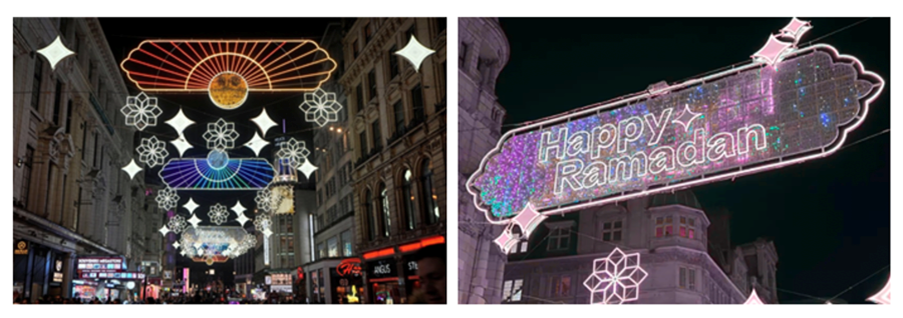
At the heart of the programme is the flagship aerial lights display along Coventry Street: a pioneering installation of more than 30,000 sustainable LED lights arranged in intricate geometric patterns inspired by Islamic art, with motifs representing suhoor and iftar.
The 2026 programme will open with a high-profile switch-on ceremony, with the lights activated by Sir Sadiq Khan, Mayor of London, Rahima Aziz BEM, Trustee at The Aziz Foundation, and Adil Ray OBE, actor and broadcaster, in the presence of senior public leaders, distinguished cultural figures, ambassadors and international dignitaries. The display will remain illuminated until 18th March 2026, before transitioning to Eid Lights through to 24th March 2026.

A selection of artworks featured in Shared Light – central London’s first interfaith art exhibition. Left: Rooh-e-Bhag (Soul of the Garden) (2025) by Mohamad Aaqib Anvarmia. Centre: Hospitality of Abraham – After Rublev (2025) by Meg Wroe. Right: Mettavihari (2025) by Colin Panrucker
This year will also see the launch of Shared Light – central London’s first interfaith Ramadan art exhibition – bringing together artists of all faiths and backgrounds whose work is inspired by the values of Ramadan. The exhibition will be unveiled by the Deputy Lord Mayor of Westminster and hosted at Aziz’s Zedwell hotel at Piccadilly Circus, reinforcing culture’s role as a bridge between communities in one of the world’s most iconic city centres.

Ramadan Lights London will also welcome back Ramadan Delights, London’s first curated iftar food trail, introduced by Aziz in 2025 and now firmly established as a district-wide West End experience. The trail brings together leading international brands and heritage institutions – including Fortnum & Mason, 1 Leicester Square Rooftop, PizzaExpress and Shake Shack- offering special menus, exclusive offers and halal-friendly dining while supporting local businesses and the economic vitality of the area.
This year, the initiative is further strengthened through a partnership with Centrepoint, the UK’s leading youth homelessness charity, reflecting a shared commitment to social mobility, economic empowerment and supporting disadvantaged young people.
Commenting on the programme, Asif Aziz said: “Ramadan Lights London reflects how the values of Ramadan – generosity, reflection and empathy – can contribute meaningfully to civic life. It is about thoughtful engagement and creating shared experiences that strengthen communities and endure over time.”
Beyond Ramadan Lights London, Aziz’s wider philanthropic work continues to deliver impact. Since 2015, The Aziz Foundation has awarded over 750 scholarships, supported more than 100 media internships, and delivered extensive mentorship programmes across key industries. Aziz is also leading the regeneration of Criterion Capital’s Grade II-listed London Trocadero, transforming the landmark into a 1,000-capacity mosque and community centre – a long-term investment in cultural and faith infrastructure in a major global city.
Alongside his charitable endeavours, Aziz is establishing a scalable, world-class co-investment platform in Abu Dhabi, working with UAE institutions to deploy capital into transformative urban and living-sector opportunities across Europe and the Middle East, with a continued focus on sustainable social outcomes.
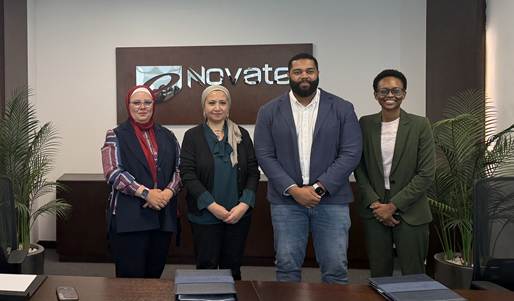
eNovate, a subsidiary of eFinance Investment Group, and Cobi, a UAE-headquartered AI-native customer intelligence platform, today announced the integration of Cobi’s AI-powered intelligence infrastructure across its digital payment ecosystem to redefine how young people across Egypt engage with digital financial services. Enabled through Mastercard’s Engage programme, the partnership combines eNovate’s digital payments product suite and Cobi’s AI-powered engagement platform to give financial institutions a new level of intelligence, personalisation, and behavioural insight across their customer base. As the MENA region emerged as a global hub for financial services innovation in 2025, fuelled by government initiatives and rapid digital payments growth, the focus is shifting toward AI-powered engagement and intelligence at scale.
The collaboration begins with the Rize app, eNovate’s flagship digital wallet, where Cobi’s intelligence layer will power real-time personalisation for Egypt’s youth segment. With 85% of people across MENA already using at least one emerging payment method, this allows banks and fintechs to better understand spending behaviours, identify friction, and deliver timely product interventions that drive activation, loyalty, and long-term customer value. The capability will extend across eNovate’s broader digital payment services, forming Egypt’s first large-scale AI-driven portfolio management infrastructure.
With the MENA region’s AI in financial services market projected to reach $4.7 billion by 2032, underscoring the scale of opportunity for intelligent, data-driven payment infrastructure across the region. At the core of the partnership is Cobi’s behavioural AI engine, which builds deep context on how users engage, identifies patterns, and recommends or triggers next-best-actions across acquisition, activation, and retention journeys for customers combining it with eNovate’s role as a central payments and digital services provider to Egypt’s banks, telcos, fintechs, merchants, and government-linked entities, the collaboration marks a major step toward intelligent, personalised financial experiences across the country.
Nashwa Kamel, CEO of eNovate, explained: “eNovate is committed to enabling banks & financial institutions with modern, data-driven capabilities. Partnering with Cobi allows us to introduce real-time intelligence into every digital wallet and payment experience we support, starting with the youth-focused Rize app. This collaboration strengthens our mission to provide Egypt with the most advanced and responsive payment infrastructure that provides insights into spend behaviour, helping banks & financial institutions to spot inefficiencies, optimize costs, and make smarter, data-driven decisions. By turning raw spend data into strategic intelligence, businesses can anticipate trends, strengthen supplier relationships, and accelerate sustainable growth.
Darren Edmund, CEO of Cobi, highlighted: “Our partnership with eNovate represents a fundamental shift in how digital payment infrastructure operates. By embedding Cobi as the intelligence layer across eNovate’s ecosystem, we are enabling banks and financial platforms to move beyond static transaction processing toward real-time, adaptive systems that understand and respond to user behaviour instantly. This allows institutions to personalise at scale, optimise portfolio performance, and build deeper, longer-lasting customer relationships. We’re glad to have had Mastercard’s Engage programme support this collaboration.”
Looking ahead, the partnership will extend toward agentic payment experiences, where AI not only analyses user behaviour but autonomously recommends or initiates actions that improve financial outcomes, ushering in a new era of intelligent and proactive financial services across Egypt. The initial deployment begins in Q1 2026, with expansion planned across additional eNovate-powered platforms and regional markets.


SAGE Unveils Premium Eid Gifting Collection for Coffee Lovers
FROM COMPLIANCE TO COMPETITIVE EDGE: WHY DIGITAL RECORD-KEEPING IS A BUSINESS IMPERATIVE
Majid Al Futtaim Malls Launch Ramadan Experiences Across the UAE




-

 Tech News2 years ago
Denodo Bolsters Executive Team by Hiring Christophe Culine as its Chief Revenue Officer
-
News10 years ago
SENDQUICK (TALARIAX) INTRODUCES SQOOPE – THE BREAKTHROUGH IN MOBILE MESSAGING
-
 VAR11 months ago
Microsoft Launches New Surface Copilot+ PCs for Business
-

 Tech Interviews2 years ago
Navigating the Cybersecurity Landscape in Hybrid Work Environments
-

 Tech News8 months ago
Nothing Launches flagship Nothing Phone (3) and Headphone (1) in theme with the Iconic Museum of the Future in Dubai
-

 Automotive1 year ago
AGMC Launches the RIDDARA RD6 High Performance Fully Electric 4×4 Pickup
-

 VAR2 years ago
Samsung Galaxy Z Fold6 vs Google Pixel 9 Pro Fold: Clash Of The Folding Phenoms
-

 Tech News2 years ago
Brighton College Abu Dhabi and Brighton College Al Ain Donate 954 IT Devices in Support of ‘Donate Your Own Device’ Campaign