
 Have a question? +971 56 404 0503




Technology
EXE AND IPSOS LAUNCH FIRST-EVER GCC PEOPLE PULSE MONTHLY WORKFORCE SENTIMENT TRACKER

The GCC People Pulse, the region’s first dedicated monthly workforce sentiment tracker, is out and survey results indicate that positive sentiment among employees working for organisations across the region outperforms global benchmarks.
The report, which has been launched by Employee Experience Exchange (EXE), a bold new community for business leaders and professionals working in people, culture, and communications in the Middle East, and Ipsos, one of the world’s leading market research companies, was based on data collected from a representative sample of 1,500 employees across the UAE, Saudi Arabia, Kuwait, and Qatar via online survey.
Respondents were adults in full or part-time employment at the time of fieldwork, and the survey covered 11 questions across five themes: advocacy, confidence, wellbeing, inclusion, and AI.
A key result of the survey showed that 81 percent of respondents have indicated that they would recommend their organisations as a great place to work, which is higher than the global benchmark by nine points. In addition, 77 percent of respondents said that they are confident in the future direction of their organisation, with a higher margin of 22 points from the global benchmark.
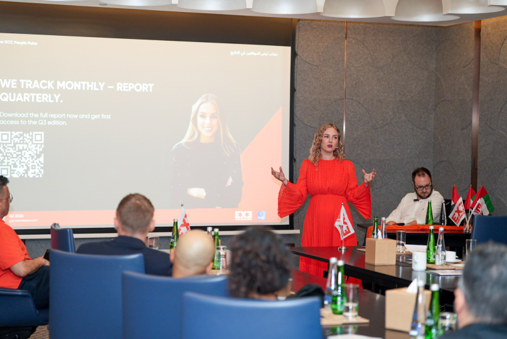
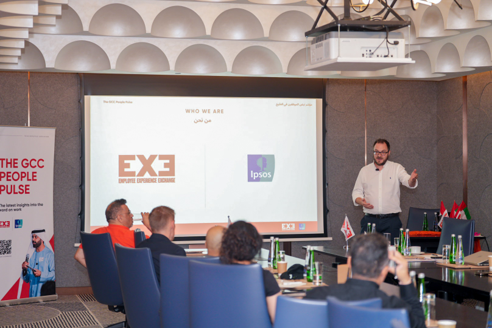
“What this means for organisations is huge,” said Ruth Dance, Co-Founder of EXE. “Advocacy is one of the most telling signs of real engagement, and it’s directly linked to business performance and talent outcomes. When employees recommend their workplace, they become powerful brand ambassadors, which is a huge boost for recruitment and reputation. But when advocacy is weak, it gets a lot harder to attract and keep good people in a market this competitive and growing.”
“When people feel confident and clear about where their organisation is headed, they talk about it,” Lorna King, Co-Founder of EXE, added. “That confidence comes from clear communications and visible leadership. When employees understand the direction and see leaders walking the talk, they become genuine advocates, and that’s your strongest brand asset.”
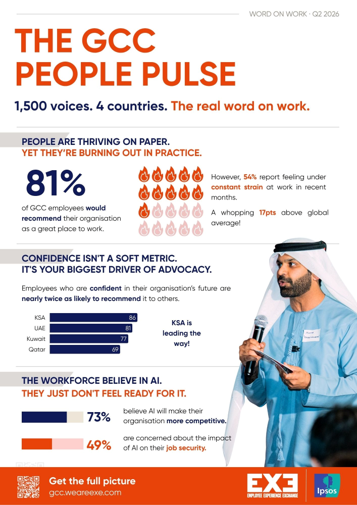
Other notable positive indications from the survey results include more than a quarter of respondents (78 percent) saying they can be themselves in their organisations, as well as (77 percent) seeing an organisational commitment to nationalisation.
On the adoption of AI, 73 percent of respondents see AI as a critical business enabler and believe that AI will make their organisation more competitive. However, 49 percent or almost half of the respondents expressed concern on the impact of AI on job security.
Furthermore, the survey results have also indicated that 54 percent of respondents feel that they have been in constant strain in recent months, with only 18 percent reporting a complete absence of strain at work.
“Strain is what happens when employees come under sustained stress or pressure. It creates anxiety, fatigue, and eventually burnout,” said James Tarbit, Global Head of Employee Experience at Ipsos. “Our research shows strain has a hugely negative impact on decision-making, on team dynamics, and on overall employee performance. Strain might not lead to an employee leaving but, even if they stay, they won’t be performing at their best, contributing fully, or helping your business succeed.”
The GCC is one of the world’s most diverse and fast-evolving labour markets and the GCC People Pulse tracker provides a regular, region-specific lens on how what employees think, feel, and experience. This helps inspire genuine dialogue between employees and management, leading to better talent retention and organisational performance.

Delinea, the identity security platform that governs what humans, machines and AI agents do once they have access, today announced its participation at GISEC Global 2026. Under the theme, “From Access to Action: Governing AI at Runtime,” the company will spotlight the growing need for organisations to govern the actions autonomous AI agents take after access has been granted.
Following its release of new runtime authorisation capabilities for AI agents this summer, Delinea will use GISEC to advance the conversation around runtime authorisation, an approach designed to enforce policy on an agent’s actions within a session, at the time those actions are executed.
As AI agents take on increasingly autonomous roles across databases, cloud environments, infrastructure and business systems, the security challenge is shifting beyond authentication. While an agent may have legitimate access to a system, it can still take an action that exceeds its intended task or creates operational risk. Delinea’s runtime authorisation capabilities enable organisations to apply policy at the point of action — allowing, blocking or escalating activity before it executes.
“AI adoption is moving the identity-security conversation beyond the moment of authentication,” said Mortada Ayad, VP Sales at Delinea. “The question for organisations is no longer simply whether an AI agent can access a critical system. It is whether they can govern what that agent does once it is inside. At GISEC, we want to put that challenge, and the need for runtime control, at the centre of the regional conversation.”
Delinea has strategically adopted a channel-led presence at this year’s show, reflecting its focus on bringing these capabilities to market through the regional partners enterprises rely on to deploy, manage and operationalise complex security programmes. Through its presence at the stands of regional distributor, Shifra, and integrator partner, Defa3, the company will deepen engagement with existing partners, recruit new partners and build the specialist capabilities needed to support secure AI adoption across the region.
The approach builds on the Delinea Partner Advantage Program, launched in July 2026. The program provides partners with clearer rules of engagement, deal protection, tiered incentives and AI-driven enablement, helping them build profitable identity-security practices, while delivering stronger outcomes for customers. It is designed to support selling partners today, with expanding roles planned for managed service providers, global systems integrators, advisory partners and technology partners.
“For a capability this consequential, technology alone is not enough,” Ayad added. “Customers need partners who understand their environment, their risk and how to translate security policy into practical control. Our focus at GISEC is to equip and grow that ecosystem, so organisations can move forward with AI, knowing that authorised access does not become unchecked action.”
Delinea’s runtime authorisation for AI agents enables organisations to govern activity across the systems agents use, including databases, SSH hosts, Kubernetes clusters and cloud consoles. Through just-in-time, task-scoped access, and real-time policy enforcement, organisations can reduce reliance on standing credentials, while maintaining a defensible record of AI-driven activity.

Enterprise AI has entered a new phase. The conversation is no longer centred on whether organisations should invest in artificial intelligence, but on how they can transform that investment into measurable business value.
By: Mohammed Hilili – General Manager, Lenovo Gulf

Across the GCC, enterprises are moving beyond experimentation. Pilot projects are giving way to enterprise-wide deployments as organisations seek to integrate AI into customer experiences, business operations, software development, cybersecurity and decision-making. Yet despite growing investment, many AI initiatives continue to struggle to deliver the outcomes leadership teams expect.
In my experience, the reason is rarely the technology itself. More often, organisations begin with the wrong conversation.
Too many AI discussions start with infrastructure specifications, GPU availability or the latest foundation models. These are undoubtedly important decisions, but they are not the first ones organisations should make.
The first question is much simpler.
What business problem are we trying to solve?
Without a clear answer, AI initiatives often remain isolated demonstrations of technical capability rather than platforms capable of delivering sustainable business value.
From AI Pilots to Enterprise Platforms
Across industries, organisations have spent the past two years experimenting with generative AI. Many have successfully launched departmental pilots that demonstrate what AI can achieve within a controlled environment. The greater challenge now lies in scaling those experiments across the enterprise.
That transition requires far more than additional computing power. It demands clear governance, high-quality data, well-defined business objectives and an architecture capable of supporting continuous growth. Successful AI adoption is increasingly becoming an organisational transformation exercise rather than simply another technology deployment.
Business Strategy Before Infrastructure
I recently worked with a leading regional financial institution looking to strengthen its research and development capabilities through AI. The ambition was clear, but many practical questions remained unanswered.
How much computing capacity would the organisation require? Which GPU architecture would support both current and future workloads? How could the environment remain scalable as AI adoption expanded across the business?
These may appear to be technology questions. In reality, they are strategic business decisions with long-term operational consequences.
Instead of beginning with hardware selection, we started by understanding the organisation’s objectives. Together with the leadership team, we assessed AI readiness, identified priority business outcomes and defined what success would look like before discussing infrastructure.
Only after establishing that foundation did we determine the appropriate compute resources, architectural approach and deployment model required to support long-term growth.
The result was not simply a successful implementation but an AI platform capable of evolving alongside the organisation’s ambitions.
AI Readiness Extends Beyond Technology
Many organisations still view AI readiness primarily through the lens of infrastructure. In reality, readiness begins much earlier.
Leadership alignment, data quality, governance frameworks, cybersecurity, skills development and measurable business outcomes all influence whether an AI initiative succeeds or stalls. Infrastructure remains essential, but it should support strategy rather than define it.
The organisations achieving the strongest results are those treating AI as a long-term business capability rather than a series of disconnected technology projects.
Building for a Hybrid AI Future
Enterprise AI environments are also becoming increasingly hybrid. Certain workloads will remain on-premises to address latency, compliance or data sovereignty requirements, while others will leverage the scalability of public cloud environments.
This makes architectural flexibility increasingly important. Organisations need infrastructure strategies capable of supporting multiple deployment models while allowing AI workloads to evolve alongside changing business priorities.
Selecting technology is therefore no longer simply about purchasing hardware. It is about building an adaptable foundation capable of supporting continuous innovation over many years.
The GCC Opportunity
The GCC is uniquely positioned to accelerate enterprise AI adoption. Governments across the region continue investing heavily in digital transformation, sovereign AI capabilities and next-generation cloud infrastructure while strengthening regulatory frameworks around data governance and cybersecurity.
These investments provide organisations with an increasingly mature environment in which to deploy AI at scale. However, long-term success will depend less on access to technology than on the ability to align AI investments with clear operational priorities and measurable business outcomes.
As AI becomes embedded within core enterprise operations, leadership decisions made today will determine competitive advantage for years to come.
Why Clarity Still Comes Before Compute
Technology will continue evolving at remarkable speed. New AI models, specialised processors and deployment approaches will continue reshaping the enterprise landscape.
What will remain constant is the importance of making the right decisions before investing.
At Lenovo, this philosophy shapes how we work with customers. We believe AI is not simply a product to deploy, but an organisational capability that develops over time. By combining advisory expertise with infrastructure, lifecycle services and long-term planning, organisations can reduce uncertainty, optimise investment and build AI platforms that continue creating value as business needs evolve.
The organisations that lead in the AI era will not necessarily be those with the largest AI budgets or the most powerful infrastructure. They will be those that begin with business clarity, build the right foundations and scale with purpose.
Because in enterprise AI, infrastructure enables transformation—but clarity makes it possible.
Tech News
Tech First Gulf Strengthens its presence in Africa with the appointment of Mustapha Rafiki as General Manager – Maghreb & Francophone Africa

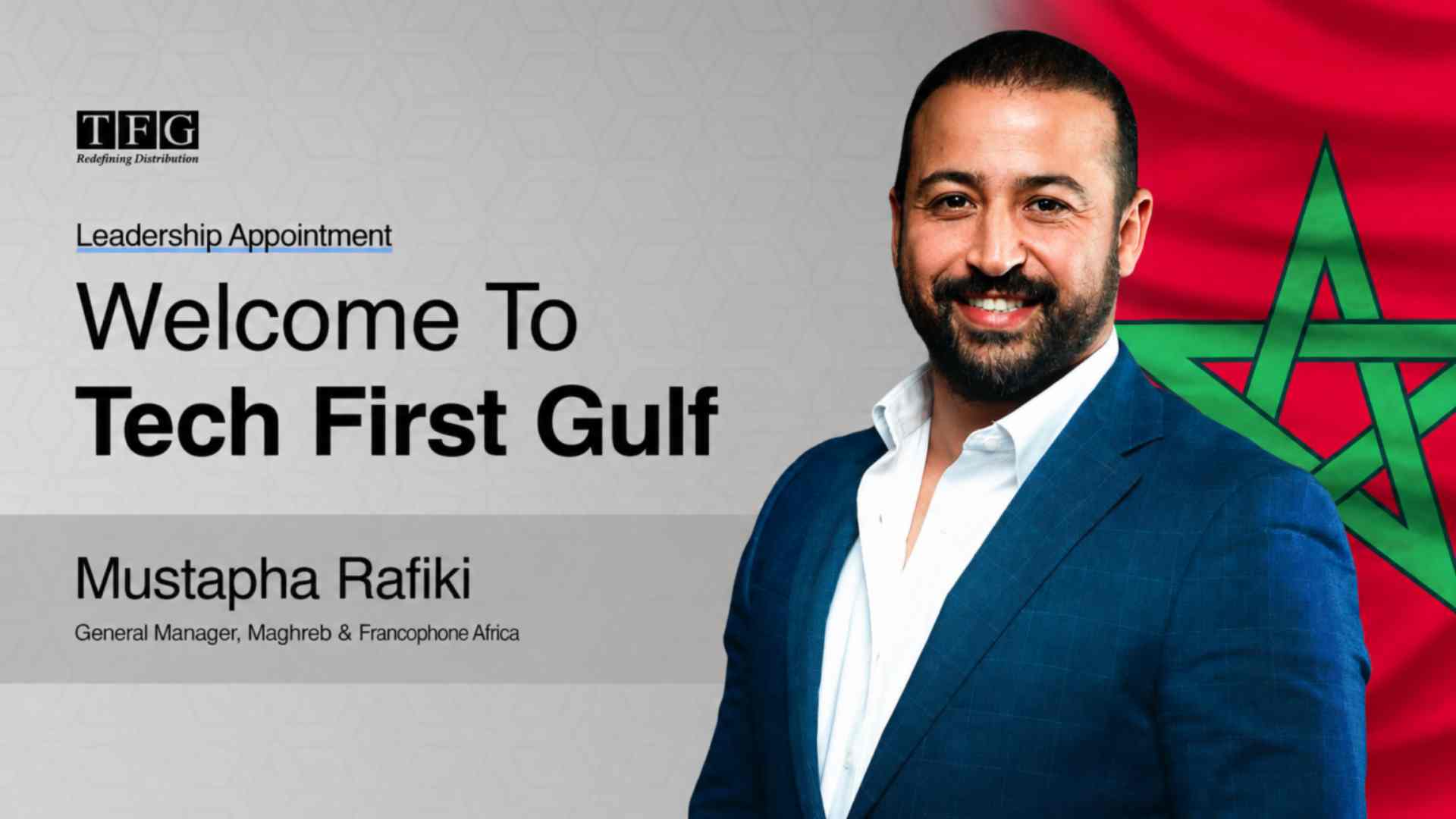
Tech First Gulf (TFG), a leading value-added technology distributor across the Middle East and Africa, is pleased to announce the appointment of Mustapha Rafiki as General Manager – Maghreb & Francophone Africa. This strategic appointment marks another significant milestone in TFG’s continued regional expansion and reinforces the company’s commitment to strengthening its footprint across Africa.
With over 19 years of experience in the information technology industry, Mustapha brings extensive expertise in business development, channel management, sales leadership, and operational excellence. Throughout his career, he has successfully built and managed high-performing partner ecosystems while driving sustainable business growth across North, West, East, and Central Africa.
Before joining Tech First Gulf, Mustapha served as Head of B2B Africa at Logitech, where he led business operations across multiple African markets, developing strategic go-to-market initiatives and strengthening channel partnerships. Prior to Logitech, he held the position of Country Manager at Canon, where he played a pivotal role in expanding the company’s presence, developing strategic alliances, and accelerating growth across key enterprise and commercial segments.
As TFG continues to expand its operations throughout Africa, Mustapha’s appointment reflects the company’s vision of investing in experienced leadership to unlock new opportunities, deepen vendor and partner relationships, and deliver greater value to customers across the markets.
Under his leadership, TFG aims to accelerate regional growth by strengthening its distribution network, expanding strategic technology alliances, enabling channel partners, and introducing innovative solutions that address the evolving needs of enterprises and public sector organizations across the region. His deep understanding of African markets, combined with his proven leadership, will play a vital role in driving TFG’s next phase of growth.
“We are pleased to welcome Mustapha to Tech First Gulf as we continue our expansion across the region. The markets under his leadership offer tremendous opportunities for growth and innovation, and we remain committed to investing in their future through strong leadership and long-term partnerships. Mustapha’s proven track record, strategic vision, and extensive regional expertise make him the ideal leader to accelerate our growth, strengthen our market presence, and deliver lasting value to our partners and customers,” said Mr. Akashdeep (Sky), Chief Strategy Officer, Tech First Gulf
Commenting on his appointment, Mustapha Rafiki said:
“I am excited to join Tech First Gulf at such an important stage of its growth journey. TFG has built a strong reputation for delivering innovative technology solutions and empowering its partner ecosystem. I look forward to working closely with our vendors, partners, and customers to accelerate growth, expand our market presence, and create lasting value across the region.”
As Tech First Gulf continues its regional expansion strategy, the company remains focused on empowering businesses through world-class technology solutions, strengthening strategic partnerships, and building a future-ready digital ecosystem across India, Middle East and Africa.


HONOR Pad X9b Max Review: When a Tablet Starts Challenging Your Laptop
Home Centre celebrates Emirati Women’s Day with Made By Her, a campaign spotlighting homegrown talent
Delinea Brings Runtime Control for AI Agents to GISEC Global 2026



-
News11 years ago
SENDQUICK (TALARIAX) INTRODUCES SQOOPE – THE BREAKTHROUGH IN MOBILE MESSAGING
-

 Trending10 months ago
OPPO A6 Pro 5G Review: Reliable Daily Driver
-

 Tech News2 years ago
Denodo Bolsters Executive Team by Hiring Christophe Culine as its Chief Revenue Officer
-
 VAR1 year ago
Microsoft Launches New Surface Copilot+ PCs for Business
-

 Automotive2 years ago
AGMC Launches the RIDDARA RD6 High Performance Fully Electric 4×4 Pickup
-
Tech Interviews2 years ago
Navigating the Cybersecurity Landscape in Hybrid Work Environments
-

 Tech News1 year ago
Nothing Launches flagship Nothing Phone (3) and Headphone (1) in theme with the Iconic Museum of the Future in Dubai
-

 VAR2 years ago
Samsung Galaxy Z Fold6 vs Google Pixel 9 Pro Fold: Clash Of The Folding Phenoms