
 Have a question? +971 56 404 0503





Tech Interviews
Sizeable proposition

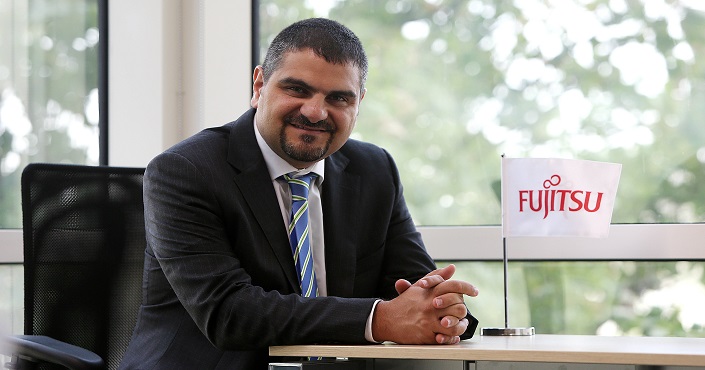
Fujitsu offers an extensive range of solutions including a cloud platform that helps organisations looking to deploy more digital services. Farid Al-Sabbagh, VP & Managing Director at Fujitsu Middle East, discusses details
Discuss the cloud solutions portfolio of Fujitsu? Is that a growing focus in the region?
Cloud offers obvious agility, speed and cost efficiency advantages and has grown from an emerging trend to becoming part of the standard IT services delivery model for many organizations today. Fujitsu’s sees cloud as having a key role in underpinning our vision of a Human-Centric Intelligent Society, one where social and business innovation is driven by the intelligent use of information and communication technology. Fujitsu has extensive Cloud portfolio covering all Private, Public and Hybrid Cloud customer requirements. An example would be PrimeFlex for VShape mainly for customers looking to have their cloud running on VMWare stack. For those who prefer to run their environment based on open source, Fujitsu works with them on our offering, PrimeFlex for Openstack. Both these solutions can be deployed as an integrated infrastructure package on customer premises. For customers looking for hybrid/public cloud we have Fujitsu hybrid IT K5 Cloud platform deployed across several regions. This highly flexible cloud service includes network, Infrastructure as a Service (IaaS) and Platform as a Service (PaaS). K5 enables you to modernize, innovate, extend and interoperate. It lets you build, test and deploy new digital services more easily than other approaches.
Fujitsu’s Cloud is the foundation of our digital services, delivered in a range of styles to meet customers’ needs for security, data regulation and business agility and it’s definitely a growing focus in the region. In the Middle East, cloud is picking up and we have seen many customers who are ready to adopt it. Fujitsu ME has already deployed Public cloud in partnership with one of the system integrators and seen multiple entities utilizing it successfully.
You have a comprehensive Big Data portfolio- elaborate on key elements in the portfolio?
Big Data is a great opportunity for organizations. Establishing the right infrastructure able to keep processing time constant while volumes are increasing, is a challenge which should not be underestimated. Fujitsu has advanced solutions, where organizations can get optimized Big Data infrastructure solutions including hardware, software and services – all from a single source.
FUJITSU Big Data portfolio is a powerful and scalable offering that provides business users with a more cost-effective way of creating actionable analytics from big data. Our portfolio consists of ‘PrimeFlex for SAP HANA’ and ‘PrimeFlex for Hadoop’.
PRIMEFLEX for Hadoop is provided as a ready-to-run Integrated System as well as a Reference Architecture for flexible deployment, and enables business users to tap hidden information from huge amounts of data. In addition, strategic big data consulting, analytics consulting, consulting for Hadoop, and integration and maintenance services supplement the offering. In Short, PRIMEFLEX for Hadoop analyses large volumes of data, extracting meaningful business-relevant information, combining the convenience of pre-configured and pre-tested hardware with the economic advantages of open source software.
Fujitsu PRIMEFLEX for SAP offerings help to accelerate the SAP transformation process by augmenting internal resources and delivering a robust, agile infrastructure which supports business growth and innovation. PRIMEFLEX for SAP HANA is backed by 40 years of experience in delivering fast, secure, high availability implementations with optimized Total Cost of Ownership, successfully reducing complexity. Our SAP knowledge and expertise has helped our customers to transform their SAP environments in a smarter, faster fashion, with proven cost reduction by up to 90% and increased enterprise agility by up to 50%. The result is a modernized IT environment centered on delivering business impact.
Has Big data deployments been a growing business in the region for Fujitsu and its partners?
Yes, we have seen tremendous growth specifically in SAP HANA solutions and this will remain one of the major focus area for Fujitsu ME with our partner eco system showing great interest in this area. As a matter of fact, Fujitsu is the largest provider of SAP HANA deployments in the Middle East.
Discuss if support and solutions for SAP and Oracle customers is also a significant area of focus for Fujitsu?
As one of the world’s largest IT services providers, and as global partners at the highest tier to both Oracle and SAP, this is definitely a significant area of focus for us. Case in point – Fujitsu has over than 3,500 Oracle specialists and has exhibited its deep knowledge of Oracle by achieving Specialization in more than 32 Oracle technologies and this number is increasing. Similarly, we have SAP deployments across the globe with more than 2500 specialists. We constantly keep abreast of latest technologies on offer, and have achieved successful certification and completion of various SAP projects including latest products.
We go beyond offering basic support and solutions and also help and advise customers entirely from an Enterprise Applications perspective.
Comment on the integrator partner strategy/focus for Fujitsu?
Fujitsu globally delivers an integrated portfolio of products, services and solutions that enable customers to innovate and achieve growth in a Human Centric Intelligent Society. To address each customer’s individual needs, Fujitsu uniquely combines the ability to deliver with deep technical expertise, significant global reach and the rare ability to orchestrate best-in-class offerings from one of the most comprehensive partner ecosystems. We work collaboratively with the world’s leading IT companies to develop products, services and solutions and enable customers to optimize their IT infrastructure investments, while transforming or modernizing their business. By integrating the innovative expertise of our partners, Fujitsu is able to help its customers turn technology into a competitive advantage.
As for the Middle East, except for a few global and extremely complex integration projects, most of our Datacenter Products are sold through a set of Select Expert direct partners, as well as through selected resellers.
We also constantly invest in training, joint market development plans and support for our partners.
You have recently opened an office in Qatar- what would be its focus?
Fujitsu has seen a huge demand for their IT infrastructure and ERP application services within the country. Smart city plans, which include smart security and surveillance, environmental management, and disaster management solutions are integral to the development of Qatar as a modern, forward-thinking country. Combined with the country’s far-reaching plans for urbanisation, harnessing of big data, developing the necessary ICT infrastructure, etc prominent clients such as Qatar Petroleum, Oryx GTI, Nakilat, Qatari Diar and Hassad Food, among others will look to benefit from Fujitsu’s new office.
The new office will also help us to work closely with our partners and large enterprise customers and offer them support whenever needed.
Are there any plans to open more offices in the GCC?
The number of cities getting smarter in the GCC is faster than anywhere else around the world which definitely calls for being closer to our customers. Hence, yes, we will be opening offices in other GCC countries as a part of our growth and investment plans for the region.
Discuss key verticals that are showing growth in region from Fujitsu’s perspective?
While Education and Healthcare verticals are consistently charting growth across all the countries, we also find a vibrant private sector and investments in the UAE across other verticals as well.


As artificial intelligence becomes embedded in higher education, universities face a growing challenge: ensuring that students develop independent thinking rather than simply producing polished AI-assisted work. From rethinking assessments to preserving the value of intellectual effort, the conversation is shifting towards what Turnitin calls learning integrity.
In this interview with Amal Dimashki – Regional Director, MENAT & Pakistan, Turnitin explores how institutions can balance AI adoption with critical thinking, meaningful assessment and the development of essential learning skills.

Students are becoming increasingly comfortable prompting AI, but how can universities ensure they are still developing independent reasoning and critical thinking rather than simply producing better AI-assisted answers?
Prompting is becoming an important skill, but being able to write a sophisticated prompt is not the same as being able to think critically.
AI can be a very effective learning partner. It can help students brainstorm, explore different perspectives, challenge an argument or receive feedback on something they have written. But students still need to do the cognitive heavy lifting. If they simply prompt AI for an answer and then refine that answer until it looks better, we may improve the quality of the output without necessarily developing the student’s thinking.
This is why AI literacy needs to go beyond teaching students how to prompt. Students need to learn how to critically evaluate AI-generated content, verify information and sources, question what they are given and make their own judgments about the output. Turnitin’s guidance on responsible prompting encourages students to engage with AI iteratively and interrogate its responses rather than simply accepting what it produces.
We want students to use AI as a learning partner while remaining actively engaged in the learning process and taking ownership of the work they produce. Turnitin’s guidance to students reinforces this by encouraging them to ensure that the majority of their work remains their original thinking.
Universities therefore need to develop AI literacy alongside critical thinking and independent judgment, so that becoming better at using AI does not come at the expense of developing the skills students are there to learn.
What should a modern assessment look like if institutions want to measure a student’s actual understanding rather than just the quality of the final submitted work?
In an AI-enabled environment, assessing only the final product gives us a limited view of whether learning actually took place. A polished final submission does not necessarily tell us how the student arrived there.
This is where a process-based approach to assessment becomes increasingly important. Educators can build meaningful checkpoints into the learning journey through outlines, drafts, formative feedback, revisions and reflection. This allows them to see how the student’s thinking developed, how they responded to feedback and where they may need additional support. Turnitin’s multipart assignments, for example, are designed around structured checkpoints for guidance and reflection throughout the writing process.
At Turnitin, we refer to the broader framework behind this as learning integrity. It expands traditional academic integrity by placing greater emphasis on the integrity of the learning process and ensuring that students are doing the work necessary to learn and develop.
It brings us back to a familiar principle: “show your work.” Greater visibility into drafts, revisions and the development of ideas gives educators richer evidence of how a student approached the assignment rather than relying on a single snapshot at the end. Turnitin Clarity, for example, provides visibility into how students develop their work from ideation through to final submission.
This does not mean making every assessment more complicated. It means designing assessment around the learning objective and creating opportunities for students to demonstrate that they have developed the skills being assessed.
The final submission will continue to matter, but it can be considered alongside evidence of the learning process that produced it.
AI makes it possible to get answers, summaries and explanations almost instantly. Do you worry that this could reduce students’ ability to sustain attention, read deeply and work through difficult material without immediate assistance?
There is certainly a risk, and students themselves recognise it. Turnitin’s research found that 64% of students are concerned that the use of AI in education may be shortcutting their learning.
Learning should not become a completely frictionless process. Researching a subject, developing a point of view, articulating ideas with evidence, editing and working through something difficult all require effort, and some of that effort is where learning happens.
Turnitin refers to this through the concept of “productive struggle.” Cognitive growth and long-term retention require students to engage with difficulty rather than having every challenge immediately removed for them.
That does not mean students should struggle without support. AI can provide guidance and feedback throughout the learning process. Turnitin Clarity’s AI Assistant, for example, is designed to prompt reflection and support students throughout their writing without generating the full response for them.
As AI becomes more capable, preserving productive struggle will become increasingly important. We want students to benefit from the support AI can provide without removing the effort involved in developing knowledge and skills.
4. Looking ahead, how do you see the role of academic integrity evolving as AI becomes embedded in writing, research and learning, and what will universities need to change over the next few years?
Academic integrity will remain fundamental, but its role is expanding as AI becomes embedded in learning.
At Turnitin, we describe this evolution through learning integrity, a proactive expansion of traditional academic integrity that places greater emphasis on the integrity of the learning process. It reflects the need to understand how students are developing their work and ensure they are developing the skills their education is intended to build.
Over the next few years, universities will need to translate this into practice. AI governance needs to provide educators with clear guidance, while recognising that responsible AI use will not look the same across every subject or assessment. Turnitin’s learning integrity framework recognises a spectrum ranging from no AI in some contexts to defined AI use cases and more open use in others.
Educators will also need greater agency over how AI is introduced into teaching and assessment. Turnitin’s latest Learning Integrity Insights found that AI decision-making is moving closer to faculty and teaching and learning leaders, while educators are asking for education-specific AI that is flexible enough to reflect how they actually teach and design assignments.
Technology therefore needs to adapt to pedagogy, rather than pedagogy adapting to the technology. This is the principle behind Turnitin Clarity’s configurable AI settings, which allow educators to determine the level and type of AI support appropriate for an individual assignment.
Over the next few years, universities will need to bring these pieces together: clear AI governance, greater educator agency, assessment practices that support learning integrity, and technology designed around the needs of teaching and learning.

Exclusive interview with Anirban Mukherjee, Director of Solutions Architecture, Red Hat
Digital sovereignty is increasingly moving beyond data residency. What does genuine operational control look like for organisations that need to retain control over their data, applications and infrastructure?
Data residency answers where information sits. Operational control answers who can run, inspect, recover, and change the stack when it matters.
In practice, that means organisations can choose where workloads run – on premises, sovereign cloud, or public cloud – without rewriting applications every time. It means they can audit the software supply chain, keep recovery paths under their own governance, and decide which models, tools, and partners sit in their AI and application environments.
For many MENA enterprises and public-sector bodies, the test is simple: can you keep serving citizens and customers if a single vendor, region, or connectivity path is constrained? Open hybrid platforms give you that room to manoeuvre because the control plane and the open source components stay portable.
As organisations continue to rely on hyperscalers, where do you see the strongest case for combining public cloud with sovereign cloud and on-premises environments?
Hyperscalers remain excellent for elasticity, global reach, and certain managed services. The strongest case for a mixed model is when data sensitivity, latency, or regulatory expectations vary across the same organisation.
We routinely see customer data, AI inference close to the data, and regulated workloads stay in sovereign or on-premises environments, while less sensitive or bursty workloads use public cloud. The point is not to reject public cloud. It is to stop treating it as the only place innovation can happen.
An open hybrid cloud approach lets MENA organisations keep one consistent platform experience across those footprints, so teams are not rebuilding skills and tooling for every environment.
Could the growing AI infrastructure requirement actually increase technology concentration, and what can organisations do to avoid creating a new form of dependency around AI platforms?
Yes, the growing AI infrastructure requirements can actually increase technology concentration, – if every AI workload is tied to one model provider, one accelerator vendor, or one proprietary stack, concentration risk simply moves up a layer.
Organisations reduce that risk by treating AI like the rest of enterprise IT: multiple models for multiple jobs, open tooling where possible, and a platform that can run across hardware and clouds. Smaller, purpose-built open models are often a better fit for specific enterprise tasks than relying on one giant external model for everything.
In the Middle East, where national AI strategies are accelerating investment, the winners will be the ones who can innovate quickly without locking the next decade of infrastructure decisions into a single vendor path.
Open hybrid cloud is often positioned as a way to balance control with access to innovation. What does a mature open hybrid cloud strategy look like in practice?
Maturity looks like consistency. Same platform, same security and policy controls, same developer experience – whether the workload sits in a national data centre, a partner sovereign cloud, or a hyperscaler.
It also looks like deliberate placement: you put each application and AI workload where it creates the best outcome for cost, performance, and governance, and you can move it when those conditions change.
For solution architects in this region, the practical question is: can the customer ship new services without creating a parallel stack every time? If the answer is yes, the hybrid strategy is working.
Vendor dependency is difficult to eliminate entirely. How should organisations assess concentration risk and maintain credible alternatives without creating unnecessary complexity?
You will always have dependencies. The goal is to make them conscious and reversible.
Assess concentration by asking: what breaks if this vendor changes pricing, exits a market, or restricts a capability? Which workloads have no second path? Where does your data or model IP become hard to extract?
Credible alternatives do not mean running five of everything. They mean open standards, portable workloads, and a clear exit or dual-run plan for the few systems that truly matter. Complexity comes from unmanaged sprawl. Discipline comes from a shared platform and clear ownership of what must stay portable.
Red Hat’s role is to help customers keep that optionality – from infrastructure through to AI – so strategic independence is designed in, not bolted on after a crisis.

Exclusive interview with Shadi Hatoum, Regional Director MEA at Tealium
The UAE is moving quickly from AI experimentation to deployment. What do you think will determine which organizations actually turn adoption into measurable business value?
The organizations that create measurable value will be those that connect AI to a clearly defined business decision, then give it the right data and operating model to support that decision.
The UAE has already built significant momentum. Boston Consulting Group found that 42% of UAE organizations qualify as AI Leaders, while 37% have reached the scaling stage of AI maturity. The next test is whether that maturity translates into sustained outcomes.
Deploying a model is not the same as changing how a business operates. AI needs trusted, consented, and real-time context around customer identity, behavior, intent, and journey stage. It also needs clear ownership, measurable objectives, and teams that understand how to use the output.
From my perspective, data readiness and organizational adoption will be the two biggest differentiators. The organizations that can put reliable context in front of AI at the moment of decision, and embed the resulting insight into daily workflows, will be best positioned to turn adoption into measurable value.
How much of the current gap between AI ambition and AI impact comes down to fragmented or outdated customer data?
A significant part of the gap comes down to data readiness, although technology alone is not the whole answer. Most organizations do not lack data. Their challenge is that the data is fragmented, difficult to interpret, or unavailable when a decision needs to be made.
Historical data provides useful depth, but AI also needs data in motion. It needs to understand what a customer is doing now, what has changed, what the customer has consented to, and whether the signal belongs to the correct individual or account.
Tealium’s Future of Customer Data research found that 88% of organizations consider real-time data important to achieving business objectives. That is important because an AI system working from yesterday’s profile may produce a technically valid recommendation that is no longer relevant.
The real opportunity is to create a trusted context layer that connects identity, behavior, consent, and intent, then makes that context available to models and decisioning systems while the customer interaction is still taking place.
Does agentic AI create a new governance problem for enterprises, particularly when agents are acting on customer data without constant human intervention?
Agentic AI does not make the principles of governance entirely new, but it raises the stakes and increases the speed at which controls need to operate. When an AI agent can move from recommendation to action, governance can no longer be treated only as a periodic policy or review exercise. It needs to operate within the data flow and decision process itself.
Enterprises need clear controls over which data an agent can access, the purpose for which it can use that data, how identity and consent are verified, which actions it is authorized to take, and when a person must review or approve the outcome.
The key question is not only whether an agent can access a piece of customer data. It is whether the agent should use that data for this customer, for this purpose, at this moment.
That requires trusted data, current consent, auditability, defined action limits, and clear escalation paths. As autonomy increases, accountability needs to become more precise, not less.
Which sectors in the Middle East do you think are furthest ahead in using real-time customer data and AI together effectively?
From my experience across the region, telecommunications and travel, hospitality, and tourism are among the most active and promising sectors because they generate frequent customer signals and have a clear need to respond in the moment.
In a recent discussion with the Chief Commercial Officer of a major telecom operator in the region, we talked about growth as filling a bucket while also stopping the leaks. Acquisition fills the top, but poor service, irrelevant engagement, and unresolved friction allow value to escape through churn. Sustainable growth requires both attracting new customers and protecting the loyal customer base already in the bucket.
This is where AI-supported decisioning can create real value. Trusted, consented, real-time behavioral data can help an operator recognize changes in usage, service issues, digital engagement, and signs of churn. The next best action may be to resolve a problem, recommend a more suitable plan, position a bespoke package at the right time, or avoid making an offer when the customer first needs support.
The objective is not to push more offers. It is to improve relevance and timing. That can support retention, strengthen loyalty, and create opportunities to grow average revenue per user, or ARPU, by responding to what the customer needs in that moment.
Travel, hospitality, and tourism have a similarly strong opportunity. The customer journey moves from inspiration and research to booking, arrival, the in-destination experience, and loyalty. Each stage creates different needs. A traveler facing disruption needs assistance, while a guest already at a destination may value a timely, personalized experience or service.
These sectors show why hyper-personalization at scale depends on trusted, consented behavioral data in motion. The value comes from giving AI initiatives the current context they need to choose the next best action for that specific moment.
At AI Everything Abu Dhabi 2026, what are the biggest changes you are seeing in the conversations enterprises are having compared with a year or two ago?
The biggest change is that enterprises are no longer asking whether they should adopt AI. They are asking how to move it into production, connect it to measurable outcomes, and govern it at scale.
A year or two ago, many conversations centered on experimentation and individual use cases. Today, the questions are more operational. Leaders want to understand how AI will work with their existing data, how agents will receive current customer context, how decisions will be controlled, and how value will be measured beyond a successful pilot.
I am also hearing much more emphasis on adoption. Organizations recognize that a model does not create value by itself. Teams need clear use cases, practical training, shared measures of success, and confidence in the data behind the recommendation.
The conversation has therefore moved from AI capability to AI readiness. That includes the quality of the data foundation, the governance around it, the ability to make decisions in real time, and the people and processes required to turn those decisions into action. For me, that is a sign that the market is becoming more mature and more focused on sustainable business impact.


The Connected Home Is Evolving into an Intelligent Ecosystem

New Partnership Connects Residential Wellbeing With Preventive Healthcare

Dubai Ride-Hailing App Zed Strengthens Leadership with Appointment of Shobhit Singhal to Shape Its Future



-

 Trending12 months ago
OPPO A6 Pro 5G Review: Reliable Daily Driver
-

 Tech News2 years ago
Denodo Bolsters Executive Team by Hiring Christophe Culine as its Chief Revenue Officer
-
 VAR2 years ago
Microsoft Launches New Surface Copilot+ PCs for Business
-

 Automotive2 years ago
AGMC Launches the RIDDARA RD6 High Performance Fully Electric 4×4 Pickup
-
Tech Interviews3 years ago
Navigating the Cybersecurity Landscape in Hybrid Work Environments
-

 Hospitality2 years ago
Gulfood 2025 30th Edition Kicks Off Today, Setting New Benchmarks in F&B Growth and Innovation
-

 VAR10 months ago
Huawei Nova 14 Pro Review: Where Camera Excellence Meets Ecosystem Evolution
-

 Tech News1 year ago
Nothing Launches flagship Nothing Phone (3) and Headphone (1) in theme with the Iconic Museum of the Future in Dubai