
 Have a question? +971 56 404 0503




Technology
Nokia plans to acquire Withings to accelerate entry into Digital Health

Nokia has announced plans to acquire Withings S.A., a pioneer and leader in the connected health revolution with a family of award-winning digital health products and services to help people all over the world lead healthier, happier and more productive lives. Withings will be part of our Nokia Technologies business.
“We have said consistently that digital health was an area of strategic interest to Nokia, and we are now taking concrete action to tap the opportunity in this large and important market,” said Rajeev Suri, president & CEO of Nokia. “With this acquisition, Nokia is strengthening its position in the Internet of Things in a way that leverages the power of our trusted brand, fits with our company purpose of expanding the human possibilities of the connected world, and puts us at the heart of a very large addressable market where we can make a meaningful difference in peoples’ lives.”
World Health Organization figures show cardiovascular disease as today’s number one cause of death, with more than a billion adults around the world living with uncontrolled hypertension. Diabetes now affects more than one in twelve adults worldwide, a four-fold increase since 1980. Healthcare is expected to be one of the largest vertical markets in the Internet of Things, with analysts forecasting that mobile health, with a CAGR of 37%, will be the fastest growing health care segment from 2015-2020.
“Withings shares our vision for the future of digital health and their products are smart, well designed and already helping people live healthier lives,” said Ramzi Haidamus, president of Nokia Technologies. “Combining their award-winning products and talented people with the world-class expertise and innovation of Nokia Technologies uniquely positions us to lead the next wave of innovation in digital health.”
The combination of innovative products from Withings and the Digital Health business will also ensure the ongoing renewal of Nokia Technologies’ world class IPR portfolio.
Withings was founded by Chairman Eric Carreel and CEO Cedric Hutchings in 2008 and is headquartered in France, with approximately 200 employees across its locations in Paris, France, Cambridge, US and Hong Kong. Withings’ portfolio of regulated and unregulated products includes activity trackers, weighing scales, thermometers, blood pressure monitors, home and baby monitors and more, and is built on a sophisticated digital health platform, providing insights to empower people to make smarter decisions about the health and wellbeing of themselves and their families. Withings’ own products are complemented by an ecosystem of more than a hundred compatible apps.
“Since we started Withings, our passion has been in empowering people to track their lifestyle and improve their health and wellbeing,” said Cédric Hutchings, CEO of Withings. “We’re excited to join Nokia to help bring our vision of connected health to more people around the world.”
The Nokia brand continues to be recognized, valued and trusted by consumers, built on a heritage of beautifully designed, innovative and reliable technology in the service of people around the world to help real human needs.
The planned transaction values Withings at EUR 170 million and would be settled in cash and is expected to close in early Q3, 2016 subject to regulatory approvals and customary closing conditions.
Tech Features
SUPPORTING EMPLOYEES ABROAD OR RELOCATING AMID REGIONAL TENSIONS: A STRATEGIC ADVISORY FOR ORGANISATIONS

By Gillan McNay, Security Director Assistance – Middle East, International SOS
Periods of regional tension place organisations under intense pressure to protect their people while sustaining operations. For UAE‑based companies with employees working from abroad, traveling frequently, or facing potential relocation, uncertainty can escalate quickly. Routes change, borders tighten, information moves faster than it can be verified, and employees look to their organisation for clarity and reassurance. In this environment, support must be strategic, deliberate, and people‑first.
Shift From Reaction to Preparedness
The most resilient organisations are those that move beyond reacting to events and instead operate with a preparedness mindset. This starts with acknowledging that uncertainty is not an exception but a condition organisations must continuously manage. Strategy, therefore, should anticipate disruption and define how the organisation will respond before decisions are forced by urgency.
Preparedness does not mean planning for every possible outcome. It means establishing decision frameworks that allow leaders to act confidently as conditions evolve, whether that results in continued remote work, relocation to a safe haven, or shelter‑in‑place with enhanced support.
Establish Workforce Visibility as a Strategic Capability
Supporting employees abroad begins with accurate, real‑time visibility. Leaders must know where their people are, their travel status, and whether they are working remotely, stationed overseas, or in transit with dependents. Visibility should extend beyond employees to include contractors and accompanying family members where duty‑of‑care obligations apply.
This visibility is strategic because it underpins all subsequent decisions. Without it, organisations risk delayed responses, fragmented communication, and uneven support. With it, they can act proportionately, supporting those most exposed while avoiding unnecessary disruption for others.
Differentiate Between Relocation, Evacuation, and Stability
One of the most common strategic mistakes during regional tensions is treating all movement decisions as evacuations. In reality, organisations need three clearly defined postures:
- Stability: Supporting employees to remain where they are with guidance, wellbeing checks, and secure working arrangements.
- Relocation: Moving employees to a safer location, often within the region, as a preventive measure.
- Evacuation: Executing time‑bound movement out of an area due to elevated risk.
Clear definitions allow leaders to choose the least disruptive option that still protects people. Often, relocation or stability with structured support is safer and more sustainable than rapid evacuation.
Prepare Employees Before Movement Is Required
Relocation becomes significantly smoother when employees are prepared before they are asked to move. Strategy should include guidance on documentation readiness, passport validity, visa requirements for neighbouring countries, preferred relocation countries and expectations around timelines and flexibility.
Employees working abroad need to understand not only what may happen, but how decisions will be made. When organisations explain decision triggers, what would prompt relocation, what would not, employees feel informed rather than anxious. This transparency builds trust and reduces panic-driven movement.
Integrate the Human Dimension into Planning
Strategic support must address the human impact of uncertainty. Employees working from abroad or facing relocation are often balancing professional obligations with family concerns, schooling, medical needs, and other emotional strains. Ignoring these factors weakens any relocation or stability strategy.
Effective organisations integrate wellbeing considerations into operational plans. This includes access to medical advice, continuity of prescriptions, support for family travel, and regular wellbeing check‑ins. Leaders should be attuned to signs of fatigue or anxiety and equip managers with guidance to support teams compassionately and consistently.
Communicate With Discipline and Predictability
In uncertain times, communication is as important as movement planning. Strategy should define how, when, and by whom information is shared. Centralised, fact‑based updates delivered at a predictable cadence reduce speculation and rumor.
Employees should know where official updates will come from and which sources to trust. Communications do not need to be frequent to be effective; they need to be consistent, clear, and grounded in verified information. Saying “there is no update yet” is often more reassuring than silence.
Support Employees Who Must Remain Abroad
Not all employees can or should relocate. Many will continue working from abroad in environments affected by regional tension. Supporting these employees strategically means ensuring they have guidance on local conditions, access to support services, and clearly defined expectations around work, availability, and safety.
Stability should be treated as an active posture, not inaction. Regular check‑ins, updated guidance, and contingency planning signal to employees that their situation is being managed deliberately, not overlooked.
Plan for Relocation as a Managed Process
When relocation is required and viable, it should be executed as a controlled, end‑to‑end process. This includes manifesting all individuals, front‑loading documentation checks, coordinating transport and accommodation, and communicating each step of the journey.
Strategically, leaders must also consider what comes after relocation: access to work, schooling for children, healthcare, and communication continuity. Relocation is not just movement; it is a temporary operating model that must be sustainable.
Learn, Adapt, and Strengthen
Each period of disruption provides insight into what worked and what did not. Strategic organisations capture these lessons and feed them back into planning. This may involve refining decision thresholds, improving data accuracy, or strengthening manager training.
Preparedness evolves as operating environments change, and organisations that invest in continuous improvement are better positioned to protect both their people and their business.
A Strategy Built on Trust and Clarity
Ultimately, supporting employees abroad or relocating amid regional tensions is a test of organisational maturity. Clear visibility, disciplined planning, transparent communication, and genuine care form the foundation of resilience. When organisations operate from these principles, employees feel supported rather than vulnerable, and leaders can make decisions with confidence rather than urgency.
By Dr. Craig Cook, CEO, The Brain & Performance Centre, A DP World Company
Healthcare is entering one of the most transformative periods in its history. Artificial intelligence is accelerating diagnostics, enhancing imaging, and enabling more personalised treatment pathways than ever before. These advancements are no longer theoretical, they are already shaping how care is delivered across leading medical systems.
However, as the industry moves forward at pace, there is a risk of focusing too heavily on what technology can do, and not enough on what individuals actually need.
At its core, healthcare is not a technical transaction. It is a human experience. Within that experience, trust, communication and empathy are not optional, they are fundamental.
Strong human interaction between clinicians and clients remains one of the most important factors in delivering safe and effective care. Technology can identify patterns, process data and support decision-making, but it cannot replace the reassurance an individual feels when they are heard, understood and taken seriously. That interaction often determines whether someone follows through with treatment, shares critical information, or seeks support early rather than late.
From a safety perspective, this is critical. Individuals who feel comfortable with their clinician are far more likely to communicate openly about symptoms, concerns and uncertainties. They ask more questions, clarify instructions, and engage more actively in their own care. This level of engagement reduces the likelihood of miscommunication, improves adherence to treatment plans, and ultimately leads to better outcomes.
In contrast, when the human element is diminished, even the most advanced systems can fall short. An individual may receive accurate data but still leave uncertain about what it means. They may hesitate to disclose something important, or disengage entirely. No algorithm can compensate for that gap.
This is why meaningful communication must remain at the centre of healthcare delivery. It is not simply about explaining a diagnosis. It is about creating an environment where individuals feel safe to speak, where their concerns are acknowledged, and where complex information is translated into something clear and actionable.
As artificial intelligence continues to evolve, the role of the clinician will not diminish, it will become more important. Technology should reduce administrative burden, enhance precision, and create time. That time should be reinvested into the client relationship through greater clarity, deeper understanding and more considered care.
At The Brain & Performance Centre, A DP World Company, this balance is central to how we approach care. Advanced technologies play a critical role in our assessments and programmes, but they are always applied within a human-led framework. Every programme is personalised, every interaction is intentional, and every client journey is built on understanding the individual, not just the data.
The future of healthcare will undoubtedly be shaped by innovation. But its success will not be defined by how advanced the technology becomes. It will be defined by whether we use that technology to strengthen, rather than replace, the human connection at the centre of care. Because ultimately, the most powerful tool in healthcare is not artificial intelligence. It is trust.
Exclusive interview with Andrew McInerney (CEO) and Ebad Abid (Head of Product), Track24
Can you introduce your company to us? What does AtlasNXT do?
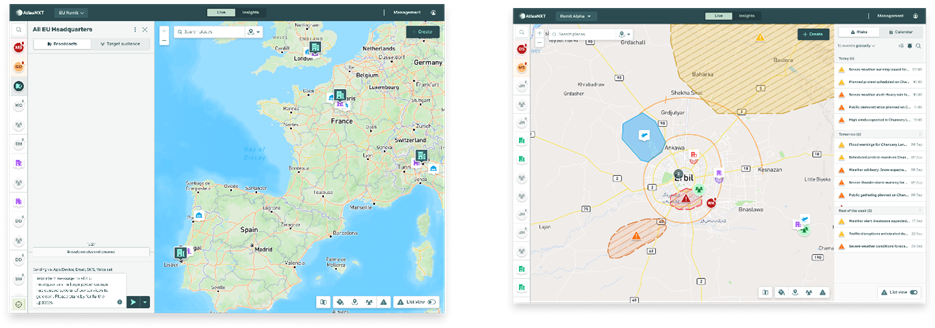
AtlasNXT, from TRACK24, is a duty-of-care location services and communication system. So, it enables a business to know where its people are and relate those people to the risks and other information they might face and then enables them to make decisions and communicate about to ensure the duty-of-care of their teams.
So, what inspired the founding of AtlasNXT and how does its mission differ from other duty-of-care and operational communication platforms?
TRACK24 was formed in 2004 as a location services company in high-risk environments, principally using satellite locations and satellite communication devices. And that remains one of our key differentiators, the ability to integrate satellite communications and satellite devices from any of the competitors. Since then, the world and the technology has moved on.
And in the last five years, we at TRACK24 have integrated lots of different, divergent bits of our software into AtlasNXT as a single software offering. And that provides those location services, not just to high-risk environments, but to GSM-capable and GPS-capable devices across any environment. So, where risk moves across place and time, then any business can use this, not just those ones in high risks as well.
So, it helps with travel risk management, it helps with precision communications to people, it reduces the amount of noise compared to the amount of signal that individuals get. So, precision information to the right people at the right time.
In your view, what is the biggest misconception organizations still have about modern duty-of-care technology?
We’ve come from a high-risk environment, from the most high-risk, and bring with us that sort of ethos of protection. Many organizations have come from a travel risk management environment, and therefore that tends to be diary predictions of where your diary says you’re going to be traveling that day, rather than precision location. And so, a lot of people bring with them the expectation that they get a generic travel risk management update, rather than something precise for their own movements, which changes as their own movements change.
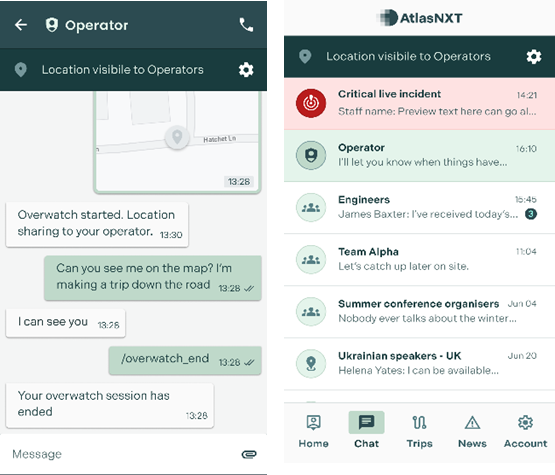
So, the adaptability of a live tracking system enables that. The other key differentiator is the ability to maintain privacy. I’ve done that quick demonstration of the system.
So, the individual knows when they’re able to be seen by their operation, by their operators, by their employer, and when they’re not, so they can maintain their privacy. And they only lose their privacy through consent. They press a button on the app and say, track me, or check me, overwatch me, or I’m in a panic mode, or by event, and they go inside a geofence, which their employer has put up on the map.
It might be their location, it might be a risk environment, and even then, the app tells the individual that you’re now visible to your operator. So, I think it’s key, the privacy element, and the live tracking, rather than any predictive element. Ibad, any other ideas? Coming to the privacy part, AtlasNXT emphasizes privacy-first location-based communications.
How do you balance delivering critical information with user privacy concerns?
One of the challenges is, as you have said, is if you give the user the control, you won’t be able to actually support the user, because they’ll just switch it off. So, what we do is, we allow the system to share information, but we manage privacy through the visibility of the data that’s transferred, as opposed to switching it on and off, as most people do.
Because once you switch it off, the person’s MIA, and you can’t do anything to support them. They’re not going to get any notifications; we’re not going to know where they are. But if the system is always sharing, if their device is always sharing a location, or any form of notification with our system in the background, then we’re always able to reach them in the event something goes wrong.
The way we manage privacy is we essentially make them invisible, and they become visible by consent or event. So, one of the main things in data protection laws is legitimate interest. So, you should only ever have access to somebody’s information if you actually need it.
And so, you either give consent, that you can use my location data, or two, there’s a legitimate interest, such as they are in a potential area where there is a risk to them. And at that point, we can reveal that location, and therefore, we’re always in control.
AtlasNXT integrates geofencing, precision messaging, and real-time operational intelligence. And how do you see these capabilities evolving or utilizing AI?
Geofences themselves have evolved. First, they just used to be sort of a digital perimeter. And now, we then introduce smart geofences, which essentially allows you to track people coming in and out of that perimeter. What we also do is see what impacts that perimeter.
So, we have various intelligence feeds we integrate with, and you can see if a particular perimeter is impacted by that. Now, with AI, you can also then say, is that piece of intelligence relevant to the perimeter I’m monitoring? Again, when you’re integrating with data providers, you’re probably getting a few thousand events a day. As humans, we can’t consume that much information, or if we can, we can’t comprehend what it means.
And so, with the power of AI, we can summarize it and only give us, we can allow it to give us clarity. We can also get it to give us reports. So, it can do trend analysis.
Over X period of time, we’ve had X types of risk. And so, it can give us the ability to predict future risk as well. So, if there is, for example, a civil conflict near a particular geofence, you’ll find that there is X amount of panic alarms pressed in the vicinity or near it.
So, what AI will be able to do is allow us to forecast whether, you know, because of this event, we can expect this many people to be at risk. And so, it can send out early warnings automatically without anybody having to do so. The other thing I’d say on AI is there’s lots and lots of data, as Ibad said, lots and lots of information.
And from our engagement with our customers, they want to maintain a human in the decision loop. So, our approach to AI is that AI does the heavy lifting, but it only ever suggests to a human option it could take. And a human stays in command, makes the decisions.
So that you keep a human in the loop so that you’re not handing over life and death security to a machine. So, AI does the ground level work while a human is always overlooking it. Yeah, and it can come up with pattern recognition.
It can say, hey, we’re noticing this, do you want to, whatever. So, it’s a co-pilot, not a pilot. It’s also time efficiency, right? So, by the time a human has actually had the time to go through all the information and all of the people to find out whether something is impacting someone or something, right? AI can do it instantly, right? So, the more delay there is between supporting an individual, the higher chance there is of something going wrong. So, the earlier you can intervene, right, the safer you can keep your people. But a human always takes a call on whether to act or not. Whether to act or not, correct.
And how important was InterSec for you and this region, Middle East, for your company?
We’re headquartered in London with two subsidiary organizations in the Emirates and a country office in Iraq. The region is hugely important. It’s where we originated as a species and as a company. So, we started in 2004 in Baghdad. And we’ve always maintained a large presence in Iraq, Kurdistan and across the Middle East.
The world isn’t getting any easier. The world is not getting any less risky. The world is not getting any more certain. Risk is spreading and becoming quite unpredictable whether you’re the president of an independent nation or an independent nation that belongs to somebody else. Risk is coming to you around the globe.
Our services become more and more important and more relevant globally. The region of the Middle East is important because I think it’s a region that understands security in a very central way.
It was our first attendance at InterSec. We’re a software provider. From what I’ve seen so far, there’s lots of hardware providers.
And that means there’s lots of potential partners for us. We can integrate any of their systems into our system and make access control useful for decision support which is what we’re here to do. That’s all from my side.

SUPPORTING EMPLOYEES ABROAD OR RELOCATING AMID REGIONAL TENSIONS: A STRATEGIC ADVISORY FOR ORGANISATIONS
IN THE AGE OF AI, THE BEST HEALTHCARE WILL STILL BE HUMAN
A RELAXING POOLSIDE RETREAT AT PALACE DOWNTOWN



-
News10 years ago
SENDQUICK (TALARIAX) INTRODUCES SQOOPE – THE BREAKTHROUGH IN MOBILE MESSAGING
-

 Tech News2 years ago
Denodo Bolsters Executive Team by Hiring Christophe Culine as its Chief Revenue Officer
-
 VAR11 months ago
Microsoft Launches New Surface Copilot+ PCs for Business
-

 Tech Interviews2 years ago
Navigating the Cybersecurity Landscape in Hybrid Work Environments
-

 Tech News8 months ago
Nothing Launches flagship Nothing Phone (3) and Headphone (1) in theme with the Iconic Museum of the Future in Dubai
-

 Automotive1 year ago
AGMC Launches the RIDDARA RD6 High Performance Fully Electric 4×4 Pickup
-

 Trending5 months ago
OPPO A6 Pro 5G Review: Reliable Daily Driver
-

 VAR2 years ago
Samsung Galaxy Z Fold6 vs Google Pixel 9 Pro Fold: Clash Of The Folding Phenoms