
 Have a question? +971 56 404 0503




Financial News
Riverbed Alluvio IQ Unified Observability New Release Delivers More IT Insights and Security

Riverbed, the leader in unified observability, announced new updates to Alluvio IQ, its cloud-native, SaaS-delivered Unified Observability service that empowers IT with actionable insights to remediate problems faster and improve the digital experience. The latest capabilities expand Alluvio IQ’s reach of machine learning and automated investigations to include end-user experience telemetry from Alluvio Aternity Digital Experience Management to solve issues in remote and SASE environments as well as integrate with third-party tools. Alluvio IQ enables IT organizations to “shift left,” enabling all staff to do the job of more experienced IT experts, freeing-up senior IT staff to focus on strategic business initiatives.
“IT teams are struggling with the complexity of today’s environments. Siloed tools designed for a single domain have created blind spots in new environments such as remote work and SASE. IT teams often need to look at different perspectives, from flow, packets, infrastructure, and end-user experience to understand a problem and its impact fully,” said Richard Tworek, Chief Technology Officer, Alluvio, at Riverbed.
“The latest release of Alluvio IQ now includes the end user experience perspective powered by Alluvio Aternity to help diagnose issues in remote work and SASE/SSE environments. We also added support for third-party tools further to expand the reach of Alluvio IQ’s automation. These features further accelerate troubleshooting by providing IT with a single source for alerts and supporting data.”
“Alluvio IQ is helping my team realize a self-healing network. Using the built-in features of runbooks and AI/ML we can reduce the number of alerts and capitalize on our automation processes to perform corrective actions to the network before users experience impact. Alluvio IQ is a game changer in monitoring and unified observability,” said Earl Foster, Manager Network Services, American Airlines.
Alluvio Aternity Integration Adds Remote Work and SASE Visibility
Organizations need to surface connectivity or transport issues affecting user experience, no matter where the user is located or which type of application they use (data center, mobile, cloud, or SaaS). With the Alluvio Aternity integration, Alluvio IQ allows network teams to surface impactful incidents in these environments and pinpoint where the problem is happening.
Third-Party Integration with Automated Runbooks
Alluvio IQ now includes data from third-party tools in its automated investigations. Enterprises typically have multiple monitoring tools from different providers and manually combine data from these different tools when troubleshooting. Alluvio IQ can now integrate with non-Riverbed tools using a flexible approach, including pulling data from other monitoring tools or pushing contextual events to ITSM solutions within the automated Runbooks. Organizations leveraging Alluvio IQ can now have one place to see impactful events, including the context IT teams need to solve problems quickly. That context can come from both Riverbed and non-Riverbed sources.

Bitcoin edged higher last week, gaining 11%, yet it continues to struggle to convincingly break through the $74,000 resistance level, according to Simon Peters, crypto analyst at eToro.
US bitcoin spot ETFs recorded $763 million in net inflows over the past week, helping to push prices higher. Strategy, the largest bitcoin treasury company by total holdings, also disclosed another significant purchase of 17,994 bitcoin for approximately $1.28 billion.
Looking ahead, the Federal Reserve meeting this week could prove pivotal in determining whether bitcoin breaks above the $74,000 level or experiences a correction. While markets had previously anticipated a dovish pivot, a sudden spike in oil prices due to the ongoing conflict in the Middle East may prompt the Fed to reconsider its outlook.
“The consensus is for the Fed to hold rates on Wednesday, but if Chairman Powell signals in his press conference that the central bank is prepared to raise rates should oil prices remain elevated or continue rising, this could trigger a sell-off in cryptoasset prices,” said Peters.
The meeting will also see the release of the Federal Reserve’s latest “dot plot”, offering insights into where each Federal Open Market Committee participant believes interest rates should be by the end of the year, next year and over the longer term.
AI tokens surge amid Nvidia comments
Among the biggest movers in the crypto market over the past week were AI-related tokens TAO and FET, both rising 47% as investors rotated into the sector following bullish remarks about artificial intelligence by Nvidia CEO Jensen Huang.
Ahead of Nvidia’s GTC AI conference this week, Huang described AI as “essential infrastructure”, stating that every company and nation will build and use it.
These comments have renewed interest in on-chain, decentralised AI networks, pushing tokens such as TAO and FET higher.
Mastercard launches crypto partner program
Mastercard has launched its Mastercard Crypto Partner Program, a new global initiative bringing together more than 85 companies across the crypto ecosystem, including exchanges, stablecoin issuers and blockchain development teams.
The program aims to foster dialogue and collaboration as the crypto sector continues to mature. Participants will work with Mastercard teams to combine the speed and programmability of blockchain technology with Mastercard’s merchant network spanning more than 210 countries.
The initiative builds on Mastercard’s existing digital asset activities, including its Start Path blockchain track, Engage platform and Crypto Card program.
Bitcoin reaches 20 million supply milestone
Bitcoin reached a historic milestone last week when the 20 millionth bitcoin was mined, marking the issuance of more than 95% of the cryptocurrency’s total capped supply of 21 million coins.
The milestone was reached on 10 March at block height 931200, 17 years after the network first launched. Due to Bitcoin’s halving schedule, the remaining one million coins are expected to take approximately another 114 years to be mined, with the final bitcoin projected to enter circulation around the year 2140.
Crossing the 20 million milestone again highlights Bitcoin’s scarcity dynamics. With demand continuing to outpace the new supply issued daily by miners and many holders unwilling to sell at current prices, the market could be positioned for a significant move higher over the coming months and years.
Financial
ABA Legal Highlights UAE’s Legal Framework as Catalyst for the Next Wave of Foreign Investment


In alignment with the UAE’s ambitious vision to evolve into a global hub for business and foreign capital, ABA Legal, a boutique corporate law consultancy headquartered in Abu Dhabi, UAE, has announced its bold and strategic expansion of Legal Structure Mapping – a refined core advisory specially mentoring FDI and investors in interpreting and navigating the UAE’s investor-focused legal framework across the region. The move strengthens the firm’s positioning as one of a kind legal resource for foreign investors seeking clarity, compliance, and structured market entry within the UAE.
The United Arab Emirates has rapidly evolved into a leading destination for global business and foreign capital. According to recent government and industry reports, the UAE continues to rank among the top global destinations for foreign direct investment inflows, driven by continuous legal and regulatory modernization. ABA Legal observes that legal clarity, regulatory certainty, and structural reforms are increasingly central to investor decision-making, with businesses placing greater emphasis on well-defined legal pathways, ownership structures, and enforceability before committing capital to new markets.
Commenting on the evolving landscape, Ms. Geethalakshmi Ramachandran, Managing Counsel at ABA Legal, said “The UAE’s legal framework today is not only progressive but highly responsive to global investor expectations. The shift toward full foreign ownership, stronger dispute resolution systems, governance reforms, and IP protection has significantly enhanced legal certainty. At ABA Legal, our core service now is guiding foreign investors through these reforms with clarity and precision, ensuring they can structure, enter, and operate in the UAE market with confidence and long-term security. We aim to become the Legal Mentors for FDIs and Investors UAE interest”
A New Era of Legal Reform
The UAE has entered a new era of legal reform designed to strengthen transparency, predictability, and investor confidence across its commercial ecosystem. One of the most significant developments has been the overhaul of foreign ownership regulations. Sectors that previously required majority UAE national ownership have been widely liberalized, enabling 100% foreign ownership across a growing range of industries, including technology, manufacturing, and professional services. From a legal standpoint, this marks a structural realignment of the corporate framework, giving investors greater control over governance and operations while reducing compliance ambiguity and intermediary dependence. The reforms align the UAE with global best practices and reinforce its appeal for long-term, high-value investment.
Strengthening Contract Enforcement and Dispute Resolution
Investor confidence is closely tied to enforceability and legal certainty. The UAE has modernized commercial laws and strengthened dispute resolution mechanisms to create a secure environment for international business. Specialized courts operating under internationally recognized standards and common law principles, alongside stronger integration with global arbitration systems, ensure disputes are resolved efficiently and impartially. This protects contractual rights, lowers legal risk, and supports long-term cross-border investment strategies.
Governance, Transparency, and Investor Protection
Governance, transparency, and investor protection have also been enhanced through stricter corporate reporting, anti-money laundering, and financial compliance frameworks. These measures reduce regulatory uncertainty and strengthen market credibility by embedding internationally recognized standards into law. Investors benefit from a more stable, accountable, and transparent operating environment.
Free Zones: Tailored Legal Advantages: Free zones continue to play a central role in the UAE’s foreign investment strategy, offering tailored legal and regulatory advantages such as full foreign ownership, capital repatriation, customs exemptions, and flexible employment and residency structures. Designed around priority sectors, these zones combine flexibility with legal certainty and reduced administrative burden.
Modern Commercial Laws, Digital Economy Support, and IP Protection
Recent updates to commercial company regulations, data protection laws, and intellectual property protections further support digital economy and innovation-driven businesses. Together, these reforms create a resilient and adaptable legal ecosystem that not only attracts foreign capital but enables sustainable, knowledge-based growth; with ABA Legal supporting investors through structured legal guidance in this evolving framework.
For global investors seeking stability, transparency, and strategic opportunity, the UAE’s legal framework is more than supportive, it is a dynamic engine for capital inflow, innovation, and knowledge-based economic development, with ABA Legal serving as a strategic legal mentor in this journey.
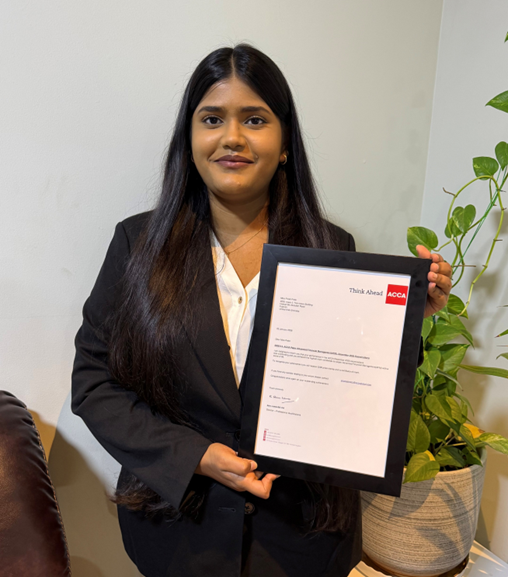
Preeti Peter, student – BCom ACCA – MAHE Dubai
Advanced Financial Management is a paper that separates theoretical knowledge from applied thinking. It tests your ability to make strategic decisions under uncertainty, weighs competing risks in real time, and defends your reasoning when there is not one right answer. The pass rates reflect that difficulty. When I sat for the exam, World Rank 1 was never the target, surviving the paper with credibility was. I scored 96 out of 100. But the number, on its own, tells you very little. What matters is what the journey demanded: a complete rewiring of how I approached preparation, pressure, and failure.
Treating preparation like a financial model
Early on, I made a decision that changed everything: I would stop following a generic study plan. Instead, I approached my preparation the way an analyst might approach a sensitivity analysis. I tested variables by studying at different times of the day, experimenting with visual mapping versus deep reading. Each iteration helped me identify what produced the best results for my learning style.
This was about precision, not volume. In finance, we talk about capital allocation, where you deploy resources matters more than the sheer amount available. I applied the same logic to my time. High-yield areas got the most attention. Weak spots got targeted effort. Comfortable topics got less.
Strategy is not a luxury reserved for boardrooms. It belongs in every decision you make.
The negative cash flow phase
There is a phase in every long-term project, financial or otherwise, where the output does not match the input. In corporate finance, we call this negative cash flow. You are investing, and the returns have not materialised yet.
My first few weeks of AFM preparation felt exactly like that. I was putting in the hours, but comprehension was patchy. It would have been easy to panic or abandon ship for a different approach.
Instead, I recognised the phase for what it was: temporary. Every business that reaches breakeven has survived this stage first. I leaned into discomfort, trusted the process, and kept showing up. Slowly, the fog lifted.
That early patience was critical. If I had changed course every time results lagged behind effort, I would never have built the understanding that carried me through the exam.
Discipline over motivation
There is a popular idea that success comes from being motivated. I found the opposite to be true. Motivation is unreliable, it fluctuates with your mood, your energy, a difficult question that throws you off balance.
What carried me was routine. I built a daily structure that operated regardless of how I felt on any given morning. Good days and bad days received the same treatment: sit down, open the material, work through the plan.
During my time at Manipal Academy of Higher Education Dubai, I learned to value consistency over intensity. Resilience, I realised, is not about gritting your teeth and pushing through pain. It is about designing a process robust enough to function even when you are running on empty.
Confronting discomfort deliberately
One of the more counterintuitive lessons AFM taught me was about comfort zones. When preparing for a high-stakes exam, there is a strong temptation to practise what you already understand. You move through questions quickly, confidence builds, and the work feels rewarding.
But that feeling is misleading. The topics I avoided, the ones that made me uneasy, the questions I got wrong repeatedly were precisely where the growth was. I started restructuring my study sessions to front-load the most difficult material. If a topic made me uncomfortable, it went to the top of the list.
Over time, those uncomfortable sessions became the foundation of my exam performance. The questions that would have caught me off guard were the ones I was most prepared for.
Managing pressure, not just content
I remember finishing a mock exam and feeling genuinely defeated. The time pressure had overwhelmed me. I knew the material but knowing the material and performing under timed conditions are two very different skills.
That experience changed my approach. I began treating exam technique as its own discipline, separate from subject knowledge. I practised under strict time limits and developed a method for approaching unfamiliar questions: pause, outline, then write.
On exam day, there were moments where questions looked unfamiliar at first glance. Instead of panicking, I paused, outlined a structure, and worked through each part methodically. I finished on time, with every question addressed.
The real lesson: stress does not disappear because you have prepared well. You simply get better at functioning within it.
Feedback as fuel
A score of 96 percent might suggest a clean, linear path to the top. The reality was messier. Mock results were humbling. Feedback on practice answers was sometimes blunt.
But I made a conscious decision early on, I would treat every piece of critical feedback as information, not as judgement. If a mock answer missed the mark, I wanted to understand why so, to close the gap between where I was and where I needed to be.
That openness to correction was, I believe, one of the most important factors in my result. The students who improve fastest are rarely the most talented. They are the ones willing to be told they are wrong and to adjust accordingly.
Beyond the exam
World Rank 1 was a rewarding outcome. But the rank is a snapshot, a single data point from a single day.
Structured thinking. Disciplined preparation. The ability to remain calm when the stakes are high. A willingness to sit with discomfort rather than avoid it. These are not exam skills. They are life skills.
AFM taught me that risk is not something to fear. It is something to understand, to price, and to manage. That principle holds whether you are valuing a derivative or deciding how to spend your next hour. The same applies to every challenge worth pursuing.

A SEASON OF RADIANT HOSPITALITY: NATUZZI ITALIA CELEBRATES MOTHER’S DAY AND THE SPIRIT OF EID WITH MASTERPIECES OF ITALIAN COMFORT
CASA MILANO EXPANDS UAE FOOTPRINT WITH 7TH SHOWROOM LAUNCH IN AL AIN AMID MARKET UNCERTAINTY
TRENDS IN AI COMPLIANCE INFLUENCING HOW GCC COMPANIES OPERATE



-
News10 years ago
SENDQUICK (TALARIAX) INTRODUCES SQOOPE – THE BREAKTHROUGH IN MOBILE MESSAGING
-

 Tech News2 years ago
Denodo Bolsters Executive Team by Hiring Christophe Culine as its Chief Revenue Officer
-
 VAR11 months ago
Microsoft Launches New Surface Copilot+ PCs for Business
-

 Tech Interviews2 years ago
Navigating the Cybersecurity Landscape in Hybrid Work Environments
-

 Tech News8 months ago
Nothing Launches flagship Nothing Phone (3) and Headphone (1) in theme with the Iconic Museum of the Future in Dubai
-

 Automotive1 year ago
AGMC Launches the RIDDARA RD6 High Performance Fully Electric 4×4 Pickup
-

 VAR2 years ago
Samsung Galaxy Z Fold6 vs Google Pixel 9 Pro Fold: Clash Of The Folding Phenoms
-

 Trending5 months ago
OPPO A6 Pro 5G Review: Reliable Daily Driver