
 Have a question? +971 56 404 0503




Automotive
Maximum transparency: Mercedes-Benz is the world’s first car manufacturer to X-ray a crash test.


The technical sensation begins with a very loud bang. At 60 km/h, a device with a crash barrier rams into the orange C-Class saloon and hits it full on the side. Crash tests are always something special – even for the experts. But the spectacular part of this side impact test is located in a frame on the hall ceiling above the vehicle: A linear accelerator serves as an X-ray camera. Together with the Fraunhofer-Institute for High-Speed Dynamics, the EMI (Ernst Mach Institute) in Freiburg, Mercedes-Benz has now carried out the world’s first X-ray crash with a real car. On board was one SID II dummy on the left-hand side facing the impact. This is a test specimen with a female anatomy, specially designed for side impact tests.
This technology demonstration (proof of concept) at the EMI research crash facility in Freiburg has shown that high-speed X-ray technology can be used to visualise highly dynamic internal deformation processes. Previously invisible deformations and their exact processes thus become transparent. The numerous, high-resolution images allow precise analysis.
“The Mercedes-Benz X-ray crash sets a milestone in the development tools of the future. With a direct view into the hidden interior, it can help to draw important conclusions for the further improvement of vehicle safety. Mercedes-Benz thus confirms its role as a safety pioneer in automotive engineering.”Markus Schäfer, Member of the Board of Management of Mercedes-Benz Group AG, Chief Technology Officer
“The successful X-ray crash provides us with valuable insights to further optimize our technology for capturing previously inaccessible information. Fraunhofer EMI is thus consistently pursuing its strategy of using high-speed X-ray imaging to make dynamic processes visible.” Dr. Malte Kurfiß, Head of Crash Test Centre, Fraunhofer EMI
“The world’s first X-ray crash shows that X-ray technology can provide revealing new insights. We learn what happens inside a vehicle and to the dummies during an accident. The X-ray images also offer the opportunity to further improve the model quality of the digital prototypes.” Prof. Dr Paul Dick, Director of Vehicle Safety, Mercedes-Benz AG
Ultrashort X-ray technology: up to 1,000 images per second
For several years, the Mercedes-Benz vehicle safety division has been researching the use of X-ray technology in crash tests together with colleagues from EMI. The decisive factor for the breakthrough was the use of a linear accelerator with 1 kHz technology as the radiation source. The device is far more powerful than the X-ray flashes previously used in trials: The photon energy of the linear accelerator is up to nine megaelectron volts. This allows all materials commonly used in vehicle construction to be screened. The duration of the X-ray pulse is only a few microseconds. This makes it possible to record deformation processes in the crash test without motion blur. The linear accelerator also generates a continuous stream of these X-ray pulses. This means that up to 1,000 images per second are possible. That is about 1,000 times as many as with conventional X-ray procedures.
During the crash test, the beams shine through the bodywork and any dummies from above. A flat detector is located under the test vehicle. It serves as a digital image receiver in the X-ray system: When the radiation hits the detector, an electrical signal is generated. The intensity of this depends on how strongly the radiation was previously absorbed by the vehicle and dummy structure. This influences the grey value that is later visible – similar to the X-ray inspection of luggage at the airport or images of this kind taken by a doctor.
In the milliseconds of the actual impact time, the X-ray system shoots around 100 still images. Combined into a video, they provide highly exciting insights into what happens inside safety-relevant components and in the dummy’s body during a crash. In this way, it is possible to observe in detail how the thorax of the dummy is pressed in or how a component is deformed. The important part on the way from research to industrial application is the fact that the X-ray crash does not affect any other analysis tools. Even the interior cameras in the crash test vehicle record without any disturbance.
The EMI experts drew up a comprehensive radiation protection concept for the X-ray crash. Dosimeters are used as monitors to ensure that employees are not exposed to radiation. The government authority has approved the operation of the plant in accordance with legal requirements. The elaborate physical protection measures include an additional 40-centimetre-thick concrete wall around the building and a protection door weighing around 45 tonnes.
Crash tests: Part of Mercedes-Benz’s “Real Life Safety” philosophy
On 10 September 1959, the first crash test in the history of Mercedes-Benz took place – on open ground close to the plant in Sindelfingen. A test car was driven head-on into a solid obstacle. This opened a new chapter in safety research at Mercedes-Benz, as it made it possible to study the crash behaviour of both vehicles and occupants under realistic conditions using test cars and dummies. Together with the analyses of the Group’s own accident research, crash tests form the basis for the “Real Life Safety” philosophy.
Mercedes-Benz currently carries out up to 900 crash tests per year and around 1,700 “sled tests” at the Vehicle Safety Technology Centre in Sindelfingen. In this crash simulation, a test sled is accelerated and braked. A test object (vehicle body shell or assembly) is mounted on the sled and subjected to the forces arising during a real vehicle crash. These sled tests allow non-destructive testing of individual components, especially restraint systems such as seat belts.
And the world’s first public crash test on two fully electric vehicles in autumn 2023 shows that safety at Mercedes-Benz is not a question of the drive system. EQA and EQS SUV models crash into each other in a real accident scenario at a speed of 56 km/h and an overlap of 50 per cent. The test confirms the high level of occupant protection: The passenger cell and high-voltage battery of both vehicles remain intact as intended, the doors can be opened, and the high-voltage systems switch off automatically.
About the Fraunhofer-Institute for High-Speed Dynamics, the Ernst Mach Institute (EMI)
The Fraunhofer EMI specialises in the physics, engineering and computer science of fast processes in experiments and simulations. The aim is to develop solutions for industrial applications with a focus on reliability, safety, resilience, efficiency and sustainability.
The Fraunhofer EMI deals with crash, impact and shock wave phenomena across all materials. Adopting a comprehensive approach, the institute analyses and optimises the entire range of materials and microstructures through to complex structures. Applications range from materials to components, cars, aeroplanes, satellites, buildings, urban systems and infrastructure networks.
The Fraunhofer Society is the leading organisation for applied research in Europe. Under its umbrella, 76 institutes and research facilities work at locations throughout Germany. More than 30,000 employees generate an annual research volume of more than 2.9 billion euros.
Automotive
Anticipating the Automotive Aftermarket: Preparing the GCC Aftermarket for a Software-Led Future

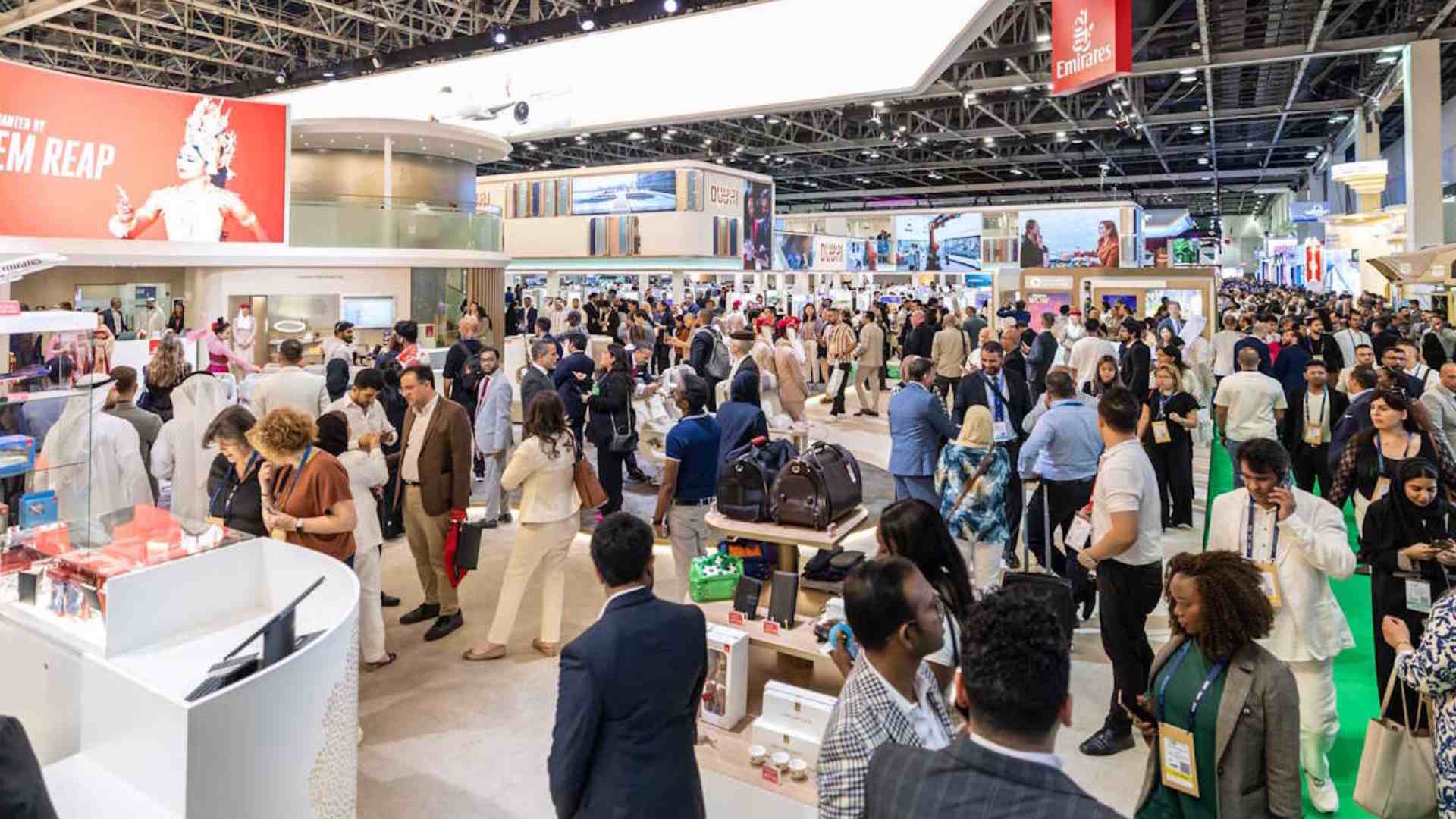
The GCC aftermarket is preparing to support a more diverse vehicle mix as electrification, connected systems and software-led technologies develop at different speeds across regional markets.
In this exclusive, Tommy Le, Show Manager of Automechanika Dubai, explains how aftermarket businesses can remain relevant as vehicle technologies and customer expectations change, why workshop and workforce readiness must advance together, and how industry platforms can support long-term collaboration across the region.

From your conversations with manufacturers, distributors and industry associations, what is the most significant transformation currently reshaping the regional aftermarket?
From our conversations with manufacturers, distributors and industry associations, the most significant change is the diversification of demand. It is not happening uniformly across the GCC, but businesses increasingly need to support conventional vehicles alongside hybrids, EVs, connected systems and a growing mix of brands. Dubai offers one indication of the direction: according to the Dubai Electricity and Water Authority, registered EVs increased from 37,486 at the end of 2024 to 47,944 at the end of 2025, a rise of nearly 28%. Each technology and brand brings different parts, software, diagnostics and servicing needs. Companies therefore need stronger market intelligence, flexible supply chains and closer collaboration. The businesses that remain relevant will respond quickly without compromising quality, safety or trust.
How are electrification, connected vehicles, advanced diagnostics and software-led technologies changing the requirements of aftermarket businesses?
They are changing both what businesses sell and the capabilities they require. A repair may now involve electronic diagnosis, sensor calibration, battery and thermal-system assessment, or access to vehicle-specific technical information. The complexity is already visible: a study by the Insurance Institute for Highway Safety found that about half of owners whose crash-avoidance systems were calibrated following vehicle damage reported continuing problems after the repair. That reinforces the need for correct tools, current procedures and trained technicians. Looking ahead, software-led servicing and predictive maintenance could create faster and more transparent customer experiences, but only where workshops have authorised data access, compatible systems and appropriate diagnostic infrastructure. Internationally, software governance is becoming more formalised through measures such as United Nations Economic Commission for Europe Regulation No. 156 on software updates and software update management systems. The opportunity is significant, but capability cannot be assumed to be universal.
As the vehicle mix becomes more diverse, how must parts supply chains and service networks support conventional, hybrid and electric vehicles simultaneously?
Conventional vehicles will remain central to the regional fleet even as hybrid and electric adoption grows at different rates. According to the Dubai Electricity and Water Authority, the number of registered EVs in Dubai increased by nearly 28% during 2025, showing why the aftermarket must prepare for several technology cycles at once. Distributors need visibility of vehicle populations and demand to balance availability against excess stock, backed by traceable sourcing. Service networks must decide which capabilities belong in every workshop and which can sit in specialist centres. Horizontal collaboration could let independent businesses share high-cost diagnostic or calibration resources, technical knowledge and regional support without duplicating investment.
Where are the most urgent workshop-readiness gaps, and what roles should manufacturers, training institutions and industry platforms play in closing them?
Skills are the most urgent gap because equipment creates value only when people can use it safely and accurately. Workshops need technicians who understand high-voltage systems, advanced diagnostics, software-led repair and ADAS calibration, supported by current technical data, safe working areas and clear procedures. The consequences of incomplete capability are tangible: according to the Insurance Institute for Highway Safety, around half of respondents whose crash-avoidance systems were calibrated after vehicle damage reported continuing issues. The US National Highway Traffic Safety Administration also advises that high-voltage work requires vehicle-specific guidance and properly trained personnel. Manufacturers can provide recognised training pathways, vocational institutions can build foundations, and industry platforms can connect them. We also need to show young people that the aftermarket now combines engineering, data and software, offering credible technology-led careers rather than only traditional mechanical roles.
How has your commercial experience shaped your strategy, and what is your long-term ambition for Automechanika Dubai as it moves to Dubai Exhibition Centre in November 2026?
Working across commercial and exhibitor roles has shown me that different parts of the industry experience change in very practical ways. Manufacturers may focus on market access, distributors on dependable supply, and workshops on tools, training and technical support. My role is to find where those needs meet and build useful connections. The move to Dubai Exhibition Centre opens a new phase for the show, with opportunities to improve the visitor experience, connectivity and the way knowledge is shared. I want Automechanika Dubai, taking place from 10–12 November 2026, to develop as a year-round industry platform where businesses exchange insight, understand emerging technologies and form partnerships. It must remain a commercial marketplace while helping the aftermarket anticipate change rather than react to it.
Note:Historical 2025 figures: Automechanika Dubai welcomed visitors from 161 countries and exhibitors from 63 countries at its 2025 edition. Following 22 editions at Dubai World Trade Centre, the exhibition will take place at Dubai Exhibition Centre (DEC) for the first time in 2026. These figures describe the 2025 edition and are not projections for 2026.
Tommy Le, Show Manager of Automechanika Dubai, explains how aftermarket businesses can remain relevant as vehicle technologies and customer expectations change, why workshop and workforce readiness must advance together, and how industry platforms can support long-term collaboration across the region.
The GCC aftermarket is preparing to support a more diverse vehicle mix as electrification, connected systems and software-led technologies develop at different speeds across regional markets.
From your conversations with manufacturers, distributors and industry associations, what is the most significant transformation currently reshaping the regional aftermarket?
From our conversations with manufacturers, distributors and industry associations, the most significant change is the diversification of demand. It is not happening uniformly across the GCC, but businesses increasingly need to support conventional vehicles alongside hybrids, EVs, connected systems and a growing mix of brands. Dubai offers one indication of the direction: according to the Dubai Electricity and Water Authority, registered EVs increased from 37,486 at the end of 2024 to 47,944 at the end of 2025, a rise of nearly 28%. Each technology and brand brings different parts, software, diagnostics and servicing needs. Companies therefore need stronger market intelligence, flexible supply chains and closer collaboration. The businesses that remain relevant will respond quickly without compromising quality, safety or trust.
How are electrification, connected vehicles, advanced diagnostics and software-led technologies changing the requirements of aftermarket businesses?
They are changing both what businesses sell and the capabilities they require. A repair may now involve electronic diagnosis, sensor calibration, battery and thermal-system assessment, or access to
vehicle-specific technical information. The complexity is already visible: a study by the Insurance Institute for Highway Safety found that about half of owners whose crash-avoidance systems were calibrated following vehicle damage reported continuing problems after the repair. That reinforces the need for correct tools, current procedures and trained technicians. Looking ahead, software-led servicing and predictive maintenance could create faster and more transparent customer experiences, but only where workshops have authorised data access, compatible systems and appropriate diagnostic infrastructure.
Internationally, software governance is becoming more formalised through measures such as United Nations Economic Commission for Europe Regulation No. 156 on software updates and software update management systems. The opportunity is significant, but capability cannot be assumed to be universal.
As the vehicle mix becomes more diverse, how must parts supply chains and service networks support conventional, hybrid and electric vehicles simultaneously?
Conventional vehicles will remain central to the regional fleet even as hybrid and electric adoption grows at different rates. According to the Dubai Electricity and Water Authority, the number of registered EVs in Dubai increased by nearly 28% during 2025, showing why the aftermarket must prepare for several technology cycles at once. Distributors need visibility of vehicle populations and demand to balance availability against excess stock, backed by traceable sourcing. Service networks must decide which
capabilities belong in every workshop and which can sit in specialist centres. Horizontal collaboration could let independent businesses share high-cost diagnostic or calibration resources, technical knowledge and regional support without duplicating investment.
Where are the most urgent workshop-readiness gaps, and what roles should manufacturers, training institutions and industry platforms play in closing them?
Skills are the most urgent gap because equipment creates value only when people can use it safely and accurately. Workshops need technicians who understand high-voltage systems, advanced diagnostics, software-led repair and ADAS calibration, supported by current technical data, safe working areas and clear procedures. The consequences of incomplete capability are tangible: according to the Insurance Institute for Highway Safety, around half of respondents whose crash-avoidance systems were calibrated after vehicle damage reported continuing issues. The US National Highway Traffic Safety Administration also advises that high-voltage work requires vehicle-specific guidance and properly trained personnel.
Manufacturers can provide recognised training pathways, vocational institutions can build foundations, and industry platforms can connect them. We also need to show young people that the aftermarket now combines engineering, data and software, offering credible technology-led careers rather than only traditional mechanical roles.
How has your commercial experience shaped your strategy, and what is your long-term ambition for Automechanika Dubai as it moves to Dubai Exhibition Centre in November 2026?
Working across commercial and exhibitor roles has shown me that different parts of the industry experience change in very practical ways. Manufacturers may focus on market access, distributors on dependable supply, and workshops on tools, training and technical support. My role is to find where those needs meet and build useful connections. The move to Dubai Exhibition Centre opens a new phase for the show, with opportunities to improve the visitor experience, connectivity and the way knowledge is shared. I want Automechanika Dubai, taking place from 10–12 November 2026, to develop as a
year-round industry platform where businesses exchange insight, understand emerging technologies and form partnerships. It must remain a commercial marketplace while helping the aftermarket anticipate change rather than react to it.
Automotive
Zeekr UAE and AWR Automotive Unveil Redesigned Flagship Showroom on Sheikh Zayed Road in Dubai
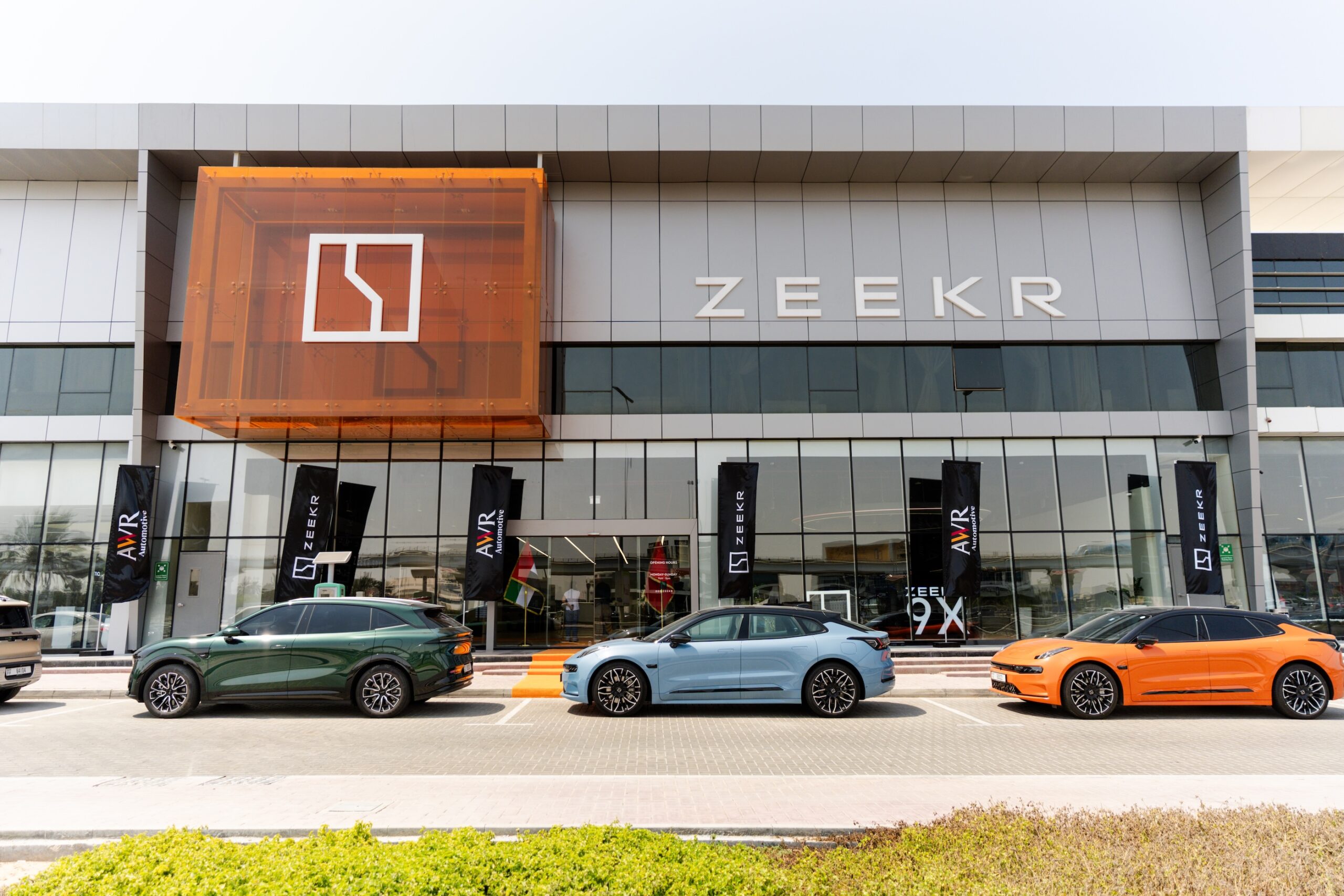
Zeekr UAE and AWR Automotive are proud to announce the unveiling of the redesigned Zeekr flagship showroom on Sheikh Zayed Road in Dubai. The new space brings together contemporary design, refined hospitality, and personalised customer engagement, reflecting the partners’ confidence in the UAE’s expanding electric mobility market.
The showroom gives customers a clear and practical way to explore electric mobility. Zeekr product specialists will provide personalised guidance around the Zeekr range, charging, intelligent technology, performance, test drives, and after-sales care. Interactive touchscreen TVs allow customers to explore vehicle configurations in detail and place orders directly from the showroom. Customers can also discuss their individual driving requirements and ownership considerations in a relaxed setting, helping them understand how electric mobility can support everyday journeys, family travel, and longer drives across the UAE.
At the centre of the redesigned showroom is the Zeekr Lounge, a refined hospitality space for customer appointments, coffee conversations, and owner gatherings. The lounge brings a more personal dimension to the retail experience, providing a welcoming place for guests to spend time with the brand before or after a consultation or test drive. A partnership with Maison 7, AWR Group’s luxury lifestyle brand, adds curated homeware and elegant décor, creating a warm, lifestyle-led environment that complements Zeekr’s progressive design philosophy and brings the showroom’s material, colour, and craftsmanship story to life.
“The UAE’s electric mobility market is advancing quickly, and customers want the confidence that comes from clear guidance, a trusted local partner, and an ownership experience designed around their needs,” said Roberto Colucci, Director of EVs, AWR Automotive. “Our redesigned flagship showroom brings those elements together, creating a destination where customers can experience Zeekr’s technology, design, and hospitality while exploring how electric mobility can fit their everyday lives.”
The redesigned flagship also includes two AC charging points, giving customers an added practical touchpoint with the Zeekr ownership experience during their showroom visit. Two dedicated vehicle delivery bays provide an elevated handover setting, allowing every delivery to become a more personal and memorable moment for customers and their families. The flagship will also serve as a platform for product introductions, owner engagement, and curated events, bringing customers and electric mobility enthusiasts together around premium electric driving. Customers are invited to visit the showroom on Sheikh Zayed Road to experience the Zeekr range, speak with a product specialist, and book a personalised test drive.
AWR Automotive is Zeekr’s official distributor in the UAE. Supported by decades of automotive expertise and an established national network of showrooms and service centres, it brings the Zeekr ownership experience to customers from first discovery through to long-term support, helping advance premium electric mobility across the region.


Al Bustan Centre & Residence concludes successful participation at Arabian Travel Market 2026

From 350+ Applications to One Champion: School of Cyber Defense Final Stage at GISEC GLOBAL 2026

Half a billion people live with arthritis: MEAF puts early action at the heart of World Arthritis Day 2026



-
News11 years ago
SENDQUICK (TALARIAX) INTRODUCES SQOOPE – THE BREAKTHROUGH IN MOBILE MESSAGING
-

 Trending11 months ago
OPPO A6 Pro 5G Review: Reliable Daily Driver
-

 Tech News2 years ago
Denodo Bolsters Executive Team by Hiring Christophe Culine as its Chief Revenue Officer
-
 VAR1 year ago
Microsoft Launches New Surface Copilot+ PCs for Business
-

 Automotive2 years ago
AGMC Launches the RIDDARA RD6 High Performance Fully Electric 4×4 Pickup
-
Tech Interviews3 years ago
Navigating the Cybersecurity Landscape in Hybrid Work Environments
-
 Tech News2 years ago
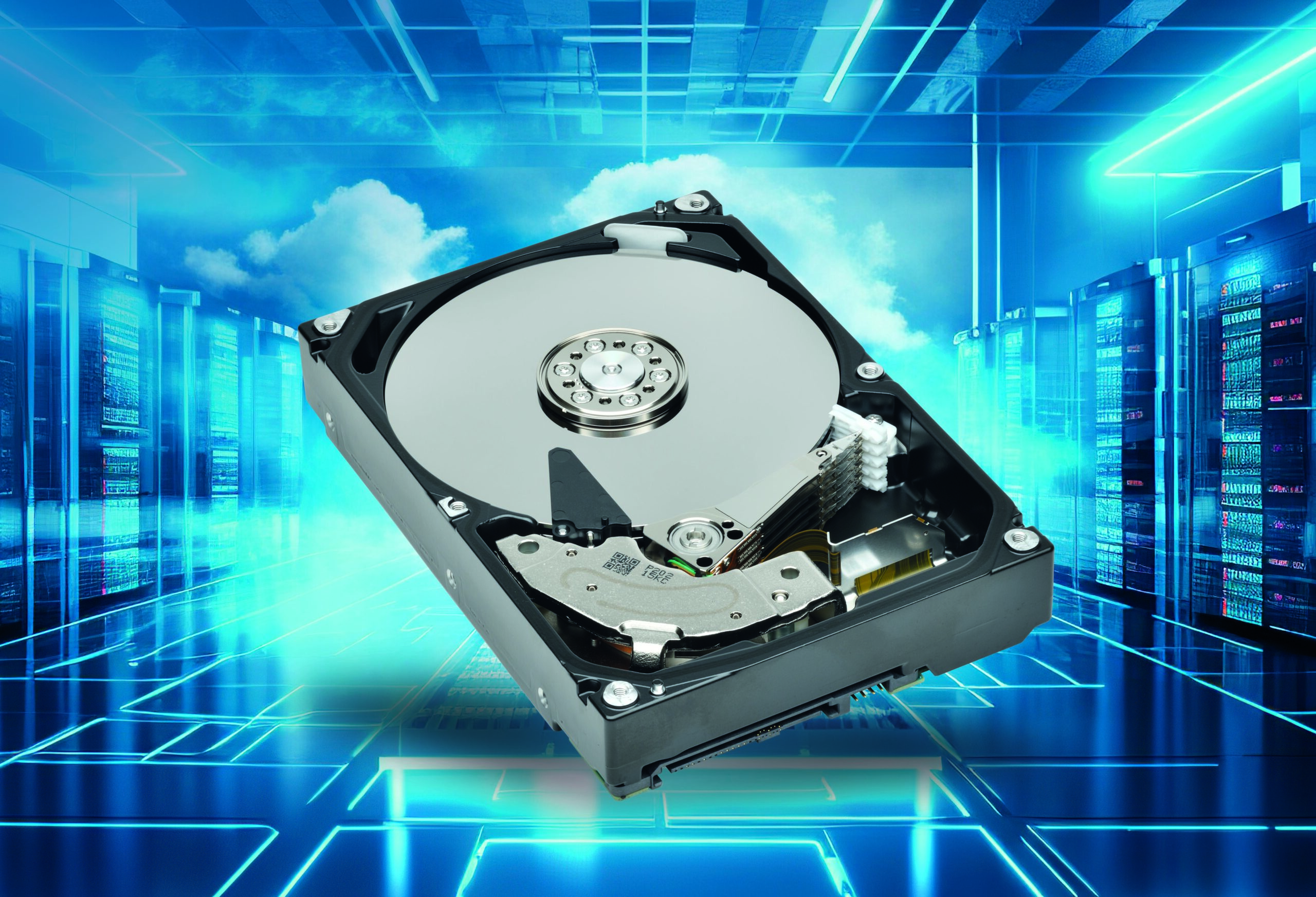
Toshiba Announces MG10-D Series of Enterprise HDDs with Capacities up to 10TB
-

 Tech News1 year ago
Nothing Launches flagship Nothing Phone (3) and Headphone (1) in theme with the Iconic Museum of the Future in Dubai