
 Have a question? +971 56 404 0503





Tech Features
Zoho Integrates AI And ML Capabilities


By: Hyther Nizam, President Middle East and Africa, Zoho
Zoho Corp. launched a new version of Zoho Analytics, the company’s self-service business intelligence and analytics platform. The update introduces significant enhancements including AI-powered features, custom machine learning model building, integration with OpenAI, improved data management, and platform extensibility. These features enable businesses to analyse data and make more informed decisions, in addition to helping them understand their customers, predict future trends, and improve operations.
Zoho Analytics has been enhanced with powerful AI and ML capabilities, allowing for diagnostic insights, predictive analysis, and automated report and dashboard generation. This, combined with improved data management features, empowers businesses to make data-driven decisions. The platform now offers expanded data management capabilities, including more data sources and data pipelines. This enables businesses to connect to a broader range of data sources, automate data workflows, and centralise business metrics.
“Zoho Analytics launched in 2009 as Zoho Reports, long before technology had caught up to Zoho’s vision for business intelligence,” said Hyther Nizam, President Middle East and Africa (MEA). “Since then, Zoho has made considerable investments around automation, no-code/low-code development, third-party integration, machine learning, and Zia, Zoho’s in-house AI engine. The latest version of Zoho Analytics is one of the first solutions from the company that takes advantage of every one of these decades-long investments. The result is a democratised platform that is powerful, intelligent, and flexible enough to benefit everyone and anyone,” Hyther added.
In addition to these enhancements, Zoho Analytics has incorporated AI-powered features such as natural language queries through Ask Zia that understands different languages including English, Spanish, and French. The platform has become more flexible and extensible, allowing businesses to customise the platform to meet their specific needs and integrate it with other BI platforms, automate tasks, and create custom data connectors.
The platform’s latest version offers a Unified Metrics Layer that allows users to manage all their business metrics in one place. This includes defining, standardising, monitoring, controlling access to, and cataloguing metrics. It also features AutoML, a no-code assistant that simplifies the model-building process. It automatically handles tasks like feature engineering, hyper parameter tuning, and model analysis, allowing users to focus on training, testing, comparing, deploying, and managing their models.









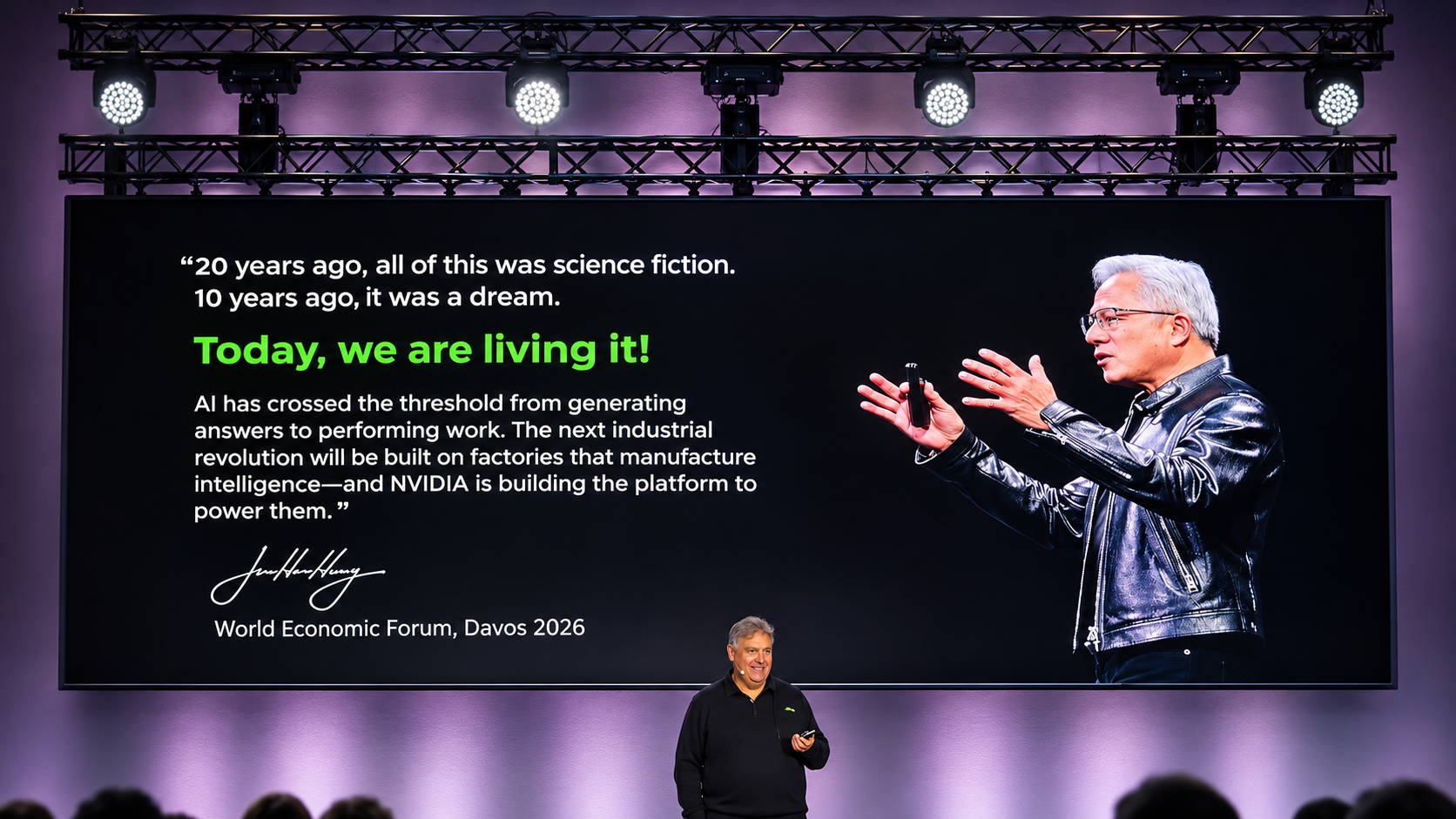
There is something almost ironic here. A company that helped persuade the world AI could reduce dependence on human judgment now faces one of its biggest uncertainties because of one human being.

By: Srijith KN, Technology Integrator
On November 12, Nvidia announced that Jensen Huang had resigned as CEO and director, with CFO Colette Kress assuming the role on an interim basis. His departure followed reports involving personal relationships and possible national security concerns. Allegations of foreign intelligence connections remain unproven. In a statement on November 8, Nvidia’s board said it had no reason to believe company secrets or national security were compromised and had initiated an independent investigation.
But the bigger story is what happens to the AI empire he built.
At a recent infrastructure conference in Croatia, an Nvidia executive jokingly introduced himself as the cheaper alternative to “my boss Jensen,” adding that he only needed the leather jacket. A funny remark, but also revealing. Huang had become more than a CEO. He was the personality behind Nvidia’s extraordinary rise.
Five issues now deserve attention.
Governance. Huang led Nvidia for 33 years as strategist, dealmaker and chief evangelist. Investors understood the value of Nvidia’s technology. What remains uncertain is how much of that value depended on the vision, relationships and influence of one individual. The question now is whether Nvidia has built the institutional strength to carry that legacy forward.
Strategy. Huang’s ambition extended far beyond GPUs. His five-layer AI framework, encompassing energy, chips, infrastructure, models and applications, envisioned an entire computing economy. The opportunity was never simply about selling processors. It was about shaping the foundations upon which the next generation of technology would operate. That vision now needs leadership capable of carrying it forward.
AI sovereignty. Perhaps Huang’s most consequential message was directed at governments. According to the Nvidia executive in Croatia, Huang routinely asks presidents and prime ministers whether their countries want to become AI “takers” or AI “makers.”
Every nation will consume AI. But those developing their own infrastructure, models and capabilities could exercise greater control over their digital futures. The executive described Huang’s support for open architectures, deployable under national laws and data requirements, as making this a geopolitical conversation, not merely a technology discussion.
Geopolitics. Huang advocated maintaining access to the Chinese market for advanced chips. His departure removes an influential voice from that debate, amid continued scrutiny of chip exports.
Economics. Nvidia’s investments in AI companies that also purchase its computing infrastructure have added another dimension to the debate over AI economics. The real question is whether the revenues generated across this ecosystem can ultimately justify the extraordinary capital flowing into it.
None of this means Nvidia’s technology advantage has disappeared. Its engineering talent, software ecosystem and customer relationships remain formidable. The board has also expressed confidence that its leadership team can continue executing the company’s technology roadmap without interruption.
But perhaps the AI industry is entering a different chapter, where governance matters more than charisma and profitability matters more than promises.
For enterprises, the lesson is simple. Never build an AI strategy around one vendor, one chip or one personality.
Technology is only as strong as the judgment guiding it.
The real test now is whether Nvidia can demonstrate that its future is bigger than the man who built it.

BY SRIJITH KN & SUBRATO BASU

As AI spending rises and experimentation gives way to accountability, the real challenge for business leaders is no longer access to technology, but proving value, controlling cost and redesigning how organisations work.
Every year, the technology industry promises a breakthrough that will change everything. New models arrive, computing capacity expands and investment reaches new highs. Then, somewhere between the product demonstration and the quarterly earnings call, someone asks the question that matters most:
What did all of this actually improve?
That question came into sharper focus in 2026.
Artificial intelligence moved deeper into everyday business. Companies deployed assistants, experimented with agents and embedded AI across customer service, software development, compliance, finance and operations.
Yet adoption turned out to be the easy part.
Installing an AI assistant is relatively straightforward. Redesigning an organisation around it is not.
Fragmented systems, poor-quality data, unclear ownership, weak governance and sceptical employees do not disappear because a company has purchased another software licence.
Businesses do not need another year of impressive demonstrations. They need to know whether AI is helping them make better decisions, serve customers more effectively and run their operations more reliably.
That shift is turning AI from primarily a technology question into a management one.
From experimentation to accountability
The adoption numbers appear impressive.
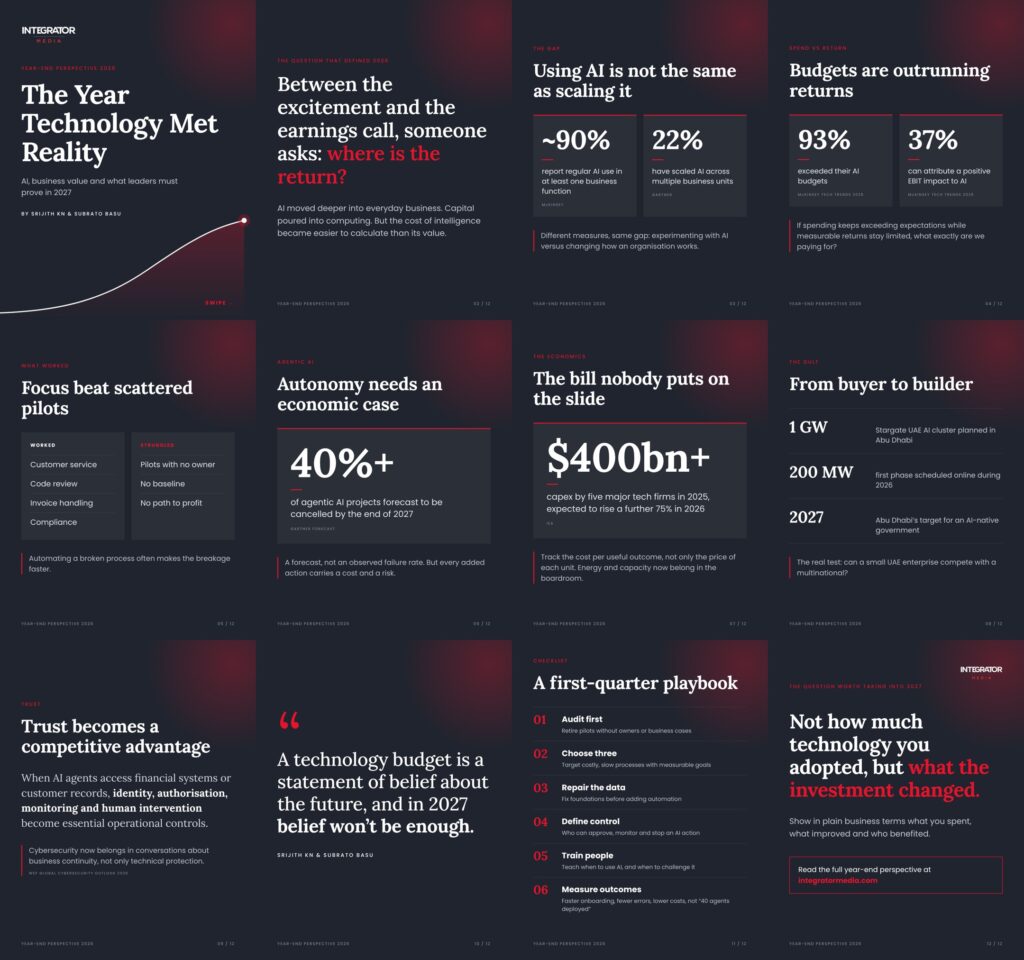
McKinsey found that nearly nine in ten survey respondents reported regular organisational use of AI in at least one business function. Gartner, using a different measure, found that only 22% of organisations had successfully scaled AI across multiple business units or adopted an AI-first approach.
The methodologies are different, but together they point to an important distinction: using AI is not the same as changing how a business operates.
The economics reinforce that concern.
In McKinsey’s Technology Trends Outlook 2026, one survey found that 93% of respondents had exceeded their AI budgets. Another found that only 37% of companies could attribute a positive EBIT impact to their AI programmes.
Those numbers create an uncomfortable boardroom question.
If spending continues to exceed expectations while measurable returns remain limited, what exactly are organisations paying for?
The clearest returns are likely to emerge where companies begin with a defined business problem: reducing customer-service resolution time, accelerating code review, simplifying invoice handling or strengthening compliance.
What becomes harder to justify is the proliferation of pilots with no accountable owner, no performance baseline and no clear route to economic value.
Automating a broken process can simply make the breakage happen faster.
Agentic AI raises the stakes
Agentic AI made this management challenge more significant in 2026.
Traditional generative AI largely responded to requests. Agents can increasingly perform multistep activities, interact with systems and execute actions.
That creates more opportunity, but it also introduces more cost, operational risk and responsibility.
Gartner has forecast that more than 40% of agentic AI projects will be cancelled by the end of 2027 because of escalating costs, unclear business value and inadequate risk controls.
It is a forecast rather than an observed failure rate, but the warning matters.
Giving software more autonomy only increases the need for organisations to define who owns the outcome, who monitors the process and who can intervene when something goes wrong.
The question for leaders is therefore becoming less about what an AI agent can do and more about what the organisation should allow it to do.
The economics nobody puts on the slide
AI is also forcing companies to think differently about technology costs.
The International Energy Agency reported that capital expenditure by five major technology companies exceeded $400 billion in 2025 and was expected to rise by another 75% in 2026.
The physical foundations of AI require enormous amounts of computing infrastructure, electricity, cooling, networking, land, semiconductors and highly specialised talent.
An individual AI task may become cheaper while the total technology bill continues to grow simply because usage expands.
That is not necessarily a problem if the additional activity creates measurable value.
But somebody needs to be able to explain what the extra expenditure produced.
Did it generate more revenue?
Did customers receive better service?
Did employees become more productive?
Did the organisation reduce risk?
Technology and finance leaders increasingly need to measure the cost per useful outcome, rather than concentrating only on the price of individual models, tokens or software licences.
Energy, computing capacity and infrastructure resilience now belong in the same boardroom conversation as digital transformation.
AI also creates a wider economic question
There is another issue that sits beyond corporate productivity.
A business may be able to reduce certain labour requirements through automation, but an economy still depends on people earning, consuming, creating businesses and paying taxes.
If productivity gains do not translate into new industries, new forms of employment or greater economic opportunity, the benefits become harder to sustain.
Reskilling cannot therefore be treated simply as a corporate social-responsibility programme.
It increasingly belongs at the centre of technology strategy.
The real measure of intelligent technology should not be how many jobs it eliminates or how many tasks it completes. It should be whether it creates durable value for enterprises while expanding economic opportunity around them.
The Gulf moves from technology buyer to builder
This is particularly relevant in the Gulf.
For years, the region was often described primarily as a major buyer of global technology. That description increasingly feels incomplete.
Across the UAE, Saudi Arabia and the wider Gulf, governments and businesses are investing in AI infrastructure, cloud capacity, digital government, data centres and technology ecosystems.
Stargate UAE, the planned one-gigawatt AI infrastructure cluster in Abu Dhabi, illustrates the scale of that ambition. Its first 200 megawatts were scheduled to come online during 2026.
Abu Dhabi’s ambition to build an AI-native government by 2027 and Dubai’s support for digital entrepreneurship point in the same direction.
But infrastructure alone does not create prosperity.
The more important question is whether that infrastructure lowers the cost of innovation and makes advanced technology accessible to the companies that drive the region’s everyday economy.
Can a UAE SME use AI to compete more effectively with a multinational?
Can a local healthcare provider deploy specialised intelligence without building an enormous internal technology operation?
Can a logistics company use automation to improve reliability rather than simply add another layer of software?
The Gulf has invested heavily in technological ambition. The next chapter will be about making that ambition useful.
That means moving from importing technology to developing capabilities, intellectual property, businesses and talent around it.
Innovation moves into the physical world
The technology conversation is also becoming broader than generative AI.
Physical AI is bringing intelligence into robotics, logistics, manufacturing, healthcare and mobility.
Digital twins, edge computing and intelligent energy systems are connecting digital decisions to physical operations. Smaller, specialised AI models may also offer better economics and governance than enormous general-purpose systems for narrowly defined industry tasks.
Quantum computing continues to advance, although business leaders should remain cautious about claims of immediate universal commercial impact.
The more urgent issue for many organisations is post-quantum cybersecurity.
Confidential information protected today could potentially become vulnerable as computing capabilities evolve, meaning organisations handling long-lived sensitive data need to begin thinking about cryptographic resilience well before large-scale quantum computing arrives.
Across these technologies, the competitive advantage is unlikely to come from collecting the greatest number of tools.
It will come from integrating the right technologies into an operation that works.
Trust becomes part of the business model
As AI systems gain access to more sensitive information and perform more consequential activities, cybersecurity becomes inseparable from business strategy.
The World Economic Forum’s Global Cybersecurity Outlook 2026 described an environment shaped by AI-enabled threats, geopolitical fragmentation and uneven cyber resilience.
AI agents interacting with financial systems, customer information or operational infrastructure raise the importance of identity controls, authorisation, monitoring and human intervention.
Cybersecurity can therefore no longer be treated simply as the responsibility of the security department.
It is increasingly about business continuity, reputation and customer trust.
The companies that can demonstrate that intelligent systems are secure, explainable and accountable may find that trust becomes a genuine competitive advantage.
2027: the numbers will have to add up
If 2026 was the year organisations experimented with how far AI could go, 2027 is likely to bring much tougher questions about whether those investments make economic sense.
A good demonstration will matter less than what a company can responsibly allow a system to do.
Agents will begin taking responsibility for defined activities, but each will require boundaries, monitoring and a human being who ultimately owns the consequences.
Boardroom conversations should shift from:
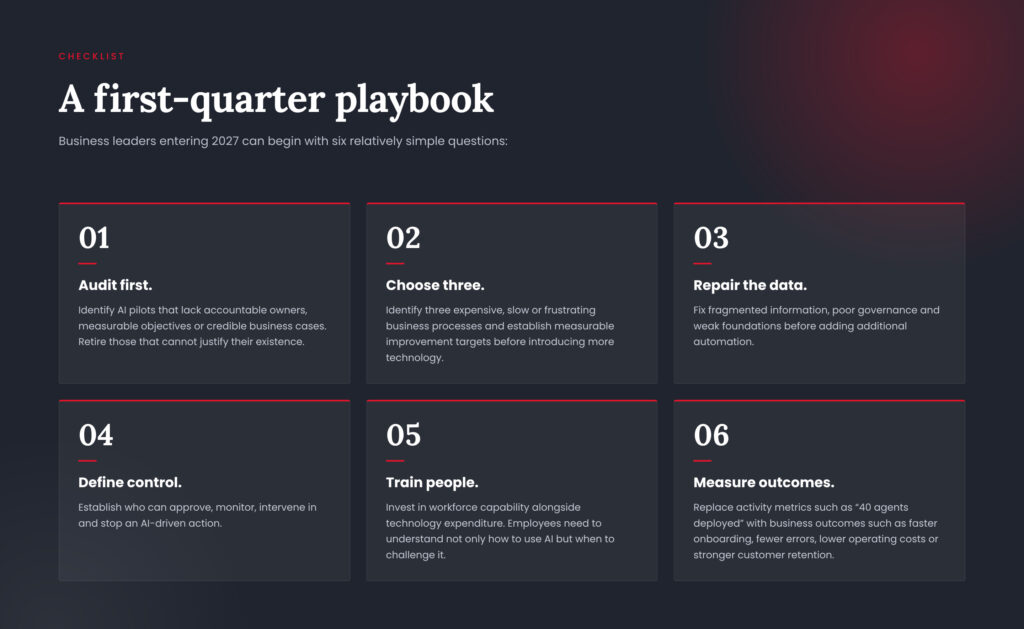
- How many AI tools have we deployed?
- to:
- What does this process cost now?
- How much faster is it?
- Has the error rate fallen?
- Are customers noticing the difference?
That scrutiny will extend beneath the software layer.
Energy availability, sovereign computing capacity, regulatory requirements and infrastructure resilience will increasingly influence where companies choose to invest.
The same scrutiny will reach the workforce.
Employees will need technical fluency, but they will also need business judgement: the ability to understand exceptions, question automated recommendations and take responsibility when systems get something wrong.
Access to another AI model will not be the defining advantage.
An organisation that operates better — at a cost that survives examination — will be.
The question worth taking into 2027
As 2026 closes, business leaders should temporarily set aside the question of how much technology their organisations have adopted.
Instead, ask what the investment actually changed.
Did serving a customer become simpler?
Did an expensive process become more efficient without becoming less reliable?
Did employees gain the ability to spend more time on valuable work?
Can the improvement be seen in the numbers?
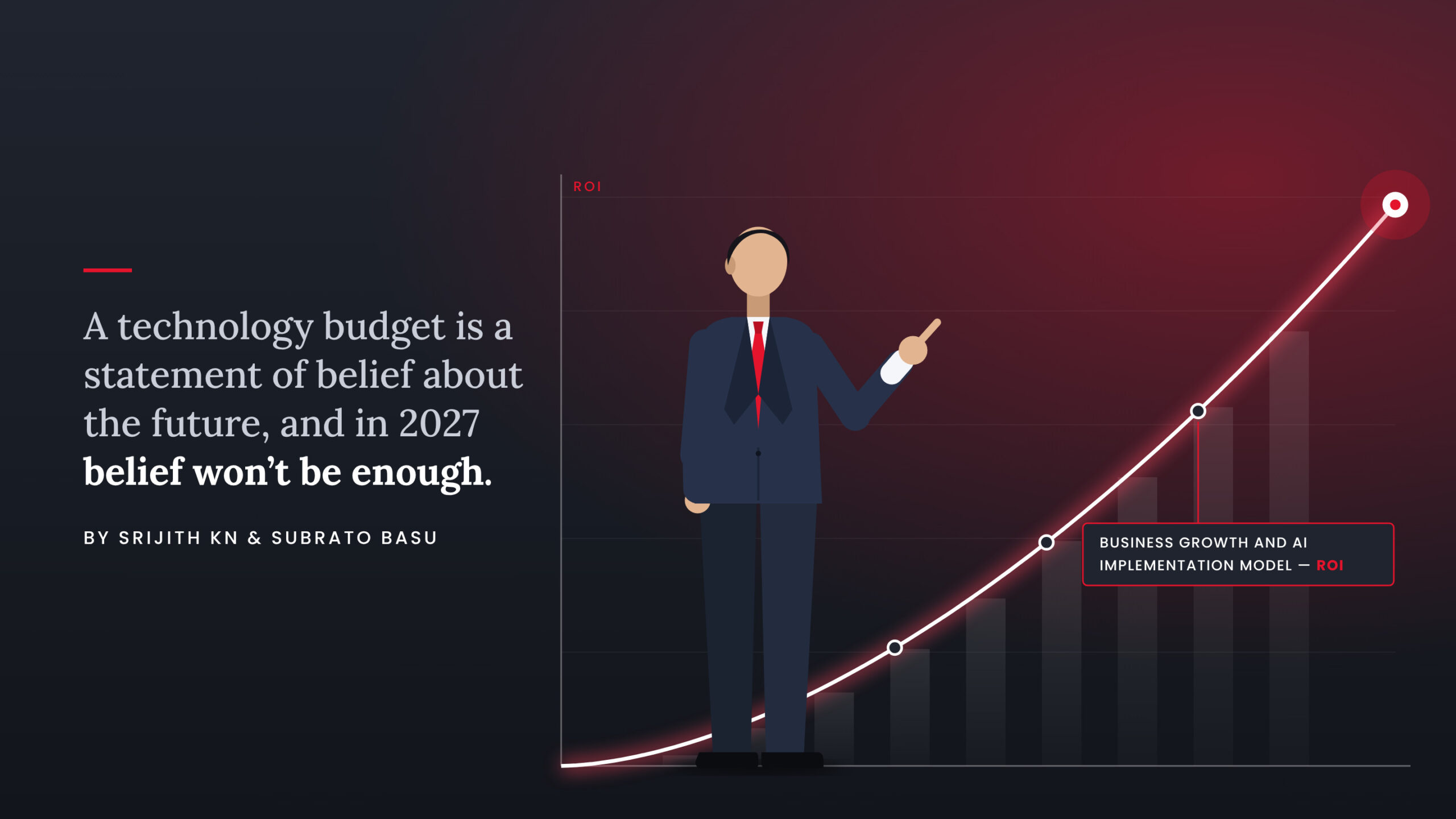
A technology budget is ultimately a statement of belief about the future.
In 2027, belief will not be enough.
AI adoption alone will no longer be impressive. The organisations that stand out will be those that can explain, in plain business terms, what they spent, what improved and who benefited.
And that may be the clearest indication yet that AI is becoming less of a technology problem — and much more of a management one.
Subrato Basu is an author, adviser and speaker on AI strategy and technology cost management. With nearly three decades of experience advising C-suite leaders, he helps organisations across North America, Asia Pacific and the Middle East turn technology investment into measurable business value.
Srijith KN is Senior Editor at Integrator Media, who is hands-on in covering enterprise technology, artificial intelligence, cybersecurity and the digital economy across the Middle East.
By Sourav Guha Roy, Practice Head – Cyber Academy, CPX
Prevention remains essential to cybersecurity, but it is no longer enough on its own. As AI-enabled threats become increasingly complex, convincing and harder to detect, a new question is gaining prominence in boardrooms across the region: if an attack succeeds, how quickly can the business recover? How effectively can teams recognize a threat, leaders make critical decisions under pressure and coordinate a response before disruption escalates?

For business leaders, the focus is shifting from simply keeping attackers out to containing damage, restoring critical services and maintaining business continuity. Building this capability requires more than technology safeguards. It means preparing people, establishing clear processes and ensuring teams can act decisively under pressure.
Recovery readiness: From prevention to preparation
Cyber readiness is often measured by what an organization puts in place before an incident: clear responsibilities, tested response plans and technology that supports detection and decision-making. But when an attack succeeds, the real measure of preparedness is how effectively are the people able to use these capabilities to limit disruption and restore critical services.
Cyber resilience extends beyond the initial response. It is an organization’s ability to adapt to disruption, maintain essential functions and recover while managing the wider impact on customers, employees and business performance. The speed and effectiveness of that recovery depend on more than the tools available. People must interpret alerts, assess business impact and make decisions that enable the organization to move forward.
This distinction has important implications for leadership. Preventing every incident may not be realistic, but organizations can prepare for the moments when prevention fails. The priority is to ensure that response plans work in practice, responsibilities are understood and teams can make coordinated decisions under pressure.
Three connected pillars of cyber readiness
A human-centric approach does not reduce the importance of technology. Instead, it aligns three interdependent pillars: people, process and technology.
- People provide context, judgment and ethical oversight. They need the confidence to pause when an instruction appears unusual, verify a request through a trusted channel and report concerns without delay. In an environment shaped by AI-generated impersonation, these behaviors are increasingly important.
- Process turns individual awareness into a coordinated response. Clear escalation routes, decision authority and defined ways of working help employees and specialist teams understand what happens after a concern is raised. Processes should also clarify the responsible use of AI, including which tools are approved, what information may be shared and how AI-related risks should be reported.
- Technology protects systems and supports human decisions by detecting suspicious activity, controlling access and monitoring how AI and organizational data are used. Yet an alert is only an indication that something requires attention. Without context, ownership and action, it does not create readiness or guarantee a timely recovery.
Consider a finance employee who receives an urgent payment instruction that appears to come from a familiar executive. Technology may flag unusual activity, process determines how the request is verified and escalated, and people apply judgment and involve the right decision-makers.
From the frontline to the boardroom
Cyber readiness should reflect the decisions expected of each role. Employees must recognize and report warning signs. Specialists must assess the impact, coordinate the response and restore operations securely. Leaders must make informed decisions when facts are incomplete, balancing security, continuity and accountability.
Readiness depends on the handoffs between these groups: employees need clear reporting routes, specialists need the authority and information to act, and leaders need timely insight into business impact.
Build capability through a continuous cycle
Human-centric readiness is not achieved through a one-time awareness campaign. A practical model is to Assess, Train and Simulate continuously.
Do employees verify unusual requests? Can specialist teams build a shared view of impact? Do leaders know when to intervene? Can critical services be restored within acceptable timeframes? The findings should feed back into the next assessment and improvement cycle.
Conclusion: Make recovery a business priority
No organization can guarantee that every cyberattack will be prevented. But every organization can decide how prepared it will be when one occurs. That means moving beyond prevention metrics to test how effectively teams contain incidents, protect critical services and restore operations.
The most important shift is to stop treating people as the weakest link and start preparing them as an active part of the defense. This does not mean turning every employee into a cybersecurity expert. It means ensuring that each person knows what to recognize, how to respond and when to escalate.
The strongest organizations will not be those that eliminate every human error. They will be those that give people the judgment, processes and support to prevent a single mistake from becoming a business crisis.
For boards and executive teams, the call to action is clear: ask not only how likely an attack is, but how long the business could operate under disruption. Cyber resilience is ultimately measured not by the absence of incidents, but by the ability to withstand them and recover. The organizations best positioned for the future will be those that make recovery readiness a business priority before the next attack begins.


DOERS Summit Dubai 2026 to Bring Together 5,000 Participants for Technology and Investment Discussions

Beyond the 30×30: EVIRON Encourages Everyday Wellness This Dubai Fitness Challenge
UBK Turns Up the Festive Season with Weekly Quiz Nights, a Saturday Mic Drop and Festive Turkey to Go

OPPO A6 Pro 5G Review: Reliable Daily Driver

Denodo Bolsters Executive Team by Hiring Christophe Culine as its Chief Revenue Officer

Microsoft Launches New Surface Copilot+ PCs for Business

2026 in Review: Is AI Becoming More of a Management Problem Than a Technology Problem?

Inside XPENG Brand Night: AI Mobility Lands Centre Stage in Dubai

Chinese Cars Are Reshaping the GCC Market, but Resale Value Could Be the Next Battleground

-
 Trending1 year ago
OPPO A6 Pro 5G Review: Reliable Daily Driver
-
 Tech News2 years ago
Denodo Bolsters Executive Team by Hiring Christophe Culine as its Chief Revenue Officer
-
VAR2 years ago
Microsoft Launches New Surface Copilot+ PCs for Business
-

 Automotive2 years ago
AGMC Launches the RIDDARA RD6 High Performance Fully Electric 4×4 Pickup
-

 VAR11 months ago
Huawei Nova 14 Pro Review: Where Camera Excellence Meets Ecosystem Evolution
-
Tech Interviews3 years ago
Navigating the Cybersecurity Landscape in Hybrid Work Environments
-

 Hospitality2 years ago
Gulfood 2025 30th Edition Kicks Off Today, Setting New Benchmarks in F&B Growth and Innovation
-
News4 years ago
BenQ ZOWIE : First TN 360Hz DyAc+ Gaming Monitor