
 Have a question? +971 56 404 0503




Home Integrator
LEOS Developments Joins Emirati Families in Giving Back This Ramadan in partnership with Dubai Charity Association


LEOS Developments is embracing the spirit of giving through a meaningful partnership with Dubai Charity Association. Together, they will provide vital support to hundreds of thousands of families throughout the month, reinforcing the values of generosity and unity that define the country’s traditions.
In collaboration with Emirati families, LEOS Developments will prepare traditional meals, and distribute them across Dubai, ensuring those in need receive iftar meals. Dishes such as Biryani, Mandi, Machbous, Harees—staples of traditional cuisine—will provide nourishing meals but also celebrate the country’s rich cultural heritage. Beyond meal distribution, LEOS will also contribute to assembling and delivering essential meal boxes at various locations across the city.
By working hand-in-hand with local families throughout the month, LEOS Developments reaffirms its deep respect for Emirati traditions and its ongoing commitment to meaningful community engagement. More than just a seasonal initiative, LEOS believes in creating communities that thrive together and go beyond real estate development, extending to the well-being of people and strengthening the social fabric of the UAE.










Home Integrator
DUBAI INVESTMENTS BREAKS GROUND ON LANDMARK AL VISTA MIXED‑USE DEVELOPMENT IN MEYDAN, COMMENCES MAIN CONSTRUCTION WORKS

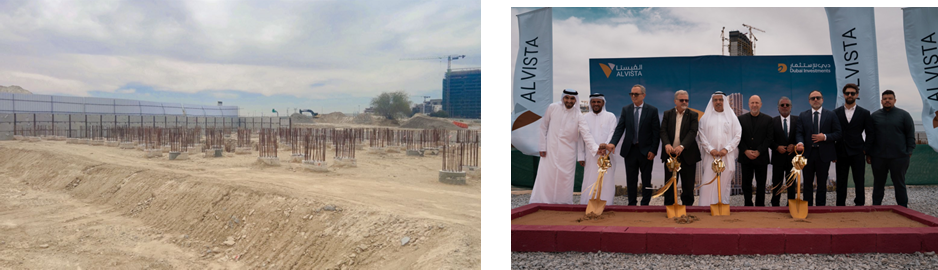
Dubai Investments breaks ground on Al Vista, its landmark mixed‑use development in Meydan Horizon. Developed through its wholly‑owned real estate subsidiary, Dubai Investment Real Estate (DIR), Al Vista is a large‑scale mixed‑use development comprising residential, commercial and retail components within a unified masterplan.
The ground‑breaking ceremony was held in the presence of Khalid bin Kalban, Vice Chairman and CEO, Dubai Investments, Obaid Salami, General Manager, Dubai Investment Real Estate along with other senior representatives and the contractor for the project.
As part of the milestone, DIR also signed the main construction contract with JV Hourie Paramount appointing the contractor to deliver the project in line with the approved execution plan.
Commenting on the ground-breaking, Obaid Salami, General Manager of Dubai Investment Real Estate, said: “Al Vista represents an important addition to DIR’s portfolio and reflects a disciplined approach to development, anchored in quality, execution certainty and long‑term value creation. With main construction now underway, DIR is committed to delivering well‑planned, high‑quality developments in key growth locations across Dubai, positioning Al Vista to emerge as a defining mixed‑use destination upon completion.”
Located within Meydan Horizon, one of Dubai’s most sought‑after mixed‑use districts, Al Vista comprises a 39‑storey residential tower featuring 312 apartments, including one‑, two‑ and three‑bedroom units, alongside a 19‑storey commercial tower offering approximately 120,000 sq. ft. of shell‑and‑core office space, complemented by integrated retail components. The development is designed to support a connected urban environment, with a comprehensive range of lifestyle and recreational amenities serving both residents and commercial occupiers. Construction is advancing as scheduled, with planned completion targeted for Q1 2028
Home Integrator
DAMAC’S AMIRA SAJWANI: IN THE PRESENCE OF HH MOHAMMED BIN ZAYED AL NAHYAN AND HH MOHAMMED BIN RASHID AL MAKTOUM, WE HAVE NOTHING TO FEAR

Amira Sajwani, Managing Director of DAMAC Properties, the UAE’s and the Middle East’s largest private real estate developer, issued a statement affirming confidence in the future of the United Arab Emirates despite the current political tensions in the Middle East and the GCC.
Sajwani emphasised that the nation’s continued stability and economic strength are underpinned by the country’s wise leadership and long-term vision, which have consistently guided the UAE through global and regional challenges while reinforcing its economic fundamentals.
Commenting on the current conditions, Amira Sajwani, said: “In the presence of His Highness Sheikh Mohamed bin Zayed Al Nahyan, President of the UAE and the Ruler of Abu Dhabi, and His Highness Sheikh Mohammed bin Rashid Al Maktoum, Vice-President and Prime Minister of the UAE, and the Ruler of Dubai, we have nothing to fear. History has taught us that the UAE always overcomes challenges and emerges stronger. We witnessed this during the global financial crisis in 2008, during COVID-19, and again following the April 2024 storm widely known as the ‘Hadeer Storm.’ With the guidance of our leadership, this time will be no different. The UAE will continue to move forward with resilience and confidence.”
Sajwani added that the strength of the UAE’s economic fundamentals, particularly in the real estate sector, continues to be reflected in record market performance. According to Dubai REST, Dubai recorded AED 246.12 billion in real estate sales in Q1 2026, compared to AED 142.7 billion in Q1 2025, representing a 72.46% year-on-year increase.
“These figures clearly demonstrate that despite political tensions across the region, the fundamentals of Dubai’s real estate market remain exceptionally strong,” Sajwani said. “Demand continues to grow, and investor confidence in Dubai remains robust, reinforcing the emirate’s position as one of the world’s most attractive investment destinations.”
Sajwani further noted that DAMAC Properties continues to play a leading role in the market’s performance. The developer ranked No. 1 in Dubai’s real estate industry by market share of sales transactions, recording a total of 3,663 units sold, further cementing its position as a key contributor to the emirate’s real estate success.
She also confirmed that construction progress across all DAMAC projects remains on track, with handover timelines continuing as scheduled without any changes, reflecting the company’s strong operational capabilities and commitment to delivering projects on time.
Sajwani concluded by reaffirming that the UAE’s leadership, economic vision, and global reputation for stability will continue to attract international investors and sustain long-term growth across key sectors, including real estate.
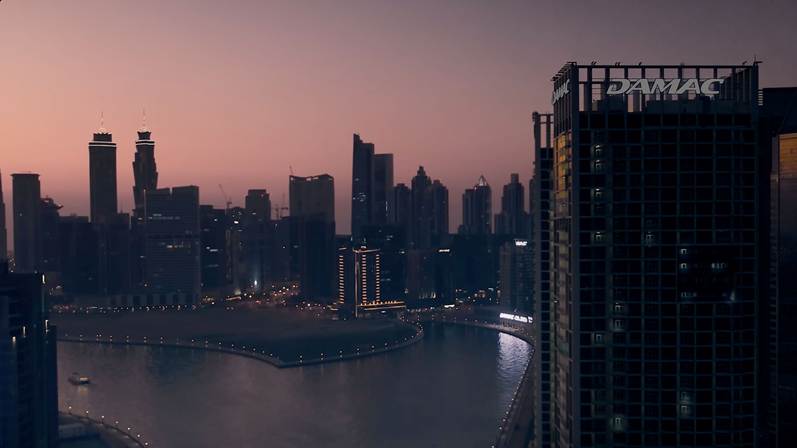
DAMAC Properties, the largest private real estate developer in the UAE and the Middle East, has urged more than 300,000 residents staying across its communities and team members to participate in ‘Earth Hour 2026’. The annual sustainability initiativeis part of a global movement highlighting the urgent need for climate awareness and energy conservation.
On Saturday, March 28, DAMAC communities and towers across Dubai will go dark by switching off lights for one hour, starting 8.30pm. The initiative is supported by community engagement teams and sustainability champions from LOAMS, the award-winning, jointly owned property and community management company.
DAMAC’schampioning of Earth Hour reinforces its commitment to building a sustainable future. Switching off lights for one hour across 50,000 homes has an impact equivalent to planting 200 trees that thrive for a decade. It saves 10,800 kWhr, equal to 4900kg of carbon dioxide emissions.
Patricia Torres, a resident of DAMAC Hills 2, noted: “It is motivating to see our community united for a meaningful cause. Earth Hour helps us appreciate how simple actions taken together can create real and lasting change. We look forward to playing our part by switching off lights and make a positive impact in the fight against climate change.”
Earth Hour, organised by WWF, is a global grassroots movement that started as a lights-out event in Sydney, Australia in 2007. Since then, it has grown to engage millions of supporters globally. As the movement grows, the one-hour lights out event continues to be the symbol of a broader commitment toward nature and our planet.

HOP INTO EASTER AT MCGETTIGAN’S WITH FAMILY ROASTS, EGG HUNTS AND CLASSIC SUNDAY FAVOURITES
CELEBRATE EASTER WITH A FAMILY-FRIENDLY BRUNCH AT LA PISCINE,AL RAHA BEACH RESORT & SPA
WHOOP RAISES $575 MILLION AT $10.1 BILLION VALUATION TO ADVANCE GLOBAL HEALTH PLATFORM AND FURTHER GCC EXPANSION

-
News10 years ago
SENDQUICK (TALARIAX) INTRODUCES SQOOPE – THE BREAKTHROUGH IN MOBILE MESSAGING
-

 Tech News2 years ago
Denodo Bolsters Executive Team by Hiring Christophe Culine as its Chief Revenue Officer
-
 VAR12 months ago
Microsoft Launches New Surface Copilot+ PCs for Business
-

 Tech Interviews2 years ago
Navigating the Cybersecurity Landscape in Hybrid Work Environments
-

 Trending5 months ago
OPPO A6 Pro 5G Review: Reliable Daily Driver
-

 Tech News9 months ago
Nothing Launches flagship Nothing Phone (3) and Headphone (1) in theme with the Iconic Museum of the Future in Dubai
-

 Automotive1 year ago
AGMC Launches the RIDDARA RD6 High Performance Fully Electric 4×4 Pickup
-

 VAR2 years ago
Samsung Galaxy Z Fold6 vs Google Pixel 9 Pro Fold: Clash Of The Folding Phenoms