
 Have a question? +971 56 404 0503




Tech Features
Localization is at the Core of Hisense’s Middle East Strategy!

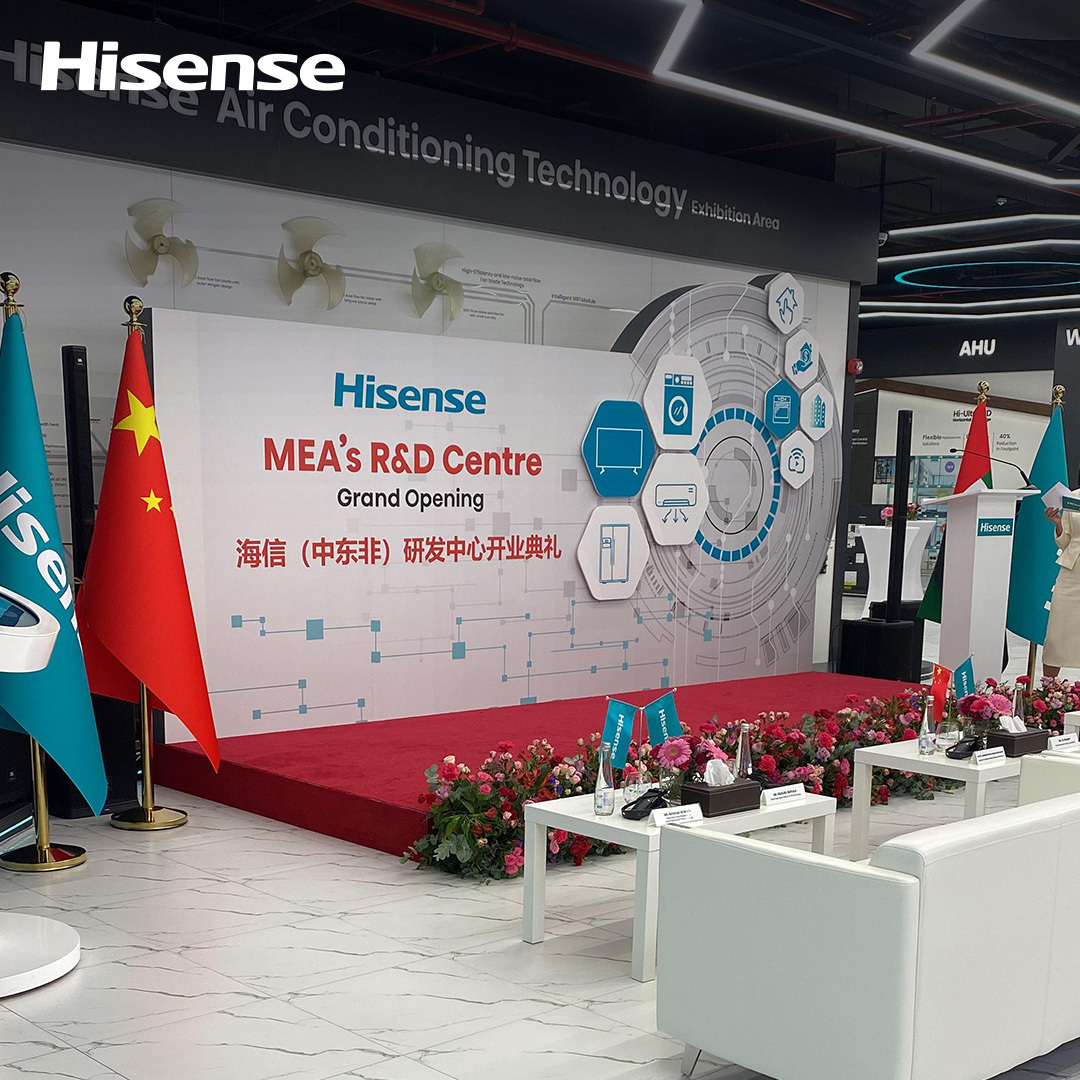

In conversation with Jason Ou, President, Hisense Middle East & Africa on regional R&D, AI-powered products, and next-generation home innovation.
Here in the interview, we take a look at the strategic role of its Dubai R&D Centre in localizing global innovation for Middle Eastern consumers, ensuring products are climate-ready, culturally relevant, and aligned with regional lifestyles.
We talk about how the company is embedding AI across TVs and home appliances to improve performance, energy efficiency, and ease of use, while reducing manual intervention.
Through Hisense we take a look at the advantages of Laser TV technology, and what Hisense is offering through its large-format, energy-efficient cinema experiences suited to our homes.
Can you start by telling us about the role of the Hisense R&D Centre in Dubai within the company’s broader innovation ecosystem?
Our Dubai R&D Centre is an essential part of how we localise global Hisense technology for the Middle East. It allows us to test products under real regional conditions, understand consumer behaviour more accurately, and adapt features or performance where needed.
The centre also helps us coordinate closely with local partners, retailers, and government entities. This ensures our innovations are not only technically strong, but also aligned with local lifestyle needs, climate demands, and regulatory standards. It strengthens the link between our international R&D network and what consumers expect from the brand here.

- Can you share examples of product tweaks or innovations that originated from local feedback? How does the R&D team ensure Hisense products meet the expectations of increasingly tech-savvy and connected households in the region?
We’ve made several practical product adjustments based on insights gathered in this market. For example, we enhanced compressor durability and airflow design to handle prolonged periods of extreme heat, dust, and humidity. We also refined our filtration systems to better suit environments where air quality can vary throughout the year. Another important highlight is our anti-mould functionality, developed specifically for this region. During the summer months, higher levels of humidity can lead to mould formation within AC units, so we engineered a cycle that keeps internal components dry and prevents mould from growing, ensuring cleaner air and improved long-term performance. Additionally, we’ve optimised cooling performance to ensure faster temperature recovery, which is a key priority for consumers in this climate.
From a smart technology perspective, we have incorporated features such as AI-enabled energy optimisation, advanced Wi-Fi controls, and more intuitive mobile app interfaces. These include smart notifications and automated modes that help users maintain healthier indoor air quality, especially during periods of high humidity. These updates came from feedback that users want greater visibility and control over energy consumption, remote access, and seamless integration with smart home systems.
To stay connected with highly tech-savvy consumers, we run continuous testing cycles and user studies. We also gather retailer feedback and analyse usage data to understand how households interact with our products. This helps us shape updates and features that are relevant, intuitive, and reliable for the region.
- How is Hisense embedding AI into its consumer products? Beyond convenience, what real benefits does AI bring to users?
We apply AI where it consistently delivers value. In TVs, AI enhances picture and audio quality by analysing content and room conditions in real time. In appliances, AI improves energy efficiency, adjusts performance based on usage patterns, and supports predictive maintenance, reducing the likelihood of breakdowns and improving overall product life. In our laundry category, AI plays an increasingly important role in recommending the ideal wash cycle based on fabric type, colour, and load size. It can even set the appropriate water temperature and spin speed, helping users to protect delicate garments while improving wash performance.
For users, the benefit is straightforward: better performance with less manual intervention. AI helps the product adapt to the user, rather than requiring the user to adapt to complex settings.
- What differentiates Laser TV from traditional LED or OLED technology, both in performance and environmental impact?
Laser TVs offer a fundamentally different viewing experience and cannot be directly compared to traditional LED or OLED panels, as they each serve different purposes. The laser TV is designed to replicate a true cinema environment; it uses ultra-short throw laser technology which is better suited for large-format screens due to consistent colour accuracy, strong contrast, and reduced eye strain. It performs especially well at sizes above 100 inches, where conventional panels become less practical, heavier, and significantly more power-intensive.

From an environmental standpoint, the laser TV uses far less energy and production materials than similarly sized LED or OLED screens. This makes it a more sustainable choice for consumers who want a big-screen experience without the high power consumption of traditional panels.
At Hisense, we are pioneering this category globally, with a current positioning as the world’s number one laser TV brand. We endeavour to continue expanding the technology to bring the big-screen cinema experience into modern homes.
- How is Hisense adapting its Laser TV lineup for Middle Eastern consumers, who often value both cinematic experience and design aesthetics?
Middle Eastern households are generally more accommodating of large, high-quality displays and interior design. While we have not developed a laser TV range exclusively for the Middle East, we are continuously enhancing our overall TV ecosystem in ways that benefit local users, particularly through our updated VIDAA operating system, which now includes more Arabic interfaces, regional apps, and local streaming platforms such as Shahid.
The region presents a strong opportunity for laser TV adoption, especially in large homes and villas where dedicated cinema rooms are becoming increasingly popular. The Hisense laser TV is ideal for this environment, offering an ultra-short throw set-up, immersive large-format viewing, and a cinema-style experience without the need for complex installation or heavy wall-mounted panels.
We continue to focus on features such as ALR (ambient light rejection) screens, enhanced sound performance, and clean, modern industrial design, all of which make laser TV a natural fit for households looking to elevate both their viewing habits and their interior spaces.
- What are the next big innovation priorities for Hisense in the Middle East?
Across the world and in the MEA region, our goal is to innovate products that simplify everyday life. We are focused on advancing our AI chips, enhancing intelligent capabilities, and expanding ConnectLife to build a fully connected home ecosystem that is smarter, more intuitive, and increasingly predictive.
We are also strengthening our core product lineup with meaningful category breakthroughs. In our laundry segment, we recently launched PureView and X-Zone Master, two products that we believe represent a new standard in performance, design, and user-centric innovation. In the display category, we’ve introduced the 116-inch RGB Mini-LED, a landmark innovation that we expect will redefine what consumers can expect from large-screen entertainment.
From a regional standpoint, we continue to develop our air-conditioning solutions to withstand extreme heat, humidity, dust, and long operational hours , priorities that are especially important for the Middle East. For home appliances, we’re building features tailored to local lifestyles, such as the Abaya wash cycle in our washing machines, ensuring cultural relevance and ease of use for consumers in this market. These initiatives reflect the growing needs of our consumers in the region: reliability, connectivity, climate-ready performance, and elevated home entertainment experiences

Kayvan Karim, Programme Director of MSc Software Engineering, School of Mathematical and Computer Sciences, Heriot-Watt University Dubai
For the past few years, the AI infrastructure race has largely been measured in scale: more GPUs, larger data centres and greater power capacity. That expansion is continuing, but the economics are beginning to change. Competitive advantage may increasingly depend not only on securing additional power, but on extracting more useful AI work from the power already available. Part of the reason is a change like AI demand. We are moving from relatively simple prompt-and-response systems towards agents that can reason across multiple steps, call tools, inspect results, revise plans and continue working autonomously. Anthropic’s latest Economic Index notes that Claude usage is increasingly shifting towards long-running agentic tasks and that more computationally intensive conversations tend to be associated with higher-value outputs.
This transition could have significant implications for infrastructure demand. A chatbot might generate one answer to one prompt. An agent performing a software-development, research or business task may invoke a model dozens of times, maintain a large context, call external tools and generate many intermediate reasoning steps before producing an outcome. Demand may therefore grow in two ways: more people using AI and more inference, model calls, and tokens processed for each task. Major AI laboratories are already working on this efficiency problem. OpenAI says one of its primary inference objectives is to serve more tokens from the same hardware, using techniques including scheduling, caching, kernel optimisation and improved model implementation. It also describes GPT-5.6 as being trained to accomplish more work per token. Google DeepMind is pursuing a similar direction: its Gemini 3.6 Flash was designed for scaled agentic workloads and uses fewer output tokens than its predecessor on several evaluations. In contrast, its recent agentic video system reduced token consumption by up to 88% for that workload.
Other approaches address efficiency at the model architecture level. DeepSeek-V3, for example, uses a Mixture-of-Experts design with 671 billion total parameters but activates 37 billion per token, so only part of the network is used for each computation. Meta has similarly worked on inference efficiency through grouped-query attention and more efficient tokenisation; the Llama 3 tokeniser was reported to require up to 15% fewer tokens than Llama 2 for equivalent text. Taken together, these approaches show that model capability is increasingly being developed alongside the cost of delivering it.
Model-level efficiency, however, is unlikely to remove the infrastructure constraint on its own. Global data-centre electricity consumption was approximately 415 TWh in 2024, according to the International Energy Agency, and its base case projects this to reach around 945 TWh by 2030. AI is expected to drive most of that growth. Efficiency is therefore improving while aggregate demand continues to rise. One reason is the Jevons, or rebound, effect: efficiency improvements reduce the resources required for each unit of work, but lower costs can also encourage greater overall use. If agents become much cheaper to operate, organisations may respond by deploying more of them, running them for longer, or applying them to tasks that were previously uneconomic. Efficiency can reduce the compute required for an individual task while still increasing total demand.
That increased demand meets infrastructure that cannot expand as quickly. Models and software can improve quickly, but grids, substations, transformers and power-generation infrastructure usually have much longer development cycles. The IEA notes that while a data centre can sometimes be developed within two or three years, the broader energy infrastructure required to support it often involves longer planning and construction periods. Where grid capacity is constrained, each available megawatt becomes a more valuable production resource. The amount of power available remains important, but so does the amount of useful computation that can be produced within that power envelope.
That changes how we should understand capacity. Improvements in accelerator performance, model architecture, workload scheduling, caching, utilisation and inference software can increase computational output without increasing a site’s electrical connection. OpenAI’s recently reported Jalapeño inference hardware illustrates the direction of travel: the company says the chip can deliver more AI work per unit of power while increasing throughput and reducing latency. Efficiency can therefore act as a form of virtual capacity. If two operators each control 100 MW, but one can consistently deliver substantially more useful AI work within that power envelope, their nominal capacity may be identical while their productive capacity is not.
The same constraint applies to physical space and cooling. AI systems are concentrating more computational power into individual racks, increasing both power density and heat output. Packing more accelerators into the same building only creates useful capacity if the electrical and thermal infrastructure can support them. This is one reason liquid cooling is moving from a specialist technology towards a more central part of AI data-centre design. Microsoft, for example, has introduced a closed-loop chip-level cooling architecture that it says eliminates evaporative water consumption for cooling and could avoid more than 125 million litres of water annually per data centre. The example also shows why power, cooling, water use and rack density cannot be treated independently.
The same shift creates a measurement problem. Power Usage Effectiveness, or PUE, has been valuable for showing how much facility energy is required beyond the electricity IT equipment consumes. It does not, however, measure whether that IT equipment is producing useful work efficiently. Uptime Institute’s 2025 survey placed average PUE at around 1.54 and noted that the headline industry figure had changed little for six years. Uptime has consequently argued for productivity measures that relate computational work to energy consumption. For AI inference, tokens per kilowatt-hour might offer one operational measure. Still, even that is incomplete: an efficient model that solves a task in 1,000 tokens may be more valuable than one generating 10,000. A more useful long-term measure may therefore be useful AI work per unit of energy, water and infrastructure.
Capacity will remain essential. The AI industry will continue to build larger data centres, secure new power supplies and deploy large quantities of computing hardware. As agentic systems create more persistent inference demand and physical resources become harder to expand, however, efficiency may increasingly determine the productive value of that capacity. Operators that can support more useful computation within the same power, cooling, water, and space constraints can accommodate more workloads without waiting for equivalent growth in physical infrastructure.
For AI infrastructure, installed megawatts will remain a headline measure. The more consequential measure may increasingly be how much useful AI work those megawatts can support.
Tech Features
Alteryx Launches New AI Capabilities to Bring Governed Analytics Anywhere Work Happens

Alteryx, the agentic analytics and automation company, today announced new AI capabilities across Alteryx One that connect enterprise-grade business logic directly to the AI agents’ teams already use. By extending governed workflows and datasets to external AI tools, organizations can “build once and govern once,” eliminating the need to recreate complex business logic from scratch. This approach allows enterprises to scale AI action with confidence, helping to reduce both security risks and runaway token costs.
- 71 percent of IT leaders report that AI initiatives are most successful when IT and business teams collaborate closely to bridge the gap between AI agents and enterprise business logic.
- NextWave achieved a 20x reduction in LLM token consumption using an Alteryx workflow during a complex Office of the CFO reconciliation between front-office and back-office data.
- Up to 93 percent reduction in token consumption and up to 85 percent increase in speed on tasks involving raw, ungrounded data, when combining an LLM with an existing, trusted Alteryx workflow.
- Up to 83 percent reduction in token costs and up to 65 percent increase in speed on tasks involving clean, grounded data.
- 65 percent of analysts confirm that AI delivers the most value when business logic is managed at the business level.
“Generative AI is brilliant at brainstorming, but it often struggles with the precision required for enterprise execution. Organizations don’t need agents that guess at business rules and burn through tokens; they need AI that operates on the same trusted business logic and governance that underpin the rest of the business,” said Ben Canning, Chief Product Officer at Alteryx. “By connecting existing tools to a governed business logic layer, we are allowing enterprises to stop the ‘re-work’ tax of rebuilding business rules for every new agent, ensuring that every AI-driven action is as reliable as the calculations they already trust.”
The latest capabilities include:
Ask Alteryx: With this release, Ask Alteryx evolves from an embedded assistant into the primary way users interact with Alteryx One, guiding new users step-by-step through their first workflow in Designer and giving everyone a natural-language front door to their data through Ask Alteryx for Live Query, with connections to Snowflake, Big Query, and Databricks for reading and writing data directly. Ask Alteryx checks existing workflows and data first, delivering a governed answer when one exists or building a new workflow when it doesn’t, with every output remaining inspectable, editable, reusable, and schedulable within Alteryx One.
Agent Studio: Enables business users to turn existing, already-governed datasets into conversational agents without rebuilding anything. Analytics teams maintain full control over which datasets and KPIs power agent responses, while finance and operations departments can instantly scope an agent to their reconciliation dataset or KPI dashboard data, so stakeholders can ask trend, root-cause, and variance questions in plain language and get governed, explainable answers back.
Alteryx Insights for OpenAI: Available through the ChatGPT Plugin Directory, this capability allows business users to generate answers based on analyst-approved data, calculations, and workflows. Employees can investigate revenue variances or resolve reconciliation issues directly, accessing trusted business logic without opening the platform or requiring an Alteryx seat. Alteryx will be expanding this surface integration strategy to bring governed logic to where teams already collaborate, including upcoming support for Claude, Gemini, Slack, and Microsoft Teams.
Alteryx MCP Server: The governed way to use Alteryx from whatever AI platform or agent you already work in. It lets AI agents interact with Alteryx as easily as a human would, finding the right data, building multi-step solutions, and turning them into governed, repeatable workflows. Agents can build, run, schedule, and discover Alteryx assets directly, with external AI requests inheriting Alteryx’s authentication, workspace context, role-based access controls, and permissions automatically, so every interaction carries the same security model and audit trail as if a person had done it. More capabilities, including connection creation and expanded scheduling, are expected to roll out later this year on the same governed connection.
Alteryx Skills: A GitHub install that teaches third-party agentic interfaces, OpenAI Codex, Microsoft Copilot, Claude Code, Gemini CLI, and more, how to build Alteryx assets the right way, closer to how Ask Alteryx already builds them. Rather than each tool guessing at Alteryx’s patterns on its own, Skills gives them Ask Alteryx’s own workflow-building know-how, so a financial calculation or reconciliation workflow gets built correctly the first time, without rebuilding logic or permissions separately for every tool your team uses.

Article by Prasanna Rajendran, Vice President – EMEA, Kissflow
Across the Middle East, governments and enterprises are investing heavily in cloud infrastructure to support national digitization agendas, from Vision 2030 in Saudi Arabia to the UAE’s push toward AI-driven government services. Gartner forecasts that IT spending across the Middle East and North Africa will reach $169 billion in 2026, an 8.9 percent increase over 2025, with software spending alone growing 13.9 percent.
Infrastructure as code (IaC) is the practice of defining and provisioning computing infrastructure, including servers, networks, databases, and load balancers, using machine-readable configuration files rather than manual processes or interactive consoles. Rather than logging into a console to click through setup wizards, teams describe their entire infrastructure in version-controlled code that can be reviewed, tested, and deployed like any other software artifact.
For CIOs and IT leaders, this matters because IaC has become the operational standard for any organization running workloads at scale. Grand View Research valued the global IaC market at $1.2 billion in 2025 and projects it to reach $6.1 billion by 2033, a compound annual growth rate of 22.3 percent. That trajectory reflects a clear shift: enterprises are moving from manual, ticket-driven infrastructure management to automated, code-driven provisioning.
What is infrastructure as code?
At its core, IaC means defining resources such as virtual machines, storage volumes, network configurations, security policies, and access controls in declarative or imperative code files. Those files become the authoritative record of what your infrastructure looks like at any moment.
IaC generally follows one of two approaches, depending on whether teams want to define an outcome or prescribe the route to it. Declarative IaC describes the desired end state: you specify what you want, such as three servers, a load balancer, and a database cluster, and the tool works out how to get there. Terraform, AWS CloudFormation, and Azure Bicep all use this method. Imperative IaC instead specifies the exact steps to reach an outcome. You write procedural instructions: create this server, then attach this disk, then configure this network. Ansible and Chef follow that model more closely.
The declarative approach dominates enterprise adoption today because it is easier to maintain and less error-prone. You describe the outcome rather than the procedure, which keeps the code readable even as infrastructure complexity grows.
What separates IaC from traditional infrastructure management is version control. Every change is tracked in Git, reviewed through pull requests, and deployed through automated pipelines. This is the mechanism Gartner points to when it describes IaC as the route to cloud governance and self-service at scale.
Why infrastructure as code matters for enterprise IT
Manual infrastructure management does not scale. When an operations team provisions servers through tickets and console clicks, every environment differs slightly, every deployment carries risk, and every audit turns painful. IaC removes these problems systematically.
Consistency and reproducibility
IaC guarantees that the development, staging, and production environments are consistent. Configuration drift, the slow divergence of environments over time, disappears because every deployment is generated from the same code. When an incident occurs, you can rebuild an environment from scratch in minutes.
Speed and agility
Organizations using IaC provision entire environments in minutes rather than weeks. When business conditions change, whether through a product launch, a capacity spike, or a compliance deadline, IaC lets you respond at the speed of code.
Security and compliance
With IaC, security policies are embedded directly in infrastructure templates. Guardrails apply automatically. Compliance checks run in the CI/CD pipeline before any change reaches production. Security stops being a gate at the end of the process and becomes part of how infrastructure gets built.
Cost efficiency
IaC gives you precise control over resource provisioning. Idle capacity gets identified and decommissioned through code rather than through quarterly manual audits. Cost discipline has grown into a standing function for this reason: 59 percent of the 759 organizations Flexera surveyed for its 2025 State of the Cloud Report now run a dedicated FinOps team, up from 51 percent the year before.
Key infrastructure as code tools for the enterprise
Several tools now anchor enterprise IaC strategy, each suited to a different environment. Terraform and its open-source fork, OpenTofu, remain the dominant choice for cross-cloud work, offering declarative provisioning across multiple clouds using HCL. Organizations standardized on a single cloud often turn to native alternatives instead: AWS CloudFormation for AWS-centric environments, using JSON or YAML, and Azure Bicep for Azure-native deployments. Ansible takes an imperative, YAML-based approach and excels at configuration management and application deployment rather than pure provisioning. Pulumi appeals to developer-led teams by letting them define declarative infrastructure in familiar languages such as Python, TypeScript, or Go.
Common challenges when adopting infrastructure as code
Adopting IaC is not without friction. The most immediate obstacle is usually a skills gap, because IaC asks infrastructure teams to work the way developers do, with version control, code reviews, and CI/CD pipelines. That shift is cultural as much as it is technical, and it requires deliberate investment in training.
State management adds complexity of its own. Declarative tools maintain state files that track current infrastructure, and multi-team environments need remote state backends, locking, and workspace isolation from day one to avoid conflicts.
Legacy system integration is another common obstacle, since not everything can be expressed in code immediately. Most organizations start with new cloud workloads and progressively extend IaC to existing systems through API wrappers.
Governance and drift detection require ongoing discipline. IaC only delivers its full value once it becomes the sole path for infrastructure changes, which makes continuous drift detection and sustained cultural enforcement critical rather than optional.
Where workflow automation fits in an IaC-driven enterprise
Infrastructure as code solves the provisioning problem. Enterprise IT complexity does not stop there. The layer above IaC, covering the processes, approvals, and operational logic that run on top of provisioned infrastructure, is where most organizations still depend on fragmented tools, manual handoffs, and spreadsheet-based tracking. That gap is especially visible across the Middle East, where cloud adoption and ambitious national targets often outpace the operational processes needed to govern them.
Regulatory pressure widens the gap further. Gartner forecasts worldwide sovereign cloud IaaS spending at $80 billion in 2026, a 35.6 percent rise over 2025, with governments as the main buyers. Provisioning infrastructure inside a national boundary is one requirement. Proving that every approval, exception, and access grant on that infrastructure followed a governed path is another, and code alone does not answer it.
This is where workflow automation platforms operate as a digital backbone for enterprise operations. IaC automates the infrastructure layer. A no-code or low-code workflow platform automates the process layer: IT service requests, change management approvals, vendor onboarding, compliance workflows, and the hundreds of cross-functional processes that connect people, systems, and decisions across the enterprise.
For IT leaders across the region pursuing IaC adoption, particularly those operating under strict data residency and regulatory requirements, this kind of platform complements the strategy by giving business teams a way to build and manage operational workflows without adding to the IT backlog. IaC handles your infrastructure. Workflow automation handles everything that runs on it.
See how Kissflow governs the change approvals, access requests, and compliance workflows that sit on top of your cloud infrastructure in a 30-minute demo.


OPPO A7 Pro 5G First Impressions: Big Battery, Wider Selfies and a Focus on Longevity

Global minimum tax is reshaping how companies are bought and sold in the UAE: Report

CABSAT and SATExpo 2026 head to new Expo City Dubai home with expanded focus on content, Mediatech & Pro AV and the commercial space economy



-
News11 years ago
SENDQUICK (TALARIAX) INTRODUCES SQOOPE – THE BREAKTHROUGH IN MOBILE MESSAGING
-

 Trending11 months ago
OPPO A6 Pro 5G Review: Reliable Daily Driver
-

 Tech News2 years ago
Denodo Bolsters Executive Team by Hiring Christophe Culine as its Chief Revenue Officer
-
 VAR1 year ago
Microsoft Launches New Surface Copilot+ PCs for Business
-

 Automotive2 years ago
AGMC Launches the RIDDARA RD6 High Performance Fully Electric 4×4 Pickup
-
Tech Interviews3 years ago
Navigating the Cybersecurity Landscape in Hybrid Work Environments
-
 Tech News2 years ago
Toshiba Announces MG10-D Series of Enterprise HDDs with Capacities up to 10TB
-

 Tech News1 year ago
Nothing Launches flagship Nothing Phone (3) and Headphone (1) in theme with the Iconic Museum of the Future in Dubai