
 Have a question? +971 56 404 0503




Tech Features
ICT CHAMPION AWARDS 2026: FIELD NOTES — FROM HYPE TO HABIT

By Subrato Basu, Global Managing Partner, The Executive Board with Srijith KN Senior Editor, Integrator Media.
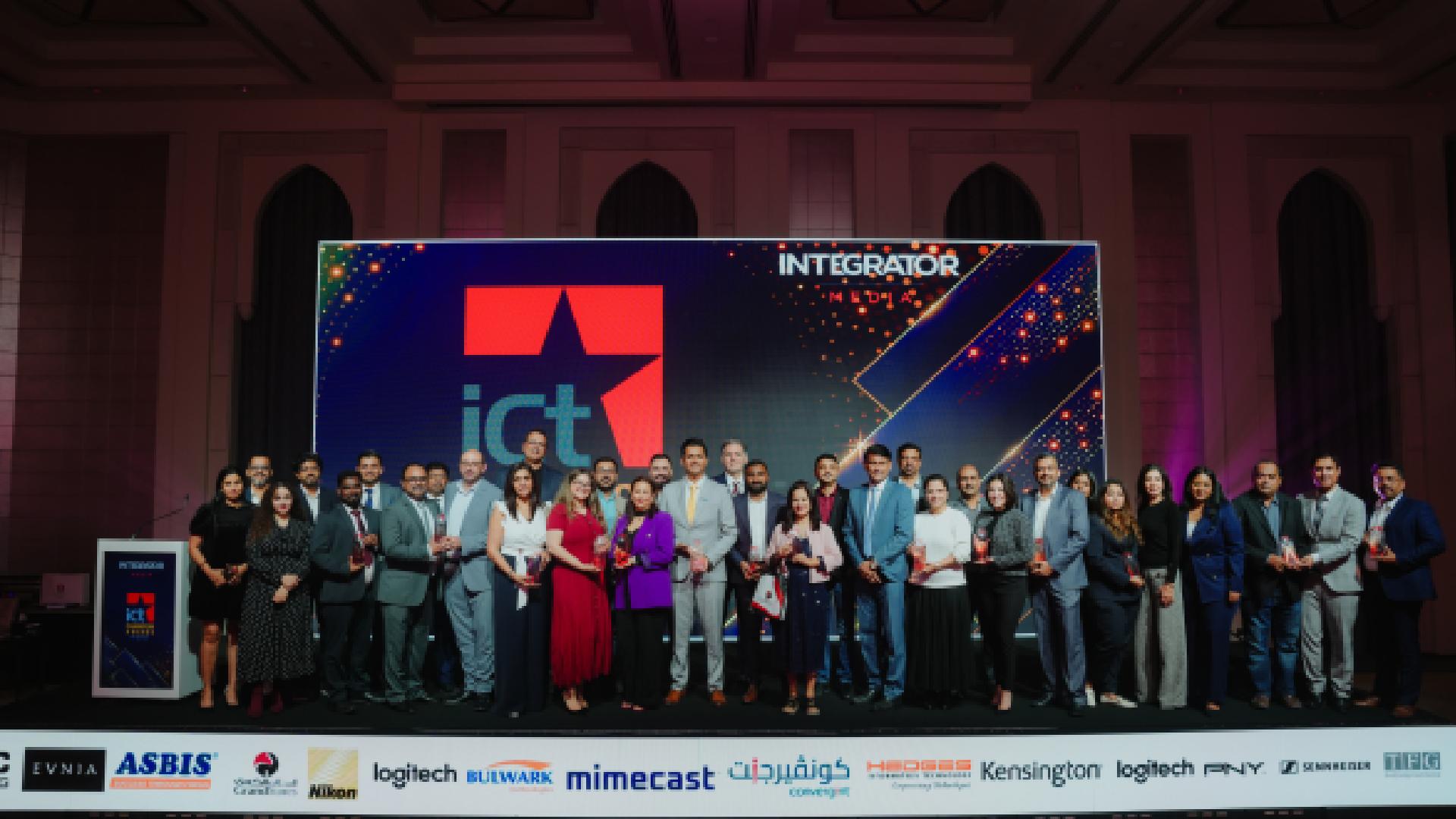
On 28 January 2026, Integrator Media hosted the 18th edition of the ICT Champion Awards at the Shangri–La Dubai Hotel, bringing together the region’s ICT ecosystem for an evening designed to celebrate milestones, recognise innovation, acknowledge ecosystem leaders, and foster community.
The programme—aligned with INTERSEC 2026—spotlighted organisations making measurable impact across enterprise solutions, critical infrastructure, cybersecurity, and public-sector technology.
By 7pm, the Shangri-La Dubai’s Al Nojoom Ballroom had the feel of a ‘state of the union’ for regional ICT—CXOs, partners, and platform leaders in one room, with AI dominating every board agenda. This wasn’t just an awards evening; it was a moment to take stock: are we still experimenting with AI, or are we ready to operationalise it at scale?
Across conversations at tables and in the corridors, the same theme surfaced: experimentation is easy—operational confidence is the hard part.
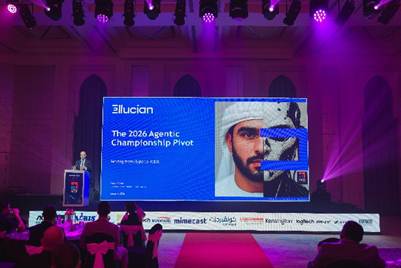
Opening keynote: “Is AI ready for us in the UAE—and what next?”
The evening’s tone was set by Mr. Maged Fahmy, Vice President, Ellucian MEA, who opened with a deliberately provocative question: Is AI ready for us in the UAE? What made the question stick wasn’t the technology—it was the implication that leadership models are now the constraint.
His message wasn’t framed as a technology debate—it was framed as a leadership test.
As a leader in enterprise technology for education and public-sector institutions—where trust, governance, and outcomes are non-negotiable—Fahmy’s ‘hype to habit’ message landed with particular weight.
His argument was simple: the UAE is past AI curiosity. The next phase is habit—repeatable, governed AI embedded in day-to-day work. The real question is no longer ‘Can we do a PoC?’ but ‘Can we run this reliably, measure it, and scale it?’
We’re moving from Generative AI (creating content) to Agentic AI (executing work). That shift changes leadership: fewer people doing repeatable steps, more orchestration of workflows across systems—with humans focused on judgement, risk, and exceptions.
For example, an agent can triage a service request, propose the fix, route it for approval, execute the change, and only escalate the ‘weird 3%’ to a human owner.
Leadership reality check: are we still leading like it’s 2022?
He also offered a leadership reality check: if your operating rhythm still assumes long cycles, manual coordination, and slow approvals, you’ll struggle in 2026. Strategy can’t be an annual exercise; it must become a live set of decisions, guardrails, and feedback loops.
AI gives the “how”; humans must own the “why”
His framing landed: AI increasingly gives you the how—options, sequencing, automation. But leaders must own the why—purpose, priorities, ethics, and accountability. In an agentic era, that ‘why’ is what keeps speed from becoming risk.
He also anchored AI’s value in a more human currency: time. Yes, AI drives efficiency. But the real prize is what leaders do with the time they get back: better customer interactions, faster decision-making, more innovation, and more space for creative work that machines cannot replicate.
Talent gaps, transformation, and “sovereign AI”
The keynote did not gloss over constraints. Fahmy flagged the talent gap that emerges when adoption rises faster than capability—especially in AI engineering, cybersecurity, governance, and change leadership. His call was practical: the future workforce isn’t only “AI builders,” but AI challengers—people who can validate outputs, pressure-test recommendations, and govern autonomous workflows.
He also introduced the importance of sovereign AI in the GCC context—where nations like the UAE and Saudi Arabia are thinking deeply about data residency, cultural alignment, regulatory control, and strategic autonomy. The point wasn’t simply “host it locally,” but to build AI that is trustworthy in local context: aligned to language, norms, governance expectations, and national priorities.
In practical terms, sovereign AI means keeping sensitive data and model control within national boundaries, enforcing local governance and auditability, and ensuring outputs reflect language, culture, and regulatory expectations.
Strategy ownership, authority, and misinformation
In 2026, he argued, leaders must be explicit about who owns strategy when decisions are increasingly shaped by AI systems. If an agent can recommend, negotiate, or trigger actions at speed, the organisation needs clarity on authority: approval thresholds, auditability, escalation paths, and responsibility when something goes wrong.
He also linked AI strategy directly to misinformation risk—not as a social media issue alone, but as an enterprise challenge: hallucinations, deepfakes, synthetic fraud, manipulated signals, and decision contamination. The answer, he implied, is not fear—it’s governed adoption: controls, verification, identity assurance, and clear human accountability.
He closed with a grounded reminder that landed strongly with the awards theme: the winners in 2026 won’t be defined by the “fastest AI,” but by the clearest purpose—and by the culture they’ve built to sustain transformation.
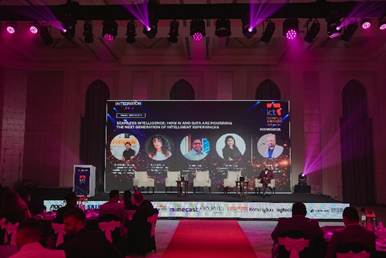
Panel discussion: “Seamless Intelligence” — when AI becomes invisible (and unavoidable)
The panel discussion, moderated by Srijith KN (Senior Editor, Integrator Media), brought the theme down from keynote altitude into product and platform reality. The session, titled “Seamless Intelligence: How AI and Dataare Powering the Next Generation of Intelligent Experiences,” featured:
- Mr. Rishi Kishor Gupta, Regional Director (Middle East & Africa), Nothing Technology
- Ms. Bushra Nasr, Global Cybersecurity Marketing Manager, Lenovo
- Mr. Nikhil Nair, Head of Sales (Middle East, Turkey & Africa), HTC
- Ms. Aarti Ajay, Regional Lead Partnerships (Ecosystem Strategy & Growth), Intel Corp
One way to read the panel: infrastructure decides what’s possible, security decides what’s safe, and experience decides what gets adopted.
The discussion converged on one powerful idea: in the next phase, the user shouldn’t “see” the intelligence—it should dissolve into the experience. The ambition is not “AI features,” but AI-native interactions that feel natural, predictive, and frictionless across devices and contexts.
Infrastructure: where does intelligence actually run?
From the infrastructure angle, the panel stressed that “AI everywhere” requires deliberate choices about where compute happens—on device, at the edge, or in the cloud—and how workloads move across that spectrum. This included clear emphasis on the hardware stack (CPU/GPU/NPU) and what it takes to scale AI responsibly.
“AI won’t scale on slogans; it scales on architecture—device, edge, and cloud—each with different cost, latency, and security trade-offs.”
Trust: security, fear factor, and the “moving data center”
From the trust perspective, the panel highlighted the growing “fear factor” around devices and autonomy: more sensors, more data, more models—more attack surface. A memorable analogy landed well: the modern connected vehicle increasingly behaves like a moving data center, raising the bar on governance, identity, and resilience.
“Every new AI capability is also a new attack surface—security has to be designed in, not bolted on.”
Human experience: AI as an experience, not a tool
On the human side, the conversation explored how AI will increasingly show up as experience—wearables, ambient assistance, multi-sensory support, and interactions that augment how people see, decide, and act. The subtext was clear: if AI is going to become ubiquitous, it must become intuitive—and aligned to what humans actually value.
“AI is becoming an experience, not an app—supporting how we see, decide, and act, often without the user noticing the machinery behind it.”
Consumer reality: “make human life smarter” and “declutter your life”
From the consumer device lens, the message was refreshingly plain: AI should help make human life smarter—not noisier. That includes automation that reduces cognitive load and helps people “declutter” their day-to-day, rather than introducing another layer of complexity.
The moderator wrapped the session with a sober economic note: as the stack expands from devices to cloud subscriptions and services, the cost of modern digital life rises—making it even more important that AI delivers tangible value, not just novelty.
“If AI doesn’t declutter your life, it’s not helping.”

Executive Board Commentary: The real shift is “delegation”—not adoption
If there was one undercurrent in the room, it’s that we’ve moved past the question of whether AI is “interesting.” The real question now is: what can we delegate—safely, repeatedly, and at scale—without degrading trust? That’s why the keynote’s emphasis on moving beyond PoCs into governed, repeatable operating models felt so relevant.
This is the step-change many organisations underestimate: adoption is a technology story; delegation is an operating model story. In an agentic era—where systems don’t just generate answers but initiate actions—the enterprise doesn’t need more demos. It needs a way to decide: what tasks can be automated end-to-end, what must stay human-led, and what requires a hybrid “human-in-the-loop” pattern?
A useful lens: the “Delegation Curve”
Think of your AI journey as a curve with three stages:
- Assist (copilot) – AI helps humans do the work faster (drafting, summarising, analysing).
- Act (agentic) – AI executes steps across workflows (triage → route → approve → action), escalating exceptions.
- Assure (governed autonomy) – AI operates with clear authority limits, auditability, and continuous controls (especially critical in regulated sectors and national infrastructure contexts).
Most enterprises are still celebrating Stage 1, experimenting in Stage 2, and under-investing in Stage 3. Yet Stage 3 is where operational confidence is built—and where reputational risk is avoided.
The missing KPI: “Trust latency”
The panel made it clear that infrastructure, security, and experience all shape whether “seamless intelligence” is adopted in the real world.
But the deeper measurement leaders should add is trust latency: how long it takes an organisation to trust an AI outcome enough to act on it without manual re-checking.
In practical terms, the most important AI metrics in 2026 won’t be model accuracy in isolation. They’ll look like:
- Time-to-trust (how quickly decisions can be taken without repeated human verification)
- Exception rate (the “weird 3%” humans must handle)
- Containment rate (how often an agent resolves end-to-end without escalation)
- Governance velocity (how quickly policy, approvals, and controls keep up with agent speed)
This is where leadership becomes the constraint—or the advantage.
Sovereign AI isn’t just residency; it’s “accountability at the boundary”
The keynote’s introduction of sovereign AI resonates strongly in the GCC because the stakes aren’t only technical. They are cultural, regulatory, and strategic.
The next phase of sovereign AI will be defined not by where data sits, but by where accountability sits—who can inspect, audit, override, and certify AI behaviour, especially when agents trigger actions across systems.
Sovereign AI done well will become a competitive advantage: it makes cross-sector adoption easier because it offers confidence by design—clear boundaries, policy alignment, and traceability.
The “AI dividend” test: what are you doing with the time you saved?
A subtle but powerful keynote point was that AI’s real asset is time.
The leadership question is what you do with it. In organisations that win, the reclaimed time becomes: better customer experience, sharper decision-making, faster innovation cycles—and more human attention where it matters.
In organisations that struggle, that time gets lost to rework, re-checking, and governance friction—because trust was never engineered into the operating model.
The new perspective to carry forward
At ICT Champion Awards, the celebration of winners implicitly reinforced the real benchmark for 2026: repeatability. Not “who has the flashiest AI,” but who can run it reliably with trust, governance, and measurable outcomes.
So perhaps the most useful question to take forward is this:
What are the first 3 workflows in your organisation that you are willing to delegate to agentic AI—end-to-end—under clearly defined authority, auditability, and exception handling?
That’s also what the ICT Champion Awards ultimately celebrated: not technology theatre, but execution maturity. The winners weren’t simply early adopters—they were organisations demonstrating innovation with outcomes, leadership with accountability, and scale with governance. In a year defined by agentic possibilities, the Awards served as a reminder that the real competitive edge is operational confidence—systems that work, controls that hold, and teams that can sustain change. Hype is easy; habit is earned.
Dr Ryad Soobhany, Deputy Academic Head of School of Mathematical & Computer Sciences, Heriot-Watt University Dubai

Camera systems, such as CCTV, are mainly used for video surveillance within organisations. Passive video surveillance has been part of the security ecosystem for years, providing organisations with the ability to monitor different areas simultaneously, while recorded footage can be inspected after an event occurs.
The evolution of computer chips and increased processing power has led to improved image quality, including better performance in low-light conditions, particularly at night. The advent of edge computing, with processing performed on edge devices within a network, has made object and scene recognition more readily accessible. This evolution has led to more active video surveillance through video analytics, where events can be identified and addressed in real time. Examples include number plate recognition systems and facial recognition for access control.
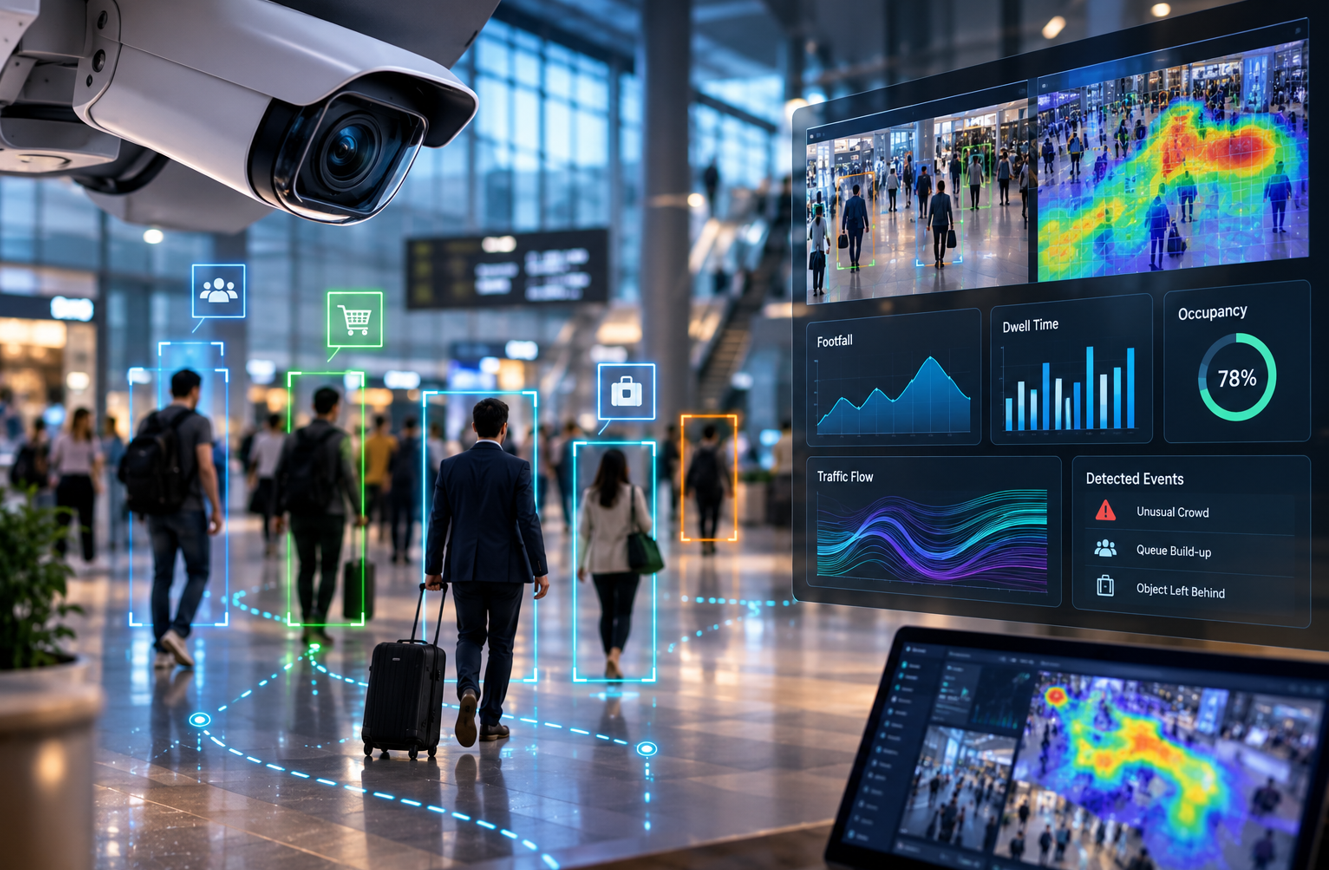
With the combination of AI and video data, computer vision can be integrated with business analytics to transform video surveillance from a security infrastructure into a business intelligence tool. Video surveillance is moving from passively recording events to sensing what is happening in the environment. This helps to answer questions such as which areas are congested, how customers are moving, how long they dwell in particular areas, and whether unusual events are occurring. Businesses can use this data to optimise their operations, such as improving the customer checkout process, monitoring asset or staff movement, and managing crowds or traffic flows. Organisations can also incorporate contextual business information to enhance the analytics by combining behavioural data with CRM or IoT data, providing additional context and insights for decision-making and improving the customer or visitor experience.
Video surveillance can be used to optimise operations, improve customer experiences, and support strategic decision-making across industries. Video itself does not create business intelligence; rather, its value increases when visual information is combined with other operational and contextual data, while computer vision is used to understand and enhance business operations. The pipeline from video to business intelligence can be represented as obtaining data from video sources such as fixed cameras, IoT-enabled cameras, or robots. Computer vision is then applied to the video to detect or track people, objects of interest, or activities. Behavioural data are taken into account, such as customer dwell time in particular product areas, occupancy of rooms or halls, movement of people across a building, and anomalies in behaviour. At this stage, operational data are also considered. The final stage is the business intelligence stage, where trends are identified and insights are inferred. At this stage, data visualisation plays an important role, with dashboards and data storytelling displaying correlations, predictions, and infographics that provide more than simple visual summaries of surveillance data. The camera becomes an operational sensor for the organisation. The important transformation occurs when visual data are combined with business data, such as sales, operational, and IoT data, to convert visual observations into business knowledge that informs operational, tactical, and strategic decision-making within an organisation.
The levels of business intelligence can be viewed as three analytical capabilities: descriptive intelligence, diagnostic intelligence, and combined predictive and prescriptive intelligence. Descriptive intelligence usually addresses what is happening. Visual analytics can identify footfall, occupancy, queue length, waiting time, dwell time, traffic flow, movement patterns, and detected events. Visualisation dashboards can present these indicators in real time or over historical periods, allowing managers to understand the current state of an operation. For example, a museum dashboard can show heat maps of visitor numbers, dwell time, and movement across different exhibition areas, while analysing visitor behaviour and providing insights into the optimal placement of exhibitions. An airport dashboard could display passenger volumes and queue lengths across terminals.

By Julio de Salvo, Chief Solution Officer for MENA & APAC at Globant
For decades, the financial industry has managed to replace banknotes and coins with “invisible” assets through different technological implementations. However, innovation in the sector has generally moved at a slow pace when dealing with something as sensitive as people’s finances. In 2026, the black swan is beginning to emerge: the first steps of AI agents that will redefine the industry (as they will many others). The financial black swan is not a crisis: it is a huge change. Across the Middle East and Africa, where a convergence of government-backed modernization agendas, digitally native consumers, and institutional ambition is accelerating the timeline for transformation.
The first step has been the use of Gen AI without the customer perceiving it. Coding, fraud prevention, phishing detection, and credit assessment are some of its tasks. But it is now beginning to become a tool for managing users’ finances. In the MENA region, this shift is already visible at the institutional level. Across the 25 MEA banks benchmarked by the Evident AI Index (June 2026), the established leaders are no longer running pilots, they are directing investment toward high-friction processes where AI can materially reshape productivity, scalability, and competitiveness. UAE-based banks and fintechs are already validating agent-initiated transaction pipelines in production environments. These are some of the examples, but there are more.
In July 2026, the revealing Mills Review, published by the FCA (Financial Conduct Authority), the UK’s official financial regulator, pointed out that AI agents will become the new financial interface. Essentially, an AI assistant will manage budgets, answer queries, generate reports on demand, and move money between accounts. How much was spent on a vacation in total, how a stock portfolio performed over the past month, or canceling an annual subscription will be as easy as making a query to ChatGPT today. For MENA consumers, who have in many cases leapfrogged legacy banking behaviors entirely, this vision is the baseline expectation.
The Mills Review also argues that Open Banking will evolve toward a model in which AI agents will have access to a broader range of financial products to enable intelligent decisions across different areas, and highlighted that this will lead to an evolution in regulation. In the GCC, this evolution is being actively shaped by regulators and governments alike, with initiatives such as Dubai’s target of 90%+ digital transactions by 2026 signaling not just ambition, but structural commitment to a cashless, AI-enabled financial ecosystem.
The agentic AI opportunity in the region is real, but it remains underexploited. According to EY-Parthenon’s 2025 Generative AI in Banking Survey, 99% of respondents are familiar with agentic AI, yet only 31% have pursued implementation, with a further 46% expressing interest. Awareness, in other words, has raced ahead of execution. This gap between recognition and production-grade deployment is precisely where the competitive battle will be won or lost.
This represents a major shift in the industry, where historically the leading banks have, for the most part, remained the same. Differentiation can now change everything, and it would not be surprising if new players manage to break into the ranks of the world’s most important financial institutions. In the Middle East, the region’s financial landscape already includes a new generation of digital-first challengers sitting alongside heritage institutions, all of which are now actively exploring or deploying agentic capabilities. The reason sounds obvious when explained: if the experience with an AI assistant can manage customers’ money better, it will prevail. This is not an exaggeration: just four years ago, nobody knew ChatGPT, and now we have become so accustomed to it that we all ask ourselves: why shouldn’t I manage my assets with a chatbot that can provide reports and recommendations? A study by JPMorgan found that half of Gen Z wanted to use them to manage their finances.
The infrastructure for agentic commerce is also being built in real time across the GCC. Mastercard has conducted regional pilots in partnership with Majid Al Futtaim, enabling consumers to search, select, and purchase VOX Cinema tickets programmatically through an integrated AI assistant. In May 2026, Visa launched its global Agentic Ready program in the UAE, with early adopters including ADCB, ADIB, Emirates NBD, Mashreq, Tabby, Wio, and Ziina already validating agent-initiated transaction pipelines in production.
We are living in a time of change. In its 2026 report on the financial sector, the World Economic Forum urged organizations to move with “urgency” and “discipline”. The greatest benefits, it stated, will go to those working on a holistic redesign of workflows and technology architecture. In the MENA region, the conditions for genuine transformation are already in place: strong institutional will, government-aligned modernization agendas, and a consumer base that has leapfrogged legacy behaviors entirely.
One of the major questions is why, if the financial sector has such a strong technological tradition, the emergence of AI Agents represents a black swan. There are several reasons. First, historically, customers used banks to execute transactions; therefore, in the executive conversations avoiding risk was prioritized over innovation. This is changing with the emergence of digital banks, which are generally more inclined toward disruption, and shifts in consumer habits. In the GCC specifically, consumers who bypassed branch banking and moved directly to mobile-first financial services are now primed to embrace AI-managed financial experiences with little friction. The challenge of the future is not to provide a tool, but to redesign experiences to address this transition comprehensively. AI has the potential to resolve the technological debt involved in migrating traditional banks, which have historically struggled the most with this transition.
The second reason is the technical debt banks have demonstrated in dealing with change. This has also occurred in other industries, but the idea of paying for a premium license for every employee and expecting immediate returns only leads to frustration. There is significant resistance when it becomes clear that certain tasks and workflows will inevitably be different from what has been established. In the Middle East, where several national banks have invested heavily in core banking modernization programs over the past decade, the foundations are more favorable than in many Western markets, but the final leap from modernized infrastructure to genuinely agentic deployment still requires focused capability and deliberate execution.
The third reason is regulation. Technology companies, banks, and authorities will need to maintain an ongoing dialogue to ensure that innovation and integrations do not affect users’ personal data or security, while ensuring that restrictions do not become a barrier to progress. One of the most valuable lessons from the banking sector’s legacy is the importance of being extremely careful when dealing with something as sensitive as people’s money.
For many years, the impact of AI was often explained as something that belonged to a distant future. In the financial sector, it is already a reality: it is part of multiple tasks and is beginning to become an asset in the customer proposition. With AI Agents, innovation can no longer, and should no longer, go unnoticed. New habits require the redesign of customer journeys, and this could represent a revolution for the sector. For Middle East banks, the opportunity is particularly compelling: a region where government will, consumer readiness, regulatory pragmatism, and institutional investment have aligned at the same moment. What is required now is the execution capability to convert that alignment into production-grade deployment. What is at stake is no small matter: the management of millions of people’s money and a battle for the competitiveness of banks on a scale rarely seen before. For those that move with urgency and discipline, the financial black swan is a transformation to be led.

By: Debo Zhang, CEO at HONOR GCC
In the hyper-competitive consumer technology sector, the launch of a flagship device is often treated as the finish line. However, true brand leadership is forged not in the showroom, but in the months and years that follow. At HONOR, we view the point of purchase not as a conclusion, but as day one of a long-term partnership with our users.
As we aggressively push the boundaries of intelligent hardware—from integrating Agentic OS to setting new benchmarks in physical durability and battery density—we recognize that advanced specifications represent only half of the premium equation. The other half is an unyielding commitment to the customer’s lifecycle experience. If a brand fails to support its users when they need it most, the underlying technological advancements lose their meaning.
Operationalizing Community Care
Our commitment to giving back to the GCC community dictates our operational investments. We do not just build resilient devices; we build resilient support networks designed to remove the friction of long-term ownership. Our recurring monthly Service Days are not promotional events—they are structural community investments.
By deliberately absorbing operational costs—such as completely waiving labor fees for expert repairs and offering complimentary professional device cleaning and disinfection—we ensure that maintaining a premium device remains accessible. We view ongoing device care, including free system upgrades and screen film replacements, as a fundamental responsibility rather than a secondary revenue stream.
Respecting the User’s Time and Individuality
True leadership in customer service also requires a profound respect for the user’s time and individuality. Recognizing that our customers’ lives are deeply integrated with their technology, we have designed our after-sales operations to adapt to the user, rather than forcing the user to adapt to us. Offering complimentary return shipping for repairs and providing complimentary gifts when repair timelines are extended are direct measures to eliminate inconvenience.
Furthermore, we understand that a smart device is a highly personal extension of the user. Incorporating free laser engraving and custom art back films into our regular service offerings transforms a standard maintenance visit into an opportunity for users to refresh and personalize their technology.
As the Middle East accelerates its digital transformation, consumers are demanding more than just innovation; they demand reliability, accountability, and respect. HONOR’s rapid growth across the region proves a fundamental business truth: when a technology brand prioritizes post-purchase empowerment and community care over short-term transactional gains, sustainable market leadership naturally follows.


The Connected Home Is Evolving into an Intelligent Ecosystem

New Partnership Connects Residential Wellbeing With Preventive Healthcare

Dubai Ride-Hailing App Zed Strengthens Leadership with Appointment of Shobhit Singhal to Shape Its Future



-

 Trending12 months ago
OPPO A6 Pro 5G Review: Reliable Daily Driver
-

 Tech News2 years ago
Denodo Bolsters Executive Team by Hiring Christophe Culine as its Chief Revenue Officer
-
 VAR2 years ago
Microsoft Launches New Surface Copilot+ PCs for Business
-

 Automotive2 years ago
AGMC Launches the RIDDARA RD6 High Performance Fully Electric 4×4 Pickup
-
Tech Interviews3 years ago
Navigating the Cybersecurity Landscape in Hybrid Work Environments
-

 Hospitality2 years ago
Gulfood 2025 30th Edition Kicks Off Today, Setting New Benchmarks in F&B Growth and Innovation
-

 VAR10 months ago
Huawei Nova 14 Pro Review: Where Camera Excellence Meets Ecosystem Evolution
-

 Tech News1 year ago
Nothing Launches flagship Nothing Phone (3) and Headphone (1) in theme with the Iconic Museum of the Future in Dubai