
 Have a question? +971 56 404 0503




Financial News
The Balancing Act of Financial Organizations to Compete in a Technology-Driven World

Written by: Ricardo Ferreira, EMEA Field CISO, Fortinet
Digital acceleration is impacting how we work, live, and consume services. In addition, the digital evolution of Financial Services Organizations (FSOs) raises essential questions about the future of banking. One looming concern is how FSOs will compete against fintechs, including addressing the need for innovation to improve customer experience.

Ricardo Ferreira, EMEA Field CISO at Fortinet
Adapt to changing times
The top three strategic areas outlined in the IDC Infobrief, sponsored by Fortinet, “Accelerating Transformation Through Cybersecurity in Financial Services,” highlight the core priorities for financial institutions: Trust, Security, and Resilience. So, the question is, how can FSOs lead and win through innovation while ensuring that risks do not overwhelm a traditionally risk-averse industry?
Many FSOs have begun adopting new digital business models to help them thrive in a digital-first economy. These include prioritizing investments in key areas such as data-driven security, legacy modernization, and personalized and contextual customer experiences. But for these business models to work, they will need to rely on data, analytics, and cloud platforms.
So, when we ask, “what does success look like for the future-ready bank?” we see three major themes:
- Automation and cost reduction: Automation, managed services, and cloud platforms will enable FSOs to innovate faster. Automation allows business units to integrate with the rest of the organization, build self-service, and reduce manual labor costs, such as adopting Robotic Process Automation and artificial intelligence-powered chatbots to deal with insurance claims. In investment banking, robot advisors use machine learning-powered algorithms to help retail investors make better decisions. Thanks to cloud platforms and managed services, these new products and services are economically feasible because they shift traditional CapEx to activities that create more value.
- Customer intelligence and centricity: New platforms provide data and analytics for anticipating customer needs and hyper-personalizing the customer journey. Customer data, such as investment patterns, can guide a robot advisor to recommend portfolio choices aligned to customer preference. Similarly, natural language processing can help an AI system quickly assess a customer’s issue to redirect them to the nearest branch or get the appropriate representative involved.
- New value propositions: Open banking was a massive change for banks, helping them realize the power of APIs. Building Banking as a Service (BaaS) has allowed them to develop new services and create stronger partnerships.
But what about the customer experience?
Who is not irked when reminded of their first troubled mobile banking experience, with terrible UX and lack of integration? It’s why, when some fintechs launched their online mobile banking, it was a beacon of light in a dark room. A real-world security example that everyone might remember was the usage of biometrics for accessing online mobile banking. Big brands took a long time to adopt it, and while it might seem trivial from a UX perspective, it’s leaps and bounds towards progress.
Today, traditional brands regularly launch products that emulate offerings from nimbler fintech organizations. The lesson is clear: to gain a competitive advantage, banks must focus on creating a fast, intuitive, and seamless customer experience.
Are clouds grey in banking?
These business models require the accelerated consumption of new platforms, such as cloud computing. Financial organizations must understand they can create differentiated value and increase competitiveness by using the cloud to increase their speed of innovation and accelerate the go-to-market of new services and products.
Cloud platforms also serve as a bridge to modernize financial organization workloads. CIOs want to migrate workloads cohesively while ensuring the capabilities from their on-prem solutions are still available. Major Cloud Service Providers (CSPs) have jumped at the opportunity to integrate their environments into the same control plane.
Yes, but isn’t that risky?
Regulators have flagged the concentration risk. For example, the Bank of England has highlighted it in their stability reports. The latest Financial Conduct Authority (FCA) PS21/3 rules address third-party risk and operational resilience. And the European Union has gone a big step beyond with its Digital Operational Resilience Act (DORA).
All these activities and proposals are designed to address these concerns. The European Systemic Risk Board has flagged cyber as a systemic risk to the European financial system due to the increase in cyberattacks—especially in the financial industry, which is 300 times more likely to be the target of cyberattacks. The International Monetary Fund (IMF) emphasizes that cyber events propagate risk through the entire financial system via three broad transmission channels: risk concentration, risk contagion, and erosion of confidence.
That is why cybersecurity is a priority as part of the EU’s “Europe fit for the digital decade” policy program. Programs such as EU-HYBNET, ACCORDION, and DORA for financial services ensure Europe works as a single entity by harmonizing requirements to increase resilience and protect citizens.
What can financial organizations do about it?
To start, security needs to be woven into transformation efforts to ensure that innovation and transformation are conducted securely. For this to work, security must be included from a project’s inception, not as a bolt-on after a project and its services are launched.
What about protecting financial assets?
55% of European financial organizations already use some form of zero-trust strategy for their authorization and authentication. Zero-trust shifts the traditional paradigm from the implicit trust for users and resources inside a static, network-based perimeter to an authentication model that focuses on users, assets, and resources. Zero-trust requires authentication and authorization to be performed every time access is granted to a specific resource.
How do we address the ‘weakest link’ problem?
While people are an organization’s most critical asset, they are also the primary source of data breaches and network compromise. Organizations must be prepared for a loss of control if their workforce is not educated on cyber awareness. Some large financial organizations have created partnerships with e-learning portals and vendors to provide tailored courses using nudges and financial instruments to reskill the workforce with new technologies. Similarly, financial organizations must plan to mitigate the rampant cybersecurity skills shortage, which will impact 90% of organizations by 2025, resulting in delays in the transformational journey.
What can we do?
Digital acceleration is essential for competing in today’s financial marketplace. However, it doesn’t come without risk. First, ensure employees are trained and reskilled in the organization’s technologies. Second, share data with industry peers to learn best practices and identify potential issues. Transaction Monitoring Netherlands (TMNL) is an excellent example of transaction data sharing to mitigate Anti-Money Laundering (AML).
Finally, work with vendors and partners committed to cross-vendor openness and integration. When vendors work together across the threat landscape, the sum of their products is greater than the individual parts, deepening your level of cyber protection.









Financial
UAE Ranks First Globally in Citizen Satisfaction with Government Digital Services at 89%, BCG Survey Finds


The UAE ranks first globally in citizen satisfaction with government digital services, with 89% of respondents rating them highly, according to Boston Consulting Group’s (BCG) sixth annual edition of its 2026 Digital Government Citizen Survey Report, which was launched on the first day of AI Everything Abu Dhabi, titled “After a Decade of Digital Gains, AI Is Reshaping Citizens’ Expectations in the GCC[SM1] [GU2] .” The finding underscores the strength of the UAE’s digital government experience and provides a strong foundation for the next phase of AI-enabled public services.
The survey, conducted across 44 countries, also highlights the depth of the UAE’s digital engagement, with the country ranking first globally in government digital service usage at 53%. More than three-quarters (76%) of UAE respondents say their latest online government transaction delivered a better experience than their typical private-sector interaction, reinforcing the strength of the country’s digital government ecosystem.
This strong digital foundation is increasingly extending into AI adoption, where 82% of UAE respondents reported using AI weekly. High levels of usage are accompanied by relatively positive attitudes toward AI in government, with 53% of UAE respondents believing its benefits outweigh the risks, compared with 49% across the GCC and 36% globally. At the same time, greater exposure to AI is bringing a broader set of considerations into focus for citizens. While GCC citizens remain more optimistic about AI in government than their global peers, overall optimism has declined by 21% since 2024.
This evolution points toward a more hybrid model of service delivery. GCC citizens increasingly favor AI for simpler services while retaining human involvement for more complex interactions, which assures a shift that reflects greater awareness of both the opportunities and considerations associated with AI. At the same time, only around 4% of GCC respondents prefer human-only services with no AI support, compared with almost one in ten globally.
“The UAE’s strong digital government experience reflects years of investment in making public services more accessible, seamless, and responsive to citizens’ needs,” said Rami Mourtada, Partner & Director, Digital Transformation, BCG. “As AI becomes more embedded in public services, governments have an opportunity to build on this foundation with more AI-enabled experiences and process re-engineering to continue focusing on quality and convenience. This next phase will be about deploying AI where it creates clear value, while maintaining human expertise for more complex citizen needs.”
GCC Citizens Embrace the Next Generation of AI-Enabled Services
The BCG report also reveals strong appetite among GCC citizens for the next generation of AI-enabled government services. The region is the most AI-receptive globally, with 79% of citizens open to AI-centered government interactions, compared with 66% globally. Notably, three of the four most strongly supported AI applications in government are agentic use cases, signaling a healthy launchpad for governments to explore services that can move beyond providing information to supporting or completing actions on citizens’ behalf.
This openness is already evident across practical applications: 82% are comfortable with AI providing 24/7 access to information and services; 81% with AI supporting government customer-service agents; 79% with AI detecting fraud and automatically following up; and 78% with AI identifying services citizens qualify for and taking action on their behalf. [SM3] [GU4] Yet citizens are not calling for AI alone. Preference for “AI for simple services, people for complex ones” has risen nine percentage points to 50% over the past two years, reinforcing a hybrid model that combines AI-enabled speed and availability with human judgment for more complex or higher-stakes interactions.
This opportunity builds on a strong track record in digital government service quality. In 2026, the GCC remained the only surveyed region where a majority of citizens rated government digital services above those of the private sector, at 72%. However, private-sector experiences are gaining ground: the net share of GCC respondents rating government services above private-sector services declined from 75% in 2024 to 69% in 2026. The shift creates both a learning opportunity and an impetus for governments to continue innovating as citizen expectations evolve.
As governments move toward more advanced AI-enabled services, citizen AI literacy will be equally important. GCC respondents with expert-level AI proficiency are around four times more likely than those without AI experience to believe that the benefits of AI in government outweigh the risks. At the same time, greater familiarity with AI is sharpening citizens’ expectations around how it is deployed. Job loss (33%) and accuracy (28%) now rank as the leading concerns, underscoring the importance of pairing AI literacy with safeguards that are visible and relevant to citizens.
“The GCC has a strong opportunity to translate its digital leadership into the next generation of AI-enabled government services,” said Dr. Lars Littig, Managing Director & Senior Partner, BCG. “As citizens become more familiar with AI, building literacy and trust will be critical to sustained adoption. The opportunity is to move forward with AI in ways that reflect how citizens want to engage, expanding automation and agentic capabilities where they create value, while retaining human judgment and embedding responsible safeguards where they matter most.”
Six Priorities for the Next Generation of Digital Government
To build on the region’s digital progress and maximize the potential of AI in government services, BCG’s report outlines six priorities for GCC governments:
- Rethink core services with AI, redesigning them end to end rather than layering AI onto existing processes.
- Learn from private-sector innovation as digital experiences improve and citizen expectations evolve.
- Embed responsible AI through governance, testing, and safeguards that strengthen citizen trust.
- Build the hybrid model citizens want, using AI for simpler interactions while retaining human expertise for complex or high-stakes needs.
- Expand agentic AI services beyond information toward services that can support complete journeys and act on citizens’ behalf.
- Advance AI literacy to build citizen understanding, confidence, and informed adoption.
Together, these priorities can help GCC governments build on a decade of digital progress and translate citizens’ openness to AI into the next generation of public services. By combining strong digital foundations with responsible AI adoption and continued access to human expertise, the region is well positioned to deliver services that are more proactive, personalized, and responsive to citizens’ evolving needs — while sustaining the trust that will be critical to long-term adoption
To access the full BCG Digital Government Citizen Survey2026, visit the link here.

Businesses buying or selling companies in the UAE are finding that the transaction itself, rather than their existing operations, brings them within the global minimum tax. That is the central finding of the latest ‘Deals Decoded’ publication from Dhruva, a Ryan LLC affiliate, on how the rules influence what a business is worth, how a deal is structured and when it should complete.
The global minimum tax, known internationally as Pillar Two, was agreed by more than 140 countries and jurisdictions through the Organisation for Economic Co-operation and Development. It requires the largest international groups to pay at least 15% tax on profits earned in every country where they operate, with any shortfall, known as a top-up tax, becoming payable. The UAE adopted it through Cabinet Decision No. 142 of 2024, effective for financial years beginning on or after 1 January 2025, and collects the shortfall on UAE profits locally rather than ceding it abroad.
The rules apply only to groups with worldwide revenue of at least EUR 750 million, approximately USD 860 million, in two of the previous four years. Many UAE businesses have concluded this places them safely outside. Dhruva identifies four points at which a transaction changes that assessment.
The first is scale. When two groups combine, their revenues are assessed together. A buyer with EUR 500 million of revenue acquiring a business with EUR 300 million enters the regime on completion, though neither neared the threshold alone.
“The threshold test is where most boards are caught out,” said Nimish Goel, Leader, Middle East Dhruva, A Ryan LLC Affiliate. “Two mid-sized businesses, each outside the regime, combine and find themselves inside it from day one. This is routinely delegated to the finance function when it belongs with those setting the price. Established at screening stage, the analysis costs little. Discovered after signing, it is hard to reverse.”
The second is timing. The tax is calculated annually on a country-wide basis and does not divide when ownership transfers, so a business being sold stays within the seller’s figures until legal completion, whenever the buyer assumes commercial risk. Completing on the first day of a financial year removes the problem.
The third is visibility. A group’s UAE companies are assessed together rather than individually, so a target cannot be evaluated in isolation.
“A business has no tax position of its own while it remains inside a seller’s group,” said Bhakti Thakker, Partner, Mergers and Acquisitions and International Tax at Dhruva, A Ryan LLC Affiliate. “The rate is an average across every company the seller holds in that country, so the buyer is pricing something it cannot fully see. Companies in the same country may also be required to settle one another’s liability, which a warranty does not address. The contract needs a defined section on who prepares the calculation, who bears the cost, and how it settles once figures are final.”
The fourth is the acquisition premium. Where a buyer pays more than the accounting value of a business, part of that cost is ordinarily written off over time, reducing taxable profit. The global minimum tax rules largely disregard those write-offs, leaving taxable profit higher than expected.
Two further developments narrow the margin. The allowance groups receive for genuine operations in a country, based on employment costs and physical assets, reduces annually by design, from 9.6% and 7.6% respectively in 2025 to 9.4% and 7.4% in 2026, and 5% each by 2033. A transitional simplification sparing some groups the full calculation ends for financial years beginning on or after 1 January 2027.
Ownership structure is decisive for sovereign wealth funds and private equity investors. Government bodies fall outside the rules, but that status does not extend to the companies they hold, and where investments sit beneath a holding company that is not a government body, the whole group is in scope.
Dhruva recommends four steps ahead of any transaction. Buyers should test the combined revenue threshold when a target is first identified, not during contract negotiation, and model the tax as a cash cost in financial projections, allowing for the reducing allowance. Sellers should prepare tax records for inspection in advance, since a position that cannot be evidenced invites a price reduction. Both should review insurance cover, which frequently excludes a risk already identified during due diligence. “Businesses that address this early are negotiating from a position of information. Those that do not are negotiating on assumption,” concluded Bhakti.
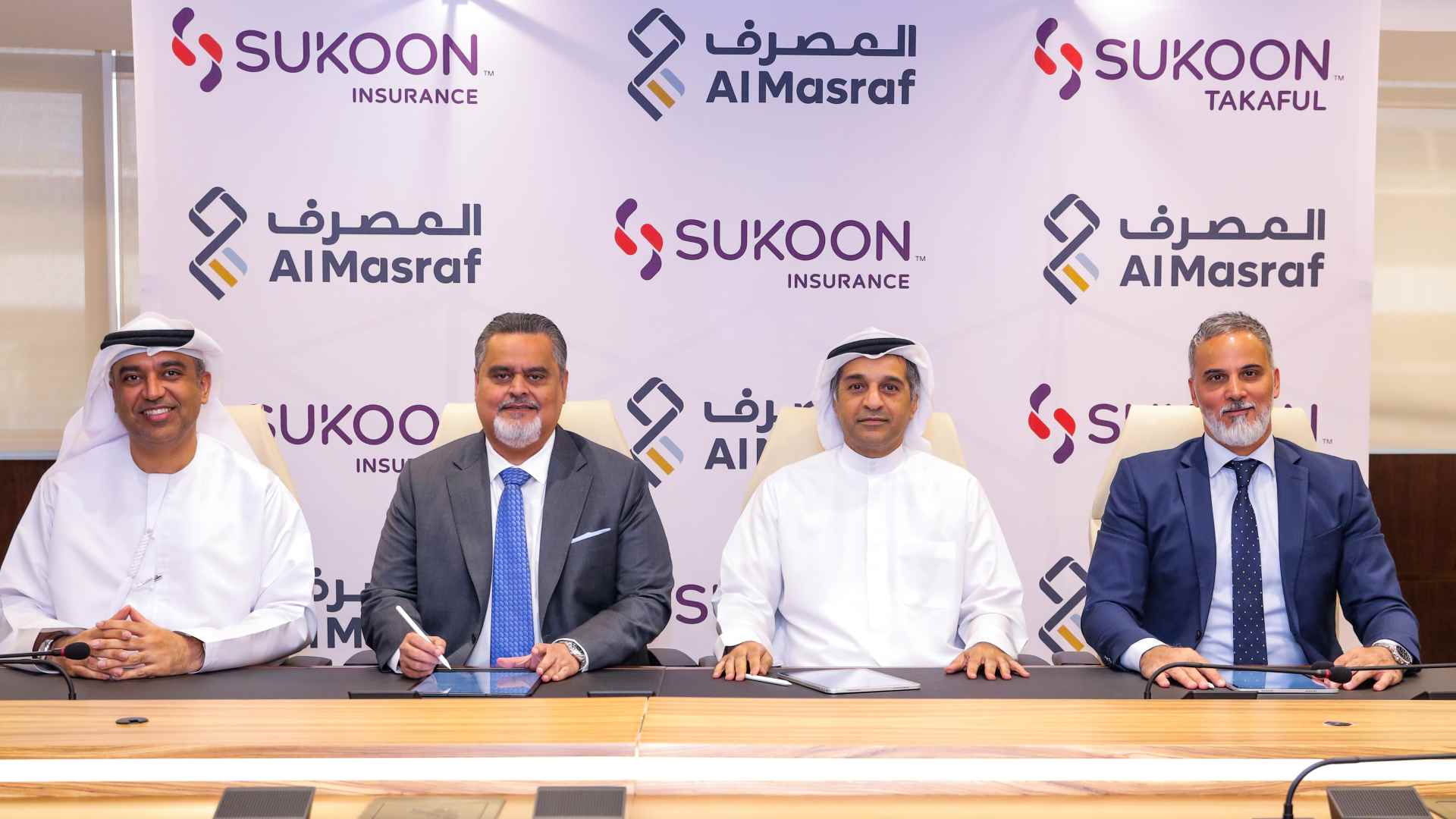
Al Masraf has entered a strategic partnership with Sukoon Insurance PJSC and Sukoon Takaful PJSC, bringing together the Bank’s banking capabilities and Sukoon’s insurance and takaful expertise to offer customers access to a broader range of protection and insurance solutions.
The partnership was formalized during a signing ceremony attended by senior leaders from Al Masraf, Sukoon Insurance and Sukoon Takaful, marking an important milestone in the Bank’s efforts to strengthen its offerings and provide customers with more comprehensive financial solutions through trusted partners.
Under the strategic partnership, Sukoon Insurance and Sukoon Takaful will join hands with Al Masraf, enabling the Bank to offer customers access to a range of insurance and takaful solutions designed to meet the evolving protection needs of individuals and businesses.
The collaboration brings together Al Masraf’s established banking platform and customer relationships with Sukoon’s extensive insurance expertise and distribution capabilities. It reflects a shared commitment to delivering greater choice, convenience and value to customers while supporting their broader financial wellbeing.
Fuad Mohamed, Chief Executive Officer of Al Masraf, said: “Our partnership with Sukoon Insurance and Sukoon Takaful reflects our commitment to building an ecosystem of trusted partners that enables us to offer our customers more complete financial solutions.”
He continued: “Insurance and protection are an important part of long-term financial wellbeing, and through this collaboration, we are bringing together the strengths of leading organizations to provide greater choice and convenience to our customers. We look forward to building a strong and successful partnership with Sukoon as we continue to enhance the overall customer experience at Al Masraf.”
Ahmad Yousuf, Chief Retail Banking Officer of Al Masraf, said: “This partnership is an important step in bringing greater choice and convenience to our customers by making relevant insurance and takaful solutions more accessible through their strategic relationship.”
He added: “Sukoon’s strong market expertise and customer-focused approach make them a valuable partner for Al Masraf, and we look forward to working closely together to deliver solutions that are simple, relevant, and aligned with our customers’ needs.”
With operations spanning all Emirates in the UAE and Oman, Sukoon Insurance is among the UAE’s leading insurance providers. Sukoon serves businesses and individuals through a broad distribution network comprising branches, brokers, agencies, e-commerce platforms and a dedicated call centre.
Sukoon Takaful PJSC is one of the UAE’s leading takaful providers. The company provides general and family takaful solutions designed to meet the protection needs of individuals and businesses, supported by a strong capital base and disciplined approach to risk.
Commenting on the partnership, Hammad Khan, Interim CEO and Chief Financial Officer at Sukoon Insurance, said, “We are pleased to partner with Al Masraf as this collaboration reflects our shared commitment to help customers access protection solutions through convenient and trusted channels. By combining Al Masraf’s strong customer relationships and banking expertise with Sukoon’s insurance capabilities, we aim to deliver greater value, broader choice and an enhanced customer experience for individuals and businesses across the UAE.”
He added, “Alongside Sukoon Insurance’s product offering, our subsidiary Sukoon Takaful will provide Shariah-compliant takaful solutions to Al Masraf customers, enabling us to deliver a comprehensive suite of protection solutions tailored to different customer preferences and needs.”
Ahmed Abushanab, Chief Executive Officer of Sukoon Takaful, said, “Partnering with Al Masraf is an important opportunity to bring accessible Sharia-compliant Takaful solutions to more customers. As Al Masraf marks 50 years of serving its customers, we are pleased to join them during this significant milestone as we build a partnership focused on providing relevant protection solutions that support customers’ financial needs and offer greater peace of mind.”
The signing ceremony brought together senior representatives from both organizations. Representing Sukoon were Hammad Khan, CFO & Interim CEO, Sukoon Insurance; Ahmed Abushanab, CEO, Sukoon Takaful; Aditya Kulkarni, Executive Vice President, Head of Distribution UAE; Ashish Kumar Singh, Head of Bancassurance and Affinity; Dexter Fernandes, Head of Bancassurance Distribution and Partnership; and Mostafa Adel, Head of Bancassurance Distribution and Partnership.
Representing Al Masraf was Fuad Mohamed, Chief Executive Officer; Ahmad Yousuf, Chief Retail Banking Officer, Shaimaa Higazy, Products Unit Head; and Rojeh Ghassan, AVP Products unit. The strategic partnership reinforces Al Masraf’s focus on expanding its financial services ecosystem and developing partnerships that support customers across their broader financial journeys.
Through the collaboration with Sukoon Insurance and Sukoon Takaful, Al Masraf will continue to explore opportunities to enhance its customer offering and deliver relevant insurance and takaful solutions to its customers.
-END-
About Al Masraf
Founded in 1976, under Federal Decree No. 50, signed by His Highness Sheikh Zayed Bin Sultan Al Nahyan, Al Masraf (Arab Bank for Investment & Foreign Trade) is a trusted UAE financial institution with a distinguished legacy of supporting trade, investment and economic development. Built on long-standing relationships, deep market expertise and a commitment to personalized service, the Bank serves corporations, businesses, individuals and families through tailored financial solutions designed to meet their evolving needs.
Guided by its promise of “Empowering Future Legacies,” Al Masraf is advancing a new phase of growth focused on deepening client relationships, enhancing banking experiences and delivering future-ready financial solutions. As a progressive, connected and trusted financial partner, the Bank combines proven expertise with responsible innovation to create lasting value for clients, support sustainable prosperity and contribute to the UAE’s long-term economic ambitions.
The Bank delivers integrated banking solutions through its Wholesale Banking and Retail Banking franchises, combining sector expertise, relationship-led Corporate and Financial Institutions coverage, transaction banking, financing, capital solutions and risk management capabilities to support clients’ growth ambitions and contribute to the UAE’s economic development.
For more information, visit www.almasraf.ae.
About Sukoon Insurance
Established in 1975, Sukoon Insurance PJSC (“Sukoon”) – a public stock company – is among the leading insurance providers in the UAE. Sukoon provides a range of comprehensive insurance solutions for motor, life, health, and general (property, energy, engineering, aviation, marine, and liability) needs to its 1.6 million insured members. Sukoon’s operations span across Oman and all Emirates in the UAE.
Sukoon is committed to providing outstanding insurance solutions which help create and protect wealth and wellbeing. The Dubai-based company stays true to its vision by serving businesses and individuals with a team of over 700 professionals through an intensive distribution network of branches, brokers, bancassurance partners, agencies, e-commerce platforms, and a dedicated call centre.
In 2025, Sukoon registered gross written premiums (GWP) of AED 7 billion. With a solvency ratio of 275 percent and exemplary ratings from Standard and Poor’s (A rated) and Moody’s (A2 rated), it clearly demonstrates its financial soundness, robustness in risk management processes, effective governance, and ability to serve its clients effectively in the long run.
At its core, the Company is customer-centric, with a keen devotion towards providing exceptional services. Its priority has always been to build long-term relationships with its clients with their delight as its non-negotiable objective.
Put simply, Sukoon wants to continue reinforcing its position as a reference for other insurers in the region for exemplary customer service.


Burjeel Holdings Launches Preventive Cardiac Campaign Across Its UAE Hospital Network for World Heart Day
Kenz ‘de’ Rasasi Debuts at Beautyworld Middle East 2026 with a New Expression of Rasasi Heritage

Abu Dhabi Projects and Infrastructure Centre and PATRIZIA sign strategic partnership to support infrastructure investment and development



-

 Trending12 months ago
OPPO A6 Pro 5G Review: Reliable Daily Driver
-

 Tech News2 years ago
Denodo Bolsters Executive Team by Hiring Christophe Culine as its Chief Revenue Officer
-
 VAR1 year ago
Microsoft Launches New Surface Copilot+ PCs for Business
-

 Automotive2 years ago
AGMC Launches the RIDDARA RD6 High Performance Fully Electric 4×4 Pickup
-
Tech Interviews3 years ago
Navigating the Cybersecurity Landscape in Hybrid Work Environments
-

 Hospitality2 years ago
Gulfood 2025 30th Edition Kicks Off Today, Setting New Benchmarks in F&B Growth and Innovation
-

 Tech News1 year ago
Nothing Launches flagship Nothing Phone (3) and Headphone (1) in theme with the Iconic Museum of the Future in Dubai
-

 VAR2 years ago
Samsung Galaxy Z Fold6 vs Google Pixel 9 Pro Fold: Clash Of The Folding Phenoms