
 Have a question? +971 56 404 0503





Tech Features
5 KEY TECHNOLOGY TRENDS AFFECTING THE SECURITY SECTOR IN 2026


By Johan Paulsson, Chief Technology Officer at Axis Communications; Matt Thulin, Director of AI & Analytics Solutions at Axis Communications; and Thomas Ekdahl, Engineering Manager – Technologies at Axis Communications
It came as a surprise that this is the 10th time that we’ve looked at the technology trends that we think will affect the security sector in the coming year. It feels like only yesterday that we sat down to write the first – a reminder of how quickly time passes, and how fast technological progress continues to move.
Something that’s also become clear is that a completely new set of trends doesn’t appear year-on-year. Rather, we see an evolution of trends and technological developments, and that’s very much the case as we look towards 2026. Technological innovations regularly arrive, which impact our sector. Artificial intelligence, advancements in imaging, greater processing capabilities within devices, enhanced communications technologies…these and more have impacted our industry.
Even technologies which still seem a distance away, such as quantum computing, may have some potential implications in the near-term in preparing for the future. While we focus here on tech trends, it’s worth highlighting a shift that we’ve seen in recent years: the increasing involvement and influence of the IT department over decisions related to security and safety technology. The physical security and IT departments now work in close collaboration, with IT heavily involved in physical security purchasing decisions.
That influence, we feel, is central to the first of our trends for 2026…
1. “Ecosystem-first” becomes an important part of decision making
At a fundamental level, the greater influence of the IT department is changing the perspective regarding security technology purchasing decisions. We call this an “ecosystem-first” approach, and it influences almost every subsequent decision. Today, however, we start to see a trend that the first decision is increasingly defined by the solution ecosystem to which the customer wants to commit. In many ways, it’s analogous to how IT has always worked: decide on an operating system, and then select compatible hardware and software.
The ecosystem-first approach makes a lot of sense. With today’s solutions including a greater variety of devices, sensors, and analytics than ever before, seamless integration, configuration, management, and scalability is essential. In addition, product lifecycle management, including, critically, ongoing software support, becomes more achievable within a single ecosystem.
Committing to a single ecosystem – one offering breadth and depth in hardware and software from both the principal vendor alongside a vibrant ecosystem of partners – is the primary decision.
2. The ongoing evolution of hybrid architectures
A hybrid architecture as the preferred choice isn’t new. In fact, it’s something we’ve highlighted in previous technology trends posts. But it continues to evolve. Sometimes evolution can seem quite subtle. In reality, we’re seeing some fundamental shifts.
We’ve always described hybrid as a mix of edge computing within cameras, cloud resources, and on-premise servers. While that’s still the same today, what’s changing is the balance of resources, as capabilities are enhanced and new use cases emerge. Edge and cloud are becoming much more significant, with the need for on-premise server computing resources reduced.
This is largely a result of enhanced computing power and capabilities within both cameras and the cloud. More powerful edge AI-enabled surveillance cameras can, put simply, handle more than ever before. Improved image quality, the ability to more accurately analyze scenes and create valuable metadata have seen cameras take on tasks previously handled on the server.
Similarly, with such a wealth of data being created, cloud-based resources have the analytical power required to surface business intelligence and insights to enhance operational effectiveness.
There can still be legitimate reasons to retain some on-premise resources, such as network video recorders, but the true value is increasingly coming from edge devices and cloud resources. Ultimately, it’s a trend that meets both the IT department’s drive for efficiency, the security team’s desire for solution quality and effectiveness, and the data integrity and security needs of both.
But, even if hybrid architectures are a trend, we must not forget that a vast majority of all solutions are still very much on-prem solutions, and this will be the case for a long time.
3. The increased importance of edge computing
In many sectors, like the automotive industry, the need and potential for edge computing has only been recognized relatively recently. As regular readers will know, however, the value of increased computing resources within devices at the edge of the network has been a feature of our technology trends predictions for several years. Enhanced capabilities mark the beginning of a new era of edge.
In many ways, the increased importance of edge computing is directly related to the evolution of hybrid architectures described in the previous trend. When hybrid solutions have included edge, cloud, and server technologies, the full potential of edge AI hasn’t always been fully realized. With on-premise servers able to support some tasks, there has been less motivation to move these to the edge.
This is already changing and will accelerate over the coming year. This is in part due to the enhanced AI available to the edge, within devices themselves. The discussion and decisions about where to deploy AI across surveillance solutions – using the strengths of edge AI in devices and the power of cloud-based analytics – has brought focus to the capabilities of cameras and the increasing variety of edge AI-enabled sensors. These bring benefits in both effectiveness and efficiency.
Edge processing generates both business data — actionable insights derived directly from the scene — and metadata, which describes the objects and scenes within it. This information has become the basis for efficient scaling of system functionality, such as smart video searches, and for generating system wide insights. Edge processing enables a much smoother scaling of system compute performance, as the system performance grows with each added edge device.
The arguments against moving more to the edge, such as cybersecurity challenges, have diminished. With the strong cybersecurity capabilities of edge devices, such as secure boot and signed OS, they now have become a strong part of the overall system security solution.
4. Mobile surveillance on the rise
Mobile surveillance solutions, like mobile trailers, aren’t a trend in themselves. For numerous reasons – commercial and technological – mobile surveillance has already seen significant growth and is set to explode over the next year.
From a technological perspective, improved connectivity has helped unlock the ability to employ more advanced, higher-quality surveillance cameras in mobile solutions. Remote access and edge AI has further enhanced the capabilities of mobile surveillance solutions. This immediately makes them an attractive option in a greater variety of situations, from public safety to construction sites to festivals and sporting events.
Power management within surveillance cameras has also advanced, resulting in lower power utilization without a compromise in quality. This is particularly important where mobile surveillance solutions are making use of battery power and renewable energy. A mobile surveillance solution can also be more straightforward to approve than a permanent installation.
Ultimately, these factors mean that security and safety can be ensured in places where it is difficult or undesirable to place physical security personnel.
5. Technology autonomy: Easier said than done!
Less a new trend, and more a reflection on one of our trends from last year where we highlighted how companies across many sectors were looking to gain more control over key technologies essential to their products. Automotive companies looking to design their own semiconductors to mitigate against supply chain disruption was an example.
As many of those organizations are finding, however, extending an organization’s focus from its traditional business (e.g. making cars) to a fundamentally different and potentially highly complex area (e.g. designing semiconductors) is easier said than done. Attempts also highlight how interconnected global supply chains are, and that true autonomy is impossible to achieve.
As we have done for many years here at Axis, focus for technological autonomy should be on the areas of a business that make a fundamental difference to the offering. Designing our own system-on-chip (SoC), ARTPEC, which Axis started doing more than 25 years ago, has given us ultimate control over our product functionality.
An example of the benefit of this has been our ability to be the first surveillance equipment vendor to provide AV1 video encoding to our customers and partners, in addition to H.264 and H.265. It also allows us to prepare for future technologies that will bring opportunities and risks, even those that still seem many years in the future.
While we always enjoy putting together our thoughts on the trends that will define the industry over the coming year, our perspective stretches much further into the future. This is what gives us the ability to plan for and develop the innovations that continue to meet the evolving needs of customers, and opportunities to improve safety, security, operational efficiency and business intelligence.
Innovation doesn’t happen in isolation, however. The best ideas emerge through collaboration, by listening to our customers and understanding their challenges, by maintaining close relationships with our partners, and by exploring solutions together. These partnerships are what will continue to drive progress as we move into 2026 and beyond, whichever way the technological winds may blow.

Kayvan Karim, Programme Director of MSc Software Engineering, School of Mathematical and Computer Sciences, Heriot-Watt University Dubai
For the past few years, the AI infrastructure race has largely been measured in scale: more GPUs, larger data centres and greater power capacity. That expansion is continuing, but the economics are beginning to change. Competitive advantage may increasingly depend not only on securing additional power, but on extracting more useful AI work from the power already available. Part of the reason is a change like AI demand. We are moving from relatively simple prompt-and-response systems towards agents that can reason across multiple steps, call tools, inspect results, revise plans and continue working autonomously. Anthropic’s latest Economic Index notes that Claude usage is increasingly shifting towards long-running agentic tasks and that more computationally intensive conversations tend to be associated with higher-value outputs.
This transition could have significant implications for infrastructure demand. A chatbot might generate one answer to one prompt. An agent performing a software-development, research or business task may invoke a model dozens of times, maintain a large context, call external tools and generate many intermediate reasoning steps before producing an outcome. Demand may therefore grow in two ways: more people using AI and more inference, model calls, and tokens processed for each task. Major AI laboratories are already working on this efficiency problem. OpenAI says one of its primary inference objectives is to serve more tokens from the same hardware, using techniques including scheduling, caching, kernel optimisation and improved model implementation. It also describes GPT-5.6 as being trained to accomplish more work per token. Google DeepMind is pursuing a similar direction: its Gemini 3.6 Flash was designed for scaled agentic workloads and uses fewer output tokens than its predecessor on several evaluations. In contrast, its recent agentic video system reduced token consumption by up to 88% for that workload.
Other approaches address efficiency at the model architecture level. DeepSeek-V3, for example, uses a Mixture-of-Experts design with 671 billion total parameters but activates 37 billion per token, so only part of the network is used for each computation. Meta has similarly worked on inference efficiency through grouped-query attention and more efficient tokenisation; the Llama 3 tokeniser was reported to require up to 15% fewer tokens than Llama 2 for equivalent text. Taken together, these approaches show that model capability is increasingly being developed alongside the cost of delivering it.
Model-level efficiency, however, is unlikely to remove the infrastructure constraint on its own. Global data-centre electricity consumption was approximately 415 TWh in 2024, according to the International Energy Agency, and its base case projects this to reach around 945 TWh by 2030. AI is expected to drive most of that growth. Efficiency is therefore improving while aggregate demand continues to rise. One reason is the Jevons, or rebound, effect: efficiency improvements reduce the resources required for each unit of work, but lower costs can also encourage greater overall use. If agents become much cheaper to operate, organisations may respond by deploying more of them, running them for longer, or applying them to tasks that were previously uneconomic. Efficiency can reduce the compute required for an individual task while still increasing total demand.
That increased demand meets infrastructure that cannot expand as quickly. Models and software can improve quickly, but grids, substations, transformers and power-generation infrastructure usually have much longer development cycles. The IEA notes that while a data centre can sometimes be developed within two or three years, the broader energy infrastructure required to support it often involves longer planning and construction periods. Where grid capacity is constrained, each available megawatt becomes a more valuable production resource. The amount of power available remains important, but so does the amount of useful computation that can be produced within that power envelope.
That changes how we should understand capacity. Improvements in accelerator performance, model architecture, workload scheduling, caching, utilisation and inference software can increase computational output without increasing a site’s electrical connection. OpenAI’s recently reported Jalapeño inference hardware illustrates the direction of travel: the company says the chip can deliver more AI work per unit of power while increasing throughput and reducing latency. Efficiency can therefore act as a form of virtual capacity. If two operators each control 100 MW, but one can consistently deliver substantially more useful AI work within that power envelope, their nominal capacity may be identical while their productive capacity is not.
The same constraint applies to physical space and cooling. AI systems are concentrating more computational power into individual racks, increasing both power density and heat output. Packing more accelerators into the same building only creates useful capacity if the electrical and thermal infrastructure can support them. This is one reason liquid cooling is moving from a specialist technology towards a more central part of AI data-centre design. Microsoft, for example, has introduced a closed-loop chip-level cooling architecture that it says eliminates evaporative water consumption for cooling and could avoid more than 125 million litres of water annually per data centre. The example also shows why power, cooling, water use and rack density cannot be treated independently.
The same shift creates a measurement problem. Power Usage Effectiveness, or PUE, has been valuable for showing how much facility energy is required beyond the electricity IT equipment consumes. It does not, however, measure whether that IT equipment is producing useful work efficiently. Uptime Institute’s 2025 survey placed average PUE at around 1.54 and noted that the headline industry figure had changed little for six years. Uptime has consequently argued for productivity measures that relate computational work to energy consumption. For AI inference, tokens per kilowatt-hour might offer one operational measure. Still, even that is incomplete: an efficient model that solves a task in 1,000 tokens may be more valuable than one generating 10,000. A more useful long-term measure may therefore be useful AI work per unit of energy, water and infrastructure.
Capacity will remain essential. The AI industry will continue to build larger data centres, secure new power supplies and deploy large quantities of computing hardware. As agentic systems create more persistent inference demand and physical resources become harder to expand, however, efficiency may increasingly determine the productive value of that capacity. Operators that can support more useful computation within the same power, cooling, water, and space constraints can accommodate more workloads without waiting for equivalent growth in physical infrastructure.
For AI infrastructure, installed megawatts will remain a headline measure. The more consequential measure may increasingly be how much useful AI work those megawatts can support.
Tech Features
TrendAI™Expands Vision One with New Security Capabilities for AI Agents and Application Development

TrendAI™, the global AI security leader and enterprise business unit of Trend Micro Incorporated (TYO: 4704; TSE: 4704), has announced new capabilities for TrendAI Vision One™. These include the private preview of Autonomous Vulnerability Discovery and expanded support for Claude’s Compliance API, which now covers Claude Code and Cowork sessions. Together, these services help enterprises identify exploitable vulnerabilities in source code before attackers do, investigate how AI agents operate, and maintain oversight as AI adoption scales.
The need for this oversight is growing rapidly across the region. According to research conducted by The Harris Poll for Dataiku, 62% of UAE chief information officers believe their organisation have more than 50 AI agents running in production, yet only 18% have a fully unified view of agents across platforms, data environments, and business applications. At the same time, AI is accelerating both how quickly code is written and how quickly attackers can identify flaws. Security teams therefore need to keep pace with AI adoption without losing visibility into what is happening across their environments.
The new capabilities extend TrendAI Vision One™ across both software development and AI agent activity. TrendAI Vision One™ Autonomous Vulnerability Discovery is powered by AESIR, TrendAI’s agentic exploit-remediation engine, which identifies and validates vulnerabilities, including zero-days. It also verifies fixes in customer source code. The engine uses purpose-built, multi-model AI architecture that relies primarily on Anthropic models and has outperformed single-model and agentic system scores on the CyberGym Leaderboard. Every finding is validated by experts from the TrendAI™ Zero-Day Initiative™ (ZDI), the world’s largest vendor-agnostic bug bounty programme. The Autonomous Vulnerability Discovery is deployed and operated on Amazon Bedrock from Amazon Web Services (AWS), enabling the full workflow to run within the customer’s AWS environment
In parallel, the expanded Claude Compliance API integration brings Claude Code and Cowork session records from Claude Enterprise into TrendAI Vision One™. These records include prompts, responses, and tool calls, each tied to a verified user. It enables security teams to investigate AI activity in context, correlate it with endpoint, identity, cloud and network signals, and build custom detections for relevant agent behaviour.
Commenting on the announcement, Salah Suleiman, Managing Director, South Gulf, TrendAI™, said, “AI is changing both how software is built and how work gets done across the enterprise. Code is being written faster than ever, while AI agents are increasingly able to access systems, call tools and act on behalf of users. As organisations across the UAE and the wider region scale AI at pace, their security teams need to identify vulnerabilities early while maintaining clear visibility into what AI systems are doing and whether their actions align with organisational policies. With these additions to TrendAI Vision One™, we are helping organisations move faster with AI while maintaining the context, oversight and control needed to do so securely.”
TrendAI Vision One™ also continues to ingest activity logs from Claude Enterprise, covering user logins, administrative actions and configuration changes, as well as from Claude Platform, covering administrative, system and resource events. Autonomous Vulnerability Discovery is now available in private preview to select enterprise customers running on AWS, while Claude’s Compliance API integration in TrendAI Vision One™ is available to TrendAI Vision One™ customers using Claude Enterprise.
Dr Ryad Soobhany, Deputy Academic Head of School of Mathematical & Computer Sciences, Heriot-Watt University Dubai

Camera systems, such as CCTV, are mainly used for video surveillance within organisations. Passive video surveillance has been part of the security ecosystem for years, providing organisations with the ability to monitor different areas simultaneously, while recorded footage can be inspected after an event occurs.
The evolution of computer chips and increased processing power has led to improved image quality, including better performance in low-light conditions, particularly at night. The advent of edge computing, with processing performed on edge devices within a network, has made object and scene recognition more readily accessible. This evolution has led to more active video surveillance through video analytics, where events can be identified and addressed in real time. Examples include number plate recognition systems and facial recognition for access control.
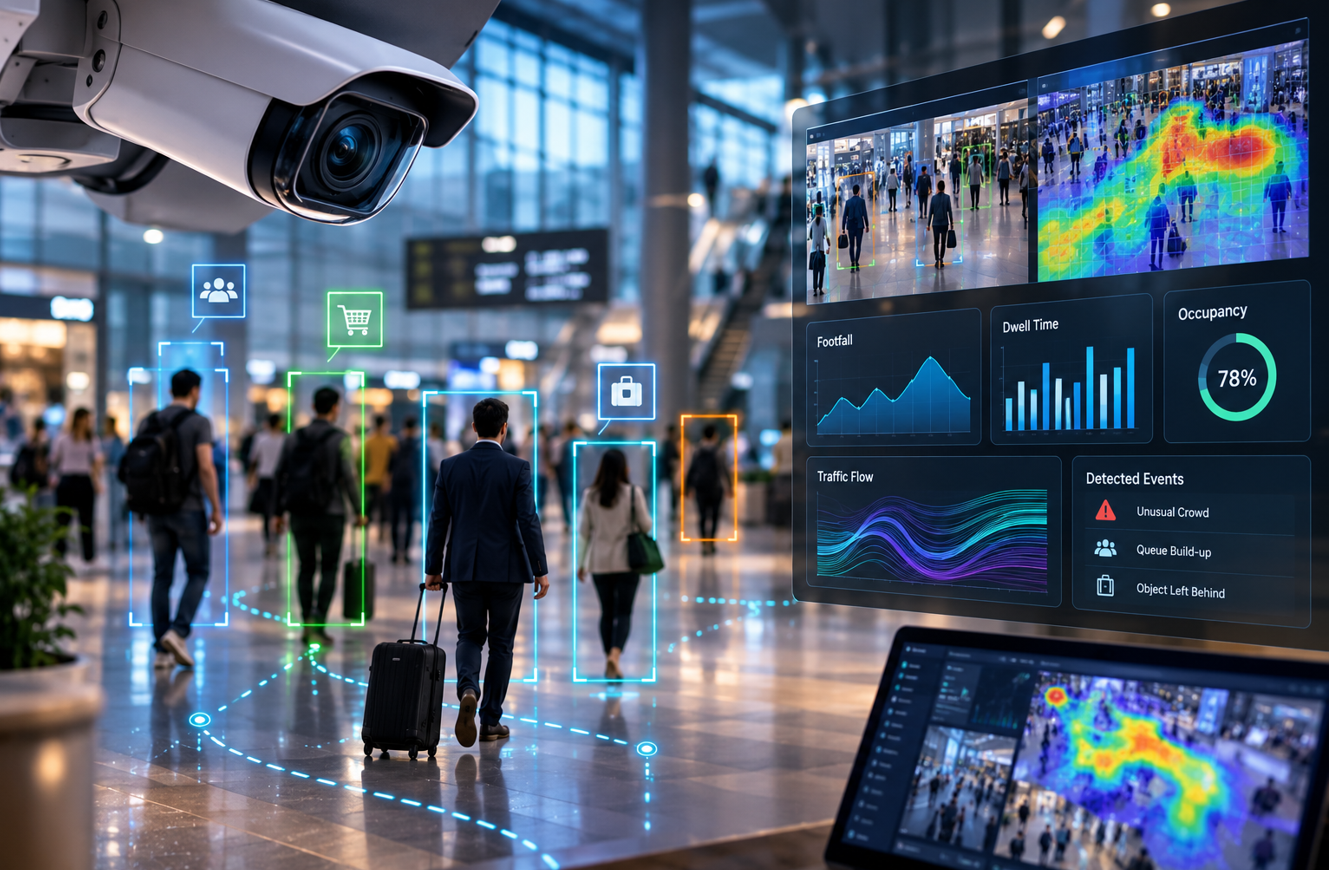
With the combination of AI and video data, computer vision can be integrated with business analytics to transform video surveillance from a security infrastructure into a business intelligence tool. Video surveillance is moving from passively recording events to sensing what is happening in the environment. This helps to answer questions such as which areas are congested, how customers are moving, how long they dwell in particular areas, and whether unusual events are occurring. Businesses can use this data to optimise their operations, such as improving the customer checkout process, monitoring asset or staff movement, and managing crowds or traffic flows. Organisations can also incorporate contextual business information to enhance the analytics by combining behavioural data with CRM or IoT data, providing additional context and insights for decision-making and improving the customer or visitor experience.
Video surveillance can be used to optimise operations, improve customer experiences, and support strategic decision-making across industries. Video itself does not create business intelligence; rather, its value increases when visual information is combined with other operational and contextual data, while computer vision is used to understand and enhance business operations. The pipeline from video to business intelligence can be represented as obtaining data from video sources such as fixed cameras, IoT-enabled cameras, or robots. Computer vision is then applied to the video to detect or track people, objects of interest, or activities. Behavioural data are taken into account, such as customer dwell time in particular product areas, occupancy of rooms or halls, movement of people across a building, and anomalies in behaviour. At this stage, operational data are also considered. The final stage is the business intelligence stage, where trends are identified and insights are inferred. At this stage, data visualisation plays an important role, with dashboards and data storytelling displaying correlations, predictions, and infographics that provide more than simple visual summaries of surveillance data. The camera becomes an operational sensor for the organisation. The important transformation occurs when visual data are combined with business data, such as sales, operational, and IoT data, to convert visual observations into business knowledge that informs operational, tactical, and strategic decision-making within an organisation.
The levels of business intelligence can be viewed as three analytical capabilities: descriptive intelligence, diagnostic intelligence, and combined predictive and prescriptive intelligence. Descriptive intelligence usually addresses what is happening. Visual analytics can identify footfall, occupancy, queue length, waiting time, dwell time, traffic flow, movement patterns, and detected events. Visualisation dashboards can present these indicators in real time or over historical periods, allowing managers to understand the current state of an operation. For example, a museum dashboard can show heat maps of visitor numbers, dwell time, and movement across different exhibition areas, while analysing visitor behaviour and providing insights into the optimal placement of exhibitions. An airport dashboard could display passenger volumes and queue lengths across terminals.


Submer to Address the Infrastructure Challenges Behind Sovereign AI at DCD Connect | MENA 2026
Terrace Dining, Oktoberfest, and Beach Days Return to InterContinental Abu Dhabi This October

THE STORIES BEHIND THE MATERIALS SHAPING UAE INTERIORS



-

 Trending12 months ago
OPPO A6 Pro 5G Review: Reliable Daily Driver
-

 Tech News2 years ago
Denodo Bolsters Executive Team by Hiring Christophe Culine as its Chief Revenue Officer
-
 VAR2 years ago
Microsoft Launches New Surface Copilot+ PCs for Business
-

 Automotive2 years ago
AGMC Launches the RIDDARA RD6 High Performance Fully Electric 4×4 Pickup
-
Tech Interviews3 years ago
Navigating the Cybersecurity Landscape in Hybrid Work Environments
-

 Hospitality2 years ago
Gulfood 2025 30th Edition Kicks Off Today, Setting New Benchmarks in F&B Growth and Innovation
-

 VAR11 months ago
Huawei Nova 14 Pro Review: Where Camera Excellence Meets Ecosystem Evolution
-

 Tech News1 year ago
Nothing Launches flagship Nothing Phone (3) and Headphone (1) in theme with the Iconic Museum of the Future in Dubai