
 Have a question? +971 56 404 0503




Technology
INFORMATICA BRINGS TRUSTED AGENTIC DATA MANAGEMENT ACROSS AWS, MICROSOFT, GOOGLE CLOUD, DATABRICKS, AND SNOWFLAKE


Informatica from Salesforce has announced a comprehensive series of strategic partnership expansions designed to empower enterprises to build, deploy, and scale trusted agentic AI workflows across their entire technology estate. The innovations span integrations with Amazon Web Services (AWS), Databricks, Google Cloud, Microsoft, and Snowflake, positioning Informatica as the unified data foundation for the agentic enterprise.
The announcements address a critical market reality: organizations adopting agentic AI are held back by unreliable, fragmented, and ungoverned data. With 89% of data leaders believing agent interoperability will soon be required to do business, and 89% stating that a strong data foundation is the most critical factor for successful AI adoption, enterprises need enterprise-grade data management embedded directly into their AI agent workflows.
“The organizations that win the AI race will be those that put trusted, governed data in front of their agents from day one,” said Rik Tamm-Daniels, Vice President, Ecosystems and Technology, Informatica from Salesforce. “These announcements demonstrate our unwavering commitment to being the data intelligence layer across every major cloud and data platform. We’re giving enterprises the confidence to operationalize agentic AI at scale.”
Headless Data Management as the Agent Enabler
Across all partnerships, Informatica is making its Headless Intelligent Data Management Cloud (IDMC) available through Model Context Protocol (MCP) servers, a rapidly emerging interoperability framework for AI agents. This approach eliminates the need for custom integrations, allowing enterprises to invoke Informatica’s core data services — metadata search, address verification, master data management, and data quality — directly within agentic workflows on any cloud.
Partnership Highlights
Databricks: Agentic Enterprise Data at Scale: Informatica brings four new capabilities to Databricks, enabling joint customers to fuel Agent Bricks with governed data. The innovations include native headless IDMC integration with Databricks Agent Bricks (Private Preview, summer 2026 GA), a purpose-built Lakebase connector optimized for agentic use cases, an MDM extension for automatic publication of trusted golden records into Databricks SQL, and governance tag federation between Informatica and Databricks Unity Catalog. The result: enterprises can move trusted master data and governance metadata seamlessly into their Databricks intelligence layer, enabling production-ready agentic deployments.
Snowflake: Trusted AI With Open-Data Confidence: Informatica deepens its collaboration with Snowflake by delivering headless IDMC integration with Snowflake Cortex AI (Private Preview moving to GA summer 2026), row-level access policy management for Snowflake Tables (generally available), and metadata scanners for Snowflake Managed Iceberg Tables. These capabilities enable enterprises to build trustworthy agents on Cortex AI, enforce unified access governance across Snowflake assets, and extend governance standards to open-data architectures with confidence.
AWS: Enterprise Data for Agentic Workflows: Informatica’s MCP servers and CLAIRE Agent skills are now available in AWS Agent Registry and Amazon Quick, enabling organizations to embed governed data directly into agentic workflows on AWS. The Metadata Explorer MCP ensures agents understand sensitive classifications; the Master Data Management MCP prevents agents from acting on fragmented records; and Data Quality MCPs validate information at the point of entry. Informatica MCP Servers on Amazon Quick are generally available in U.S. regions, while CLAIRE Agent skills on AWS Agent Registry and Amazon Quick are available in global preview.
Google Cloud: Conversational Intelligence and Open Interoperability: Informatica brings two innovations to Google Cloud: CLAIRE GPT, a conversational AI assistant for enterprise data management now generally available on Google Cloud (enabling natural-language discovery, metadata enrichment, quality assessment, and governance resolution), and A2A Protocol support (Fall 2026 release) enabling CLAIRE agents to collaborate with agents across heterogeneous enterprise agent ecosystems.
Microsoft: Trusted Data for AI and Analytics at Enterprise Scale: Informatica’s headless IDMC MCP servers are now generally available in Microsoft Foundry, enabling Azure customers to integrate data management services — governance, metadata search, address verification, and data provisioning — into their AI agents. Additionally, expanded IDMC support for Microsoft Fabric brings mass ingestion and Change Data Capture for Fabric Data Warehouse, allowing enterprises to ingest billions of rows monthly and keep data synchronized while minimizing compute costs.
The Outcomes Enterprises Need
These partnerships deliver three critical capabilities for enterprise agentic success:
- Metadata Context: Agents understand asset classifications, business terms, and governance policies, knowing which data is safe to act on and which is sensitive.
- Unified Master Records: Agents operate on single source-of-truth data, preventing personalization and compliance failures caused by fragmented or duplicate records.
- Point-of-Entry Quality: Data validation occurs immediately upon ingestion, preventing errors from propagating downstream and undermining agent accuracy.
By making these capabilities available across Databricks, Snowflake, AWS, Google Cloud, and Microsoft — the platforms enterprises are standardizing on — Informatica ensures that high-quality data management is accessible to all business personas, not just technical teams.
Availability & Support
Informatica’s MCP servers and agentic integrations are rolling out across cloud partners with varying general availability timelines — from immediate availability in Microsoft Foundry and Google Cloud to preview status on AWS and summer 2026 GA for several Databricks and Snowflake capabilities. Customers can discover and activate these integrations directly within their cloud platform partner ecosystems.

Kayvan Karim, Programme Director of MSc Software Engineering, School of Mathematical and Computer Sciences, Heriot-Watt University Dubai
For the past few years, the AI infrastructure race has largely been measured in scale: more GPUs, larger data centres and greater power capacity. That expansion is continuing, but the economics are beginning to change. Competitive advantage may increasingly depend not only on securing additional power, but on extracting more useful AI work from the power already available. Part of the reason is a change like AI demand. We are moving from relatively simple prompt-and-response systems towards agents that can reason across multiple steps, call tools, inspect results, revise plans and continue working autonomously. Anthropic’s latest Economic Index notes that Claude usage is increasingly shifting towards long-running agentic tasks and that more computationally intensive conversations tend to be associated with higher-value outputs.
This transition could have significant implications for infrastructure demand. A chatbot might generate one answer to one prompt. An agent performing a software-development, research or business task may invoke a model dozens of times, maintain a large context, call external tools and generate many intermediate reasoning steps before producing an outcome. Demand may therefore grow in two ways: more people using AI and more inference, model calls, and tokens processed for each task. Major AI laboratories are already working on this efficiency problem. OpenAI says one of its primary inference objectives is to serve more tokens from the same hardware, using techniques including scheduling, caching, kernel optimisation and improved model implementation. It also describes GPT-5.6 as being trained to accomplish more work per token. Google DeepMind is pursuing a similar direction: its Gemini 3.6 Flash was designed for scaled agentic workloads and uses fewer output tokens than its predecessor on several evaluations. In contrast, its recent agentic video system reduced token consumption by up to 88% for that workload.
Other approaches address efficiency at the model architecture level. DeepSeek-V3, for example, uses a Mixture-of-Experts design with 671 billion total parameters but activates 37 billion per token, so only part of the network is used for each computation. Meta has similarly worked on inference efficiency through grouped-query attention and more efficient tokenisation; the Llama 3 tokeniser was reported to require up to 15% fewer tokens than Llama 2 for equivalent text. Taken together, these approaches show that model capability is increasingly being developed alongside the cost of delivering it.
Model-level efficiency, however, is unlikely to remove the infrastructure constraint on its own. Global data-centre electricity consumption was approximately 415 TWh in 2024, according to the International Energy Agency, and its base case projects this to reach around 945 TWh by 2030. AI is expected to drive most of that growth. Efficiency is therefore improving while aggregate demand continues to rise. One reason is the Jevons, or rebound, effect: efficiency improvements reduce the resources required for each unit of work, but lower costs can also encourage greater overall use. If agents become much cheaper to operate, organisations may respond by deploying more of them, running them for longer, or applying them to tasks that were previously uneconomic. Efficiency can reduce the compute required for an individual task while still increasing total demand.
That increased demand meets infrastructure that cannot expand as quickly. Models and software can improve quickly, but grids, substations, transformers and power-generation infrastructure usually have much longer development cycles. The IEA notes that while a data centre can sometimes be developed within two or three years, the broader energy infrastructure required to support it often involves longer planning and construction periods. Where grid capacity is constrained, each available megawatt becomes a more valuable production resource. The amount of power available remains important, but so does the amount of useful computation that can be produced within that power envelope.
That changes how we should understand capacity. Improvements in accelerator performance, model architecture, workload scheduling, caching, utilisation and inference software can increase computational output without increasing a site’s electrical connection. OpenAI’s recently reported Jalapeño inference hardware illustrates the direction of travel: the company says the chip can deliver more AI work per unit of power while increasing throughput and reducing latency. Efficiency can therefore act as a form of virtual capacity. If two operators each control 100 MW, but one can consistently deliver substantially more useful AI work within that power envelope, their nominal capacity may be identical while their productive capacity is not.
The same constraint applies to physical space and cooling. AI systems are concentrating more computational power into individual racks, increasing both power density and heat output. Packing more accelerators into the same building only creates useful capacity if the electrical and thermal infrastructure can support them. This is one reason liquid cooling is moving from a specialist technology towards a more central part of AI data-centre design. Microsoft, for example, has introduced a closed-loop chip-level cooling architecture that it says eliminates evaporative water consumption for cooling and could avoid more than 125 million litres of water annually per data centre. The example also shows why power, cooling, water use and rack density cannot be treated independently.
The same shift creates a measurement problem. Power Usage Effectiveness, or PUE, has been valuable for showing how much facility energy is required beyond the electricity IT equipment consumes. It does not, however, measure whether that IT equipment is producing useful work efficiently. Uptime Institute’s 2025 survey placed average PUE at around 1.54 and noted that the headline industry figure had changed little for six years. Uptime has consequently argued for productivity measures that relate computational work to energy consumption. For AI inference, tokens per kilowatt-hour might offer one operational measure. Still, even that is incomplete: an efficient model that solves a task in 1,000 tokens may be more valuable than one generating 10,000. A more useful long-term measure may therefore be useful AI work per unit of energy, water and infrastructure.
Capacity will remain essential. The AI industry will continue to build larger data centres, secure new power supplies and deploy large quantities of computing hardware. As agentic systems create more persistent inference demand and physical resources become harder to expand, however, efficiency may increasingly determine the productive value of that capacity. Operators that can support more useful computation within the same power, cooling, water, and space constraints can accommodate more workloads without waiting for equivalent growth in physical infrastructure.
For AI infrastructure, installed megawatts will remain a headline measure. The more consequential measure may increasingly be how much useful AI work those megawatts can support.
Tech News
Thermax showcases advanced desalination and water recovery technologies to strengthen UAE’s industrial water security at WETEX 2026

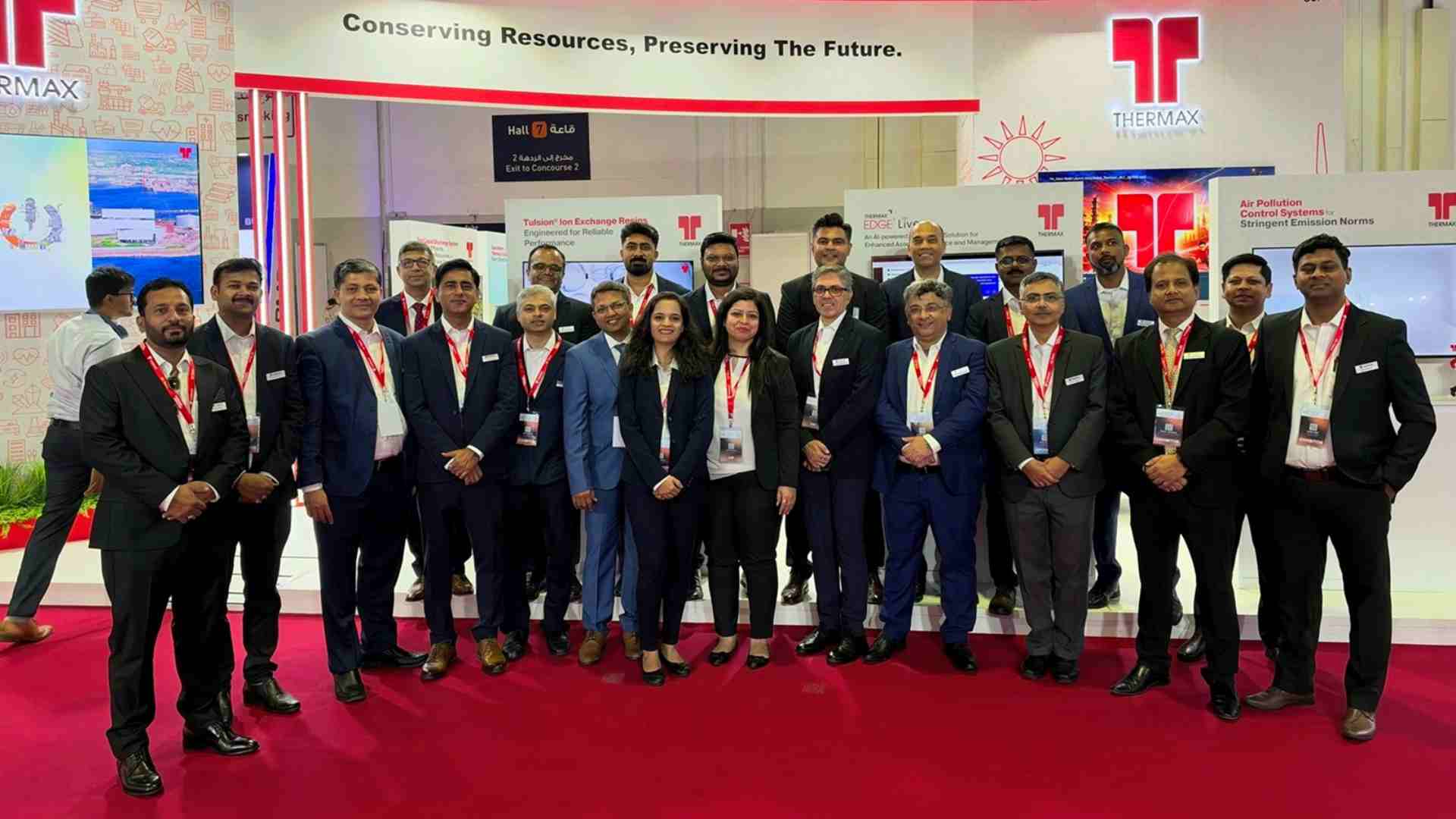
Thermax Limited showcased its advanced seawater desalination and industrial water recovery technologies at the Water, Energy, Technology and Environment Exhibition 2026 (WETEX), held from October 20 to 22 at Dubai World Trade Centre. Through its digital showcase, the company highlighted solutions designed to help industries secure reliable water supplies, improve resource efficiency and reduce environmental impact.
Thermax’s participation came as Dubai continues to strengthen its desalination infrastructure to meet growing water requirements. According to Dubai Electricity and Water Authority (DEWA) Financial Annual Report, desalinated water production increased by 5.51 per cent year-on-year in the first quarter of 2026, reaching a record 37.57 billion imperial gallons. By June 2026, Dubai’s installed desalination capacity had reached 555 million imperial gallons per day, with seawater reverse osmosis accounting for 23 per cent of the total. These developments highlight the growing importance of efficient and reliable water infrastructure in supporting the UAE’s evolving water requirements.
At the event, Thermax highlighted its desalination solutions that help industries meet their water needs while easing pressure on freshwater resources. The systems use energy-efficient membrane technology to remove salts from seawater and produce water suitable for industrial use, with designs tailored to each customer’s water quality and operating requirements.
Through its digital showcase, Thermax also highlighted portable and containerised desalination systems that bring key equipment together in compact units. This reduces installation work on site, supports faster deployment and allows treatment capacity to grow with demand.
Ashish Bhandari, Managing Director & CEO, Thermax Limited, said: “Water security shapes where industries invest and how competitively they operate. Businesses need dependable supply at a cost they can sustain. That means planning water and energy together, with investment decisions guided by performance throughout a plant’s life.”
Beyond desalination, Thermax also showcased Advanced Reverse Osmosis (RO) technology that recovers additional usable water from the concentrated stream left after treatment. By concentrating the remaining brine, the technology reduces the load on downstream evaporation systems and supports more efficient industrial wastewater management. When combined with suitable additional treatment and crystallisation processes, it can also support salt recovery, creating opportunities to recover valuable resources from wastewater and promote circular water management.
Thermax also showcased industrial water treatment, wastewater recycling and zero liquid discharge (ZLD) solutions that help industries treat and reuse wastewater for suitable applications while reducing freshwater dependence. Complementing these solutions, Thermax’s EDGE Live digital platform supports plant performance through real-time monitoring, AI-driven analytics and predictive diagnostics, helping industrial operators identify potential issues early, optimise maintenance and improve operational reliability.
These solutions align with the objectives of the UAE Water Security Strategy 2036, which targets 95 per cent reuse of treated water by 2036. Through its regional office in Dubai, Thermax is focused on exploring various opportunities across the UAE’s industrial desalination, water treatment and wastewater recycling sectors, particularly within water-intensive industries such as oil and gas, chemicals, metals, food and beverages, and pharmaceuticals.
Thermax has been active across the Middle East and North Africa region since 1993, with more than 1,000 installations across its regional energy and environment portfolio, serving over 30 industries.
Tech Interviews
Trust Is the New Speed – AI, Lexis+ with Protégé and the future of legal work in the Middle East

Exclusive interview with Lara Salem, Head of Content Strategy, MENA, LexisNexis Legal & Professional
How is artificial intelligence changing the way legal professionals research information, analyze cases and prepare legal documents?
In the middle east region, one of the key challenges has always been access to legal information. Finding the right law, the latest amendment or the one judgment that changed everything took hours, sometimes days. That scarcity is ending. What is becoming scarce instead is judgement.
AI is changing legal work at three levels.
Research is moving from searching to asking. Lawyers no longer have to guess the right combination of keywords. They can pose a complex question in plain language and receive an answer linked to the sources behind it. The skill shifts from finding information to interrogating it.
Analysis is moving from single documents to synthesis. Agentic AI can take an assignment, such as comparing how a commercial agency dispute would be treated onshore in the UAE, in the DIFC and in Saudi Arabia, break it into steps, work through each one and present the results for review. Work that once filled a week of associate time can be framed, reviewed and challenged in an afternoon.
Drafting is moving from the blank page to the review. The first draft is no longer the work. The work is knowing whether that draft is right: whether the clause reflects the correct jurisdiction, whether the terminology is accurate, and whether it serves this client’s commercial reality.
In my earlier writing I described this as the rise of the “hybrid lawyer”. What has changed since is the margin for error. We can no longer say we missed a case because it was obscure, or overlooked an amendment because there was no time to look. AI has removed many of those excuses, and in doing so it has raised the standard we are held to.
AI has not made legal judgement less important. It has made it the thing that sets one lawyer apart from another.
LexisNexis recently launched Lexis+ with Protégé in the region. How does the platform help legal professionals work more efficiently, and what makes it different from general-purpose AI tools?
Early in development, our subject-matter experts told us something that became our guiding principle: an AI assistant is only as useful as the content behind its output.
General-purpose AI can tell you what the law says. That is no longer enough. Lawyers need to know how the law is applied: how a court reads a provision, what a regulator expects in practice, what a clause has to look like to stand up in a given forum. That knowledge cannot be scraped from the internet. It has to be built.
We have been building it in this region since 2010. Over those years we have put together a substantial body of Practical Guidance written by regional experts, and it sits in Lexis+ with Protégé alongside UAE federal law and other GCC laws, legislation, regulations, official gazette materials, case decisions and expert commentary. Additionally, UK content is available through the same sign-in. This is what makes the difference in the output. Protégé does not stop at the statute. It brings in the practical layer lawyers rely on every day, and every answer links back to its sources.
The region’s many layers of jurisdiction also needed particular care, especially when we built the agentic drafting. An affidavit in the UAE is not the same as an affidavit in Saudi Arabia. The differences are small, and our experts caught them. A general-purpose tool would miss them. And that is the difference.
For efficiency, the platform supports the whole cycle of legal work. It handles conversational research in plain English. Its agentic workflows break complex assignments such as due diligence, compliance reviews or legal comparisons into structured steps you can review. It drafts contracts, clauses, memos and client correspondence, drawing on a firm’s own precedents where authorised. It also analyses matter documents securely, pulling out key issues, building timelines and comparing materials. Customer data is never used to train public AI models.
What I am proudest of is how it was built. Protégé comes from a marriage between leading regional legal experts, data scientists and software engineers. Practitioners tested it, challenged it and told us where it fell short. That is what localization really means: not translating a product but teaching it how law works here.
And it is not finished. The product evolves every week, and refining its agentic skills is one of the most fascinating parts of the work. Each refinement brings it closer to the needs of our clients and of each jurisdiction we serve.
Globally, Forrester Consulting studies commissioned by LexisNexis project a 344% three-year return on investment for a composite large law firm, and 284% for a composite corporate legal department, using the platform behind Lexis+ with Protégé. We are now validating performance with regional users and will share those results as they become available.
With the growing use of AI in legal work, how can professionals ensure that the information they receive is accurate, reliable and based on trusted legal sources?
My rule is simple: never trust an answer you cannot trace.
AI can produce something that sounds convincing and is entirely wrong, and courts in this region have already had to deal with it. Earlier this year, the ADGM Courts ordered a law firm to pay wasted costs after it filed a defence relying on authorities that did not exist, generated by an AI tool and never checked. The message was clear: the failure to verify belongs to the lawyer, not the machine. The DIFC Courts have also issued guidance requiring practitioners to verify AI-generated content they rely on in proceedings.
Every AI output should face three questions. Where did this come from? Is it current? Is it the right jurisdiction? If the tool cannot answer the first, the other two do not matter.
That is why the choice of tool matters as much as the discipline of the user. Before adopting any legal AI, firms should ask hard questions. What content is the system grounded in? Is that content verified for accuracy and currency? Does every output link to its source? How was it tested, and by whom?
But even the best tool does not replace the lawyer. The lawyer is the ultimate owner of the output, and their judgement is what matters most. A provision can be quoted correctly and still be the wrong answer. It may not be the only law that applies, or the one that best fits the question at hand. Only a lawyer who understands the matter can make that call.
This is why every firm and legal department needs a clear review process for AI output, written into an AI use policy. The policy should set out who reviews what, how sources are checked, when senior sign-off is needed, and how AI use is recorded. Verification should not depend on individual habit. It should be how the firm works.
Grounding and citations reduce risk. They do not remove responsibility. So, treat AI as an assistant, not an authority. Expect speed, not certainty. Read the source and ask whether you would have reached the same conclusion yourself. AI raises the bar. It does not lower it.
What are the biggest challenges law firms in the UAE and wider GCC face when adopting AI, and how can they overcome them?
Adoption is no longer the main hurdle. Trust is. Most lawyers in the region have already tried AI. The question is whether they can rely on it for real client work, and four challenges stand in the way.
Data. Generic models are trained mostly on English-language, common-law material. Arabic legal content is far less structured and digitised. A model that has rarely seen Gulf legislation cannot reason reliably about it.
Language. Arabic is the authoritative legal language across most of the region, yet the same legal concept is not always expressed the same way from one country to the next, and a single diacritical mark can change the meaning of a provision. Legal AI here has to reflect the terminology of each jurisdiction rather than one standardised vocabulary. This was one of the hardest, and most interesting, parts of localising Protégé.
Confidentiality and data sovereignty. GCC clients are rightly protective of their information, and data protection laws such as the UAE and Saudi PDPLs set strict expectations on how personal data is handled and transferred. Many firms hesitate because they cannot answer a simple client question: where does my data go?
Culture. Partnership models, the billable hour and concerns about how juniors will learn all create reasons to wait. Too many firms are stuck in pilots that never scale.
None of these is a reason to stand still. Choose AI built for the region’s law and languages, not adapted as an afterthought. Put governance in place before you scale, not after. Start with defined, high-value use cases such as research, document review and first drafts, where results can be measured. Train every lawyer, not only the enthusiasts. And measure what changes, so the business case rests on evidence rather than excitement.
How can legal professionals use AI responsibly while protecting confidential client information and maintaining professional standards?
Every lawyer begins their career by making a promise: to act with integrity, independence and confidentiality. That oath is personal. It cannot be delegated, and it cannot be automated.
AI does not take the oath. Lawyers do.
Protecting the client starts with the choice of tool. Consumer-grade AI has no place near confidential client information. Lawyers should know where their data goes, whether it is stored, whether it is used to train models and how it is encrypted. With Lexis+ with Protégé, customer information is protected through encryption and enterprise-grade security, and it is never used to train public AI models. That should be the minimum standard for any legal AI.
Good habits matter just as much. Share only what the task requires, and redact what it does not. Be open with clients about how AI supports your work. Clients value honesty over ambiguity, and openness signals confidence, not risk.
My test is simple: use AI only in ways you would be comfortable explaining to your client, or to a judge.
What skills will lawyer and legal teams need to develop as AI becomes a bigger part of their daily work?
The most important skill of the AI era is the oldest one in the profession: knowing when something is wrong.
Verification. It will become a core discipline, taught and practised as rigorously as drafting. Lawyers will need to read sources rather than summaries, test conclusions against their own reasoning and spot the output that is plausible but missing the nuance.
Prompting. It is often misunderstood. Prompting is not a technical trick. It is structured legal reasoning. A good prompt sets out the jurisdiction, the facts, the question, the format and the standard expected, which is exactly how a good partner briefs a junior.
Supervision. Agentic AI breaks tasks into steps and works through them. The lawyer’s role becomes scoping the task, checking each stage and deciding what reaches the client. Think of it as managing a very fast junior who never sleeps and does not always say “I’m not sure”.
AI literacy. Lawyers need to understand how these systems work, where they fail and what to ask a vendor before trusting one.
The human skills. Commercial judgement, negotiation, empathy and the ability to explain complex advice clearly will matter more, not less. In the Middle East, where relationships and trust carry great weight, these are what clients will pay for.
There is also an uncomfortable question the profession has to answer: if AI produces the first draft, how do juniors learn? I believe the answer is to redesign training, not to slow down technology. Juniors can learn by critiquing AI output, tracing its sources and explaining why it is right or wrong. Done well, that builds judgement faster than years of formatting documents.
How do you see legal technology evolving in the Middle East over the next few years, and what role will AI play in this transformation?
The Middle East has an advantage many markets do not. Governments here are not reacting to AI; they are planning for it. The UAE National AI Strategy 2031 and Saudi Vision 2030 have made digital transformation a national priority, and in June the UAE announced a single federal authority for artificial intelligence and data. Legal technology will follow that ambition.
I see four shifts over the next few years.
From answering to acting. Today, most lawyers use AI to answer questions. Next, agentic systems will carry out multi-step work such as due diligence, regulatory monitoring and contract review, with the lawyer supervising and approving each stage.
From global to local. Localisation will become the price of entry. Firms will expect AI that understands the region’s mix of civil law, common-law free zones and Sharia principles, and that works natively in Arabic rather than through a translation layer.
From experimentation to governance. Regulation is emerging through courts, free zones and data protection law rather than a single AI statute. Governance will become a competitive advantage, because clients will choose firms that can show how their AI-assisted work is controlled and verified.
From hours to value. As routine work accelerates, pricing will change. LexisNexis research in the UK found that 55% of lawyers now expect firms to change how they bill because of AI. The same conversation is beginning here.
AI will be the engine of this transformation, but trusted content will be its fuel. The firms that lead will not necessarily be the ones that adopt AI first. They will be the ones whose clients trust their AI-assisted work the most.
For us at LexisNexis, after 16 years in the region, the launch of Lexis+ with Protégé is not a finish line. It is a starting point. The journey is only beginning, and it will be guided by three principles that have always defined good legal work: trust, accountability and transparency. They are not new. They are simply more important than ever.

Terrace Dining, Oktoberfest, and Beach Days Return to InterContinental Abu Dhabi This October

THE STORIES BEHIND THE MATERIALS SHAPING UAE INTERIORS
Form Room welcomes new JVC residents with a complimentary coffee and exclusive discounts



-

 Trending12 months ago
OPPO A6 Pro 5G Review: Reliable Daily Driver
-

 Tech News2 years ago
Denodo Bolsters Executive Team by Hiring Christophe Culine as its Chief Revenue Officer
-
 VAR2 years ago
Microsoft Launches New Surface Copilot+ PCs for Business
-

 Automotive2 years ago
AGMC Launches the RIDDARA RD6 High Performance Fully Electric 4×4 Pickup
-
Tech Interviews3 years ago
Navigating the Cybersecurity Landscape in Hybrid Work Environments
-

 Hospitality2 years ago
Gulfood 2025 30th Edition Kicks Off Today, Setting New Benchmarks in F&B Growth and Innovation
-

 VAR11 months ago
Huawei Nova 14 Pro Review: Where Camera Excellence Meets Ecosystem Evolution
-

 Tech News1 year ago
Nothing Launches flagship Nothing Phone (3) and Headphone (1) in theme with the Iconic Museum of the Future in Dubai