
 Have a question? +971 56 404 0503




Technology
Avaya Breeze and Snapp store introduced at Technology forum

At the Avaya Technology Forum, taking place in Dubai, Avaya executives unveiled Avaya Breeze, a technology platform that makes it easier for organizations to develop the mobile, customer-facing and cloud-migration applications they need to achieve their digital transformation objectives, and the Avaya Snapp Store, the first-ever ecommerce app store for business communications.
As organizations today look to evolve digitally and deliver differentiated experiences to their digitally-savvy customers and workforce, IT departments are struggling to keep pace: by the end of 2017, market demand for mobile app development services will grow five times faster than internal IT organizations can deliver them, according to Gartner Inc. With 89% of companies now competing primarily on customer experience, IT executives need to overcome the skills gap and deliver initiatives at customer speed.
Avaya Breeze, the next generation of the Avaya Engagement Development Platform, provides an entirely new way to develop business communications applications, profoundly simplifying application development, while delivering built-in capabilities for enhanced mobile, customer-facing and hybrid/cloud requirements. To make it even easier to create entirely new customer experiences, Avaya announced the Avaya Snapp Store, a focused, ecommerce-enabled marketplace for Avaya Breeze applications, is now officially open for business.
Savio Tovar Dias, Director – Sales Engineering, Asia, Middle East, Africa & Turkey, said, “This game-changing technology is built for digital business where companies need the flexibility, speed and the freedom to easily create unique value for their customers. Avaya is delivering on the promise of open, mobile engagement with a platform that allows companies to easily design and embed applications into workflows via a powerful, simplified, software-defined architecture and infrastructure for communications. Avaya Breeze helps organizations get ahead of the transformation curve and stand out from their competitors.”
With Avaya Breeze, organizations can deliver enhanced business value and execute on their digital strategies by integrating communications and collaboration into workflows, business processes and existing applications. The open framework allows organizations to automate manual processes to improve digital experiences, while workflow-based applications can be created within a matter of hours or days, rather than months. The Avaya Snapp Store provides a delivery mechanism, allowing a single integrated experience via browsers and native smart apps for entirely new customer experiences.
The Avaya Snapp Store is a focused, ecommerce-enabled marketplace for Avaya Breeze applications – or Snap-ins – from Avaya and 3rd party developers. Snap-ins — easily consumable, prebuilt connectors, fit-for-purpose apps and/or developer code — enable companies to quickly build workflows, customer journeys and other unique applications. The Avaya Snapp Store makes it easy to find, access and download Snap-ins by simply using a credit card for purchase. Developers can create Snap-ins and be on-boarded in the store within weeks.
Avaya is also helping organizations met changing customer expectations with innovative customer engagement solutions, which can be implemented through a fully hosted or hybrid cloud model to help ease the transition between existing and new technologies for digital businesses.
The Avaya Customer Engagement solutions deliver a flexible, robust foundation provided by Avaya Aura and Elite contact center solutions, now available as a 100% virtualized, 100% software-based platform that eliminates the need for hardware-based media gateways to perform important call center functions. With Avaya Pod Fx, organizations can remove complexity and streamline operations, with a full turnkey solution to run an advanced virtualized contact center.
These innovative solutions build on Avaya’s successful transition to software and services, which made up 73% of revenue in its fiscal first quarter. As the only company specializing in complex business communications, built on open and mobile software platforms, and supported by a robust underlying network infrastructure, Avaya is uniquely placed to help drive customers’ digital transformation strategies.
Gary Barnett, SVP and GM, Avaya Engagement Solutions, said, “The competitive battleground has shifted, requiring a new type of solution and means to respond to digital customer behavior. Speed is the new currency for business transformation – businesses need to understand, predict and respond to customer needs in less time than it takes for a spark to burnout. Avaya is the only company that can rapidly elevate the customer end game without the disruption typical of massive technical change.”
Tech News
HONOR Announces Participation at LEAP 2026, Showcasing the World’s First Robot Phone and Its AI Ecosystem Vision

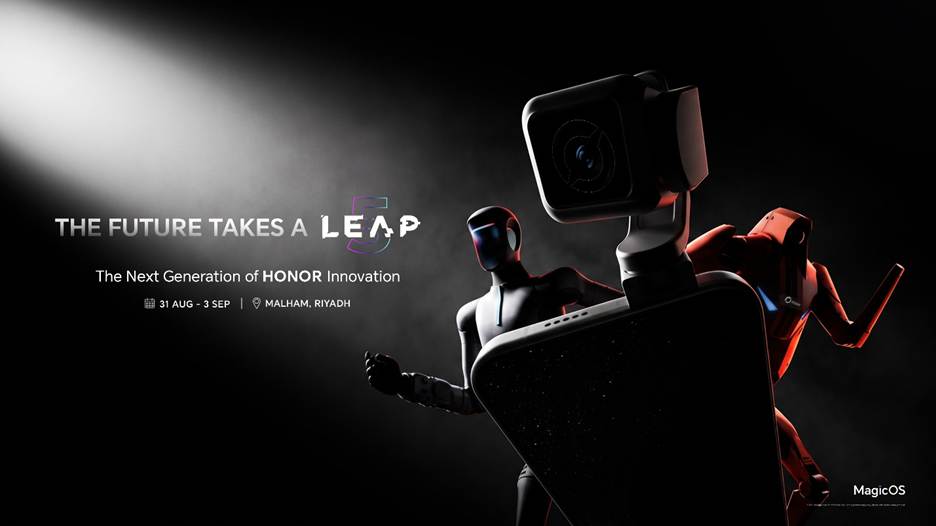
Global leading AI device ecosystem company HONOR today announced its participation in LEAP 2026, taking place from 31 August to 3 September in Riyadh, under the theme “Alpha Plan: From Vision to Reality.” The participation highlights HONOR’s commitment to bringing its AI ecosystem closer to families across the Kingdom and demonstrating how intelligent, connected technologies can enhance everyday experiences.
A key highlight of HONOR’s presence will be the world’s first Robot Phone, a groundbreaking AI device and a defining milestone in the HONOR Alpha Plan, representing a new step forward in the evolution of intelligent devices.
Visitors will have the opportunity to discover explore HONOR Robot Phone, discover new products, innovative technologies and immersive experiences, with HONOR’s growing ecosystem brought to life through a range of real-life scenarios that demonstrate how connected devices can work together to enhance everyday life.
As part of HONOR’s participation, HONOR Regional CMO Lei Kunming will deliver a keynote speech on the LEAP mainstage titled “HONOR Alpha Plan: From Vision to Reality,” sharing HONOR’s vision for the future of AI and how the company is working to bring its AI ecosystem into everyday life.
Discover What’s Next from HONOR
At LEAP, HONOR will showcase new products and technologies, giving visitors a first look at the latest innovations shaping the brand’s expanding ecosystem.
The HONOR booth will bring this vision to life through real-life scenarios, demonstrating how smartphones, tablets, wearables and other smart devices can work together to deliver more seamless, intelligent and connected experiences.
Beyond product showcases, visitors will also have the opportunity to explore interactive demonstrations and engagement activities, providing a closer look at HONOR’s latest technologies and the experiences they enable.
LEAP: A Global Hub for Technology and Innovation
HONOR’s participation underscores the importance of Saudi Arabia as a growing global hub for technology and digital innovation. For HONOR, LEAP provides an important platform to connect with consumers, technology enthusiasts and industry leaders while showcasing its vision for a more connected, intelligent and human-centric technology ecosystem.
As HONOR continues to expand its presence and ecosystem across the region, its return to LEAP reflects the company’s commitment to bringing meaningful innovation closer to consumers and the technology community. Through its latest technologies, connected experiences and the world’s first Robot Phone, HONOR will give visitors a closer look at how its AI ecosystem
-END-
About HONOR
HONOR is a global leading AI device ecosystem company. It is committed to revolutionizing human-to-device interactions to bridge the AI ecosystem with all consumers in the agentic AI era and beyond. The company endeavors to open industrial boundaries through open, seamless collaboration to co-create a value-sharing ecosystem with industry partners. With an innovative product portfolio spanning intelligent phones, AI PCs, tablets, wearables and more, HONOR aims to empower every human, enabling everyone to embrace the new intelligent world.
Tech News
Redington Brings 400 Technology Leaders to Singapore as a Technology Ecosystem Orchestrator

Redington Limited, a technology ecosystem orchestrator, today announced Global NEXT 2026, its flagship, invitation-only leadership summit, taking place from 2–4 September 2026 in Singapore.
The three-day forum will bring together approximately 400 leaders representing global technology companies, channel partners, enterprise customers, independent software vendors, innovators and policymakers from across Asia, the Middle East and Africa.
More than a technology conference, Global NEXT is designed as a working ecosystem-connecting the organisations creating breakthrough technologies with the partners who can localise and implement them, the enterprises seeking measurable outcomes, and the leaders shaping the future of high-growth markets.
The summit comes at a pivotal moment for artificial intelligence. Enterprises, SMBs and Public Sector are moving beyond experimentation and asking a more consequential question: how can AI be deployed securely, governed responsibly and scaled to deliver meaningful business, economic and societal impact?
At the centre of the programme will be the Global NEXT AI Summit, addressing sovereign AI, national technology infrastructure, data governance, cybersecurity, enterprise adoption and the partnerships required to build locally relevant technology capabilities at scale.
From Fragmented Innovation to Orchestrated Outcomes
The next phase of AI adoption will require much more than access to individual technologies. Infrastructure, cloud, data, cybersecurity, applications, skills, services, financing and implementation capabilities must work together around clearly defined outcomes.
Redington’s role as a Technology Ecosystem Orchestrator is to make those connections work-linking global innovation with local market intelligence, specialised capabilities, partner reach and execution across more than 40 markets.
V.S. Hariharan, Managing Director and Group CEO, Redington Limited, said:
“The next chapter of technology will not be shaped by one product, one platform or one company. It will be built by ecosystems.
“Customers need infrastructure, cloud, cybersecurity, software, data, skills and specialised partners to come together around the outcomes they want to achieve. Redington’s role is to orchestrate these capabilities-reducing complexity, connecting global innovation with local execution and creating a clearer path from possibility to adoption.
“This is especially important across high-growth markets, where ambition is immense but access to technology, capabilities and skills can remain fragmented. Global NEXT brings the ecosystem together to turn that ambition into secure, scalable and measurable progress.”
Participants will experience this orchestration model through technology demonstrations, enterprise use cases, leadership exchanges and visits to centres of excellence in Singapore, including the Redington AI Launchpad.
The programme will also showcase emerging technology companies and specialist ISVs across AI, cloud, cybersecurity, data infrastructure and enterprise applications. Redington’s wider ecosystem-including its AI Exchange, digital platforms, skilling capabilities and partner enablement programmes-will demonstrate how innovation can be discovered, evaluated, localised and taken to market more rapidly.
Creating New Pathways to Growth
For global technology companies, Global NEXT provides direct access to enterprise priorities, partner capability and growth opportunities across diverse markets.
For partners and ISVs, it creates pathways to new technologies, skills, use cases, customers and routes to market.
For enterprises and governments, it brings together an ecosystem through which complex technologies can be evaluated, secured, financed, implemented and scaled.
Puneet Chadha, Global Chief Marketing Officer, Redington Limited, said:
“Global NEXT is where global innovation meets local ambition. It puts the people shaping technology, building capability and solving real-world problems in the same room.
“The measure of this platform will not simply be the conversations it hosts, but the partnerships it starts, the use cases it advances and the opportunities it unlocks. We want participants to leave Singapore with more than inspiration-with new connections, actionable possibilities and a clearer path to what comes next.”
The Global NEXT programme will combine strategic conversations with practical engagement, including technology demonstrations, enterprise success stories, ecosystem panels, leadership exchanges and visits to technology centres of excellence.
Discussions will span artificial intelligence, hybrid cloud, cybersecurity, software-led business models, responsible technology adoption and the evolution of routes to market. Together, these sessions will explore how the technology industry can move from selling individual solutions to orchestrating integrated outcomes.
With operations across more than 40 markets, relationships with 450+ technology brands and a network of over 70,000 channel partners, Redington sits at the intersection of global technology innovation and local execution.
Through Global NEXT 2026, Redington aims to strengthen that intersection-creating a platform where technology providers, partners, innovators, enterprises and policymakers can collectively shape the next phase of technology adoption across Asia, the Middle East and Africa.

BY: Owais Mohammed, Regional Lead & Sales Director at WD for the Middle East, Africa, Turkey, and the Indian Subcontinent
The UAE’s ambition to become a global AI powerhouse is well established. Government investment is flowing, infrastructure is scaling, and organisations across every sector are accelerating their AI programs. But beneath the strategic announcements and the technology deployments, a fundamental question goes unanswered: is the data storage infrastructure underpinning all this built for what comes next?
For many organisations, the honest answer is: not yet. Storage is rarely the first conversation in an AI strategy discussion. It tends to be treated as a commodity decision made late in the planning cycle, long after the headline architecture choices like GPUs/CPUs have been made. That approach made sense in simpler times, but not in today’s data-driven AI economy.
The scale of what is coming
To understand why, organisations need to understand the sheer data volume that is coming their way. Global data creation is forecast to rise to 718.5 Zettabytes (ZB) through 2030 (IDC source: Market Forecast: IDC Global DataSphere Forecast, 2026-2030, June 2026, Doc #US53425426), more than tripling in five years.
AI is both a driver and a consumer of this growth. Every model trained, every inference run, every data pipeline operating continuously across a distributed architecture is generating and demanding access to data at a scale that earlier generations of infrastructure were not designed to support.
Businesses that will absorb this growth successfully are not those with the fastest individual components. They are those with architectures designed to handle volume, variety, and velocity simultaneously, at a cost that remains economically sustainable as scale increases. That is the storage strategy challenge that needs to be addressed upfront and not as an afterthought.
Why a single technology cannot solve it
A common mistake is to frame the storage decision as a technology choice: SSDs versus HDDs, flash versus spinning disk, performance versus capacity. The world’s most sophisticated storage operators, including hyperscalers and major cloud service providers, have already moved past this framing. They do not choose one technology. They deploy multiple of them, in a tiered architecture that places data on the medium best suited to its requirements.
The logic is straightforward. SSDs deliver the high IOPS and low latency that real-time, performance-critical applications demand. HDDs provide the massive capacity and cost efficiency required for the vast middle tier of active and warm data, and currently continue to represent approximately 63% of worldwide installed storage capacity through 2030. Tape generally handles archival, regulatory, and compliance workloads where retrieval times of hours or days are acceptable, representing just under 8% of worldwide installed cloud storage capacity in 2025.
These are not competing technologies. They are complementary ones, each serving a distinct purpose within a coherent architecture. The question is how each is deployed where it delivers the greatest value.
Making tiered architectures work in practice
Knowing that tiered storage is the right model and implementing it effectively are two different things. At the scale hyperscalers operate, where storage volumes are measured in hundreds of exabytes, manual allocation of data across tiers is neither practical nor efficient. Nor can all data live on cost prohibitive flash. The mechanism that makes tiered architecture manageable is software-defined storage (SDS), which pools resources centrally and provisions capacity dynamically based on demand. Rather than pre-allocating fixed capacity to individual applications, SDS responds to where data needs to be, improving overall utilisation and reducing waste.
Together, tiered architecture and SDS provide the flexibility and economic efficiency that hyperscale environments depend on. But this model is not the exclusive preserve of the world’s largest operators. For emerging infrastructure providers, including Neoclouds that are expanding rapidly across the region, the same principles apply. Architecture decisions made today will determine whether future growth is economically sustainable or structurally constrained. The window to get this right is earlier than many organisations assume.
Innovation at the storage level
Architectural thinking also changes how storage technology itself must evolve. An organisation that understands its workloads, plans for data growth, and builds tiered infrastructure will eventually reach the limits of what current storage innovations can deliver. That is why, manufacturers like WD are approaching HDDs not only as a mature, reliable product but as a technology with significant headroom remaining to help increase capacity, lower power and cost effectively scale AI data. They are advancing recording technologies, exploring novel materials, and embedding intelligence at the drive level. The aim is not incremental improvement. It is expanding the boundary of what high-capacity storage can deliver for the architectures customers are building today and the workloads they will run tomorrow.
The leadership dimension
The organisations that navigate the AI era most effectively will not be those that simply procure the latest hardware. It will be those that understand the architectural decisions that determine long-term performance, cost and scale, ask better questions earlier in the planning process, and treat storage infrastructure strategy as a source of competitive advantage rather than a procurement exercise.
Storage sits at the foundation of every AI workload, every data pipeline, and every digital service an organisation delivers. Getting the architecture right is not a technical detail. It is a leadership decision. And in a market moving as quickly as the UAE’s, it is one that deserves to be made with the same rigour and strategic intent as any other.


Baseus PicoGo AC22 Review: How Much Power Can Fit in Your Pocket?

Baseus Inspire XH1 Review: A Dependable Daily Driver That Just Keeps Going

EYWA Way of Water to be EMFIS® Certified for Low-Electromagnetic Environment in Dubai’s Business Bay



-
News11 years ago
SENDQUICK (TALARIAX) INTRODUCES SQOOPE – THE BREAKTHROUGH IN MOBILE MESSAGING
-

 Trending10 months ago
OPPO A6 Pro 5G Review: Reliable Daily Driver
-

 Tech News2 years ago
Denodo Bolsters Executive Team by Hiring Christophe Culine as its Chief Revenue Officer
-
 VAR1 year ago
Microsoft Launches New Surface Copilot+ PCs for Business
-

 Automotive2 years ago
AGMC Launches the RIDDARA RD6 High Performance Fully Electric 4×4 Pickup
-
Tech Interviews2 years ago
Navigating the Cybersecurity Landscape in Hybrid Work Environments
-

 Tech News1 year ago
Nothing Launches flagship Nothing Phone (3) and Headphone (1) in theme with the Iconic Museum of the Future in Dubai
-

 VAR2 years ago
Samsung Galaxy Z Fold6 vs Google Pixel 9 Pro Fold: Clash Of The Folding Phenoms