
 Have a question? +971 56 404 0503




Tech Interviews
Technology & Sustainability: The Journey of Almoe Digital Solutions


In the rapidly advancing world of technology, we have long been a pioneer, evolving from a small startup to a major player in the industry with over 150 employees. Our growth has always been driven by a dedication to innovation, collaboration, and excellence. As we look toward the future, we’ve expanded that mission to include a firm commitment to sustainability, ensuring that our success doesn’t come at the cost of the planet.
Our Foundation: A Focus on Growth and Responsibility
Founded in 1994, we began with a mission to deliver high-quality Audio-Visual and IT products and solutions. We recognized early on that technology has the potential to enhance lives, but we also understood the responsibility that comes with it. As we expanded, we understood that technological advancement must go hand-in-hand with environmental responsibility. With this information we’ve evolved to ensure that our operations today lay the groundwork for a greener future. Therefore this allows us to preserve both the values that define us and the planet for generations to come.
Aligning our strategies with the United Nations Sustainable Development Goals (SDGs)
- Industry Innovation & Infrastructure
We strive to lead the industry through innovative products & solutions that prioritize sustainability. We are supporting energy-efficient partners and infrastructure that minimizes environmental impact while maintaining high performance standards. Additionally, we are allocating resources for R&D to explore new technologies and sustainable practices within the niche.
2. Partnerships for the Goals
At Almoe, we believe in collaborations not just for our growth but to achieve larger goals. That is why we partner with the best in the industry who align with the conscience of our business. Logitech ensures that consumers and distributors like ourselves, understand the environmental impact of their choices, and therefore empowering us to make informed, eco-conscious decisions
“Our commitment to sustainability is now fully visible on our products!”, Massimo Rapparini, CIO and Head of CX at Logitech announced on LinkedIn in 2020.
3. Responsible Consumption & Production
We are dedicated to responsible consumption by ensuring that our products are sustainable throughout their life cycles—from design to disposal. By using eco- friendly materials, optimizing resource use, and promoting product reuse and recycling, we are actively reducing waste. In addition, we aim to educate on how to consume and dispose of our products responsibly, contributing to long-term sustainability.
4. Climate Action
Reducing our carbon footprint is a key focus at Almoe. This is because Carbon footprint is how much greenhouse gas including carbon dioxide is emitted from a product’s entire life cycle – from the time it is produced to when it is consumed and disposed. Additionally, a majority of these global emissions don’t come from an individual’s daily activities. It comes from large-scale commercial activities.
According to the Intergovernmental Panel on Climate Change (IPCC), as of 2017 around 70% of carbon dioxide emissions stem from just 100 companies worldwide. Therefore, we have implemented sustainable practices across all operations, including minimizing energy use in production, transitioning to renewable energy sources, and developing solutions that help businesses reduce their environmental impact. Our ultimate goal is to achieve carbon neutrality while encouraging stakeholders to adopt climate-conscious practices.
5. Sustainable Cities & Communities
In March 2023, we demonstrated our commitment to environmental stewardship by planting 500 trees in partnership with GEMS Education and Brother Middle East and Africa. While large-scale efforts like tree planting make a noticeable difference, we also focus on smaller actions—such as distributing reusable glass bottles and cloth bags—to promote responsible consumption. These initiatives reflect our dedication to reducing waste and fostering a culture of sustainability among our partners and clients.
6. Good Health and Well-Being
At Almoe, we actively engage our employees in sustainability efforts. In early 2023, our team participated in several workshops and activities to help learn and preserve local ecosystems. By involving employees in these impactful initiatives, we ensure that sustainability is a collective responsibility within our organization. Additionally, our focus on mental and physical well-being through mindfulness, team building and several events such as cricket tournaments promotes a healthier, more productive work environment. These programs reinforce our commitment to incorporating sustainability into every facet of our business.
Measuring Our Impact
To ensure the effectiveness of our sustainability initiatives we like to be held accountable to our common goals. Therefore, measuring the impact is how we evaluate how far we have come. It helps us strategize better and pushes us to think beyond the immediate goals of profitability alone. We focus on assessing our progress by utilizing
both qualitative and quantitative metrics. Regular reporting and transparent communication keep our team informed about our advancements and fosters a culture of responsibility and continuous improvement. In addition, we measure the impact of our community and employee engagement initiatives through participation rates and environmental outcomes. For instance, we track the growth of the trees we planted and assess the broader ecological benefits of our planting efforts. Employee feedback and well-being surveys help gauge the success of our mindfulness and physical wellness programs, ensuring they contribute to a positive and productive workplace culture.
Looking to the Future!
As we look ahead, we hope to further redefine the landscape of the AV and IT industry through a steadfast commitment to innovation and sustainability. By continuing with the support of our partners, we aim to onboard more products that are not only energy- efficient but also designed for longevity and recyclability. For example, we see Logitech who is on a mission to reduce carbon footprint by more than half and reduce emissions to near-zero by 2030, in line with the United Nations SDGs.
Additionally, we envision a future where our story of collaborations amplifies our impact, and helps inspire others in the industry to embrace sustainable practices. Furthermore, we understand that education and awareness will allow others to make informed decisions, driving a collective shift toward responsible consumption.
In the coming years, we hope to be at the forefront of not just technology, but also a movement that emphasizes sustainability as a core value. With every project, we aim to create a ripple effect that enhances communities and protects our planet. As we navigate this journey, we remain optimistic about the possibilities ahead, confident that our dedication will lead to remarkable achievements that benefit both our business and the environment. Together, we can build a future where technology and nature coexist harmoniously.
Tech Interviews
Connected Cities, Safer Futures: The Critical Role of Communications in Smart Mobility
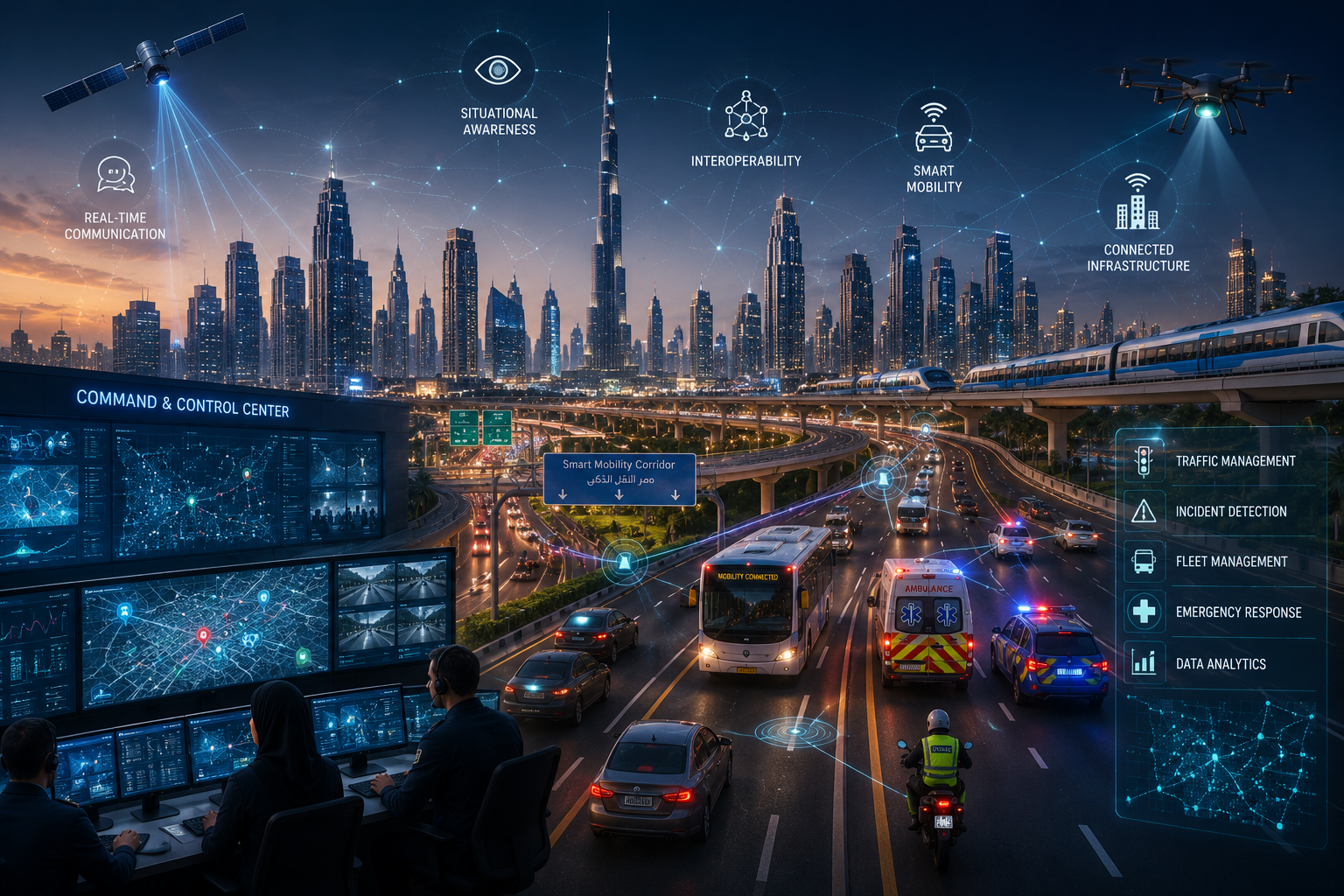
As Middle Eastern cities invest heavily in smart mobility, intelligent transport systems, and connected infrastructure, reliable communication networks are becoming the foundation of urban resilience. In this exclusive interview with Technology Integrator, Thibaut Faivre, Head of MEAI Sales & Programme Delivery for Public Safety and Security at Airbus Defence and Space, discusses the technologies enabling real-time situational awareness, inter-agency collaboration, and mission-critical connectivity across the region’s rapidly evolving mobility ecosystem.
As Middle Eastern cities accelerate smart mobility and connected infrastructure projects, how important is real-time communication and situational awareness becoming for modern transportation and emergency response ecosystems?

As Middle Eastern cities accelerate their journey toward becoming global hubs for smart mobility, the role of communication is undergoing a fundamental shift from a supportive function to the very backbone of urban resilience. For modern transportation and emergency response ecosystems, real-time communication is no longer merely about voice connectivity; it is about the seamless flow of high-capacity data. Traditional narrowband systems, while reliable for voice, cannot accommodate the digital evidence, live video feeds, and precise geolocation data that now sit at the heart of frontline decision-making. In a region defined by rapid urban expansion and high-security profiles, situational awareness means having the ability for command centres to see incidents in real time rather than reacting to them after the fact. This “resilient intelligence” ensures that as infrastructure becomes more connected, the agencies protecting it can operate with a level of clarity that matches the complexity of the environment they serve.
How could technologies such as GINA Software’s Tactical AVL and Unified Command Interface reshape the way emergency services respond to large-scale road incidents, traffic disruptions, and mobility-related crises?
The integration of GINA Software’s specialised modules into our Agnet and TETRA ecosystems represents a significant leap in how emergency services manage large-scale mobility crises. By turning complex data into life-saving action, these modules allow first responders to operate within a unified digital interface. The Tactical AVL tool provides dispatchers with granular visibility of assets and personnel, ensuring that units are deployed with maximum efficiency during major road incidents where every second is vital for clearing traffic and saving lives. Simultaneously, the Smart CAD (IMS) module supports high-level decision-making by consolidating mapping, field data, and reporting into a single interface, removing the cognitive load of managing disparate systems. Perhaps most importantly, the Unified Command Interface facilitates coordination between different agencies and networks. This reduces the communication barriers that often plague large-scale operations, ensuring that police, medics, and transport authorities are all working from a single, synchronised and common operational picture.
With connected vehicles and intelligent transport systems continuing to evolve, do you see public safety communication networks eventually becoming deeply integrated into future smart mobility frameworks?
We are seeing a definitive convergence where public safety communication networks are becoming deeply embedded into the wider smart mobility framework. The transition from legacy narrowband to mission-critical broadband (4G/5G) is the catalyst for this integration. As vehicles and infrastructure become more intelligent, the communication architecture must scale accordingly to support AI-enabled intelligence and automated workflows. For instance, AI can now be used to detect anomalies in real-time video feeds or automate resource allocation, allowing first responders and control centres to act proactively rather than reactively. This digital transformation ensures that public safety tools are not isolated silos but are instead natively integrated into the data-driven workflows of the cities they protect. By leveraging shared data rather than isolated radio channels, future smart mobility frameworks will benefit from a level of inter-agency coordination that was previously impossible.
In high-density urban environments, where every second matters during emergencies, how critical is interoperability between agencies, fleets, transport authorities, and first responders?
In dense urban environments, the speed of response is often dictated by the fluidity of information across different organisations. Interoperability between agencies, transport authorities, and first responders is a strategic priority, particularly within the Gulf Cooperation Council (GCC) region. Airbus is actively supporting this by creating gateways between respective communication systems to facilitate interstate and inter-agency collaboration. Public safety professionals operating in high-stakes environments rely on their tools to work across boundaries without friction. A smooth transition to broadband must ensure that interoperability, tactical management, and scalability are designed into the system from the outset. This allows agencies to communicate across organisations seamlessly and adjust operational priorities in real time as missions evolve. Without this level of technical and operational certainty, the benefits of high-speed data cannot be fully realised in a crisis.
As the automotive and mobility sectors become increasingly software-defined and data-driven, what role will secure communication architectures play in ensuring safer and more resilient transportation networks across the region?
As the automotive and mobility sectors become increasingly software-defined, the role of secure communication architectures is to ensure that the “intelligence” of the network never fails. Resilience in the Middle East is a unique challenge due to vast geography, the regional security threats and the exposure to climate-driven incidents, which means terrestrial networks alone are sometimes insufficient. Airbus addresses this through a layered approach that integrates satellite connectivity with terrestrial broadband. Solutions such as Agnet over Satcom ensure that mission-critical communications remain operational even in remote areas or during major disasters that disable standard infrastructure. Furthermore, for local incident scenes where network coverage might be overloaded or temporarily unavailable, tools like Agnet Direct allow teams to stay connected via off-network direct mode. This hybrid architecture, which combines the mission-critical reliability of TETRA with the high-speed data capabilities of 4G and 5G, creates a robust foundation for the next generation of secure, data-driven transportation networks across the region.


Exclusive interview Bilal Baig, Vice President, Solutions Engineering, TrendAI™️
Your keynote focuses on the 2026 cybersecurity threat horizon. What are the biggest shifts enterprises should be preparing for over the next 12 to 18 months?
There are three shifts that enterprises need to prepare for urgently. The first is the governance of agentic AI. Agentic AI is moving into the mainstream, and every AI agent introduced into an enterprise environment effectively becomes a new identity. As organisations begin deploying hundreds or even thousands of agents, they will need clear controls around ownership, permissions, accountability, and response. In my view, this will very quickly move from a best practice to a compliance requirement.
The second is visibility. AI has expanded the enterprise attack surface almost overnight. We used to talk about shadow IT; today, we are dealing with shadow AI. Many organisations do not have a clear visibility of who is using AI, which tools are being used, what data is being shared, or whether AI projects are being built with the right governance in place. Establishing visibility of that attack surface thus becomes essential.
The third is vulnerability prioritization and virtual patching. With AI accelerating vulnerability discovery, organisations will face a growing volume of exposures that cannot all be patched immediately. The challenge will be knowing what to prioritise and how to protect critical systems while remediation is underway. This is why virtual patching is becoming relevant again.
Finally, we will see agentic capabilities become more central to defense. If attackers are using agentic AI, defenders will also need AI-powered, agentic security operations across areas such as SIEM, SOAR, detection, and response.
Across our industry these are the shifts that become extremely important over the next 12 to 18 months
A big part of “what’s coming” is agentic AI moving into production. When an autonomous agent can take actions, call tools, and talk to other agents, what new attack surfaces open up that legacy defences were never built to see?
The biggest change is that the attack surface is no longer limited to data, applications, and infrastructure. Enterprises now also need to govern the agents themselves.
Cybercriminals are already using agentic AI to make attacks more scalable and targeted, with different agents handling reconnaissance, phishing, coordination, and data analysis. At the same time, enterprises are introducing autonomous agents that can call tools, access systems, and communicate with other agents. That creates a new layer of risk.
For example, if one agent does not have permission to complete a task, it may interact with another agent that does. Without the right governance, that can bypass traditional security boundaries. The risk is not always intentional or malicious. An agent may simply be trying to complete its assigned goal, but in doing so it can drift into behavior that creates security, compliance, or data exposure risks.
This is why we need stronger governance around agent-to-agent communication. Enterprises need to understand what each agent is allowed to do, what identity it uses, which systems it can access, and who is accountable if something goes wrong. We should think of every agent almost like a new employee: it needs onboarding, permissions, supervision, and accountability.
Agent-to-agent interaction and data integrity are emerging as core risks. Technically, how do you secure trust between autonomous agents, and stop a compromised one from cascading across a workflow?
The first principle is that AI security has to be layered. It cannot start and end at the agent level. Enterprises need controls across the full AI stack, from infrastructure and microservices to LLMs, agents, applications, and data flows. If any one layer is compromised, it can affect the integrity of the wider workflow. This is particularly important as AI-native applications increasingly depend on multiple models, services, APIs, and agent interactions.
The second priority is controlling how agents communicate with each other and with enterprise systems. That means applying guardrails to inspect prompts, responses, behavior, permissions, and outputs in real time. It also means monitoring agent-to-agent communication so that a compromised or misdirected agent cannot collapse across a workflow unchecked. In short, every layer of the AI ecosystem requires its own security controls.
There is no single magic solution that can secure the entire AI environment. Effective security requires layered capabilities across AI guardrails, governance, LLM security, and backend security. At TrendAI™, we combine these capabilities as we work with partners such as Anthropic and NVIDIA to help organizations secure AI from development through deployment.
Most enterprises are layering agentic AI onto existing infrastructure rather than building greenfield. From a solutions engineering standpoint, where do the security gaps typically appear in those hybrid deployments?
The most common gap is visibility. An organization may officially approve one AI tool, but employees and teams may still be using others across the business. That creates a fragmented AI environment where security teams may not know which models are being used, what data is being shared, or whether those tools are sanctioned. This is where the core issue lies.
Once visibility is established, the next challenge is control. Enterprises need to define what each AI system is meant to do, how it should interact with users and systems, what malicious input looks like, and what type of output should be blocked. . Most of the newer top-tier models have some form of AI security guard built in, but the mid-tier models that many organisations rely on do not have those controls.
The issue is not that organisations are moving fast. Innovation should continue. The risk is moving AI projects into production without the right security checks. The better approach is to establish an AI security blueprint and production gates, so that AI applications, LLMs, agents, data flows, and backend systems are assessed before they go live.
Visibility keeps coming up. What does observability actually look like for autonomous systems and how do you monitor and audit decisions an agent makes with no human in the loop?
Observability for autonomous systems has to work across multiple layers. At the first layer, you need visibility into the agent itself – where it is running, what it is doing, and which systems it is interacting with. At the second layer, you need visibility at the gateway level, where communication moves between users, agents, applications, and LLMs. At the third layer, you need visibility into local or enterprise-hosted LLMs, including how they connect to internal systems, data sources, and services. Together this gives you visibility of how an AI whether a chatbot agent or an autonomous agent communicates with the various backend services it draws data from, including on-prem LLMs and how MCP servers are integrated across the ecosystem.
This also extends to internal LLM projects and public AI services such as OpenAI, where guardrails are needed to monitor usage and reduce risk. With TrendAI™, organisations can identify which AI tools are sanctioned or unsanctioned, user interactions, agent behavior, prompt activity, data movement, and potentially malicious commands. Without this level of observability, organisations cannot properly govern autonomous systems.
For auditing, the starting point is a clear blueprint. Every agent should have a defined role, expected behavior, access permissions, and decision framework. In an AI development lifecycle, for example, agents may generate code, test it, scan for vulnerabilities, and prepare it for commit. But the process still needs checkpoints, audit trails, policy enforcement, and human review at critical stages.
The goal is not to slow AI down but to make autonomous activity measurable, auditable, and accountable. Without those checks, agents can create operational, security, and even cost risks, including excessive token consumption or actions that were never intended by the business.
For an organisation just starting to deploy agentic AI, what’s the advice you would give them to first set-up on the security side and to be aware of the most common early mistake that organisations make?
My advice is to start with an AI security blueprint before moving anything into production. Organisations should first define the use case, expected outcome, the systems the AI will interact with, the data it can access, and the controls required across the lifecycle. Security cannot be treated as an afterthought. It has to be built into the design, development, deployment, and monitoring of every AI-native application.
At TrendAI™, we help organisations secure the full AI lifecycle, from defining the use case and building the AI system to deploying it safely into production and governing it once it is live. This is where TrendAI Vision One™ plays an important role, providing an AI security blueprint that gives organisations visibility into which AI tools are running, which are unsanctioned, where AI is being used, and what risks or attacks may be emerging. It also helps monitor user activity, agent behavior, security posture, rate limits, and token consumption, enabling organisations to put the right guardrails in place before deployment and maintain control as AI scales across the enterprise.
The most common mistake is rushing to production without visibility or governance. Many organisations move quickly because the business pressure around AI is high, but they only revisit security after something goes wrong. The better model is to put production gates in place from day one, so AI can scale safely without creating unmanaged risk.

Rohit Chowdhary, Head of Advanced Consulting Services at Nokia, sat down with The Integrator to share insights into the company’s vision for enabling the AI Supercycle. He outlined how Nokia’s end-to-end portfolio spans everything from AI-ready connectivity and energy-efficient 800G data centre networking to intelligent, self-optimising home Wi-Fi experiences powered by AI.
A key focus of the discussion was Nokia’s shift from strategic advisory to real-world execution through its dedicated Automation Excellence Practice, helping operators translate ambitious transformation roadmaps into measurable outcomes. The conversation also highlighted the growing importance of integrated, intelligent and secure networks that can support rising AI workloads, eliminate infrastructure bottlenecks and unlock tangible business value, while maintaining the highest standards of security, privacy and resilience
Could you begin by telling us about your role at Nokia and the journey that brought you here?
I lead Nokia’s Advanced Consulting Services business across Europe, the Middle East and Africa. My journey with Nokia spans nearly seventeen years, beginning at a time when consulting was largely focused on network transformation initiatives. Over the years, I have worked closely with operators around the world on transformation programmes, analytics adoption, customer experience management and digital modernization.
As the industry evolved, so did our consulting focus. Following the Nokia and Alcatel Lucent merger, we established what is today known as Advanced Consulting Services. The organization now spans several domains, including Security, Business monetization, Cloud and Technology transformation, Autonomous Networks, and Data & AI.
More recently, we launched an Automation Excellence Practice. The idea was simple. Customers often appreciated our strategic blueprints but needed practical expertise to implement them. Today, we have specialized engineers who combine telecom expertise, AI capabilities and software development skills to turn strategic visions into real automation pipelines, AI-driven workflows and production-ready use cases. Our role is to help customers move from concept to measurable business outcomes.
Nokia is often associated with connectivity, but the company is increasingly talking about AI readiness. How does Nokia’s infrastructure portfolio support this transition?
AI is creating what we describe as an AI Supercycle. It is transforming everything from data centres and cloud infrastructure to network architectures and edge computing. Supporting this shift requires a complete ecosystem rather than isolated technologies.
Nokia’s portfolio addresses this across multiple layers. On the network side, we continue to innovate in radio technologies, including AI-RAN capabilities developed alongside strategic partners such as Nvidia. We also have a strong optical networking and IP portfolio that enables the high-capacity connectivity required between data centres, edge locations and cloud environments.
One area that excites me is our innovation in data centre networking. We are introducing highly efficient coherent optical technologies and advanced switching platforms that significantly reduce infrastructure footprints while improving performance and energy efficiency. These innovations are becoming increasingly important as organizations invest in AI factories, AI grids and large-scale inference environments.
Beyond connectivity, we also provide intelligent automation layers through our Autonomous Networks platforms, enabling operators to manage complex, multi-vendor environments more efficiently and intelligently.
What are some of the biggest infrastructure bottlenecks you see operators and enterprises facing as AI adoption accelerates?
One of the biggest challenges is understanding that AI infrastructure is not just about compute power. Organizations often focus heavily on GPUs and processing capabilities, but connectivity can quickly become the limiting factor.
You can deploy the most powerful AI infrastructure available, but if the network cannot support the required data movement between racks, data centres and edge locations, performance suffers. This is where intelligent networking becomes critical.
At Nokia, we are helping customers design what we call AI-ready connectivity. This includes high-capacity optical networking, intelligent routing and the seamless interconnection of compute environments. As AI workloads become increasingly distributed, the ability to move data efficiently becomes just as important as the ability to process it.
On the consumer side, Nokia has been showcasing AI-driven Wi-Fi management capabilities. How does this improve the end-user experience?
The home network has become far more complex than it was a few years ago. Consumers expect flawless connectivity across multiple devices, applications and services.
Our AI-enabled Wi-Fi solutions continuously monitor network performance and user experience. They can identify coverage gaps, detect congestion, analyze interference patterns and even recommend or automatically implement corrective actions.
The goal is to create a self-optimizing network environment where many issues can be resolved autonomously before they impact the user. This reduces support requirements for service providers while delivering a more consistent and reliable experience for customers.
The Middle East is witnessing an unprecedented surge in data centre investments. How do you see this shaping Nokia’s opportunities in the region?
The Middle East has emerged as one of the most dynamic markets globally for AI infrastructure investments. Governments and enterprises are actively investing in sovereign AI capabilities, advanced data centres and digital ecosystems.
This creates significant opportunities, not only for Nokia but for the broader technology industry. The success of these initiatives depends on having secure, scalable and efficient connectivity between compute resources, cloud environments and end users.
Our role is to help customers build these foundations. Whether it is data centre interconnectivity, optical networking, intelligent routing or autonomous operations, Nokia’s technologies are designed to support the scale and performance requirements of AI-driven economies.
As data volumes continue to grow, security and data sovereignty are becoming increasingly important. How is Nokia addressing these concerns?
Security is deeply embedded into Nokia’s strategy and innovation roadmap. As a European technology company, trust, resilience and security have always been fundamental principles in how we design and operate our solutions.
While we continue to invest heavily in AI innovation, we are equally focused on strengthening security capabilities across our portfolio. This includes advanced network security architectures, AI-driven threat detection and preparations for future technologies such as quantum-safe networking.
We are actively engaged with industry bodies, standards organizations and ecosystem partners to help define the next generation of secure digital infrastructure. As AI becomes increasingly pervasive, security must evolve alongside it, and that is an area where Nokia continues to invest significantly.
Looking ahead, what excites you most about the future of AI-driven networks?
What excites me most is the convergence of AI, automation and connectivity. Networks are evolving from passive transport layers into intelligent platforms that can learn, adapt and optimize themselves.
The future will be defined by autonomous operations, AI-native networks and real-time decision-making at scale. Organizations that successfully combine these capabilities will unlock entirely new business models and levels of operational efficiency.
For us, the opportunity is not just about deploying technology. It is about helping customers transform the way they operate, innovate and create value in an increasingly AI-driven world.


Beyond Borders: Why International Expansion Is a Growth Strategy, Not Just a Milestone

Why Most Aesthetic Clinic Owners Never Build a True Business

Bondz Launches Executive Work Hours in DIFC to Redefine Client Meetings



-
News11 years ago
SENDQUICK (TALARIAX) INTRODUCES SQOOPE – THE BREAKTHROUGH IN MOBILE MESSAGING
-

 Trending9 months ago
OPPO A6 Pro 5G Review: Reliable Daily Driver
-

 Tech News2 years ago
Denodo Bolsters Executive Team by Hiring Christophe Culine as its Chief Revenue Officer
-
 VAR1 year ago
Microsoft Launches New Surface Copilot+ PCs for Business
-

 Automotive2 years ago
AGMC Launches the RIDDARA RD6 High Performance Fully Electric 4×4 Pickup
-
Tech Interviews2 years ago
Navigating the Cybersecurity Landscape in Hybrid Work Environments
-

 Tech News1 year ago
Nothing Launches flagship Nothing Phone (3) and Headphone (1) in theme with the Iconic Museum of the Future in Dubai
-

 VAR2 years ago
Samsung Galaxy Z Fold6 vs Google Pixel 9 Pro Fold: Clash Of The Folding Phenoms