
 Have a question? +971 56 404 0503




Tech Features
THE YEAR AI WENT MAINSTREAM


Talal Shaikh, Associate Professor, Heriot-Watt University Dubai
In 2025, artificial intelligence crossed a threshold that had little to do with model size or benchmark scores. This was the year AI stopped feeling like a product and started behaving like infrastructure. It became embedded across work, education, government, media, and daily decision-making. The shift was subtle but decisive. AI moved from something people tried to something they assumed would be there.
From my position at Heriot-Watt University Dubai, what stood out most was not a single breakthrough, but a convergence. Multiple model ecosystems matured at the same time. Autonomy increased. Regulation caught up. Infrastructure scaled. And nations began to treat intelligence itself as a strategic asset.
From one AI story to many
For several years, public attention clustered around a small number of Western firms, most visibly OpenAI and Google. In 2025, that narrative fractured.
Google’s Gemini models became deeply embedded across search, productivity tools, Android, and enterprise workflows. Their strength lay not only in conversation, but in tight coupling with documents, spreadsheets, email, and live information. AI here was designed to live inside existing habits.
At the same time, Grok, developed by xAI, took a different path. With real-time access to public discourse and a deliberately opinionated tone, it reflected a broader shift in design philosophy. AI systems were no longer neutral interfaces. They carried values, styles, and assumptions shaped by their creators. That diversity itself was a sign of maturity.
By the end of 2025, users were no longer asking which model was best. They were choosing systems based on fit, trust, integration, and intent.
The rise of agentic AI
If generative AI defined earlier years, agentic AI defined 2025.
In 2023, most people experienced AI as a chatbot. You asked a question, it replied, and the interaction ended. In 2025, that interaction became continuous. An agent does not simply respond. It reads context, sets sub-goals, uses tools, checks results, and decides what to do next.
A chatbot drafts an email. An agent reads the full thread, looks up past conversations, drafts a response, schedules a meeting, and follows up if no reply arrives. A chatbot explains an error. An agent runs tests, fixes the issue, commits code, and opens a pull request.
This transition from response to agency turned AI from a helpful assistant into an operational participant. It also shifted risk. As systems gained the ability to act, questions of oversight, auditability, and failure containment moved from academic debate into everyday management.
A shift I saw first in the classroom
This change was not abstract for me. I saw it unfold directly in my classrooms.
Only a short time ago, many students dismissed AI-assisted coding with a familiar phrase: “It hallucinates.” They were not wrong. Early tools often produced code that looked correct but failed logically. Students learned quickly that blind trust led to wasted hours.
In 2025, that language faded.
Students now approach AI differently. They no longer ask whether the model is correct. They ask why it produced a solution, where it might fail, and how to constrain it. In one recent lab, a student debugging a robotics control pipeline did not reject the AI output after a failed test. He used it to generate alternative hypotheses, compared execution traces, and isolated the fault faster than traditional trial and error would allow.
At one point, a student stopped and said, “It is not hallucinating anymore. It is reasoning, but only if I reason with it.”
That sentence captures 2025 better than any benchmark.
From skepticism to supervision, in industry
The same shift is visible among our alumni now working in software engineering, fintech, data science, and robotics. Several who once warned juniors not to trust AI code now describe it as a first-pass collaborator. They use it to scaffold architectures, surface edge cases, and speed up documentation, while keeping final judgment firmly human.
The concern is no longer hallucination. It is over-reliance.
AI moved from being treated as an unreliable shortcut to being treated as a junior colleague, fast, useful, and fallible, requiring supervision rather than dismissal.
Sovereign AI, two models of power
One of the clearest signals that AI went mainstream in 2025 was the divergence in how regions approached it.
In much of the West, the year was framed as a corporate contest. Product launches, market share, and valuation battles dominated headlines. Innovation moved fast, driven by competition between private firms.
In the Middle East, and particularly in the UAE, the framing was different. AI was treated as national infrastructure.
The UAE’s investment in sovereign models such as Falcon and Jais reflected a belief that intelligence, like water or electricity, must be secured, governed, and trusted within borders. This was not about isolation. It was about resilience, data sovereignty, and long-term capacity. Dependence without control came to be seen as a strategic risk.
In 2025, this idea matured. Sovereign AI stopped being a slogan and became a planning principle. While the West debated which company would win, the UAE focused on ensuring that the capability itself remained accessible, accountable, and locally anchored.
When culture embraced AI
Another signal of mainstream adoption arrived from outside the technology sector.
The strategic alignment between The Walt Disney Company and OpenAI marked a moment when AI entered the core of global culture. Disney does not adopt technologies lightly. Its value lies in storytelling, world-building, and intellectual property sustained over decades.
This move was not about automating creativity. It was about scale and continuity. Modern story worlds span films, series, games, theme parks, and personalised digital experiences. Managing that complexity increasingly requires intelligent systems that can assist across writing, design, localisation, and audience interaction.
When a company whose primary asset is imagination treats AI as foundational, it signals that intelligent systems are no longer peripheral to creative industries. They are becoming part of how stories are built, maintained, and experienced. In that sense, 2025 marked the moment AI became cultural infrastructure, not just technical tooling.
Work changed quietly
Another sign of mainstreaming was how little drama accompanied adoption. Professionals stopped announcing that they were using AI. They simply expected it.
Developers assumed code assistance and automated testing. Analysts assumed rapid summaries and scenario modeling. Marketers assumed content generation and performance analysis. Students assumed access, but outcomes increasingly depended on how well they could guide, verify, and critique what AI produced.
This created a new divide. Not between technical and non-technical people, but between those who could reason with AI and those who delegated thinking to it.
What this means for universities
For universities, 2025 closed the door on treating AI as optional.
Every discipline now intersects with intelligent systems. Engineers must understand ethics and regulation. Business graduates must understand automation and decision support. Creative fields must grapple with authorship and originality. Researchers must design methods that remain valid when AI is part of the workflow.
At Heriot-Watt University Dubai, this pushes us toward assessment that rewards reasoning over polish, and education that teaches students not just to use AI, but to supervise it.
The real shift
AI went mainstream in 2025, not because it became smarter, but because society reorganised around it. Multiple models coexisted. Agents acted with growing autonomy. Nations planned for sovereignty. Culture adapted. Classrooms recalibrated trust.
The next phase will not be defined by faster models alone. It will be defined by judgment.
That is the quieter, more demanding challenge left to us after the year AI went mainstream.
Tech Features
How digital transformation of UAE’s industrial sector is driving ‘Net Zero 2050’ ambitions
By Ahmad Hamad Bin Fahad, CEO of DUBAL Holding
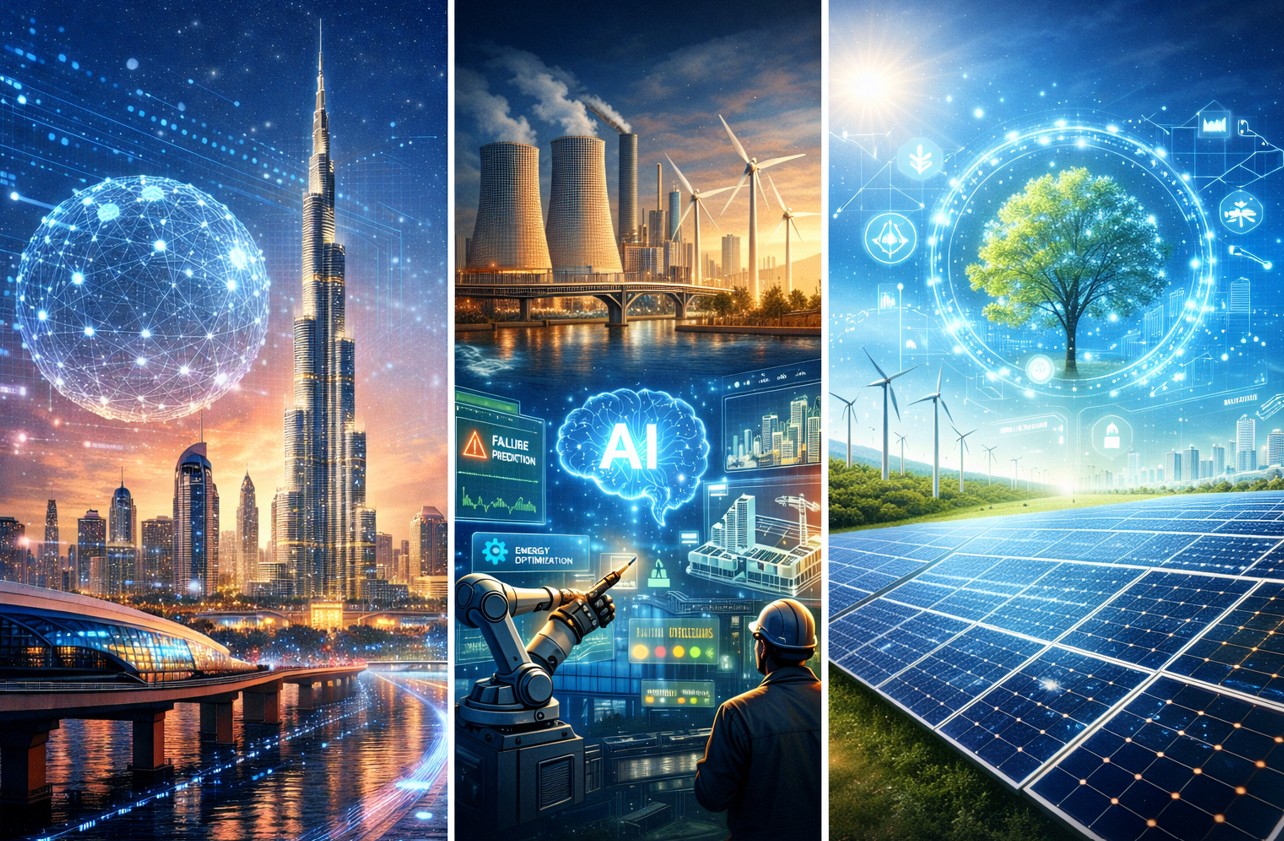
The UAE’s growth journey is led by an unwavering focus on driving digital transformation, enhancing renewable energy capacity and promoting regulatory excellence. This is best reflected in the ‘Net Zero 2050’ strategy, which aims to create 200,000 jobs across the solar, battery and hydrogen sub-sectors, combining economic and sustainability goals. Digitalisation of the industrial sector will play an important role in realising this vision by paving the way for long-term industrial competitiveness and resilience.
Smart manufacturing, AI adoption and Industry 4.0
Across the UAE, factories are being installed with smart manufacturing systems that integrate IoT sensors, predictive analytics and real-time data environments. These optimise energy usage, reduce downtime and minimise material waste, turning sustainability into a measurable, operational outcome rather than an abstract concept.
Furthermore, digitally connected factories can track emissions at every stage of production, benchmark efficiency and automate corrective actions. This is crucial to achieving the goals of ‘Operation 300bn’ and positioning the UAE as a global hub for future industries.
According to the Ministry of Industry and Advanced Technology (MoIAT), Industry 4.0 tools can increase the nation’s industrial productivity by up to 30 per cent while reducing operational costs by nearly 20 per cent through wider structural transformations. Moreover, AI adoption is set to contribute AED 335 billion to the UAE economy by 2031, as reported by the UAE Council for AI and Blockchain.
Artificial Intelligence is also redefining how industrial assets function, from power plants and smelters to logistics centres and material processing facilities. AI-enabled algorithms can even forecast equipment failures, balance energy loads and simulate entire production cycles to identify carbon-saving interventions. AI also helps enhance transparency and enforce operational discipline, promoting both sustainability and profitability.
Role of advanced automation in redefining industrial operations
Advanced automation, from robotics to autonomous transport systems, is driving sustainability by eliminating key bottlenecks that cause higher emissions. Furthermore, automated systems ensure enhanced precision, enabling industries to streamline energy usage, optimise supply chains and accelerate circular-economy practices such as recycling, material recovery and waste-to-value processes.
However, automation does not replace human capability; it merely enhances it, enabling operators to move on to high-value digital roles. It efficiently tackles repetitive, energy-intensive tasks, creating a more resilient, low-carbon industrial ecosystem. A key enabler of this transition is the rise of strategic, government-aligned investments in digital-first industrial ventures. These investments are the backbone of the nation’s industrial future as they help build advanced manufacturing platforms, AI-driven optimisation technologies, smart mobility solutions and digital energy-management systems.
By investing in companies that integrate digital tools into core industrial operations, the UAE is accelerating technology adoption at scale. These investments further position digital transformation as a strategic imperative for fulfilling the UAE’s sustainability goals while boosting economic competitiveness.
Way Forward: Shaping a resilient industrial economy
The UAE’s wise leadership remains committed to fostering an ecosystem that rewards digital innovation and AI adoption. Moreover, by directing long-term strategic capital towards transformative technologies, the nation is building an industrial sector that is both future-ready and climate-aligned.
Amid this shift, digitalisation stands out as the most critical tool for building a sustainable, net-zero industrial economy. Aligning with this, companies must embrace forward-looking strategies that can positively shape the future of the industry.

Across the technology landscape, women continue to shape innovation with resilience, curiosity, and vision. Their diverse perspectives—shaped by unique journeys, challenges, and triumphs, remind us that progress in tech is driven not only by expertise, but by the voices that dare to redefine what’s possible. This collection of insights amplifies those voices, celebrating the power of women who lead, inspire, and transform the future of technology.
International Women’s Day Comments

Sumaiya Muhammad, Sr. Marketing Specialist at Alteryx –
“My professional journey has evolved across hardware, software, telecom, and now data automation at Alteryx. Working across these domains has strengthened my adaptability and deepened my understanding of how data drives real business value. According to Alteryx research, 48% of leaders plan to increase spending on AI infrastructure and tools, signalling how rapidly enterprise priorities are shifting and how significant it is for women to build confidence in data and AI. A challenge I have consistently faced is navigating constant change in an industry where innovation cycles move quickly. I have realised that continuous learning and investing in upskilling is crucial in this industry.
This International Women’s Day, I encourage aspiring women professionals to step forward boldly and actively shape the future of technology.”
Merhan Gaballah, Construction Technology & PropTech Consultant at PlanRadar –

Throughout my career in construction technology and PropTech, my journey has evolved from commercial roles into strategic advisory positions supporting digital transformation across the GCC.
One of the key challenges has been building credibility in traditionally male-dominated environments, where technical leadership is often predefined. Overcoming this required resilience, preparation, and consistently delivering measurable impact.
Today, I see strong momentum for women in tech. Digital transformation is redefining leadership, placing greater value on collaboration, adaptability, and data-driven thinking—areas where diverse perspectives are essential.
On International Women’s Day, I hope we move beyond recognition toward sustained inclusion, where women are not highlighted as exceptions, but empowered as equal contributors shaping the future of technology.
Alexandra Gartrell, VP and EMEA Legal Lead at Cloudera –

“This year’s International Women’s Day theme, Give to Gain, is a reminder that investing in women’s advancement at work delivers returns for everyone. Diverse teams broaden talent pipelines, improve decision-making, and build workplaces where people are more engaged and more likely to stay.
AI systems inherit the assumptions of the environments that build them. When development teams skew toward a single demographic, bias doesn’t only show up in datasets. It can also appear in which problems are prioritised, how success is defined, which edge cases are tested, and what risks are accepted. In the agentic era, autonomy raises the stakes: small weaknesses in data, design, or oversight can be amplified once decisions are made at scale.
As AI becomes embedded across core business functions, coding ability is no longer the sole marker of technical contribution. Engineers need business acumen, communication skills, and the ability to collaborate across functions because responsible AI depends on context and judgment, not just models.
True inclusion means having diverse voices shape product direction and decision rights and not just representation in organisational charts. Practically, this means auditing datasets for representation gaps, testing models for unequal outcomes, stress-testing edge cases, and involving a diverse panel of human reviewers throughout the AI lifecycle.
According to Cloudera’s WLIT 2025 report, 91% of women leaders in the Middle East remain optimistic that gender equality in AI leadership will improve within five years. When women are given resources, opportunities, and authority in AI development, organisations gain better AI systems that work for everyone. In the agentic era, diversity in leadership and oversight should be treated as part of AI risk management.
Organizations that formalize cross-functional approaches, create transition pathways, and recognize emotional intelligence as a technical capability will build better AI and advance gender equity.”
Fatma Al Naggar, Senior Relationship Manager, Saxo Bank MENA –
“In times of uncertainty, women have consistently proven to be natural problem-solvers and stabilisers, leading their homes, workplaces, and communities with empathy, adaptability, and a profound sense of responsibility.
While women naturally take on the role of emotional anchors due to their deep attunement to the needs of others, it is crucial that providing this support never comes at the expense of their own well-being. Sustainable resilience requires setting boundaries, prioritizing self-care, and establishing personal rituals that help maintain a positive mindset and focus on what can be controlled amidst the external noise of today’s fast-paced digital world.
As women progress in their careers and redefine leadership across industries, they are bringing a more collaborative, empathetic, and purpose-driven approach that prioritizes transparency and inclusivity over traditional authority. In highly competitive fields, particularly male-dominated sectors like finance and technology, technical expertise may open doors, but it is the mastery of soft skills such as emotional intelligence, relationship building, and strategic thinking that sustains advancement and leadership credibility.
Furthermore, living and working in a multicultural environment like the UAE significantly amplifies this professional growth. The country’s strong emphasis on safety, opportunity, and diversity provides an unparalleled space where women from all backgrounds can pursue their ambitions with confidence, learn from diverse perspectives, and foster inclusive, globally minded innovation.
Yet, achieving true gender equity demands ongoing progress to ensure equal access to leadership roles, mentorship, and career development, while continually challenging outdated perceptions about women’s roles. An ideal workplace must actively promote equality, respect, equal pay, and flexible work options, empowering every woman to reach her full potential.
On this International Women’s Day, my message to all women, especially young girls carving their own paths, is to believe in your abilities, embrace curiosity, and never hesitate to pursue challenging opportunities. By recognizing our inherent strength, owning our expertise with authenticity, and leading with resilience, we can collectively shape a more inclusive and high-performing future for our communities and industries.”
Laura Heisman, CMO, Dynatrace –

The rise of AI isn’t just a call for women to adapt, it’s an opportunity for women to lead. With an estimated 85% of the jobs that will exist in 2030 yet to be created, AI is not only reshaping roles, but entire career journeys. Traditional paths are breaking down, opening doors for women to step into emerging opportunities – and redefining what’s possible for soon-to-be graduates and school-aged girls alike.
This is our moment to help define the future of work and pave the way for generations to come. But progress isn’t automatic. Without intentional action and human connection, women risk being sidelined in this transformation. Learning, experimenting, and getting comfortable with AI isn’t optional. It’s how we remain active participants in shaping what comes next.
The future will be shaped by what and who we invest in today. When we support women and future generations through mentorship, intentional recruiting, training, and shared learning, we don’t just advance opportunity – we build better technology, stronger businesses, and a more inclusive future. It starts with choosing to learn, experiment, and grow with AI. That is the spirit of this year’s International Women’s Day focus, where we “give to gain.”
Tech Features
NETSCOUT REVEALS QUALITATIVE SHIFTS IN DDOS ATTACK SOPHISTICATION, INFRASTRUCTURE CAPACITY, AND THREAT ACTOR CAPABILITIES

NETSCOUT® SYSTEMS, INC. (NASDAQ: NTCT), today released its second half of the year 2025 Distributed Denial-of-Service (DDoS) Threat Intelligence Report, revealing sophisticated attacker collaboration, resilient botnets, and compromised IoT infrastructure that drove more than eight million DDoS attacks worldwide – some as large as 30 terabits per second (Tbps) – marking a new era of hyper-scale, coordinated threat activity that continues to outpace global takedown efforts. Meanwhile, the accelerating growth of DDoS-for-hire services is empowering a broader range of threat actors, intensifying operational risk to digitally connected organizations and enterprises.
Implications for security professionals extend far beyond volumetric concerns and include reconnaissance and adaptive evasion which challenge traditional defense paradigms. Organizations must match adversarial innovation with intelligent, autonomous defenses, or risk operational disruption at levels previously considered theoretical.
“Threat actors identify organizations that haven’t invested in the right defenses to stay ahead of sophisticated and coordinated DDoS attacks to take down critical infrastructure,” stated Richard Hummel, director, threat intelligence, NETSCOUT. “Traditional security defenses are no longer working, and with attackers hitting new attack size and complexity ceilings, implementing automated and proactive defenses has become a business-level risk mandate – not just a technical concern for security professionals.”
Key research findings include:
- Massive attacks on a global scale – More than eight million attacks were identified across 203 countries and territories globally.
- Continued Use of Multi-Vector Attacks – approximately 42% of DDoS attacks employed two to five distinct attack vectors, with some adapting dynamically throughout the attack to complicate detection and mitigation.
- Outbound Attacks Impact Broadband and Mobile Services – Extensive direct-path attacks revealed that compromised IoT and customer-premises equipment can generate outbound floods exceeding 1 Tbps, creating liability, service, and reputational risk for broadband and mobile providers.
- Critical Infrastructure Targeted – High‑value services such as NTP and DNS continue to face sustained attack pressure, emphasizing the need for resilient, globally distributed architectures to maintain service continuity.
- Threat actors scale up collaboration – A surge of more than 20,000 botnet-driven attacks in July 2025 exemplified how coordinated threat activity can rapidly overwhelm defenses and disrupt critical government, finance, and transportation services.
- Threat actor persistence – Despite international law enforcement dismantling multiple DDoS-for-hire platforms, hacktivist groups and botnets remain resilient, exerting increased pressure.
- AI integration accelerates operations and collaboration – AI has transitioned to an operational reality, with large language models (LLMs) on the dark web accelerating vulnerability exploitation and botnet expansion, and underground forums documenting a 219% increase in mentions of malicious AI tools. Groups like Keymous+ have demonstrated how partnerships between threat actors amplify attack power, with bandwidth increasing nearly fourfold.
NETSCOUT maps the DDoS landscape through passive, internet vantage points, providing unparalleled visibility into global attack trends. For more than 15 years, NETSCOUT has delivered trusted, consistent DDoS Intelligence based exclusively on directly observed, verifiable attack traffic. NETSCOUT does not aggregate multiple alerts or geographically distributed events into composite peak values, ensuring accuracy, repeatability, and true comparability across reporting periods. Peak metrics reflect single-second maximum bits-per-second (bps) and packets-per-second (pps) rates measured at defined mitigation and monitoring points.
NETSCOUT protects two-thirds of the routed IPv4 space, securing network edges that carried global peak traffic of over 800 Tbps, covering 376 industry verticals and 12,698 Autonomous System Numbers (ASNs) in the second half of 2025. It monitors tens of thousands of daily DDoS attacks by tracking multiple botnets and DDoS-for-hire services that leverage millions of abused or compromised devices.


How digital transformation of UAE’s industrial sector is driving ‘Net Zero 2050’ ambitions
A FEAST, FAMILY & FESTIVITIES: CELEBRATE EID AT THE SPICERY

THE 2026 REVOLUTION: WOMEN LEADING IN TECH, AI, AND DATA PROTECTION




-
News10 years ago
SENDQUICK (TALARIAX) INTRODUCES SQOOPE – THE BREAKTHROUGH IN MOBILE MESSAGING
-

 Tech News2 years ago
Denodo Bolsters Executive Team by Hiring Christophe Culine as its Chief Revenue Officer
-
 VAR11 months ago
Microsoft Launches New Surface Copilot+ PCs for Business
-

 Tech Interviews2 years ago
Navigating the Cybersecurity Landscape in Hybrid Work Environments
-

 Tech News8 months ago
Nothing Launches flagship Nothing Phone (3) and Headphone (1) in theme with the Iconic Museum of the Future in Dubai
-

 Automotive1 year ago
AGMC Launches the RIDDARA RD6 High Performance Fully Electric 4×4 Pickup
-

 VAR2 years ago
Samsung Galaxy Z Fold6 vs Google Pixel 9 Pro Fold: Clash Of The Folding Phenoms
-

 Tech News2 years ago
Brighton College Abu Dhabi and Brighton College Al Ain Donate 954 IT Devices in Support of ‘Donate Your Own Device’ Campaign