
 Have a question? +971 56 404 0503




Tech Features
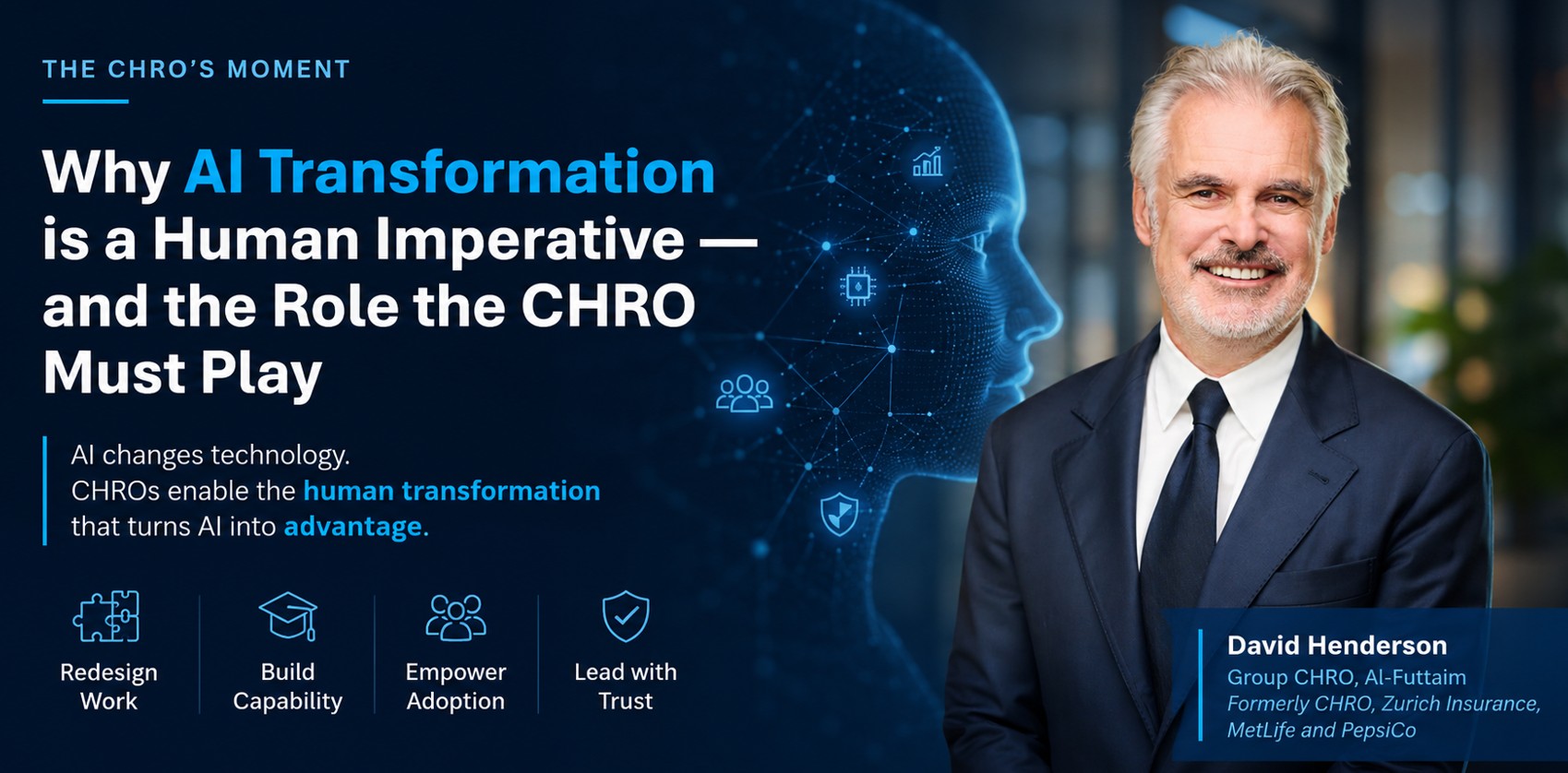
Why AI Transformation is a Human Imperative, and the Role the CHRO Must Play

A year after IBM’s Deep Blue defeated Garry Kasparov in 1997, Kasparov did something unexpected. Rather than retreat, he invented a new form of chess he called ‘advanced chess’, pairing human players with computers to see what they could produce together. The result was remarkable. Even moderately skilled players, armed with a standard machine, were capable of defeating both grandmasters playing alone and computers operating without human input. The combination was categorically superior to either element in isolation.
By: David Henderson , Group CHRO, Al-Futtaim
That experiment carries an important lesson for organisations navigating AI today. The instinct understandable, but mistaken, is to frame AI as a technology story. It is not. AI reshapes jobs, redistributes decision rights, resets operating models, and forces us to reconsider deeply embedded ways of working. It intersects directly with creativity, cognition, confidence, identity and employability. It produces as many human questions as it does technical ones.
This is why the organizations that are genuinely converting AI from experiment into competitive advantage are those that have understood it, first and foremost, as a large-scale human transformation, one that demands the business, the CHRO and the CIO working as genuine partners, each bringing what the other cannot.
The organisations winning with AI are not those with the most sophisticated technology. They are those that have most deliberately redesigned how humans and machines work together.
The Case for the CHRO
The most effective AI transformations are driven by a tight three-way partnership:
the business setting the agenda and owning outcomes,
the CIO providing the technology platforms,
data infrastructure and governance,
and the CHRO leading the human transformation that determines whether AI delivers value at scale or stalls in pilots.
Each is essential. None is sufficient alone.
What has changed is the recognition that the human dimension, the design of work and decision rights, the building of workforce capability, the management of trust and ethics, the orchestration of adoption across large and diverse employee populations, is not downstream of the technology. It is a primary enabler of it. That is the CHRO’s territory, and it demands the same strategic weight as the technology agenda itself.
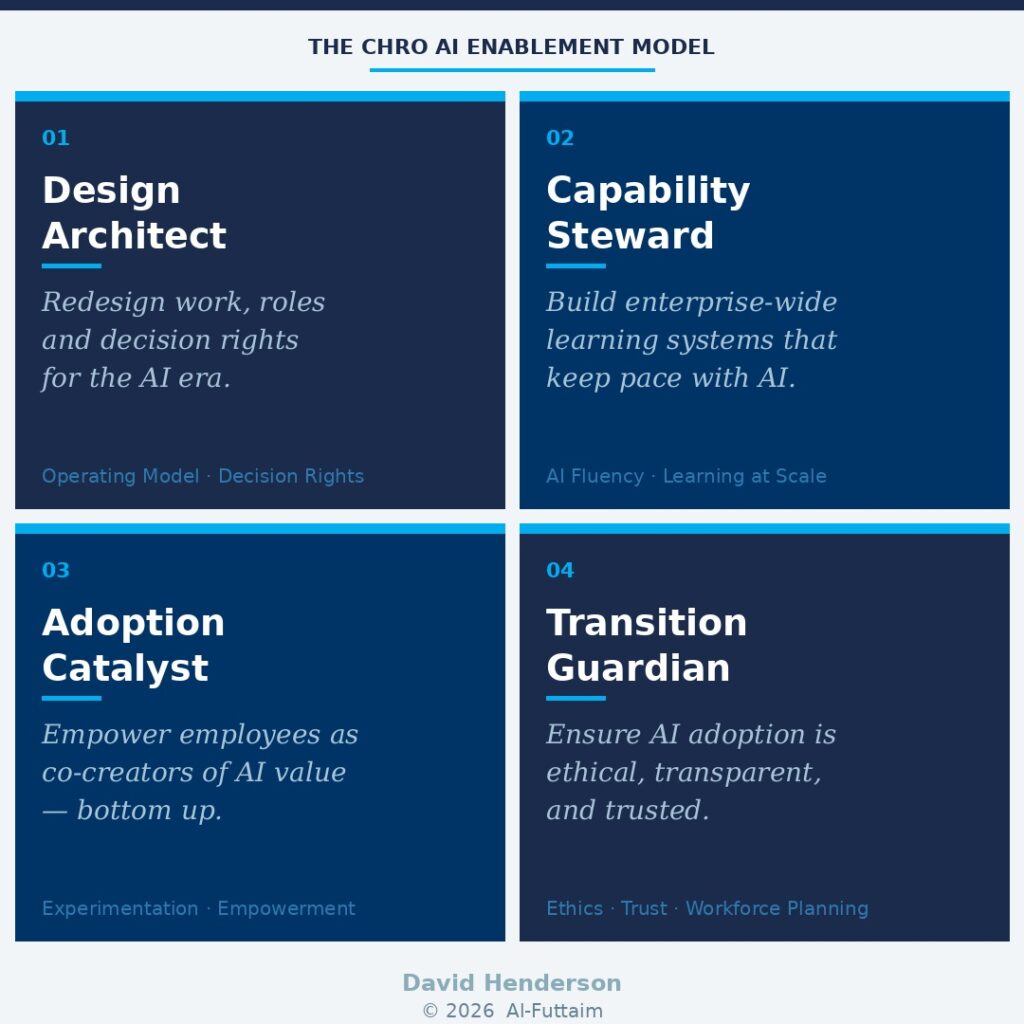
In this paper, I propose a model for how CHROs can lead AI enablement through four interconnected roles: Design Architect, Capability Steward, Adoption Catalyst, and Transition Guardian. Each role addresses a distinct dimension of the human transformation that AI demands. Together, they represent a holistic operating mandate for CHROs who are serious about delivering sustained enterprise value from AI, not just deploying tools.
01) Design Architect: Redesigning work, roles and decision rights for the AI era
AI transformation fails far more often because of organisational design choices than because of technology limitations. When companies deploy AI tools without redesigning how work is done, decision rights blur, accountability erodes, adoption stalls, and productivity gains remain trapped in pilots. The technology is rarely the binding constraint. The organisation almost always is.
The CHRO’s role as Design Architect is to get ahead of that problem. This means providing overarching direction on how work should be redesigned so that human judgment and AI-generated insight are deliberately combined, not accidentally layered on top of each other. It means clarifying which decisions remain human-led, which are AI-supported, and where accountability ultimately sits. And it means building an operating model architecture that is dynamic enough to evolve as AI capabilities continue to develop rapidly.
In my own experience, incrementalism in this domain is almost always destined to fail. The organisations that are getting this right are making bold, decisive design choices, and in some cases, breaking up parts of the organisation that have long been treated as untouchable.
| In Practice — Procter & Gamble P&G redesigned decision models across forecasting, procurement and product innovation so that AI produces insights and options while humans retain final say on portfolio bets, supplier strategy and innovation priorities. Critically, AI was embedded directly into logistics decision forums — rather than remaining siloed in group-level analytics teams, removing information-sharing barriers and enabling real-time decision-making at scale. |
In Practice — Microsoft Microsoft intentionally redesigned all knowledge-work roles so that AI copilots handle drafting, synthesis and retrieval, while employees retain judgment, prioritisation and accountability. The result was not simply cost reduction,it was the redeployment of released cognitive capacity into revenue-generating innovation and customer experience improvement. |
Being intentional on organisational design means staying one step ahead of technological adoption, not one step behind it. The CHRO must proactively reimagine how AI reshapes the value chain and translate that vision into operating model decisions — rather than reactively course-correcting after tools have already been deployed.
02) Capability Steward: Building enterprise-wide, continuous learning systems that keep pace with AI
In the AI era, capability, not technology, is the primary constraint on value creation. The organisations that are scaling AI effectively are not those with the most sophisticated tools. They are those whose people know how to use them confidently, critically, and productively in the context of real work.
The CHRO’s role as Capability Steward is to build the learning infrastructure that makes this possible at scale. This means moving decisively away from episodic, one-size-fits-all training models, which are structurally unsuited to the pace of AI change, towards continuous, contextual learning systems that are embedded in daily workflows.
It means developing AI fluency across the workforce, not just in specialist teams. And it means maintaining ongoing insight into which capabilities are emerging, shifting or declining as the skills economy evolves.
| In Practice — Amazon Amazon treats AI capability as core workforce infrastructure rather than a specialist skill. It has built role-specific learning pathways combining foundational AI fluency with immediate, in-role application, particularly in operations, logistics and corporate functions. The result has been faster adoption of AI tools across large frontline and corporate populations, with measurable productivity gains driven by applied capability rather than isolated expertise. |
| From My Experience — Zurich Insurance During my time at Zurich, we built an enterprise-wide AI and digital capability ecosystem that combined broad AI literacy with deep domain-specific learning for underwriters, claims handlers and risk professionals. Learning was continuous and embedded in daily workflows. Critically, we also focused on transferable skill identification, enabling us, for example, to rapidly retrain and redeploy claims handlers as customer service agents based on strong overlaps in their underlying skill profiles. That flexibility became a genuine competitive asset. |
The CHRO must protect long-term capability health and resilience, not simply optimise for short-term productivity. Organisations that treat AI learning as a one-time training event will struggle to sustain adoption. Those that build continuous learning as an organisational capability will compound their advantage over time.
03) Adoption Catalyst: Empowering employees as co-creators of AI value, not passive recipients of it
Many CHROs of my generation were trained in a change management orthodoxy that starts at the top of the house, guiding coalition, executive sponsorship, structured project timelines. That model is not wrong, but it is increasingly insufficient for AI.
Top-down governance and strategy remain essential. But scalable AI value does not come from mandates. It comes from the bottom up, from employees who understand the work and are empowered to apply AI where insight is deepest and value most immediate.
The CHRO’s role as Adoption Catalyst is to create the conditions for this to happen: building cultures of experimentation and knowledge-sharing, aligning incentives and recognition to reward participation, and enabling employees to co-create AI use cases rather than simply receive them.
This is a fundamental shift from change management to what I would call change orchestration, leaders creating the environment in which adoption flourishes, rather than driving it through compliance.
| In Practice — Al-Futtaim Blue Loyalty Platform The clearest proof point I can offer comes from our own experience at Al-Futtaim. The group’s Blue Loyalty Platform uses AI to combine behavioural, transactional and partner data to deliver personalised offers and purchase recommendations across our retail and service channels. What made this work was not central design — it was that the use cases were developed by multi-disciplinary frontline retail employees, working in agile action-learning teams, applying their direct customer insight to build the recommendations. AI was embedded into frontline and digital workflows by the people who understood those workflows best. The result has been measurable revenue uplift driven by use cases rooted in real customer interactions — not boardroom hypotheses. |
| In Practice — Google Google runs AI adoption through a culture of experimentation supported by internal communities, shared tooling and lightweight governance. Employees apply AI to improve workflows, products and services; successful use cases are productised and scaled through internal platforms. This produces rapid diffusion of best practices, strong employee ownership, and continuous improvement generated by those doing the work. |
Employees need to define the tools they need , not simply learn the tools they are given. That distinction is everything when it comes to whether AI adoption takes root or stalls.
Bottom-up adoption is not a cultural nicety. It is the mechanism through which AI becomes embedded, differentiated and commercially meaningful at scale. Organisations that get this right do not deploy AI. They make AI part of how the organisation thinks.
04) Transition Guardian: Ensuring AI adoption is ethical, transparent, and in the long-term interest of employees
AI introduces legitimate concerns that the CHRO cannot afford to minimise: fairness, transparency, surveillance, bias, job security, long-term employability. If these concerns are not addressed proactively and honestly, trust erodes, and without trust, adoption stalls regardless of how good the technology is.
The CHRO’s role as Transition Guardian is to ensure that AI adoption is consistent with organisational values and strengthens, rather than undermines, the employee value proposition.
This means embedding ethical guardrails and human oversight into AI adoption from the outset, not retrofitting them under regulatory pressure. It means communicating honestly with employees about what AI will change, what it will not change, and what pathways exist for reskilling and redeployment.
And it means treating strategic workforce planning not as an HR administrative function, but as a core enabler of organisational resilience.
Today’s employees need to focus less on specific target jobs and more on building transferable skill profiles that will serve them across a career that is certain to be turbulent. They need to feel that their organisation has their back. The CHRO must make that commitment credible, not through reassurance, but through concrete pathways.
| In Practice — Salesforce Salesforce has embedded ethical and responsible AI as a prerequisite for scale rather than a control imposed after deployment. The company requires mandatory Responsible AI training, applies humanin-the-loop oversight for AI-enabled decisions, and maintains clear disclosure standards when AI influences employee or customer outcomes. The trust this generates has driven faster adoption, stronger employee engagement, and meaningfully reduced legal, regulatory and reputational risk. |
| In Practice — Unilever Unilever explicitly links AI adoption to employability and internal mobility. As AI reshapes roles, the company invests heavily in reskilling and redeployment pathways, reframing AI as augmentation rather than displacement. Workforce planning, learning and ethics are intentionally connected rather than siloed , and employees can see a credible future for themselves within the transformation. |
Trust is not a soft outcome of AI transformation. It is the hard prerequisite for scaling it. The CHRO who treats it as such will find that ethical, transparent AI adoption does not slow the transformation down — it is the thing that makes it durable.
The CHRO Skill set for AI Enablement
Having defined the four roles the CHRO must play, it is worth being specific about the skills and attributes required to execute each one. In an environment where AI success is increasingly determined by organisational design, capability building, adoption dynamics and trust, not technology, these capabilities define whether the CHRO is shaping the transformation or reacting to it.
| Design Architect | Capability Steward | Adoption Catalyst | Transition Guardian |
| Operating Model Design | Learning at Scale | Change Orchestration | Ethical Judgement |
| Work & Role Deconstruction | AI Fluency Translation | Employee Empowerment Mindset | Trust Stewardship |
| Decision Rights Clarity | Skills Architecture & Workforce Sensing | Incentive & Recognition Design | Strategic Workforce Planning |
| Systems Thinking | Action Learning Systems | Business Experimentation Literacy | Risk Anticipation |
| Enterprise Co-Creation | Future Capability Stewardship | Cultural Signal Awareness | Clear, Honest Communication |
A few points of emphasis.
As Design Architect, the most underrated skill is enterprise co-creation — the confidence and credibility to act as a genuine co-owner of AI strategy with the CIO and business leaders, not merely as a supporting function.
As Capability Steward, future capability stewardship is distinct from short-term productivity optimization; CHROs must protect long-term organisational resilience, not just near-term performance.
As Adoption Catalyst, cultural signal awareness is often more powerful than formal programmes, leadership language and behaviour either accelerate or silently undermine adoption at scale. And as Transition Guardian, clear and honest communication, including on uncertainty and difficult tradeoffs, is the foundation on which all of the other skills rest.
Without it, none of the others land.
Conclusion: The Human Transformation Imperative
Organisations that are genuinely winning with AI are not those with the most sophisticated technology stacks. They are those that have most deliberately and thoughtfully redesigned how humans and machines work together, rethinking operating models, building capability at scale, empowering employees as co-creators, and managing the transition with ethics and transparency.
The CHRO who grasps this, who acts as Design Architect, Capability Steward, Adoption Catalyst and Transition Guardian simultaneously, becomes one of the most important executives in the organisation. Not because HR has staked a claim to a technology agenda, but because the most important levers for AI value creation are organisational and human, and those are precisely the levers that CHROs are equipped to pull.
Kasparov’s advanced chess experiment showed us, a quarter of a century ago, that the most powerful outcomes emerge not from humans or machines working alone, but from their deliberate, skillful combination. The CHRO’s mandate is to make that combination work, at enterprise scale, at pace, and without losing the trust of the people it depends on.
That is not a supporting role. It is a defining one.
_______________________________________________________
David Henderson is Group CHRO of Al-Futtaim Group, one of the Middle East's largest diversified conglomerates. He has previously served as CHRO of Zurich Insurance Group, MetLife and PepsiCo.















By Julio de Salvo, Chief Solution Officer for MENA & APAC at Globant
For decades, the financial industry has managed to replace banknotes and coins with “invisible” assets through different technological implementations. However, innovation in the sector has generally moved at a slow pace when dealing with something as sensitive as people’s finances. In 2026, the black swan is beginning to emerge: the first steps of AI agents that will redefine the industry (as they will many others). The financial black swan is not a crisis: it is a huge change. Across the Middle East and Africa, where a convergence of government-backed modernization agendas, digitally native consumers, and institutional ambition is accelerating the timeline for transformation.
The first step has been the use of Gen AI without the customer perceiving it. Coding, fraud prevention, phishing detection, and credit assessment are some of its tasks. But it is now beginning to become a tool for managing users’ finances. In the MENA region, this shift is already visible at the institutional level. Across the 25 MEA banks benchmarked by the Evident AI Index (June 2026), the established leaders are no longer running pilots, they are directing investment toward high-friction processes where AI can materially reshape productivity, scalability, and competitiveness. UAE-based banks and fintechs are already validating agent-initiated transaction pipelines in production environments. These are some of the examples, but there are more.
In July 2026, the revealing Mills Review, published by the FCA (Financial Conduct Authority), the UK’s official financial regulator, pointed out that AI agents will become the new financial interface. Essentially, an AI assistant will manage budgets, answer queries, generate reports on demand, and move money between accounts. How much was spent on a vacation in total, how a stock portfolio performed over the past month, or canceling an annual subscription will be as easy as making a query to ChatGPT today. For MENA consumers, who have in many cases leapfrogged legacy banking behaviors entirely, this vision is the baseline expectation.
The Mills Review also argues that Open Banking will evolve toward a model in which AI agents will have access to a broader range of financial products to enable intelligent decisions across different areas, and highlighted that this will lead to an evolution in regulation. In the GCC, this evolution is being actively shaped by regulators and governments alike, with initiatives such as Dubai’s target of 90%+ digital transactions by 2026 signaling not just ambition, but structural commitment to a cashless, AI-enabled financial ecosystem.
The agentic AI opportunity in the region is real, but it remains underexploited. According to EY-Parthenon’s 2025 Generative AI in Banking Survey, 99% of respondents are familiar with agentic AI, yet only 31% have pursued implementation, with a further 46% expressing interest. Awareness, in other words, has raced ahead of execution. This gap between recognition and production-grade deployment is precisely where the competitive battle will be won or lost.
This represents a major shift in the industry, where historically the leading banks have, for the most part, remained the same. Differentiation can now change everything, and it would not be surprising if new players manage to break into the ranks of the world’s most important financial institutions. In the Middle East, the region’s financial landscape already includes a new generation of digital-first challengers sitting alongside heritage institutions, all of which are now actively exploring or deploying agentic capabilities. The reason sounds obvious when explained: if the experience with an AI assistant can manage customers’ money better, it will prevail. This is not an exaggeration: just four years ago, nobody knew ChatGPT, and now we have become so accustomed to it that we all ask ourselves: why shouldn’t I manage my assets with a chatbot that can provide reports and recommendations? A study by JPMorgan found that half of Gen Z wanted to use them to manage their finances.
The infrastructure for agentic commerce is also being built in real time across the GCC. Mastercard has conducted regional pilots in partnership with Majid Al Futtaim, enabling consumers to search, select, and purchase VOX Cinema tickets programmatically through an integrated AI assistant. In May 2026, Visa launched its global Agentic Ready program in the UAE, with early adopters including ADCB, ADIB, Emirates NBD, Mashreq, Tabby, Wio, and Ziina already validating agent-initiated transaction pipelines in production.
We are living in a time of change. In its 2026 report on the financial sector, the World Economic Forum urged organizations to move with “urgency” and “discipline”. The greatest benefits, it stated, will go to those working on a holistic redesign of workflows and technology architecture. In the MENA region, the conditions for genuine transformation are already in place: strong institutional will, government-aligned modernization agendas, and a consumer base that has leapfrogged legacy behaviors entirely.
One of the major questions is why, if the financial sector has such a strong technological tradition, the emergence of AI Agents represents a black swan. There are several reasons. First, historically, customers used banks to execute transactions; therefore, in the executive conversations avoiding risk was prioritized over innovation. This is changing with the emergence of digital banks, which are generally more inclined toward disruption, and shifts in consumer habits. In the GCC specifically, consumers who bypassed branch banking and moved directly to mobile-first financial services are now primed to embrace AI-managed financial experiences with little friction. The challenge of the future is not to provide a tool, but to redesign experiences to address this transition comprehensively. AI has the potential to resolve the technological debt involved in migrating traditional banks, which have historically struggled the most with this transition.
The second reason is the technical debt banks have demonstrated in dealing with change. This has also occurred in other industries, but the idea of paying for a premium license for every employee and expecting immediate returns only leads to frustration. There is significant resistance when it becomes clear that certain tasks and workflows will inevitably be different from what has been established. In the Middle East, where several national banks have invested heavily in core banking modernization programs over the past decade, the foundations are more favorable than in many Western markets, but the final leap from modernized infrastructure to genuinely agentic deployment still requires focused capability and deliberate execution.
The third reason is regulation. Technology companies, banks, and authorities will need to maintain an ongoing dialogue to ensure that innovation and integrations do not affect users’ personal data or security, while ensuring that restrictions do not become a barrier to progress. One of the most valuable lessons from the banking sector’s legacy is the importance of being extremely careful when dealing with something as sensitive as people’s money.
For many years, the impact of AI was often explained as something that belonged to a distant future. In the financial sector, it is already a reality: it is part of multiple tasks and is beginning to become an asset in the customer proposition. With AI Agents, innovation can no longer, and should no longer, go unnoticed. New habits require the redesign of customer journeys, and this could represent a revolution for the sector. For Middle East banks, the opportunity is particularly compelling: a region where government will, consumer readiness, regulatory pragmatism, and institutional investment have aligned at the same moment. What is required now is the execution capability to convert that alignment into production-grade deployment. What is at stake is no small matter: the management of millions of people’s money and a battle for the competitiveness of banks on a scale rarely seen before. For those that move with urgency and discipline, the financial black swan is a transformation to be led.

By: Debo Zhang, CEO at HONOR GCC
In the hyper-competitive consumer technology sector, the launch of a flagship device is often treated as the finish line. However, true brand leadership is forged not in the showroom, but in the months and years that follow. At HONOR, we view the point of purchase not as a conclusion, but as day one of a long-term partnership with our users.
As we aggressively push the boundaries of intelligent hardware—from integrating Agentic OS to setting new benchmarks in physical durability and battery density—we recognize that advanced specifications represent only half of the premium equation. The other half is an unyielding commitment to the customer’s lifecycle experience. If a brand fails to support its users when they need it most, the underlying technological advancements lose their meaning.
Operationalizing Community Care
Our commitment to giving back to the GCC community dictates our operational investments. We do not just build resilient devices; we build resilient support networks designed to remove the friction of long-term ownership. Our recurring monthly Service Days are not promotional events—they are structural community investments.
By deliberately absorbing operational costs—such as completely waiving labor fees for expert repairs and offering complimentary professional device cleaning and disinfection—we ensure that maintaining a premium device remains accessible. We view ongoing device care, including free system upgrades and screen film replacements, as a fundamental responsibility rather than a secondary revenue stream.
Respecting the User’s Time and Individuality
True leadership in customer service also requires a profound respect for the user’s time and individuality. Recognizing that our customers’ lives are deeply integrated with their technology, we have designed our after-sales operations to adapt to the user, rather than forcing the user to adapt to us. Offering complimentary return shipping for repairs and providing complimentary gifts when repair timelines are extended are direct measures to eliminate inconvenience.
Furthermore, we understand that a smart device is a highly personal extension of the user. Incorporating free laser engraving and custom art back films into our regular service offerings transforms a standard maintenance visit into an opportunity for users to refresh and personalize their technology.
As the Middle East accelerates its digital transformation, consumers are demanding more than just innovation; they demand reliability, accountability, and respect. HONOR’s rapid growth across the region proves a fundamental business truth: when a technology brand prioritizes post-purchase empowerment and community care over short-term transactional gains, sustainable market leadership naturally follows.

By Dr Chafic Chaya, Regional Manager, Public Policy and Government Affairs, Middle East, RIPE NCC
A business launching an artificial intelligence service rarely thinks about Internet routing. A company moving its applications to the cloud does not normally ask whether its country has deployed IPv6. And when consumers make a digital payment, stream content or access an online government service, they certainly do not think about where networks exchange traffic. They notice these things mainly when something fails.
For many years, discussions around digital infrastructure focused primarily on coverage and speed. Connecting more people and businesses, expanding fibre networks and increasing mobile broadband capacity were natural priorities. Those objectives remain important, but they are no longer sufficient.
As economies become increasingly dependent on cloud computing, artificial intelligence, digital financial services, connected industries and online government services, another question is becoming just as important: can the Internet infrastructure underneath these services scale securely and remain resilient when disruption occurs?
The next phase of digital competitiveness will therefore require us to look beyond bandwidth.
From connectivity to capability
The Internet is becoming the operating environment for entire economies. Factories depend on connected systems. Financial institutions depend on real-time transactions. Governments deliver essential services digitally. Businesses increasingly rely on cloud platforms located across different networks and jurisdictions. Artificial intelligence adds another layer of demand through large-scale data processing, distributed computing and machine-generated traffic.
Connectivity is moving beyond simple availability toward quality, reliability, affordability and resilience. This shift matters because digital innovation can only scale when the underlying infrastructure scales with it.
A country may have excellent broadband coverage, but businesses will still face limitations if networks cannot exchange traffic efficiently, if addressing resources constrain future growth, if routing is vulnerable to errors or attacks or if international connectivity depends on too few pathways.
This is why digital infrastructure needs to be understood as an ecosystem rather than simply as a collection of telecom networks.
Telecom operators are essential, but no network operates alone
Telecom operators remain central to this ecosystem. They make substantial investments in fibre, mobile networks, backbone infrastructure and international capacity. Continuing those investments is essential as traffic grows and businesses demand faster and more reliable services.
But the Internet is fundamentally a network of networks. Its resilience depends not only on individual operators, but also on how networks interconnect with one another and how effectively the wider technical ecosystem functions.
Internet Exchange Points allow networks to exchange traffic locally, while data centres bring content and computing resources closer to users. Submarine cables and terrestrial routes provide international connectivity. The Domain Name System enables users to find services, and Internet Protocol addresses allow billions of devices and services to communicate. Routing systems determine how information travels between networks. Weakness in any of these layers can affect the services built above them.
This is an important distinction. Building a resilient digital economy cannot be the responsibility of telecom operators alone. It requires cooperation between network operators, Internet service providers, data centres, cloud platforms, governments, regulators and the technical community.
The invisible foundations of scalability
Some of the most important investments in the Internet receive relatively little public attention.
The Internet Protocol version 6 (IPv6) is one example. IPv6 is the latest version of the Internet Protocol. As the supply of IPv4 addresses has long been exhausted at the global level, IPv6 provides the much larger pool of Internet addresses needed for the Internet to continue expanding and for new digital services and technologies to grow, while reducing dependence on increasingly complex mechanisms used to extend the life of IPv4. For businesses, governments and operators planning for millions of additional connected devices, cloud workloads and digital services, IPv6 should increasingly be considered basic infrastructure for future growth rather than an optional technical upgrade.
Another example is routing security. Every day, networks around the world exchange information about how Internet traffic should reach its destination. Mistakes or malicious announcements can redirect traffic or make services unreachable. Resource Public Key Infrastructure (RPKI) provides a mechanism that helps network operators verify whether a network is authorised to announce particular Internet address resources.
Local interconnection is equally important. When two networks operating in the same market can exchange traffic locally through efficient interconnection and Internet Exchange Points, data may no longer need to travel thousands of kilometres through another country and a different jurisdiction before returning to nearby users. The result is lower latency, greater efficiency and improved resilience.
Internet measurement completes the picture. Policymakers and operators need reliable data to understand how traffic flows, where connectivity is concentrated, where dependencies exist and how networks react during disruptions. You cannot strengthen what you cannot see.
Resilience has a cost, but so does fragility
One of the harder questions is economic. Network redundancy costs money, as do alternative international routes. Maintaining multiple upstream connections, deploying security measures, training engineers and continuously upgrading infrastructure all require investment.
In competitive markets, operators understandably need to balance these investments against commercial realities. The solution, however, cannot simply be to minimise infrastructure costs.
Digital dependency changes the calculation. When banking, healthcare, government platforms, logistics, cloud services and business operations depend on continuous connectivity, the economic impact of prolonged disruption can quickly outweigh the cost of building greater resilience.
Failures across interconnected digital systems can cascade into other sectors. For governments and businesses, resilience should therefore increasingly be treated as an investment characteristic, not simply as an emergency response.
The objective is not to eliminate every possible failure, as no network can guarantee that. Instead, the goal is to avoid unnecessary concentration, introduce diversity wherever practical, continuously improve security and ensure that systems can recover quickly.
The Middle East is moving from adoption to infrastructure maturity
Saudi Arabia and the United Arab Emirates provide a useful example. The lesson is that Progress tends to occur when policy attention, technical capacity building and implementation by network operators reinforce one another. Infrastructure transformation is rarely achieved through regulation alone, nor through technology alone. It requires sustained cooperation between policymakers and the people who actually operate networks.
The race to build AI capacity is attracting billions of dollars in investment across our region and around the world. But compute without connectivity cannot deliver value. Connectivity without resilience cannot guarantee continuity. And infrastructure without cooperation cannot scale indefinitely. The strongest digital economies will therefore not simply be those with the most infrastructure. They will be those with Internet ecosystems that are open, interconnected, secure, scalable and resilient enough to support whatever comes next


IKEA Turned Last-Minute Hosting into a 90-Second Guest-Ready Tidy-Up Challenge
Building Digital Sovereignty Through Operational Control
A Coffee and Macaroon Affair Acacia Lounge



-

 Trending12 months ago
OPPO A6 Pro 5G Review: Reliable Daily Driver
-

 Tech News2 years ago
Denodo Bolsters Executive Team by Hiring Christophe Culine as its Chief Revenue Officer
-
 VAR1 year ago
Microsoft Launches New Surface Copilot+ PCs for Business
-

 Automotive2 years ago
AGMC Launches the RIDDARA RD6 High Performance Fully Electric 4×4 Pickup
-
Tech Interviews3 years ago
Navigating the Cybersecurity Landscape in Hybrid Work Environments
-

 Hospitality2 years ago
Gulfood 2025 30th Edition Kicks Off Today, Setting New Benchmarks in F&B Growth and Innovation
-

 Tech News1 year ago
Nothing Launches flagship Nothing Phone (3) and Headphone (1) in theme with the Iconic Museum of the Future in Dubai
-

 VAR2 years ago
Samsung Galaxy Z Fold6 vs Google Pixel 9 Pro Fold: Clash Of The Folding Phenoms