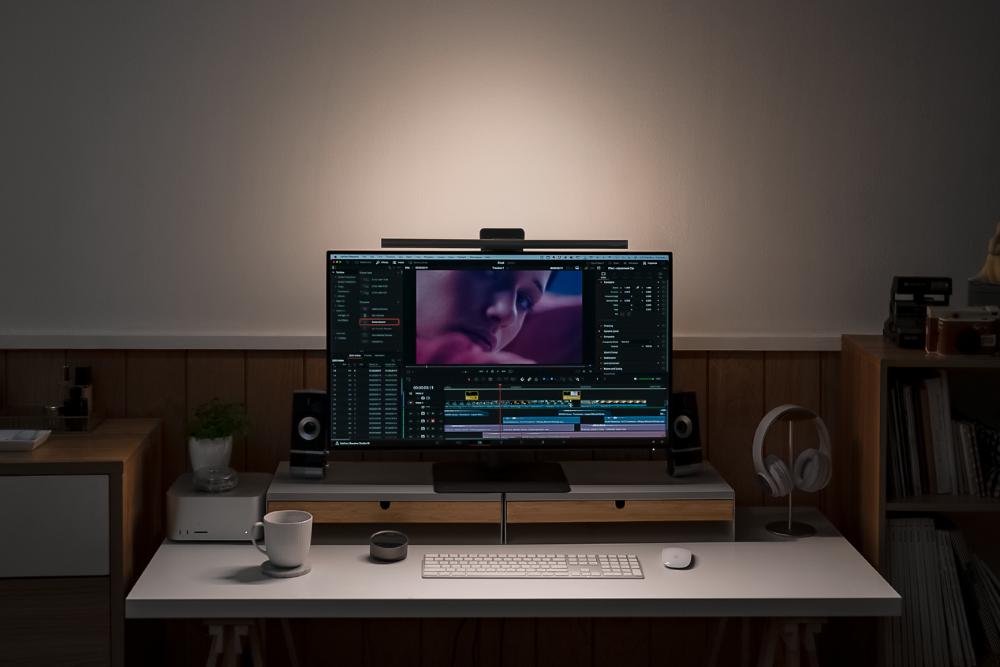
With the introduction of the ScreenBar Series in Dubai, BenQ Middle East has solidified its position as a leader in monitor-mounted lighting by addressing a prevalent problem among desk users: inadequate ambient lighting. Designed for today’s hybrid workers, content creators, and competitive gamers, the ScreenBar line goes beyond traditional task lamps to provide an intelligent illumination solution that responds to both the user and the surroundings.
ScreenBar Halo 2 – A New Benchmark for Visual Balance
At the heart of the series portfolio lies the ScreenBar Halo 2, which has been developed over four years of engineering. Its distinguishing feature is a dual-light setup that includes a forward-facing desk light and a bright rear ambient glow. This design considerably reduces the visual contrast between a bright monitor and a darker space, which is a common cause of eye strain during prolonged screen use. The modified back lighting covers a significantly larger area, resulting in a more natural and immersive lighting environment that appears consistent rather than harsh.
Precision Optics That Protect the Eyes
BenQ’s optical expertise is prominent in the Halo 2’s glare-control technology. The asymmetrical light projection guarantees that light reaches the workstation without overflowing onto the display or shining directly in the user’s eyes. This intricate light structuring keeps on-screen content clear and decreases tiredness, particularly during tasks that need prolonged attention. The ScreenBar Halo 2 is backed by academic research and aligned with international lighting regulations. It maintains a precisely balanced brightness relationship between the monitor and its surroundings, allowing the eyes to remain relaxed for extended periods of time.
ScreenBar Pro: Versatility and Everyday Intelligence
The ScreenBar Pro Black and Silver variants represent a more streamlined version of BenQ’s lighting concept. Their gravity-based clamp technology is designed to fit securely on a variety of monitors, including slim-bezel and curved screens, while providing minimal pressure. Built-in smart features like automatic brightness adjustment, motion-based power control, and memory settings make the experience simple, responding to changing lighting conditions throughout the day.
Design-Led Aesthetics with Fine-Tuned Control
The ScreenBar Series is visually appealing and complements premium workstation settings and creative studios. Developed in partnership with MINIMAL Design, the light’s clean metallic surface and discrete form allow it to fit in rather than overshadow the workspace. A new wireless dial provides smooth, accurate control of brightness and colour temperature. The wide temperature range accommodates anything from warm evening illumination to colder tones suitable for precision activities like as editing, grading, or complex design work.
Verdict: A Thoughtful Investment in Performance and Wellbeing
The BenQ ScreenBar Series presents itself as an essential component of a productive and healthy workspace rather than just an accessory. BenQ has developed a lighting system that promotes long-term comfort without sacrificing performance by fusing scientific research, adaptable technology, and sophisticated industrial design. For professionals, creatives, and gamers who spend long hours in front of a screen, the ScreenBar Halo 2 and ScreenBar Pro provide an outstanding combination of efficiency, visual comfort, and minimalist sophistication, making them a significant enhancement for any modern work environment.
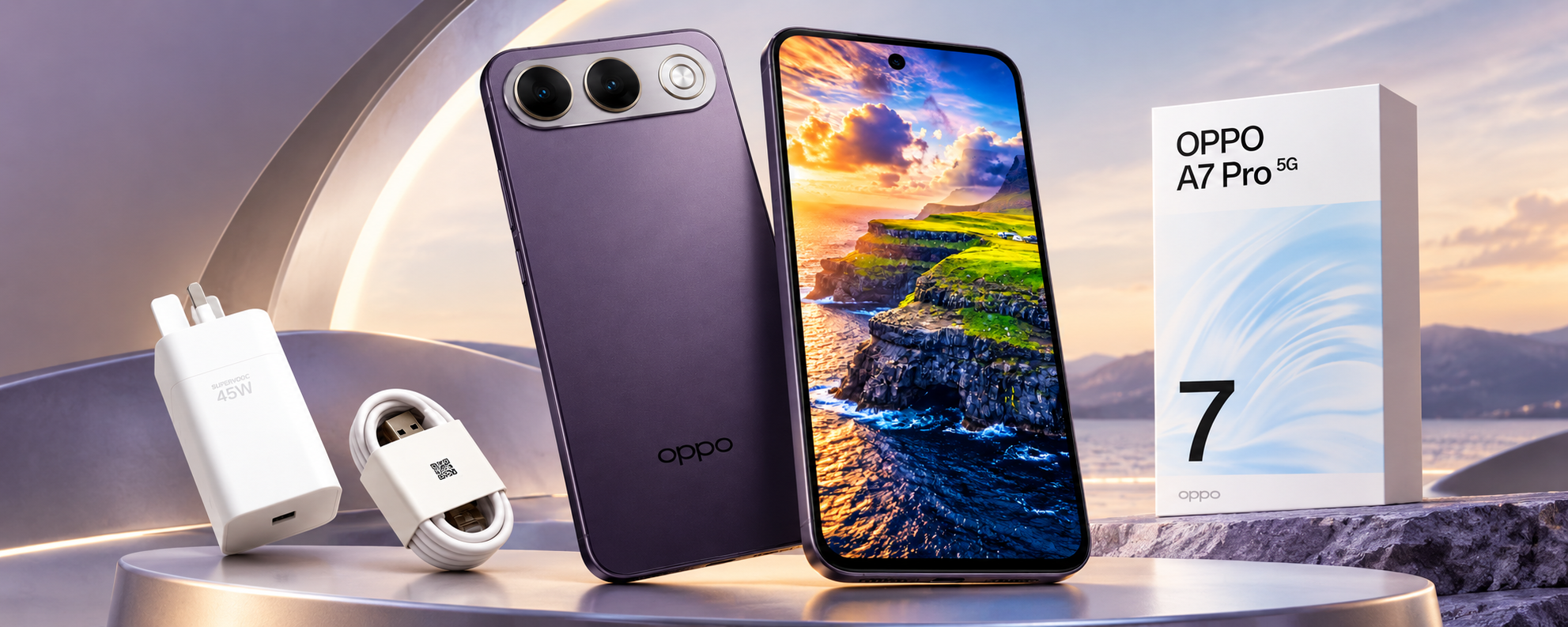
OPPO A7 Pro 5G puts longevity at the centre of the smartphone experience!
With an 8,000mAh battery, dual 50MP cameras, IP69K protection and a five-year smoothness promise, OPPO’s latest A Series smartphone makes a strong case for devices designed around longer-term ownership.
Smartphone launches have traditionally revolved around faster processors, increasingly sophisticated cameras and, more recently, AI. With the A7 Pro 5G, OPPO is putting another consideration firmly into the conversation: how well a smartphone can hold up over time.
At the centre of that proposition is an enormous 8,000mAh battery. Large-capacity batteries are becoming increasingly common, but what is interesting about the A7 Pro 5G is how little the battery dictates the physical character of the phone.
Despite the capacity, the device does not immediately look or feel like a rugged smartphone. The Shine Titanium review unit has an understated finish, while the alternative Surfing Blue introduces a more distinctive Dynamic 3D Wave Texture.
That relatively conventional appearance hides some serious durability credentials.
Built for longer ownership
The A7 Pro 5G carries IP69K dust and water resistance alongside military-grade shock resistance. Rainstorm Touch is designed to keep the display responsive even when used in heavy rain.
The longevity argument extends to the battery itself. OPPO says it can retain more than 80% of its rated capacity after 2,000 complete charging cycles, underpinning the company’s six-year battery durability proposition.
This matters because battery degradation remains one of the most noticeable compromises as smartphones age. Increasing capacity solves part of that equation; maintaining useful capacity several years into ownership potentially solves another.
Reverse wired charging also allows the A7 Pro 5G to supply power to another connected device, adding some practical value to that substantial battery reserve.
Selfies get the 50MP treatment
OPPO has also placed considerable emphasis on the front-facing camera.
The 50MP Ultra-Wide AI Zoom Selfie Camera offers a 100-degree field of view and can automatically move between 1x and 0.6x framing when additional people enter the shot.
It is a useful approach for group photographs, travel and increasingly video-led social content, where a wider front camera can make considerably more sense than simply increasing resolution. Ultra-steady video has also been included to improve handheld recording.
At the rear is another 50MP camera, using a larger 1/2-inch sensor that OPPO says captures 70% more light than its predecessor.
AI Portrait Glow, AI Popout and AI Remix Collage bring the increasingly familiar layer of computational editing into the camera experience, allowing users to manipulate images without moving immediately to third-party applications.
Five years of smoothness?
Underneath, the A7 Pro 5G is powered by the MediaTek Dimensity 6360 MAX, accompanied by OPPO’s NetworkBoost Chip S1 and AI LinkBoost 4.0.
A 4,300mm² Glacier VC Vapor Chamber handles cooling, while software-based resource and memory management is designed to maintain responsiveness as workloads increase.
Perhaps more interesting than outright performance figures is OPPO’s 5-Year Smoothness Protection. The company says the device has passed its five-year smoothness testing, reflecting a wider attempt to position performance around consistency rather than simply launch-day speed.
Naturally, five-year performance cannot be established during a conventional review period, but the emphasis itself is notable. Smartphone replacement cycles are lengthening, making sustained performance, battery health and software optimisation increasingly relevant purchasing considerations.
AMOLED keeps the experience contemporary
The front houses a 6.57-inch FHD+ AMOLED display with a 120Hz refresh rate, up to 1,400 nits of brightness and a 92.8% screen-to-body ratio.
The combination provides the fluid scrolling and vibrant presentation expected from a contemporary AMOLED smartphone, while complementing a device otherwise heavily focused on practical considerations.
Warranty coverage also extends across the GCC, Pakistan, India and Bangladesh, potentially useful for users who regularly travel between these markets.
The 8,000mAh battery will inevitably attract most of the initial attention, but the A7 Pro 5G becomes more interesting when viewed as a complete package. OPPO is combining battery capacity with physical durability, thermal management, connectivity enhancements and longer-term performance optimisation. At the same time, it has avoided turning the device into something that visually resembles a specialist rugged phone.
BY: SRIJITH KN
A different definition of smartphone performance that may ultimately be the A7 Pro 5G’s more relevant proposition. Rather than asking how much faster a smartphone can become every year, OPPO is increasingly asking another question: how much longer can it remain useful?
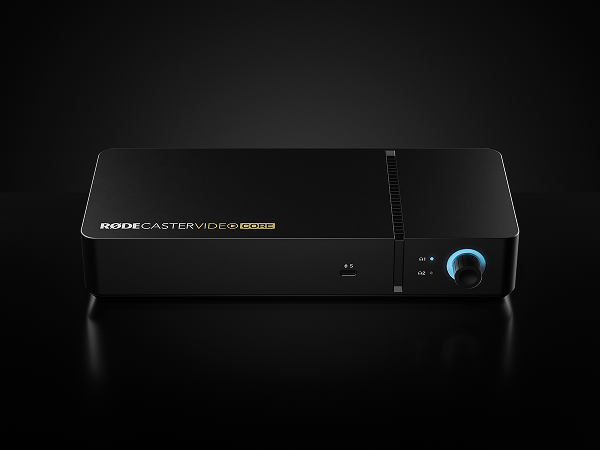
RØDECaster Video 1.4 introduces 4K30 multi-camera capture, isolated recording, expanded RØDECaster Sync support and Adobe Premiere Pro timeline export.
RØDE has released RØDECaster Video 1.4, a free firmware update for the RØDECaster Video, RØDECaster Video S and RØDECaster Video Core, adding new 4K and Full HD capture modes alongside deeper integration across its audio and video production ecosystem.
The headline addition is 4K Capture Mode, which turns compatible RØDECaster Video consoles into dedicated UHD capture and distribution systems. Multiple HDMI camera feeds can be received at up to 3840×2160 resolution and distributed individually over NDI at UHD30.
The RØDECaster Video supports up to four UHD30 HDMI feeds, while the Video S and Video Core support three. Each source can also be recorded independently to an external SSD in H.264 or H.265, giving editors isolated 4K files for post-production.
A separate Full HD Capture Mode supports multiple 1080p feeds at 60fps for productions where frame rate takes priority over resolution.
The complete RØDE audio mixer remains available in both capture modes, with each NDI output capable of carrying its own custom audio mix. Some switching, keying, scene and media functions are reduced in 4K Capture Mode to prioritise video throughput, while these remain available through the standard FHD Switching Mode.
Version 1.4 also expands RØDECaster Sync across the current-generation RØDECaster family. RØDECaster Video and Video S can now connect to a RØDECaster Pro II or Duo via USB-C, enabling combined audio and video control, shared mixing, SMART Pad functionality and consolidated recording.
The update also introduces OTIO timeline export for Adobe Premiere Pro, complementing existing DaVinci Resolve EDL export support. Additional features include USB webcam audio support and keyboard shortcuts for Scene Builder within the RØDECaster App.
RØDECaster Video 1.4 is available now as a free firmware update.
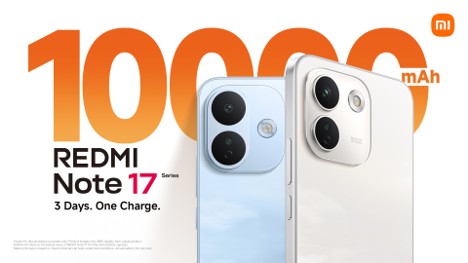
Xiaomi has introduced the REDMI Note 17 Series, expanding its mid-range smartphone portfolio with four models led by the new REDMI Note 17 Pro Max 5G.
The launch also comes as the REDMI Note Series crosses 500 million shipments worldwide. The new range focuses heavily on device longevity, with up to six years of security updates across the lineup and selected models offering up to six years of battery-health support. Pasted text
At the top of the range, the REDMI Note 17 Pro Max 5G features Xiaomi’s largest smartphone battery to date at 10,000mAh in selected markets, paired with 100W HyperCharge and 27W reverse charging. The REDMI Note 17 Pro 5G offers an 8,340mAh battery, while the Note 17 5G and Note 17 feature 7,700mAh units. Pasted text
Durability is another major focus. The two Pro models have received TÜV SÜD 5-star Titan Quality Certification and feature IP66, IP68, IP69 and IP69K ratings, alongside Gorilla Glass Victus 2 protection. Pasted text Pasted text
The Pro models also feature 1.5K displays with peak brightness of up to 3,500 nits, while the Pro Max is powered by the Snapdragon 6 Gen 5 platform and supports Xiaomi HyperAI. Google Gemini and Circle to Search are available across the series. Pasted text
UAE pricing starts at AED 1,059 for the REDMI Note 17, rising to AED 1,999 for the 512GB REDMI Note 17 Pro Max 5G.

 Have a question? +971 56 404 0503










 Trending11 months ago
 Tech News2 years ago

 Automotive2 years ago

 Tech News1 year ago