
 Have a question? +971 56 404 0503




Tech Features
HEAD: Beyond ChatGPT: 7 ways UAE startups are secretly using AI to scale faster than big corporates

Authored by: Dr. Anurag Byala, CEO, Techies Infotech, a global digital transformation & commerce company
Everyone’s talking about ChatGPT. Big corporations are hosting AI transformation workshops. Consultants are selling million-dirham roadmaps. But here’s what nobody’s telling you: while enterprises are still forming committees to discuss AI adoption, UAE startups are already winning the race. And the best part? This might be the most level playing field we’ve seen in decades.
The great equalizer. Think about it. AI is still evolving. We’re on the ground floor. Whether you’re a billion-dollar conglomerate or a three-person team working out of DIFC’s Hub71, you’re accessing the same GPT-4, the same Claude, and the same open-source models. The technology doesn’t care about your market cap. Every business—big or small—is starting from the same line. The difference? Speed. And in the UAE’s startup ecosystem, speed isn’t just an advantage—it’s a necessity. It’s the entire game.
1. AI-powered customer service that actually works
While corporates are negotiating year-long contracts with enterprise chatbot vendors, UAE startups are spinning up customer service agents in days. They’re using platforms like Voiceflow and Stack AI to build conversational interfaces that actually understand Arabic dialects—crucial in a market where your customer might switch between English, Arabic, and Urdu in the same sentence.
A fintech startup in Dubai recently told me they handle 87% of customer queries without human intervention. Their secret? They’re not waiting for perfect. They’re iterating weekly based on honest conversations, something a corporate legal team would take months to approve.
2. Spec-driven development is killing traditional coding
Here’s where it gets interesting. Tech startups in the UAE have already started replacing traditional software development cycles with AI agents. Platforms like Cursor, v0 by Vercel, and Replit’s AI pair programmer aren’t just helping developers code faster—they’re letting non-technical founders build products.
You write the specification. The AI writes the code. You test it. You refine it. What used to take a team of developers three months now takes a founder with vision three weeks. And when you’re bootstrapping in Dubai’s Internet City or Abu Dhabi’s ADGM, that timeline difference isn’t just convenient—it’s survival.
3. The incubator advantage nobody talks about
Dubai has an AI Campus, a Center of Artificial Intelligence, and the Mohamed bin Zayed University of Artificial Excellence. Abu Dhabi has Hub71 and ADGM’s RegLab. Sharjah has Sheraa. But here’s what makes these incubators special in the AI era: they’re knowledge accelerators.
When a startup in Hub71 figures out a clever AI workflow, they share it over coffee. When someone cracks multimodal search for e-commerce in a market with three languages, it spreads through the
ecosystem in days. Try getting that knowledge transfer in a corporate tower where departments don’t even share the same floor.
The UAE’s startup ecosystem isn’t just about funding anymore. It’s about collective intelligence moving at WhatsApp speed.
4. Fail fast, fix faster—no corporate theatre required
Big corporations have a problem: failure is documented, analyzed, presented, and archived. Startups have a different relationship with failure—they expect it, learn from it, and move on before lunch.
Testing an AI cold email sequence? A startup tries five variations this week. A corporate marketing department schedules a meeting next quarter to discuss testing parameters.
Building an AI voice agent for bookings? A startup launches a beta to 50 customers on Monday—a corporation waits for legal, compliance, and brand approval, and three VP signatures.
The UAE’s regulatory environment, especially in free zones, enables this experimental velocity. You can test, iterate, and scale without navigating the bureaucratic maze that slows down established companies.
5. AI sales teams that work while you sleep
UAE startups are deploying AI SDRs (Sales Development Representatives) that operate 24/7. These aren’t basic bots—they’re sophisticated systems that research prospects, personalize outreach, qualify leads, and book meetings.
A SaaS startup targeting regional enterprises told me their AI SDR reached out to 2,000 decision-makers last month, personalized each message based on LinkedIn data and company news, and booked 47 qualified meetings. Their human sales team of two focused entirely on closing deals.
Try getting that level of automation approved through a corporate sales enablement process. You’d still be filling out the business case template.
6. Compliance is their moat—and your opportunity
Big corporates love to talk about their “robust compliance frameworks.” But here’s the dirty secret: compliance frameworks designed for 2019 don’t know what to do with AI in 2025.
Can we use LLMs to process customer data? That requires a privacy review, a security audit, a risk committee meeting, and a sign-off from three departments. By the time they get approval, the technology will have advanced two generations.
Startups, especially those in UAE free zones with clear regulatory sandboxes, can move faster. They’re building compliance into their AI workflows from day one, not retrofitting it into legacy systems.
7. Small teams are the competitive advantage
Here’s the paradox: in the AI era, being small is better. A five-person startup can adopt a new AI tool across the entire company in a team meeting. A 5,000-person corporation needs change management, training programs, and a year-long rollout plan.
When GPT-4 launched, UAE startups rebuilt their products in weeks. Corporations formed AI steering committees that are still meeting quarterly to discuss strategy.
The hierarchy that once signaled strength—layers of management, specialized departments, approval chains—is now dead weight. AI rewards agility, and agility lives in small teams.
The race you didn’t know you were winning. If you’re running a startup in the UAE right now, you’re sitting on an asymmetric advantage that won’t last forever. Big corporations will figure this out eventually. They’ll hire the consultants, restructure their teams, and deploy AI at scale. The question isn’t whether you can compete with corporates using AI. The question is: how much ground can you cover before they even get started? The starting line is level. The finish line hasn’t been drawn yet. And in the UAE’s startup ecosystem, you’ve got everything you need—the infrastructure, the community, the regulatory environment, and most importantly, the speed—to win this race. The only question left is: are you running fast enough?
More about the author: Dr. Anurag Byala is a business leader with 15+ years of experience in technology, helping eCommerce and digital businesses scale across the GCC. His journey—from working at a multinational corporation to founding Techies Infotech—has been centered on building solutions that genuinely move the needle for customers. Along the way, he completed his Doctorate in Business Administration at ESC Clermont Business School in France, where he focused on consumer behavior in
e-commerce. Under his leadership, Techies Infotech has grown into a global player, delivering
AI-powered software solutions that enable faster time-to-market, greater cost efficiency, and compliance with international quality standards. The company serves enterprises across Digital Transformation, Tech Consulting, eCommerce, and Software Development in MENA and beyond. Dr. Byala has been recognized as one of the Top 50 Business Growth Leaders in Technology at the BizzTalk World Conference. He is also a mentor to startups and an active contributor to industry forums, passionate about scaling businesses and building future-ready teams. Outside work, he enjoys playing cricket and padel, exploring new places, and spending time with family.
Tech Features
How digital transformation of UAE’s industrial sector is driving ‘Net Zero 2050’ ambitions
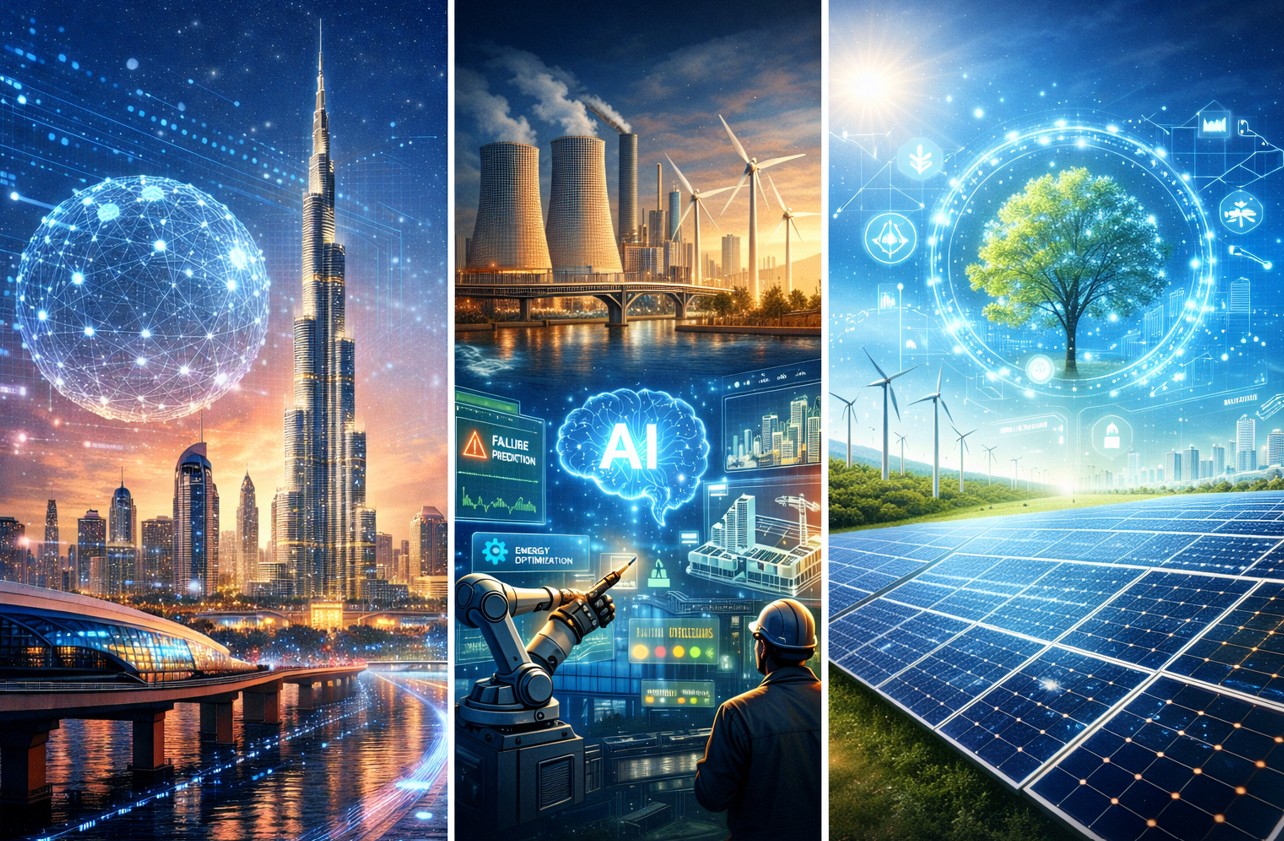
By Ahmad Hamad Bin Fahad, CEO of DUBAL Holding
The UAE’s growth journey is led by an unwavering focus on driving digital transformation, enhancing renewable energy capacity and promoting regulatory excellence. This is best reflected in the ‘Net Zero 2050’ strategy, which aims to create 200,000 jobs across the solar, battery and hydrogen sub-sectors, combining economic and sustainability goals. Digitalisation of the industrial sector will play an important role in realising this vision by paving the way for long-term industrial competitiveness and resilience.
Smart manufacturing, AI adoption and Industry 4.0
Across the UAE, factories are being installed with smart manufacturing systems that integrate IoT sensors, predictive analytics and real-time data environments. These optimise energy usage, reduce downtime and minimise material waste, turning sustainability into a measurable, operational outcome rather than an abstract concept.
Furthermore, digitally connected factories can track emissions at every stage of production, benchmark efficiency and automate corrective actions. This is crucial to achieving the goals of ‘Operation 300bn’ and positioning the UAE as a global hub for future industries.
According to the Ministry of Industry and Advanced Technology (MoIAT), Industry 4.0 tools can increase the nation’s industrial productivity by up to 30 per cent while reducing operational costs by nearly 20 per cent through wider structural transformations. Moreover, AI adoption is set to contribute AED 335 billion to the UAE economy by 2031, as reported by the UAE Council for AI and Blockchain.
Artificial Intelligence is also redefining how industrial assets function, from power plants and smelters to logistics centres and material processing facilities. AI-enabled algorithms can even forecast equipment failures, balance energy loads and simulate entire production cycles to identify carbon-saving interventions. AI also helps enhance transparency and enforce operational discipline, promoting both sustainability and profitability.
Role of advanced automation in redefining industrial operations
Advanced automation, from robotics to autonomous transport systems, is driving sustainability by eliminating key bottlenecks that cause higher emissions. Furthermore, automated systems ensure enhanced precision, enabling industries to streamline energy usage, optimise supply chains and accelerate circular-economy practices such as recycling, material recovery and waste-to-value processes.
However, automation does not replace human capability; it merely enhances it, enabling operators to move on to high-value digital roles. It efficiently tackles repetitive, energy-intensive tasks, creating a more resilient, low-carbon industrial ecosystem. A key enabler of this transition is the rise of strategic, government-aligned investments in digital-first industrial ventures. These investments are the backbone of the nation’s industrial future as they help build advanced manufacturing platforms, AI-driven optimisation technologies, smart mobility solutions and digital energy-management systems.
By investing in companies that integrate digital tools into core industrial operations, the UAE is accelerating technology adoption at scale. These investments further position digital transformation as a strategic imperative for fulfilling the UAE’s sustainability goals while boosting economic competitiveness.
Way Forward: Shaping a resilient industrial economy
The UAE’s wise leadership remains committed to fostering an ecosystem that rewards digital innovation and AI adoption. Moreover, by directing long-term strategic capital towards transformative technologies, the nation is building an industrial sector that is both future-ready and climate-aligned.
Amid this shift, digitalisation stands out as the most critical tool for building a sustainable, net-zero industrial economy. Aligning with this, companies must embrace forward-looking strategies that can positively shape the future of the industry.

Across the technology landscape, women continue to shape innovation with resilience, curiosity, and vision. Their diverse perspectives—shaped by unique journeys, challenges, and triumphs, remind us that progress in tech is driven not only by expertise, but by the voices that dare to redefine what’s possible. This collection of insights amplifies those voices, celebrating the power of women who lead, inspire, and transform the future of technology.
International Women’s Day Comments

Sumaiya Muhammad, Sr. Marketing Specialist at Alteryx –
“My professional journey has evolved across hardware, software, telecom, and now data automation at Alteryx. Working across these domains has strengthened my adaptability and deepened my understanding of how data drives real business value. According to Alteryx research, 48% of leaders plan to increase spending on AI infrastructure and tools, signalling how rapidly enterprise priorities are shifting and how significant it is for women to build confidence in data and AI. A challenge I have consistently faced is navigating constant change in an industry where innovation cycles move quickly. I have realised that continuous learning and investing in upskilling is crucial in this industry.
This International Women’s Day, I encourage aspiring women professionals to step forward boldly and actively shape the future of technology.”
Merhan Gaballah, Construction Technology & PropTech Consultant at PlanRadar –

Throughout my career in construction technology and PropTech, my journey has evolved from commercial roles into strategic advisory positions supporting digital transformation across the GCC.
One of the key challenges has been building credibility in traditionally male-dominated environments, where technical leadership is often predefined. Overcoming this required resilience, preparation, and consistently delivering measurable impact.
Today, I see strong momentum for women in tech. Digital transformation is redefining leadership, placing greater value on collaboration, adaptability, and data-driven thinking—areas where diverse perspectives are essential.
On International Women’s Day, I hope we move beyond recognition toward sustained inclusion, where women are not highlighted as exceptions, but empowered as equal contributors shaping the future of technology.
Alexandra Gartrell, VP and EMEA Legal Lead at Cloudera –

“This year’s International Women’s Day theme, Give to Gain, is a reminder that investing in women’s advancement at work delivers returns for everyone. Diverse teams broaden talent pipelines, improve decision-making, and build workplaces where people are more engaged and more likely to stay.
AI systems inherit the assumptions of the environments that build them. When development teams skew toward a single demographic, bias doesn’t only show up in datasets. It can also appear in which problems are prioritised, how success is defined, which edge cases are tested, and what risks are accepted. In the agentic era, autonomy raises the stakes: small weaknesses in data, design, or oversight can be amplified once decisions are made at scale.
As AI becomes embedded across core business functions, coding ability is no longer the sole marker of technical contribution. Engineers need business acumen, communication skills, and the ability to collaborate across functions because responsible AI depends on context and judgment, not just models.
True inclusion means having diverse voices shape product direction and decision rights and not just representation in organisational charts. Practically, this means auditing datasets for representation gaps, testing models for unequal outcomes, stress-testing edge cases, and involving a diverse panel of human reviewers throughout the AI lifecycle.
According to Cloudera’s WLIT 2025 report, 91% of women leaders in the Middle East remain optimistic that gender equality in AI leadership will improve within five years. When women are given resources, opportunities, and authority in AI development, organisations gain better AI systems that work for everyone. In the agentic era, diversity in leadership and oversight should be treated as part of AI risk management.
Organizations that formalize cross-functional approaches, create transition pathways, and recognize emotional intelligence as a technical capability will build better AI and advance gender equity.”
Fatma Al Naggar, Senior Relationship Manager, Saxo Bank MENA –
“In times of uncertainty, women have consistently proven to be natural problem-solvers and stabilisers, leading their homes, workplaces, and communities with empathy, adaptability, and a profound sense of responsibility.
While women naturally take on the role of emotional anchors due to their deep attunement to the needs of others, it is crucial that providing this support never comes at the expense of their own well-being. Sustainable resilience requires setting boundaries, prioritizing self-care, and establishing personal rituals that help maintain a positive mindset and focus on what can be controlled amidst the external noise of today’s fast-paced digital world.
As women progress in their careers and redefine leadership across industries, they are bringing a more collaborative, empathetic, and purpose-driven approach that prioritizes transparency and inclusivity over traditional authority. In highly competitive fields, particularly male-dominated sectors like finance and technology, technical expertise may open doors, but it is the mastery of soft skills such as emotional intelligence, relationship building, and strategic thinking that sustains advancement and leadership credibility.
Furthermore, living and working in a multicultural environment like the UAE significantly amplifies this professional growth. The country’s strong emphasis on safety, opportunity, and diversity provides an unparalleled space where women from all backgrounds can pursue their ambitions with confidence, learn from diverse perspectives, and foster inclusive, globally minded innovation.
Yet, achieving true gender equity demands ongoing progress to ensure equal access to leadership roles, mentorship, and career development, while continually challenging outdated perceptions about women’s roles. An ideal workplace must actively promote equality, respect, equal pay, and flexible work options, empowering every woman to reach her full potential.
On this International Women’s Day, my message to all women, especially young girls carving their own paths, is to believe in your abilities, embrace curiosity, and never hesitate to pursue challenging opportunities. By recognizing our inherent strength, owning our expertise with authenticity, and leading with resilience, we can collectively shape a more inclusive and high-performing future for our communities and industries.”
Laura Heisman, CMO, Dynatrace –

The rise of AI isn’t just a call for women to adapt, it’s an opportunity for women to lead. With an estimated 85% of the jobs that will exist in 2030 yet to be created, AI is not only reshaping roles, but entire career journeys. Traditional paths are breaking down, opening doors for women to step into emerging opportunities – and redefining what’s possible for soon-to-be graduates and school-aged girls alike.
This is our moment to help define the future of work and pave the way for generations to come. But progress isn’t automatic. Without intentional action and human connection, women risk being sidelined in this transformation. Learning, experimenting, and getting comfortable with AI isn’t optional. It’s how we remain active participants in shaping what comes next.
The future will be shaped by what and who we invest in today. When we support women and future generations through mentorship, intentional recruiting, training, and shared learning, we don’t just advance opportunity – we build better technology, stronger businesses, and a more inclusive future. It starts with choosing to learn, experiment, and grow with AI. That is the spirit of this year’s International Women’s Day focus, where we “give to gain.”
Tech Features
NETSCOUT REVEALS QUALITATIVE SHIFTS IN DDOS ATTACK SOPHISTICATION, INFRASTRUCTURE CAPACITY, AND THREAT ACTOR CAPABILITIES

NETSCOUT® SYSTEMS, INC. (NASDAQ: NTCT), today released its second half of the year 2025 Distributed Denial-of-Service (DDoS) Threat Intelligence Report, revealing sophisticated attacker collaboration, resilient botnets, and compromised IoT infrastructure that drove more than eight million DDoS attacks worldwide – some as large as 30 terabits per second (Tbps) – marking a new era of hyper-scale, coordinated threat activity that continues to outpace global takedown efforts. Meanwhile, the accelerating growth of DDoS-for-hire services is empowering a broader range of threat actors, intensifying operational risk to digitally connected organizations and enterprises.
Implications for security professionals extend far beyond volumetric concerns and include reconnaissance and adaptive evasion which challenge traditional defense paradigms. Organizations must match adversarial innovation with intelligent, autonomous defenses, or risk operational disruption at levels previously considered theoretical.
“Threat actors identify organizations that haven’t invested in the right defenses to stay ahead of sophisticated and coordinated DDoS attacks to take down critical infrastructure,” stated Richard Hummel, director, threat intelligence, NETSCOUT. “Traditional security defenses are no longer working, and with attackers hitting new attack size and complexity ceilings, implementing automated and proactive defenses has become a business-level risk mandate – not just a technical concern for security professionals.”
Key research findings include:
- Massive attacks on a global scale – More than eight million attacks were identified across 203 countries and territories globally.
- Continued Use of Multi-Vector Attacks – approximately 42% of DDoS attacks employed two to five distinct attack vectors, with some adapting dynamically throughout the attack to complicate detection and mitigation.
- Outbound Attacks Impact Broadband and Mobile Services – Extensive direct-path attacks revealed that compromised IoT and customer-premises equipment can generate outbound floods exceeding 1 Tbps, creating liability, service, and reputational risk for broadband and mobile providers.
- Critical Infrastructure Targeted – High‑value services such as NTP and DNS continue to face sustained attack pressure, emphasizing the need for resilient, globally distributed architectures to maintain service continuity.
- Threat actors scale up collaboration – A surge of more than 20,000 botnet-driven attacks in July 2025 exemplified how coordinated threat activity can rapidly overwhelm defenses and disrupt critical government, finance, and transportation services.
- Threat actor persistence – Despite international law enforcement dismantling multiple DDoS-for-hire platforms, hacktivist groups and botnets remain resilient, exerting increased pressure.
- AI integration accelerates operations and collaboration – AI has transitioned to an operational reality, with large language models (LLMs) on the dark web accelerating vulnerability exploitation and botnet expansion, and underground forums documenting a 219% increase in mentions of malicious AI tools. Groups like Keymous+ have demonstrated how partnerships between threat actors amplify attack power, with bandwidth increasing nearly fourfold.
NETSCOUT maps the DDoS landscape through passive, internet vantage points, providing unparalleled visibility into global attack trends. For more than 15 years, NETSCOUT has delivered trusted, consistent DDoS Intelligence based exclusively on directly observed, verifiable attack traffic. NETSCOUT does not aggregate multiple alerts or geographically distributed events into composite peak values, ensuring accuracy, repeatability, and true comparability across reporting periods. Peak metrics reflect single-second maximum bits-per-second (bps) and packets-per-second (pps) rates measured at defined mitigation and monitoring points.
NETSCOUT protects two-thirds of the routed IPv4 space, securing network edges that carried global peak traffic of over 800 Tbps, covering 376 industry verticals and 12,698 Autonomous System Numbers (ASNs) in the second half of 2025. It monitors tens of thousands of daily DDoS attacks by tracking multiple botnets and DDoS-for-hire services that leverage millions of abused or compromised devices.

A CASSINA EDIT FOR RAMADAN AND EID GIFTING
SEVA Holds Its Table Open for Community This Ramadan
WOMEN’S DAY AT JOE’S CAFÉ: ENJOY A COMPLEMENTARY TIRAMISU WITH THE BURJ KHALIFA VIEW




-
News10 years ago
SENDQUICK (TALARIAX) INTRODUCES SQOOPE – THE BREAKTHROUGH IN MOBILE MESSAGING
-

 Tech News2 years ago
Denodo Bolsters Executive Team by Hiring Christophe Culine as its Chief Revenue Officer
-
 VAR11 months ago
Microsoft Launches New Surface Copilot+ PCs for Business
-

 Tech Interviews2 years ago
Navigating the Cybersecurity Landscape in Hybrid Work Environments
-

 Tech News8 months ago
Nothing Launches flagship Nothing Phone (3) and Headphone (1) in theme with the Iconic Museum of the Future in Dubai
-

 Automotive1 year ago
AGMC Launches the RIDDARA RD6 High Performance Fully Electric 4×4 Pickup
-

 VAR2 years ago
Samsung Galaxy Z Fold6 vs Google Pixel 9 Pro Fold: Clash Of The Folding Phenoms
-

 Tech News2 years ago
Brighton College Abu Dhabi and Brighton College Al Ain Donate 954 IT Devices in Support of ‘Donate Your Own Device’ Campaign