
 Have a question? +971 56 404 0503




Uncategorized
SHADOW DATA: A HIDDEN RISK IN THE GULF

By Yazen Rahmeh, a Cybersecurity Expert at SearchInform
Digital transformation across the UAE and Saudi Arabia brings new opportunities and prospects for enhancing efficiency and growth. However, it also causes new challenges to data protection. As digital environments expand, data spreads across endpoints, cloud storage, and internal environments, escaping oversight by security and compliance teams.
This is shadow data, and it may be one of your organization’s most underestimated risk.
What Is Shadow Data?
Despite all efforts, some business data can be stored and processed outside official IT systems. As a result, a company won’t even know that such datasets exist.
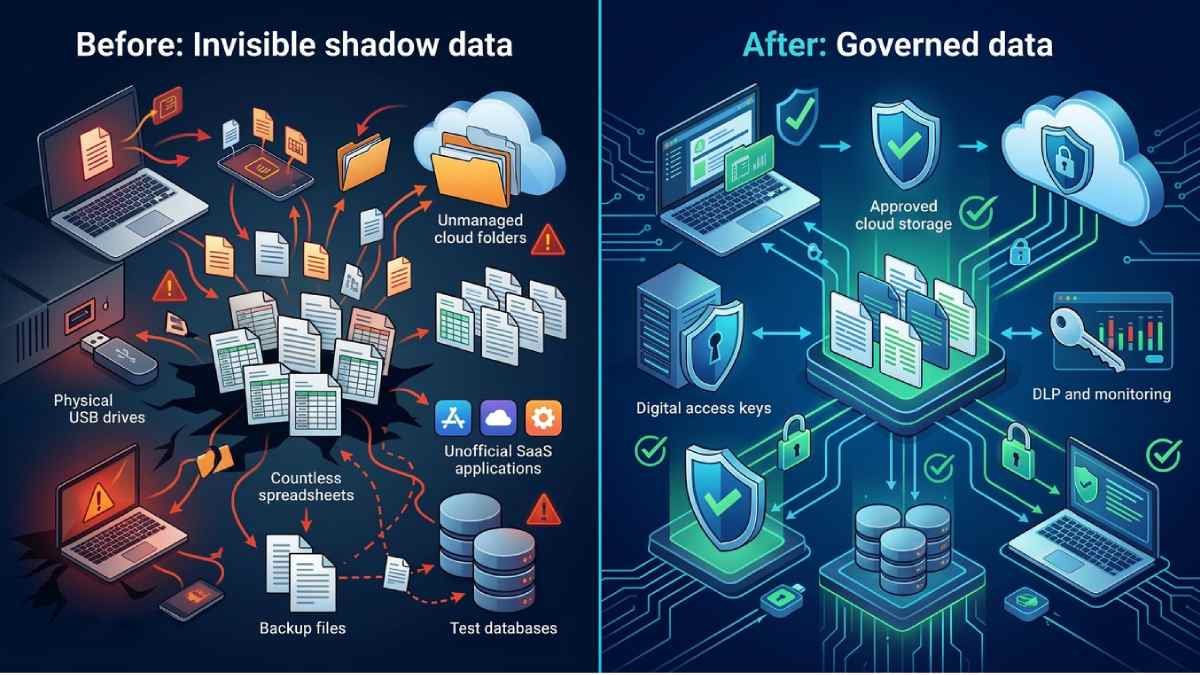
There are a lot of reasons behind the creation of shadow data. Basic examples are:
- Files stored in personal accounts. An employee can send important files to personal email or cloud storage “just in case.”
- Access to corporate data from personal devices. A person can log in to corporate cloud services from a personal tablet or laptop. As a result, sensitive documents can be downloaded to a personal device. This usually happens when someone is working overtime or wants to keep important files readily available.
- Unaccounted copies of sensitive data. An employee can simply copy and paste records from a CRM system or a customer spreadsheet into a file on their workstation. As a result, sensitive data may bypass security controls, increasing the risk of data leakage.
- Some business units can adopt SaaS services without oversight. Employees usually do it to boost their productivity or if whitelisted tools are perceived as slow or bulky.
- Test datasets and temporary databases. Sometimes confidential data can duplicate during migration from one service to another or if developers use production data for test or development environments.
These examples may seem abstract, but the recent Cybersecurity and Infrastructure Security Agency (CISA) data leak shows that shadow data is a real-world threat.
The leak reportedly originated from a contractor’s GitHub repository, which was being used as a working scratchpad. The repository exposed various sensitive records, including AWS keys and plaintext passwords for internal CISA systems. An individual had simply copied sensitive data to make their work more convenient. To do so, the contractor disabled GitHub’s default security setting that prevents users from publishing secrets in public repositories.
Why Shadow Data Is a Business Risk
Increased Risk of Data Leaks
Consider a common scenario: an employee stores confidential data on a personal laptop or cloud service. As a result:
- Sensitive records could be stolen via phishing or malware, as the laptop isn’t protected by enterprise-grade security controls.
- An employee could share the laptop with other individuals. Shared devices increase the risk of data exposure.
- Unauthorized cloud backups. An employee may configure automatic file backups to a cloud service. As a result, sensitive data can leave the protected perimeter and be duplicated in cloud storage, increasing the risk of unauthorized access or data leakage.
That’s how a small and seemingly irrelevant piece of ungoverned data could lead to a major incident. In fact, in 2024, one in three data breaches involved shadow data, according to IBM’s Cost of a Data Breach 2024 report.
One of the most recent cases of data leaks, involving shadow data, is the Abu Dhabi Finance Week exposure. An independent researcher discovered unsecured cloud storage with ID details.
Event representatives stated that only the researcher accessed the data and that the incident affected a limited number of participants. According to them, the issue was caused by a misconfigured cloud storage system managed by a third-party provider.
The incident is the perfect example of shadow data, as the data was copied outside of secured corporate infrastructure and had been left unmanaged.
Regulatory Pressure
Shadow data also presents compliance risks. When using a cloud service, it is essential to verify the geographic location of the data center where the data is stored. Data could be stored at a data center in a different country if you didn’t specify a server location.
As a result, if shadow data includes confidential records such as customer details or transaction records, it will be transferred and stored abroad. From a legal perspective, such misconfiguration is a cross-border transfer and lead to regulatory fines for violations of data protection regulations.
Saudi Arabia’s Personal Data Protection Law dedicates a lot of attention to data residency and cross-border transfers. Organizations, especially in regulated sectors, such as financial institutions, may be required to store certain categories of data within the Kingdom. Companies may need regulatory approval before transferring data to foreign data centers to avoid penalties.
Emirati businesses have less strict conditions for cross-border data transfers. However, there are limitations for banking, payments, healthcare, and telecom organizations and governmental entities. Companies from these industries must store confidential data, such as health records, payment transactions, and customer data, within the country.
Lack of visibility equals lack of control, and regulators do not accept invisibility as an argument.
How to Bring Shadow Data Under Control
Eliminating shadow data entirely is unrealistic. The goal is to make it visible and manageable without slowing down the business.
A Practical Starting Checklist
- Discover regulated data, especially data subject to local PDPLs requirements, cybersecurity frameworks issued by National Cybersecurity Authority in the KSA, and Information Assurance Regulation by TDRA in the UAE. It is essential to identify all information that qualifies as confidential and valuable, incl. unaccounted copies of such data.
- Map where this data is actually stored and shared, not just where it should be. Sensitive data can be stored on-prem or in cloud environments. Look for data discovery solutions. Ideally, choose a solution that combines data discovery and data classification, like DCAP software.
- Classify files & distribute access rights. Use specialized tools to analyze file content and classify it in accordance with a local classification scheme. The next step is to assign user access rights to sensitive data based on employees’ roles and responsibilities.
- Control data transfer channels, including cloud storage, SaaS tools, and USB-devices. Use DLP systems to prevent unauthorized spread of sensitive data. Advanced DLP solutions monitor cloud services, as well as traditional channels, such as email or web browsers.
Conclusion
Data protection is not a one-time initiative. It is an ongoing discipline. Security achieved today must still hold tomorrow — and next year.
Organizations that treat data security as a strategic investment, rather than a compliance obligation, build resilience, regulatory confidence, and long-term business stability.
Shadow data may be invisible. But its consequences are not.





This Halloween, MOON Bar at SANA Restaurant invites Dubai’s night owls to step into the shadows for ECLIPSE AT MOON, an immersive evening of karaoke, themed cocktails, dance entertainment and a DJ afterparty on Saturday, 31 October.
Set within the intimate speakeasy at Jumeirah Mina Al Salam, Madinat Jumeirah, the event promises a playful take on Halloween nightlife, bringing together music, friendly competition and a dramatic eclipse-inspired setting.
The evening begins at 9:00 PM with open karaoke, inviting guests to take the microphone and perform their favourite tracks, from Halloween classics such as Michael Jackson’s Thriller to crowd-pleasers including Disturbia and Toxic. Those who prefer to share the spotlight can join the Scary Duet round, while competitions for Best Costume, Best Karaoke Performance and Best Duet add a competitive edge to the night. A secret guest appearance during karaoke will offer an additional surprise.
Special dance performances will build the energy throughout the evening before the focus shifts to the dance floor at 11:00 PM, when the DJ afterparty begins. The celebration continues until 2:00 AM, accompanied by atmospheric lighting and eclipse-inspired visuals.
The venue will be transformed with silver eclipse details, dark florals and moody lighting, creating a sophisticated Halloween setting. Costumes are encouraged but not compulsory. Guests looking for a subtler approach to the theme can opt for black, silver, charcoal grey, midnight blue or deep burgundy.
Food and drinks remain part of the experience, with SANA’s à la carte menu available at MOON throughout the evening, alongside specially created Halloween cocktails.
Whether guests are ready to take the stage, compete for the best costume or simply settle in for dinner, cocktails and late-night music, ECLIPSE AT MOON offers a Halloween night out with a distinctive speakeasy atmosphere.
This October, Acacia Lounge at Al Habtoor Grand Resort, Autograph Collection invites guests to enjoy a simple yet indulgent pairing of expertly brewed coffee and a delicate pink macaron.
Bathed in natural light and offering a relaxed setting, Acacia Lounge provides the perfect spot to pause and unwind over a freshly prepared coffee, accompanied by a petite pink macaron.
Available daily throughout October, the experience is priced at AED 38 per person. Date & time: Daily – throughout the month of October | 7:30am – 10:30pm | Price: AED 38 per person | Place: Acacia Lounge, Al Habtoor Grand Resort, Autograph Collection

Sunset cocktails on the rooftop, steakhouse nights, Saturday brunches that carry on into DJ sets, and a one-night-only Halloween edition of Vista Latina on 30 October: October at The WB™ Abu Dhabi is filling up the week. Teachers can also unwind with 50% off spa treatments every Sunday.
Friday, 30 October: Vista Latina: Halloween Edition at The Overlook
The Ibero-Latin menu moves from ceviche, empanadas and arepas to chicken tamal, Caribbean seafood soup and birria tacos, finishing with a selection of Latin-inspired desserts. A live singer and pianist duo, joined by a percussionist, will play throughout the evening.
Date: Friday, 30 October 2026
Time: From 7:00 PM
Price: AED 199 per person with soft beverages; AED 299 per person with house beverages and cocktails for three hours
Venue: The Overlook
Every week at The WB™ Abu Dhabi
Tuesdays: Ladies’ Night at The Overlook
The Overlook celebrates its Leading Ladies every Tuesday from sunset, with expertly crafted cocktails. AED 50 for three drinks and 25% off the à la carte menu. 6:00 PM–9:00 PM.
Thursdays: Gents Club at The Director’s Club
Premium steaks, cold draughts and easy conversation in the restaurant’s relaxed cinematic steakhouse setting. Created primarily for gents, the evening includes one signature main, two portions of seasoned fries, a condiment trolley and three draught beers for AED 199 per person. 5:30 PM–11:00 PM.
Thursdays: Wine & Charcuterie Soirée at The Overlook
Free-flow charcuterie and wine with rooftop views for AED 169 per person. 7:00 PM–9:00 PM.
Saturdays: Brunch at The Director’s Club and After Brunch at The Overlook
Saturday Brunch at The Director’s Club brings live entertainment, premium cuts, desserts and a selection of beverages from 1:00 PM–4:00 PM. Packages are AED 320 per person with soft beverages, AED 399 with house beverages, AED 460 with premium beverages and AED 599 with bubbly. From 4:00 PM–6:00 PM, starting 3 October, After Brunch at The Overlook continues the day with rooftop views, live DJ beats and two hours of free-flow house beverages including beer, wine, bubbles, spirits and cocktails. After Brunch is AED 119 per person for Director’s Club brunch guests and AED 169 for walk-in guests.
Sundays: Sunday Roast at The Director’s Club
Roast meat, golden vegetables and gravy from 1:00 PM–4:00 PM. AED 225 per person with soft beverages, AED 340 with premium beverages and AED 440 with bubbles.
Sundays: Relaxation Is the New Curriculum at The A-List Spa & Health Club
Teachers receive 50% off 60- or 90-minute spa treatments every Sunday from 10:00 AM–4:00 PM, from 27 September to 27 December 2026. A valid teacher ID is required and advance booking is recommended. Terms and conditions apply.
For reservations or enquiries:
For dining reservations, please email dine.thewbabudhabi@hilton.com or call 02 815 0000 . For spa reservations, please call 02 815 0000 or email spa.thewbabudhabi@hilton.com.


The Connected Home Is Evolving into an Intelligent Ecosystem

New Partnership Connects Residential Wellbeing With Preventive Healthcare

Dubai Ride-Hailing App Zed Strengthens Leadership with Appointment of Shobhit Singhal to Shape Its Future



-

 Trending12 months ago
OPPO A6 Pro 5G Review: Reliable Daily Driver
-

 Tech News2 years ago
Denodo Bolsters Executive Team by Hiring Christophe Culine as its Chief Revenue Officer
-
 VAR2 years ago
Microsoft Launches New Surface Copilot+ PCs for Business
-

 Automotive2 years ago
AGMC Launches the RIDDARA RD6 High Performance Fully Electric 4×4 Pickup
-
Tech Interviews3 years ago
Navigating the Cybersecurity Landscape in Hybrid Work Environments
-

 Hospitality2 years ago
Gulfood 2025 30th Edition Kicks Off Today, Setting New Benchmarks in F&B Growth and Innovation
-

 VAR10 months ago
Huawei Nova 14 Pro Review: Where Camera Excellence Meets Ecosystem Evolution
-

 Tech News1 year ago
Nothing Launches flagship Nothing Phone (3) and Headphone (1) in theme with the Iconic Museum of the Future in Dubai