
 Have a question? +971 56 404 0503




Spotlight
Freshworks Announces CEO Transition


Freshworks today announced the appointment of Dennis Woodside as Freshworks’ Chief Executive Officer & President, effective later today. Woodside, currently Freshworks’ President, will succeed Girish Mathrubootham, the company’s Founder, as CEO.
Mathrubootham will transition to a new role of Executive Chairman. Mathrubootham will remain the chairman of the Board of Directors, and Woodside will also remain a member of the Board of Directors.
“When I first proposed this next step to the Freshworks Board, we were starting to chart the next phase of our company’s journey. We brought Dennis on board to partner with me on crafting an ambitious growth plan, and my hope was that he could eventually lead the team of talented employees around the world to execute it, which would allow me to spend more time on the long-term product vision, innovation and AI strategy,” said Mathrubootham.
“Dennis has a deep understanding of Freshworks’ business, customers and our employees, and a strong track record of building and scaling large global teams – he is the right leader to become our next CEO. I’m thrilled to announce this transition.”
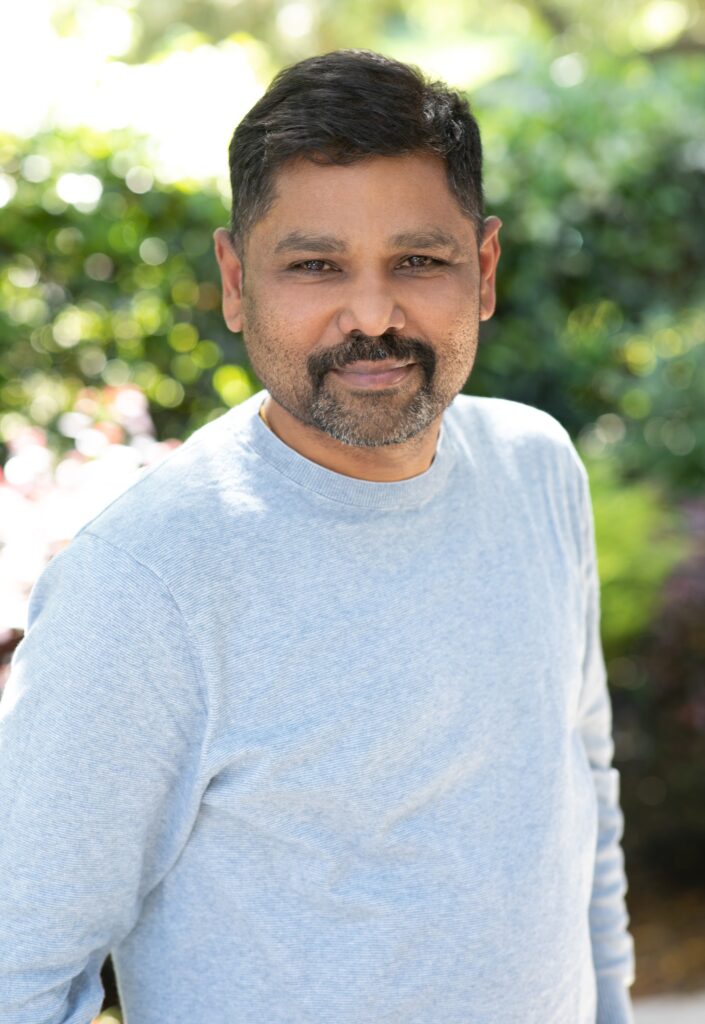
Girish Mathrubootham, Founder -CEO
Woodside joined Freshworks as President in September 2022. Since then, Woodside has accelerated Freshworks’ investments in enterprise grade products, and driven increased focus on the growth of mid-market and enterprise customers.
Woodside brings great leadership experience to this new role. Previously, Woodside served as Chief Operating Officer of Dropbox, helping grow revenue from $250M to $1.3B and ultimately raising over $1B in a successful IPO in 2018. Prior to that, Woodside held various sales and strategy leadership roles at Google from 2003 to 2014, including serving as CEO of Motorola Mobility after Google acquired the company in 2012. Before his long tenure at Google, Woodside was a consultant at McKinsey & Co. Woodside currently serves on the board of the Boys & Girls Club of the Peninsula in California and previously served on the board of the American Red Cross from 2016 to 2022 and on the board of ServiceNow from 2018 to 2022.
In his new role as Executive Chairman, Mathrubootham will remain highly engaged with our product vision, customers, and employees. He will work across the company to bring Freshworks’ long-term vision to life and consult with Woodside on strategic decisions. The transition frees him up to spend more time with our product teams in India, and our customers globally, and stay engaged with other external stakeholders.
“As I step into the role of CEO, I am deeply honoured to build upon Girish’s remarkable legacy,” said Woodside. “What he has created is truly special. Our mission and strategy remain the same. We stand before extraordinary opportunities and have the right foundation to make it possible – a winning combination of our strong focus on delighting customers and our product portfolio and innovation. I’m committed and excited to continue our journey of growth.”
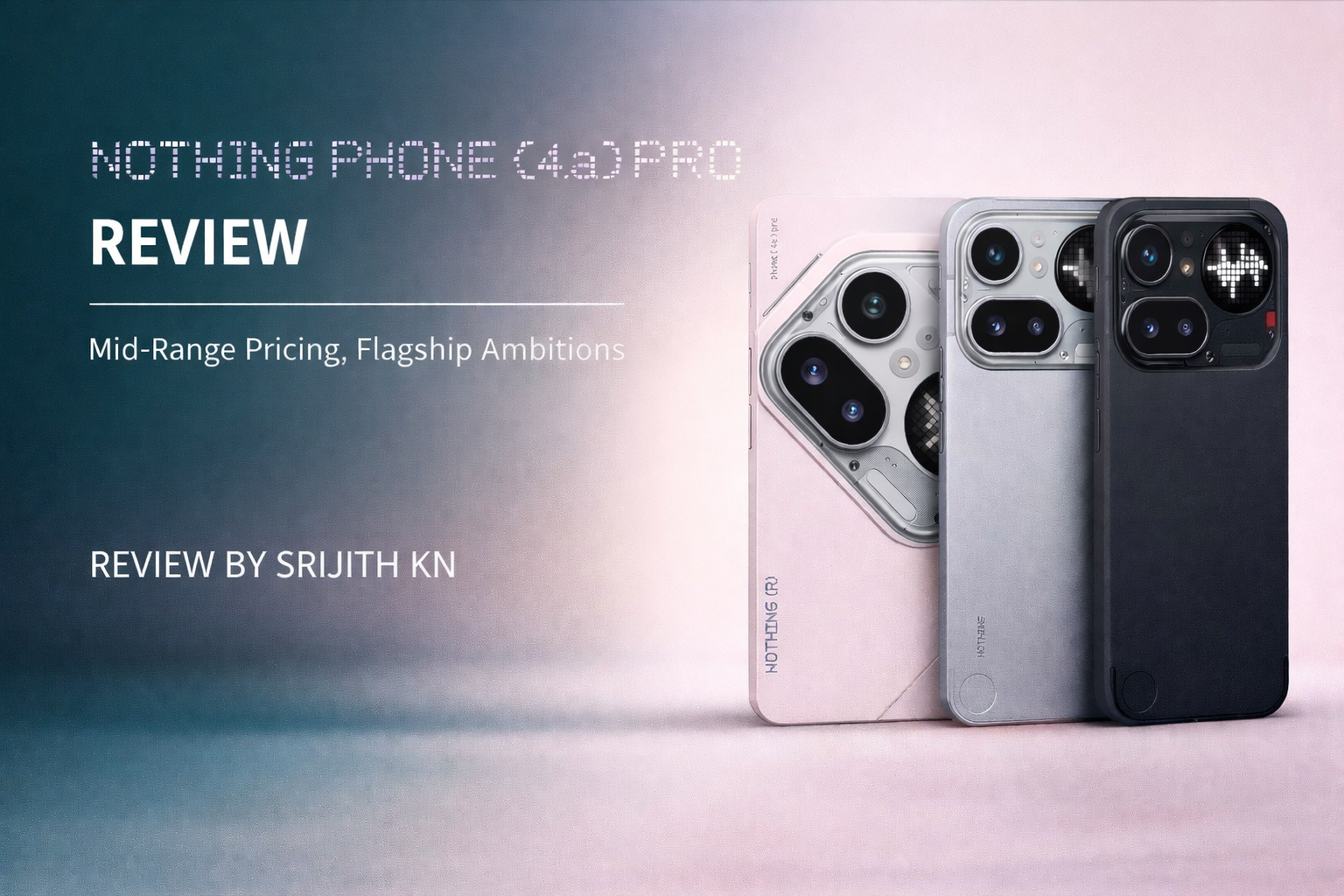
By Srijith KN
An in-depth look at Nothing’s 4a Pro, the clean stylish looking mid-range powerhouse!
Nothing has built its reputation on standing apart in an increasingly crowded smartphone market. With the launch of the Nothing Phone (4a) and the more ambitious Nothing Phone (4a) Pro, the company continues that philosophy while shifting its positioning. While the standard model focuses on accessibility, the Pro model moves closer to the premium segment, combining refined hardware with one of the most impressive displays in its category.
The Design Shift

The first thing that stands out about the Phone (4a) Pro is its departure from Nothing’s signature transparent aesthetic. Instead of the exposed internal design language that defined earlier models, the Pro adopts a more traditional and solid look with a clean metal frame and a conventional camera bump. At just 7.5mm, it is also the slimmest Nothing phone to date.
It is a different direction, but one that works. The device feels noticeably more premium than its price might suggest. Having used Nothing phones extensively, including the Phone (1) for nearly two years and the Phone (3) as a daily driver, this design shift feels like a more mature step for the brand. For some users, the move toward a more understated look may actually increase its appeal.
A Display Built for Immersion
The Phone (4a) Pro features a large 6.83-inch AMOLED display with a 1.5K resolution and a variable 144Hz refresh rate. On paper, these specifications are already top tier for this price range.
In practice, the display delivers exactly what those numbers promise. The screen feels fast and responsive with extremely smooth scrolling, while peak brightness reaching up to 5000 nits ensures excellent outdoor visibility. For everyday use, the combination of size, speed, and brightness makes the device feel significantly more expensive than its mid-range positioning suggests.
Performance That Surprises
Powering the device is the Snapdragon 7 Gen 4 chipset paired with up to 12GB of RAM. While this chipset is not designed to compete with flagship processors, it represents a meaningful performance jump compared with previous mid-range Nothing devices.
In early testing, the phone handled multitasking comfortably and performed well in gaming scenarios. Nothing has always focused on smooth real-world performance rather than chasing benchmark numbers, and the Phone (4a) Pro continues that same philosophy. For most users, the device feels quick, responsive, and capable of handling everyday workloads without difficulty.
Nothing OS Remains a Strength
Nothing OS continues to be one of the strongest aspects of the device. The software experience remains clean, responsive, and refreshingly free from unnecessary bloatware.
In a smartphone landscape increasingly filled with overly aggressive AI features and cluttered interfaces, Nothing OS stands out for its simplicity. For users who prefer a lightweight Android experience that stays focused on usability, the software remains one of the Phone (4a) Pro’s biggest competitive advantages.
Camera Performance
The Phone (4a) Pro includes a 50-megapixel main camera supported by a telephoto lens designed to offer additional versatility for photography.
In good lighting conditions the camera produces detailed images with balanced colour reproduction. While it may not fully compete with flagship level camera systems, the overall performance remains strong for the device’s price category.
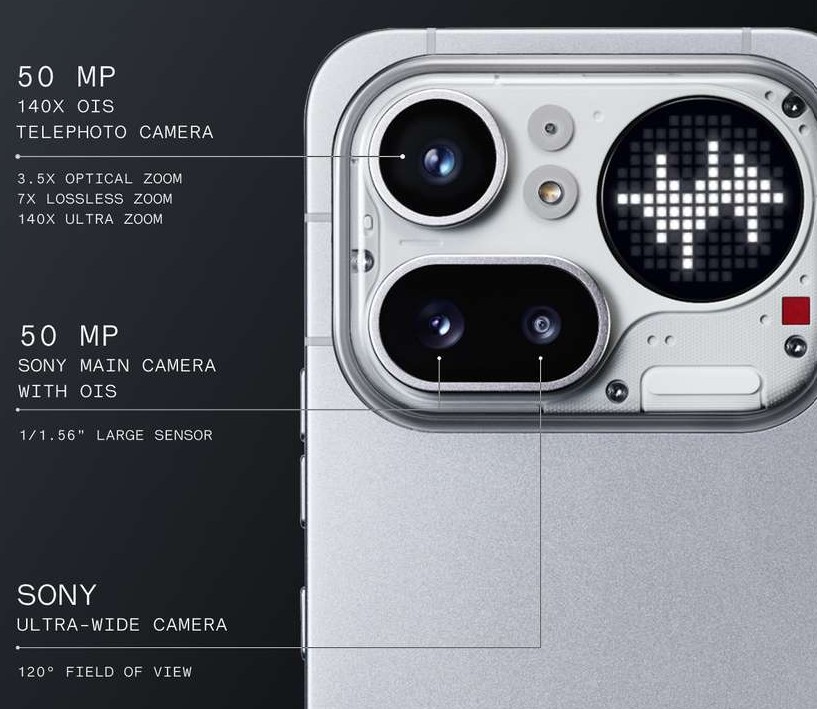
However, there are some compromises. The ultra-wide camera uses an 8MP sensor and the front facing camera represents a slight downgrade compared with higher end models in the Nothing lineup. For most users the results will still be more than sufficient, but the camera system does not completely match flagship expectations.
The 140× Zoom Experiment
One of the more unusual features on the Phone (4a) Pro is the advertised 140× zoom capability. On paper this sounds extraordinary, particularly for a mid-range device.
In practice the phone achieves this through a combination of its 3.5× optical telephoto lens and AI driven image processing that digitally extends the zoom range far beyond what the optics alone can provide.
Testing the feature reveals a surprisingly practical use case. While extreme zoom levels will not replace traditional photography, the ability to zoom into distant text or objects and capture a quick shot to inspect them works well. The heavy lifting appears to come from AI processing, which sharpens the image enough to make those faraway details readable.
Carl Pei once mentioned in an interview that some features come from giving internal teams the freedom to experiment creatively. The 140× zoom feels like one of those ideas. It may not always produce perfect photos, but it works surprisingly well as what could be described as a “digital binocular” mode.
The Glyph System: Refined Identity
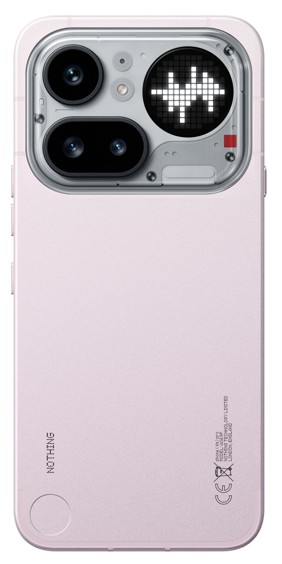
The Glyph lighting system remains one of Nothing’s most recognisable design signatures. On the Phone (4a) Pro the concept evolves with a larger and brighter light array that expands its visual notification capabilities.
The Glyph system can display alerts for incoming calls, timers, notifications, and recording indicators through distinctive lighting patterns on the back of the phone.
While visually distinctive and occasionally useful for quick notifications, the Glyph system still feels more like a signature design element than a practical necessity. That said, the implementation on the Phone (4a) Pro looks particularly striking and continues to give Nothing devices a visual identity that few other smartphones offer.
Editor’s Impressions
Having moved from the Phone (1) to the Phone (3) as my primary device, the Phone (4a) Pro feels like an interesting pivot for Nothing. The shift away from a fully transparent aesthetic toward a polished metal design feels both refreshing and more mature.
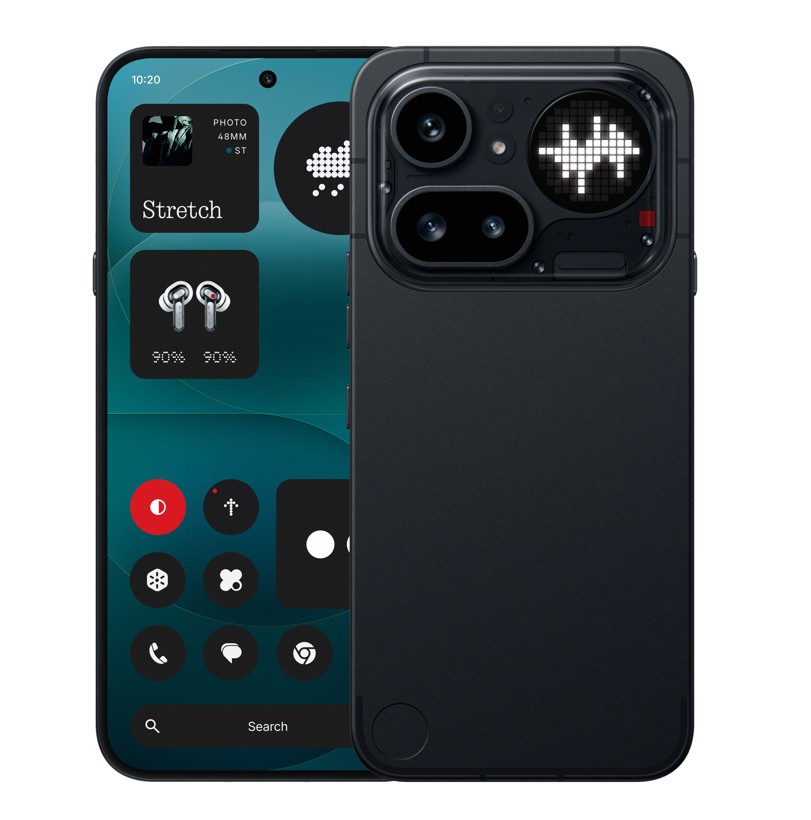
Performance is strong enough for everyday use and even moderate gaming, while the display is easily one of the highlights of the device. The camera system is capable, though there are a few compromises including the 8MP ultra-wide lens and the slightly downgraded front camera.
For users looking for the absolute highest specifications available, there are other devices that push further into flagship territory. But that has never been Nothing’s core philosophy. Instead, the brand focuses on creating devices that feel distinctive, practical, and thoughtfully designed.
For users who want a smartphone with a strong personality without paying flagship prices, the Nothing Phone (4a) Pro offers a compelling balance of style, performance, and value.

When did you last see geopolitical risk appear as a named line item in your technology governance framework?” This question — posed by Subrato Basu to technology leaders across industries and geographies, and echoed in the conversations Srijith KN has tracked across the CXO community — increasingly divides its audience into two groups. The gap between them is widening, and it reveals a deeper shift: geopolitics is no longer external to technology strategy. It is now one of its defining forces.
The first group — still the majority — treats geopolitical risk as someone else’s problem. It belongs, they assume, to risk officers, government affairs teams, or the audit committee. Technology is their domain; geopolitics is noise in the background. The second group has understood something that the first has not: the boundary between geopolitical risk and technology risk no longer meaningfully exists.
This article is written for both. For the first group, it is a wake-up call — offered in the hope that it arrives before an incident makes the argument more forcibly. For the second, it is an attempt to sharpen a framework and ground it in the operational realities that boards and CXOs are navigating right now. The central argument is this: geopolitical volatility has become a direct, structural input into enterprise technology strategy. Organizations that govern for it with the rigor applied to financial or regulatory risk will be measurably more resilient, more competitive, and more trusted than those that do not.
“Geopolitical volatility is no longer background noise for technology leaders. It is a direct input variable into technology strategy, and the boards that do not govern for it are operating with a critical blind spot.“
The Assumption That Built Our Governance Frameworks Is Broken
For most of the past two decades, a workable assumption underpinned how organisations sourced, deployed, and governed technology: that the global technology ecosystem was broadly open, commercially-driven, and largely apolitical. Hardware vendors competed on specification. Cloud providers competed on price and performance. Procurement teams evaluated suppliers on technical merit. Geopolitical considerations were, at most, a due diligence footnote.
That assumption has been systematically dismantled. The deliberate weaponisation of technology — through trade restrictions, regulatory controls extended beyond national borders, state-sponsored cyber operations, and the calculated use of supply chain access as an instrument of strategic leverage — has fundamentally altered the risk calculus for any enterprise that depends on globally sourced technology infrastructure. What was once a commercially neutral procurement decision is now, in many cases, a geopolitical exposure.
This is not a temporary disruption that will normalise once a particular set of tensions eases. It reflects a durable structural shift in how major powers compete, and in how that competition is increasingly waged through, and against, the technology layer of the global economy. For enterprises operating in markets defined by proximity to active geopolitical fault lines — whether those fault lines are geographic, commercial, or digital — the consequences are not theoretical. They are already reaching enterprise cloud contracts, hardware procurement pipelines, and security operations. From our respective vantage points — practitioner and editorial — the pattern is unambiguous.
“What was once a commercially neutral procurement decision is now, in many cases, a geopolitical exposure. Governance frameworks designed for a different era are systematically unfit for this one.“
Five Fault Lines Running Through the Enterprise Technology Stack
When we map the pathways through which geopolitical volatility translates into technology operational risk, five pressure points emerge with consistency across sectors and geographies. We offer them not as a comprehensive risk register — every organisation’s exposure profile will differ by market, sector, and architecture — but as a diagnostic lens for board and CXO discussion.
a) The Cloud Compliance Trap
The hyperscalers that power the majority of enterprise digital infrastructure operate under regulatory frameworks whose reach extends well beyond their home jurisdictions. Technology access controls and compliance obligations do not stop at national borders. Enterprises with commercial relationships, supply chain connections, or infrastructure footprints that intersect with restricted or conflict-adjacent jurisdictions can find themselves subject to service reviews, contract amendments, or capability restrictions — sometimes with limited notice, and often as a downstream consequence of their vendor’s own compliance posture rather than anything the enterprise has done directly.
The trap is that this exposure is rarely visible until it activates. It can emerge through indirect supply chain adjacency, shared infrastructure configurations, or compliance flags several steps removed from the enterprise’s own operations. CIOs who have mapped their cloud footprint against potential regulatory jurisdiction risk — proactively, not reactively — hold a material governance advantage. Understanding which workloads reside on infrastructure subject to extended regulatory reach is not optional hygiene. It is foundational governance.
b) The Cyber Threat Multiplier
A consistent and well-documented pattern has been established across multiple cycles of geopolitical escalation, recorded in threat intelligence reports published by recognised international cybersecurity research organisations and government security agencies: periods of elevated inter-state tension correlate with increased state-linked cyber activity targeting financial institutions, critical infrastructure, and government-adjacent enterprises in proximate markets. This is not the authors’ independent assertion. It is an observable, documented, and reproducible pattern in the publicly available record.
The structural implication for technology leaders is clear: the cyber threat environment in markets proximate to active geopolitical fault lines is durably more elevated than in geopolitically stable ones, and that elevation intensifies when political temperature rises. The attack surface has expanded materially through the convergence of information and operational technology, the proliferation of AI-integrated workflows, and the broad adoption of connected devices. CISOs who construct their security posture reactively, in response to incidents rather than in anticipation of structural threat conditions, have fundamentally misread the governance mandate their environment demands.
c) The Supply Chain Blind Spot
Most enterprises maintain reasonable visibility into their software supply chains. Very few have equivalent clarity on the geopolitical exposure embedded in their hardware supply chains. Semiconductors, networking equipment, and industrial technology components originate from supply chains subject to trade restrictions and regulatory controls that can translate, under escalatory conditions, into sudden procurement constraints, extended lead times, or mandatory certification requirements creating material operational bottlenecks.
The organizations most exposed are those in active digital transformation or major infrastructure refresh cycles that have never stress-tested their procurement pipeline against a scenario in which specific hardware categories become unexpectedly constrained. The board-level question is not whether this will happen. It is whether, if it did, the organization would have ninety days of operational runway or ninety hours.
d)The Vendor Dependency Risk
Multi-year enterprise software commitments — ERP platforms, data infrastructure, security tooling, AI platforms — are made on the assumption of uninterrupted service from vendors operating in predictable regulatory environments. The regulatory obligations carried by enterprise software vendors headquartered across major technology jurisdictions can, under specific and not implausible circumstances, translate into licence amendments, capability restrictions, or service reviews with limited contractual notice. This risk is amplified, and actively expanding, for software incorporating AI capabilities as those capabilities attract increasing regulatory attention across multiple jurisdictions simultaneously.
Boards approving these investments are, in our view, frequently not receiving the full picture of vendor jurisdiction exposure. Requiring legal and technology leadership to jointly assess this exposure before committing to multi-year agreements is not procedural excess. In the current environment, it is a core fiduciary responsibility.
e) The Talent Dimension
The talent dimension of geopolitical risk is consistently the least visible and the most underestimated. Technology-intensive organisations in dynamic markets draw on internationally mobile specialist talent pools. Sustained geopolitical instability affects those pools in ways that are difficult to predict and slow to reverse: senior professionals reconsider relocation decisions, acquisition pipelines for specialist roles — particularly cybersecurity engineering, AI architecture, and regulatory compliance — tighten, and workforce continuity in critical functions comes under pressure at precisely the moment when those functions matter most.
Resilience against this risk requires proactive investment in local talent pipelines, structured knowledge transfer protocols for critical technology functions, and a workforce continuity discipline that treats geopolitical scenarios as first-class planning variables — not as footnotes in the HR risk register.
“The technologies most exposed to geopolitical disruption are simultaneously the most powerful instruments available to build resilience against it.“

Exclusive Interview with Chef Thomas Smeeth, Senior Sous Chef, QWERTY
In this exclusive chat, chef shares his journey from family kitchens to Dubai, blending British tradition with authentic, comforting flavors.
You started working in your father’s kitchen at the age of 13. How did those early experiences shape your passion for food and cooking?
Starting young in my father’s kitchen ignited my passion for the culinary world. It wasn’t just about learning to cook—it was about discovering the energy and creativity of kitchen life. Those formative years taught me skills I never had before and instilled a respect for hard work and attention to detail, which continue to drive me today.
What’s your personal twist on classic British dishes that makes them stand out to diners in Dubai?
I like to keep things simple yet impactful. Authenticity is at the heart of everything I do, avoiding overcomplications. My focus is on presenting classic British flavors that stay true to tradition while subtly elevating them to appeal to a diverse audience in Dubai.
You’ve described British food as comfort food. If you had to choose one dish that embodies this sentiment, what would it be?
For me, it has to be apple crumble with custard. It’s the perfect balance of sweet and warming—a dish that feels like a hug on a plate. It takes me back to my roots and resonates with people looking for that same nostalgic comfort.
Menu at QWERTY promises to tantalize taste buds, so what is one of your signature creations?
One of my standout dishes is the tuna steak paired with burnt onion purée and chimichurri. The dish offers a nice contrast of smoky, tangy, and herby flavors with a unique balance that surprises diners and leaves them wanting more.
Dubai is known for its diverse culinary landscape. How do you plan to carve a niche for British flavors in this multicultural city?
By keeping things simple and authentic. My goal is to remind diners of the comforts of British home cooking, whether they’re locals exploring new flavors or expats craving a taste of home. It’s about delivering those familiar tastes with the highest quality ingredients and care.
Does the art of welcoming lie in ambiance creation or human connection?
For me, it’s all about human connection. Ambiance plays a role, but nothing beats being made to feel truly welcome by attentive and genuine staff. It’s that warmth and personal touch that allows guests to relax, unwind, and fully enjoy their experience.

DUBAI GETS ITS FIRST HONESTY BASED BREAD COUNTER AS NOBLE SOURDOUGH LAUNCHES IN THE UAE
MAKI AND RAMEN IS TURNING SUSHI INTO A GAME – AND RAMEN INTO A CHALLENGE THIS APRIL
MAGNA AI AND CORVIT NETWORKS FORGE STRATEGIC ALLIANCE TO ACCELERATE PAKISTAN’S NATIONAL AI DEVELOPMENT



-
News10 years ago
SENDQUICK (TALARIAX) INTRODUCES SQOOPE – THE BREAKTHROUGH IN MOBILE MESSAGING
-

 Tech News2 years ago
Denodo Bolsters Executive Team by Hiring Christophe Culine as its Chief Revenue Officer
-
 VAR12 months ago
Microsoft Launches New Surface Copilot+ PCs for Business
-

 Trending6 months ago
OPPO A6 Pro 5G Review: Reliable Daily Driver
-

 Tech Interviews2 years ago
Navigating the Cybersecurity Landscape in Hybrid Work Environments
-

 Tech News9 months ago
Nothing Launches flagship Nothing Phone (3) and Headphone (1) in theme with the Iconic Museum of the Future in Dubai
-

 Automotive2 years ago
AGMC Launches the RIDDARA RD6 High Performance Fully Electric 4×4 Pickup
-

 VAR2 years ago
Samsung Galaxy Z Fold6 vs Google Pixel 9 Pro Fold: Clash Of The Folding Phenoms