
 Have a question? +971 56 404 0503




Hospitality
INDIKAYA UNVEILS A MICHELIN-RECOMMENDED FESTIVE CHRISTMAS MENU CELEBRATING INDIAN CULINARY CRAFTSMANSHIP


This festive season, INDIKAYA invites guests to gather around the table for a Christmas dining experience shaped by warmth, intention, and refined Indian flavours. Located at Shangri-La Hotel, Sheikh Zayed Road, the contemporary Indian restaurant presents a thoughtfully curated Christmas menu that reflects tradition, balance, and quiet celebration.
Recognised in the MICHELIN Guide 2025, INDIKAYA approaches festive dining with restraint and cultural depth. The Christmas menu is designed as a composed tasting journey — one that honours seasonal ingredients while remaining rooted in the culinary heritage of India.
“Festive dining is about slowing down and sharing moments,” said Chef Hemant Oberoi, Indikaya. “For Christmas, our chefs have curated a menu that feels familiar yet considered — respectful of tradition, shaped with care, and meant to be enjoyed together.”
Available in both vegetarian and non-vegetarian formats, the Christmas menu unfolds as a progression of flavours rather than an elaborate display. The experience opens with refined interpretations of classic chaat, including Amritsari Chowk ki Tikki Chaat and Quinoa Avocado Chaat, offering a gentle introduction to the courses ahead.
From there, the menu moves into tandoor and grill selections that reflect regional influences and precise technique. Vegetarian dishes include Pothari Paneer Tikka and Till Methi Broccoli Kebab, followed by composed main courses such as Paneer Bemisal and Subzi Nizami Handi. The non-vegetarian selection features dishes including Nawabi Chicken Tikka, Fish Farcha, and Bhatti Prawns, alongside a seasonal Ghee Roast Turkey — a subtle nod to Christmas traditions, interpreted through an Indian lens.
Slow-cooked rice preparations form a natural continuation of the experience, with Subz Dum Biryani and Chicken Dum Biryani, accompanied by traditional condiments and breads, each prepared with quiet precision.
The meal concludes with a restrained selection of festive desserts. Kunafa Kalakand, Chikki Phirni, and Rose Petal Ice Cream offer a composed finale — familiar flavours presented with balance and simplicity.
With its understated ambience and culturally rooted approach, INDIKAYA provides an elegant setting for intimate Christmas celebrations, family gatherings, and festive evenings in the heart of Dubai. The Christmas menu is available for a limited time during the festive period.

Siyam World has never been one for quiet celebrations, and its fifth birthday is no exception. True to its promise of “A World Beyond Your Wildest”, the Lifestyle Collection resort under the Sun Siyam umbrella, is marking the milestone with a packed programme of sport, entertainment and island celebrations. England rugby star Danny Care kicks things off with a three-day children’s rugby camp, followed by football sessions with Gary Cahill and Millie Bright, a kids’ carnival, an island-wide Amazing Race, a 3K Fun Run and cinema experiences out on the lagoon. The celebrations reach their heart on 28 October, when Siyam World officially turns five with a full day dedicated to the Maldives, before CULT CLASSICS brings the Birthday Bash to a suitably wild finale on Halloween night.
23–25 October: Danny Care Rugby Camp
The Birthday Bash gets moving on 23 October, when England rugby star Danny Care takes to the field for a three-day children’s rugby camp. Some will arrive knowing the game inside out. Others may be picking up a rugby ball for the first time. Both are welcome. Across three days, young guests will get the chance to train with Care, learn new skills and put them into practice on the field. The focus is on learning, playing and enjoying the experience, although we expect things to become fairly competitive once the games begin.
26–30 October: Football with Gary Cahill and Millie Bright
From 26 October, the rugby ball makes way for football as Gary Cahill and Millie Bright take over the pitch for five days of coaching sessions, matches and challenges.
This is not a quick wave from the sidelines followed by a group photograph. Young guests will train with them, learn from them and play some actual football. They will probably also return home with a very detailed account of every pass, tackle and goal.
Away from the pitches
There is plenty happening beyond the sporting action. The kids’ carnival brings games, music and colourful chaos, while the Amazing Race sends families and friends across the island in search of clues and challenges. Teamwork helps. So does having at least one person who can follow directions.
Guests and team members can also join the 3K Fun Run around the island. Run it, jog it or walk the whole thing while insisting that was always the plan. Nobody is chasing a record here.
Cinema, but make it Siyam World
Movie night is leaving dry land. Cinema by Moonlight takes guests out onto the water to watch a film aboard a boat cruising through the lagoon. Stars overhead, sea breeze, no cinema walls and hopefully nobody asking you to move because they cannot see the screen.
Guests can also choose our version of a drive-in cinema. Instead of arriving by car, they take a JetCar into the lagoon and park on the water in front of the screen. It is not the most conventional way to watch a film. That is rather the point.
On 28 October, the Maldives is the main event
Siyam World officially turns five on 28 October, and the entire day belongs to the Maldives. Maldivian food, music, traditions and creativity take over the island, leading into a major birthday stage production that evening. Guests won’t simply watch from a distance. They’ll be invited to join the celebration and meet more of the people behind Siyam World. The sporting names bring plenty of attention to the week, but the Maldives is not the backdrop to this birthday. It is the heart of it.
“We had a lot of ideas for the fifth birthday. Probably too many, if I’m honest,” says Sara Siyam, Director of Marketing at Sun Siyam. “But the 28th was always clear. It had to be about the Maldives and our team. They have given Siyam World its energy and personality over the last five years, and we want our guests to celebrate that with us.”
And then we ruin the lovely mood
On 31 October, Cult horror’s most infamous faces are checking into Siyam World this Halloween and they’re definitely not here for the all-inclusive. For 2026, Siyam World is rewinding to the golden age of horror with CULT CLASSICS an epic, immersive Halloween experience inspired by the characters that kept an entire generation awake at night. Freddy Krueger. Pennywise. Leatherface. Jason. They’re all invited. Whether the guests will be quite as pleased to see them is another story.
The night begins with an interactive horror walkthrough through themed sets, live performances and a series of encounters that become increasingly difficult to laugh off. Guests move through the story themselves, eventually reaching the main stage, assuming everyone makes it that far. A theatrical production follows, combining live performance, music and dark humour before the night finishes with a Halloween party.
We have learned that our guests don’t want to watch Halloween safely from a table. They want to walk into it. Some hide behind their children. Others send their children ahead first. We try not to judge.
“Halloween at Siyam World was never going to be a few pumpkins and someone dressed as a ghost. Every year, we create an entire experience that guests can step into, and CULT CLASSICS takes that to another level. It’s nostalgic, theatrical, ridiculously fun and genuinely scary. One minute you’re laughing, the next you’re running from Leatherface. Pretty standard night at Siyam World, really.” Says Sara Siyam, Director of Marketing, Sun Siyam.
Across nine days, the fifth Birthday Bash moves from rugby and football to carnival games, an island race, a 3K run, films on the lagoon, a full Maldivian celebration and one final night of original nightmares. It is a lot for one birthday. Fortunately, more is more around here.
Hospitality
Warner Bros. Discovery Brings Extraordinary Journeys, Untold Stories and High-Stakes Challenges to Screens This October

This October, Warner Bros. Discovery brings viewers across the region a diverse lineup of compelling stories, extraordinary journeys and real-life challenges across Discovery, TLC, HGTV and ID, alongside gripping new content on discovery+.
From a historic journey to the Moon and legendary expeditions around the globe, to high-stakes relationship retreats, unconventional house-flipping projects and investigations into some of the most complex stories of our time, October’s programming offers audiences a mix of discovery, drama and real-life storytelling. With fascinating personalities, remarkable experiences and stories that go beyond the expected, there is something to engage audiences throughout the month.
discovery+
Unmasking a monster: Aileen Wuornos S1
Unmasking A Monster: Aileen Wuornos presents exclusive first-person accounts from people connected to the life and crimes of Aileen Wuornos. Using cutting-edge digital replica technology to recreate key figures as they appeared at the time, the series revisits untold stories through the perspectives of homicide detectives, childhood friends, Wuornos’ attorney and an undercover officer who encountered her. The series offers a detailed examination of the events and people surrounding one of America’s most notorious serial killers.
Airs: Available as of 2nd October on discovery+ on OSN+ and stc tv.
DISCOVERY
Artemis II : To the Moon And Back
Artemis II: To The Moon And Back takes viewers behind the scenes of NASA’s historic mission to return Americans to the Moon for the first time in more than 50 years. From mission preparation through to splashdown, the series follows the Artemis II crew on their 10-day journey of exploration, offering an inside look at an extraordinary milestone in human space exploration.
Airs: Weekly from Sunday 11th October, 20:10 KSA time on Discovery channel. Discovery is available via OSNtv channel no. 50, BeIN channel no. 201, stc tv channel no. 205 and TV by e& channel no. 360.
Expedition Unknown | New Season
Josh Gates returns for a new season of Expedition Unknown, travelling around the globe to investigate some of the world’s most captivating legends and mysteries. Combining his archaeological expertise with his signature sense of humour, Josh immerses himself in the locations at the heart of each story as he searches for clues and uncovers new perspectives on age-old tales.
Airs: Weekly from Thursday 15th October at 21:00 KSA time on Discovery channel. Discovery is available via OSNtv channel no. 50, BeIN channel no. 201, stc tv channel no. 205 and TV by e& channel no. 360.
TLC
90 Day: The Last Resort | New Season
In the new season of 90 Day: The Last Resort, couples whose relationships have reached a critical point come together at a paradise retreat in an effort to confront their challenges and determine what comes next. With their relationships on the line, each couple must navigate difficult conversations and decide whether they can rebuild their future together or move forward separately.
Airs: Weekly from Sunday 25th October at 21:00 KSA on TLC. TLC is available via OSNtv channel no. 26, stc tv channel no. 52 and TV by e& channel no. 421. The series will also be available on discovery+.
HGTV
Crashers
Crashers returns to HGTV with a high-energy renovation format that sees unsuspecting homeowners receive the surprise of a lifetime: a free 72-hour home makeover. Hosted by home restoration expert and NKOTB vocalist Jonathan Knight, the series follows ambush-style renovations that can begin anywhere from the local coffee shop to the hardware store or school pickup line.
Airs: Weekly from Saturday 3rd October at 22:00 KSA time on HGTV. HGTV is available via BeIN channel no. 260, stc tv channel no. 65 and TV by e& channel no. 410.
ID
Toxic | New Season
In the new season of Toxic, Elizabeth Chambers draws on her own experience of a relationship that ended publicly to explore the warning signs and dynamics that can cause relationships to become toxic. Meeting with victims and examining their experiences, Elizabeth investigates how unhealthy relationship patterns can escalate and, in some cases, lead to tragedy.
Airs: Weekly from Friday 16th October at 21:00 KSA on ID. ID is available via OSNtv channel no. 52, Jawwy TV channel no. 208 and TV by e& channel no. 361.
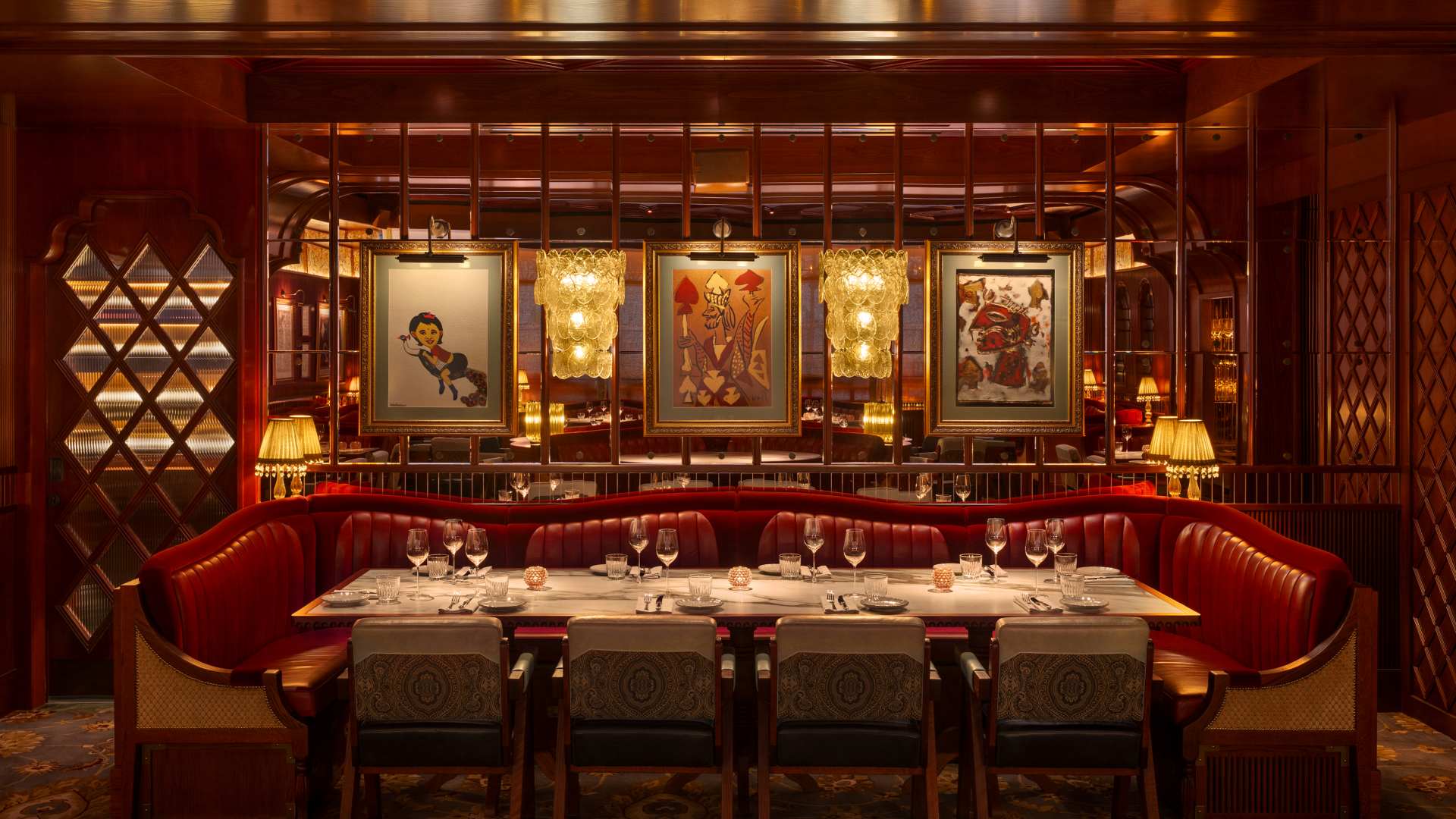
By Samuel Hosker, Founder, North End Design
The design of Gymkhana Dubai began with a question we have been exploring with the team behind the restaurant for several years – how do you continue to evolve a successful and recognisable design identity without simply replicating what has come before?
Our relationship with Gymkhana now spans seven years, beginning with the redesign of the London restaurant in 2019 and continuing as the brand has expanded internationally. With each location, we have looked at how we can retain the character and identity that makes Gymkhana distinctive, while introducing new layers of detail and creating something that feels relevant to its setting. For Dubai, the ambition was to create the most complete expression of Gymkhana to date.
A journey through India
The starting point for the design was the architecture and interiors of Northern Indian residential properties, alongside the richness of Indian fashion and bridal couture. The intricate detailing and opulence of designers such as Sabyasachi, as well as the theatricality of traditional Indian wedding celebrations, informed our approach to pattern, texture, ornament and colour.
Travel has always been an important part of my design process. Visits to Chandigarh and Pondicherry helped shape a broader and more contemporary interpretation of India, moving away from the more familiar visual language associated with the British Raj.
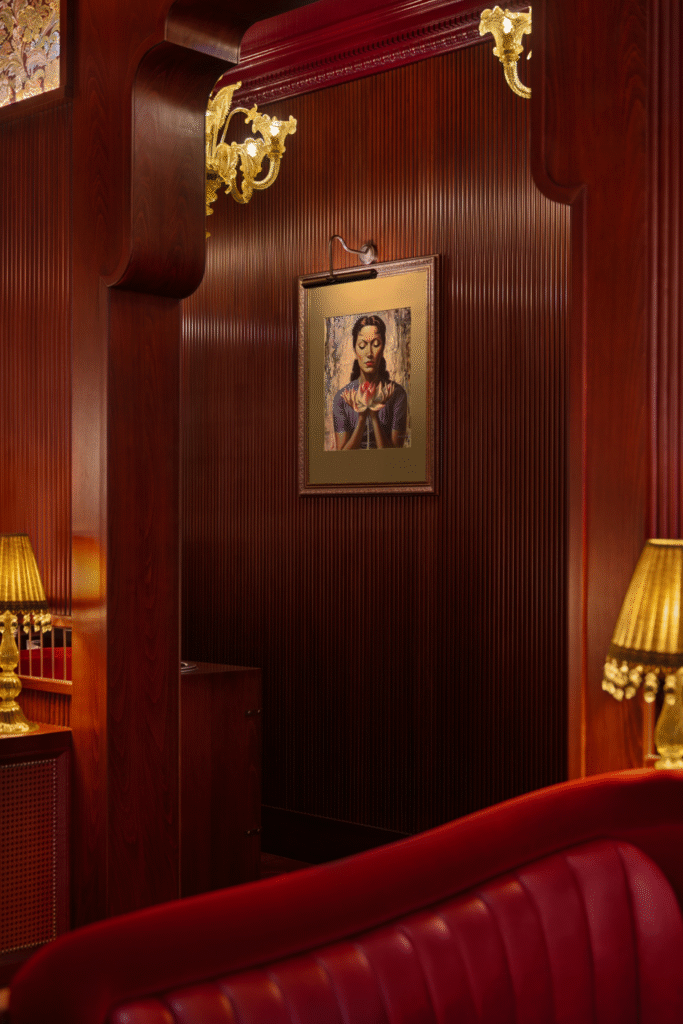
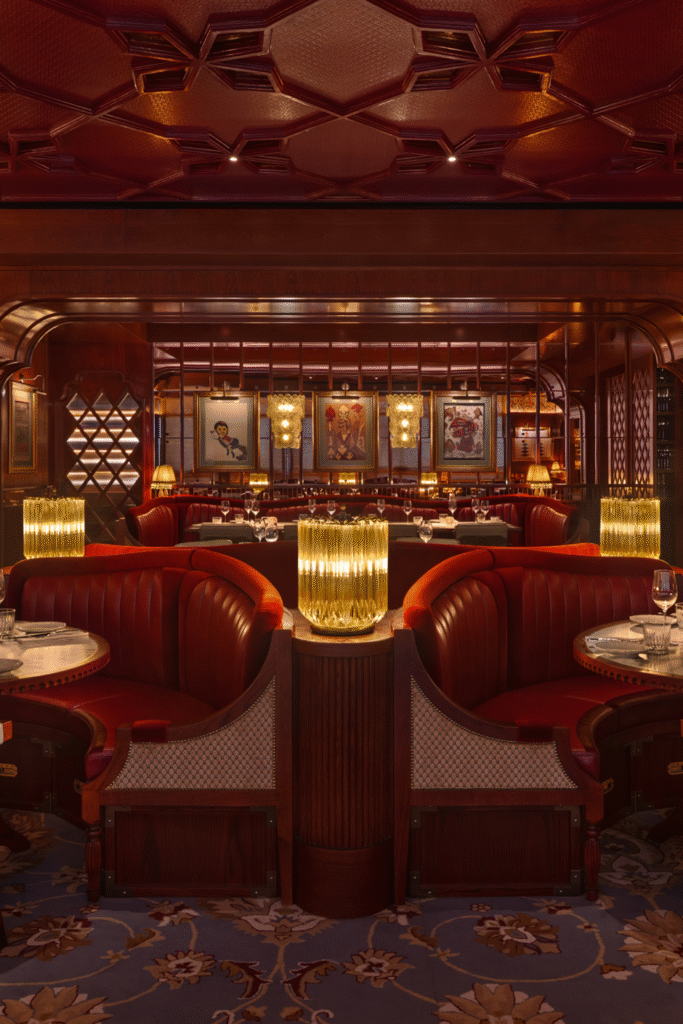
Chandigarh was particularly influential. Its modernist architecture offered a very different perspective on Indian design and informed elements of the furniture and proportions within the restaurant. Elsewhere, references to Rajasthani architecture, the Red Fort in Old Delhi and buildings encountered in Kolkata have been translated into timber arches, decorative rosettes and floral stained-glass detailing.
These Indian influences sit alongside references from Europe. Northern Italian design, particularly the architecture and interiors of Venice, inspired elements including Murano-style lighting and marble detailing, while Antoni Gaudí’s Casa Vicens in Barcelona influenced the expressive pattern, geometry and ornament of the dining room ceiling.
Furniture adds another layer through references to Edwardian campaign furniture manufactured in India, using materials such as cane, rosewood and teak to bring together British-Indian heritage and Indian craftsmanship.
The artwork continues the narrative, combining bespoke oil paintings of native Indian animals and equestrian events with 55 contemporary Indian artworks reinterpreting traditional playing cards – all subtle references to the sporting clubs of India from which Gymkhana takes its name.
Designing a restaurant that works
While the visual experience is important, successful hospitality design has to work operationally.
The Dubai site was previously another restaurant, and its existing layout presented several challenges. We remodelled the space to maximise covers while creating dining rooms that still feel intimate and purposeful, alongside two separate staircases to improve front- and back-of-house circulation.
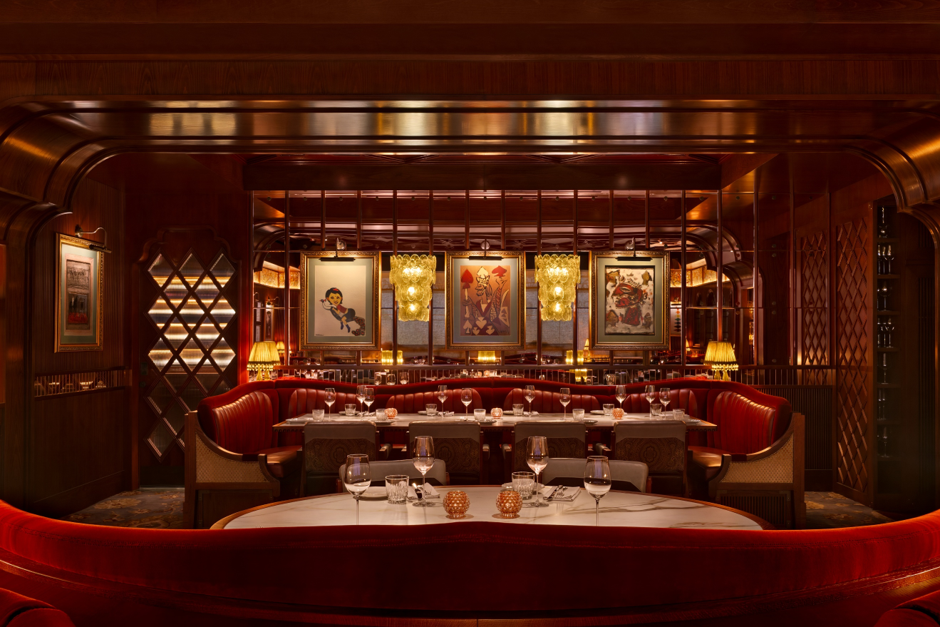
We work closely with Gymkhana’s operations and kitchen teams because seemingly small design decisions can have a significant impact on the guest experience. A dish coming from the tandoor, for example, should reach the guest within a minute of leaving the pass. Understanding that journey influences how we plan circulation, service routes and the relationship between the kitchen and dining spaces.
That operational understanding has developed considerably through our long-term relationship with the client.
Seven years of evolution
For us, one of the most rewarding aspects of Gymkhana has been demonstrating what can happen when the relationship between client and designer continues long after a project opens.
Over the course of seven years, we have been able to challenge, refine and evolve the design together. Crucially, our involvement doesn’t stop at handover. We remain close to the operations team after opening, learning how spaces perform in practice, what works and what can be improved before applying those lessons to future projects.
That continuity has allowed North End Design to operate almost as an in-house design consultancy – an extension of the client team with a deep understanding of the brand, its operations and its ambitions.
For me, that is ultimately what a successful hospitality design relationship should look like. It isn’t simply about delivering a beautiful restaurant and moving on. It’s about understanding a client’s business, growing alongside them and continually finding ways to make the next project better than the last.
Gymkhana Dubai is the culmination of that process so far – but, importantly, it is also another step in an ongoing relationship.


Dubai Longevity Authority Could Accelerate Shift Towards Wellness-Led Homes

TiE Women MENA Crowns Five Regional Winners Ahead of GITEX Global Final

Beyond the camera: Why video surveillance is becoming a business intelligence tool



-
News11 years ago
SENDQUICK (TALARIAX) INTRODUCES SQOOPE – THE BREAKTHROUGH IN MOBILE MESSAGING
-

 Trending11 months ago
OPPO A6 Pro 5G Review: Reliable Daily Driver
-

 Tech News2 years ago
Denodo Bolsters Executive Team by Hiring Christophe Culine as its Chief Revenue Officer
-
 VAR1 year ago
Microsoft Launches New Surface Copilot+ PCs for Business
-

 Automotive2 years ago
AGMC Launches the RIDDARA RD6 High Performance Fully Electric 4×4 Pickup
-
Tech Interviews3 years ago
Navigating the Cybersecurity Landscape in Hybrid Work Environments
-
 Tech News2 years ago
Toshiba Announces MG10-D Series of Enterprise HDDs with Capacities up to 10TB
-

 Tech News1 year ago
Nothing Launches flagship Nothing Phone (3) and Headphone (1) in theme with the Iconic Museum of the Future in Dubai