
 Have a question? +971 56 404 0503




Financial
The StashAway Story and the Future of Digital Investing


By Srijith KN, Senior Editor
Financial Integrator

StashAway’s journey began when Co-founder and CEO Michele Ferrario found himself frustrated and dissatisfied with the investment landscape marked by high fees and a lack of transparency. By age 35, his corporate career had provided him with substantial savings — yet when he approached his banks to invest in a portfolio of ETFs, he was sold expensive products that didn’t fit his needs.
This frustration inspired him to create a platform that would simplify investing while providing access to sophisticated financial products. In July 2016, he, along with the other two co-founders, came together, and by July 2017, after navigating regulatory requirements, StashAway was launched in Singapore.
“Stash,” as the word suggests—meaning to store something safely for future use—perfectly reflected what he wanted to achieve for himself. Over the past nine years, that personal need has grown into a company of more than 200 professionals, operating across five regions through a single, centralized technology platform.
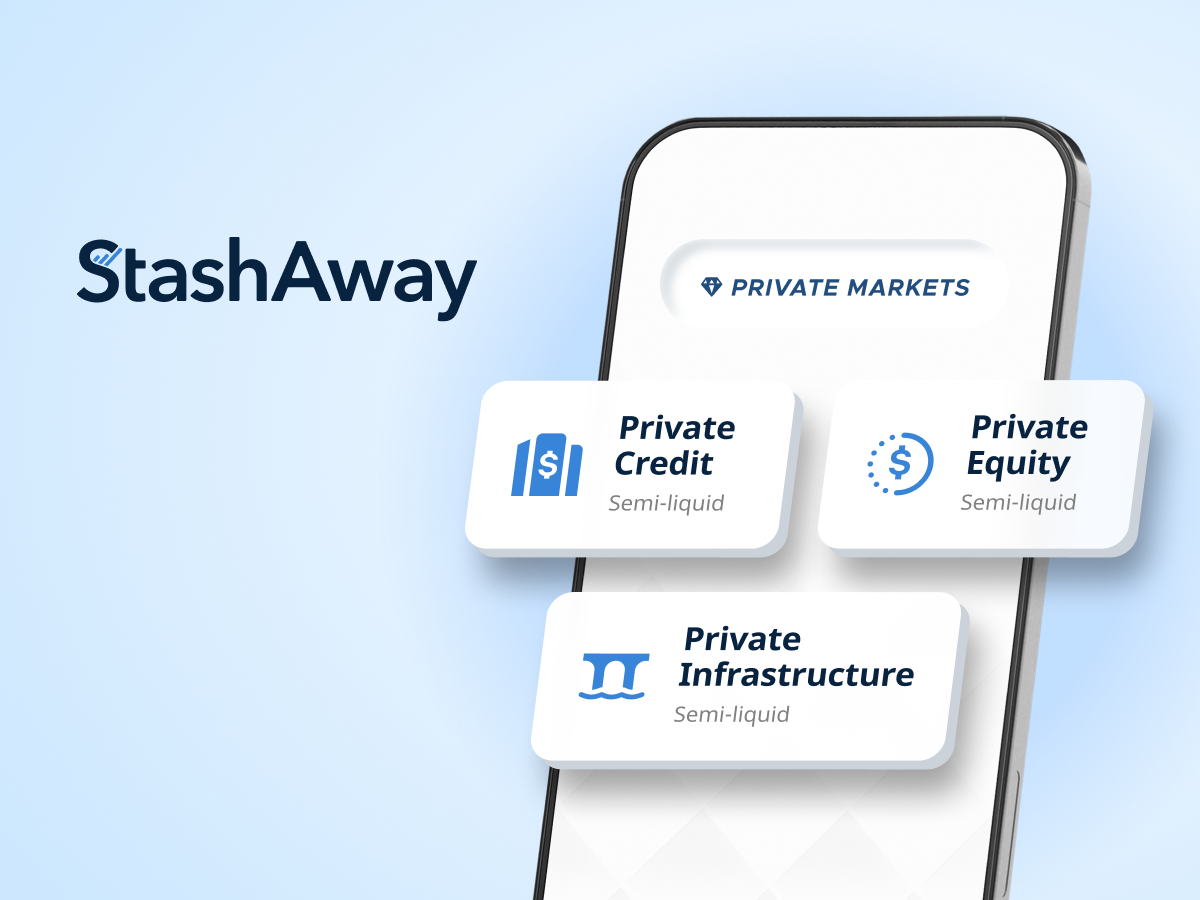
Today, StashAway stands out as a pioneer in digital wealth management. The company leverages technology and deep investment expertise to offer accessible, low-cost alternatives to traditional wealth management, with a particular focus on private markets. Its approach has resonated with clients and positions the firm to benefit from regional economic growth and an increasingly digitally savvy population.
In the UAE, StashAway operates from the DIFC and has extended its presence to Malaysia, Thailand, and Hong Kong, with a chief investment officer based in Hong Kong overseeing investment strategies.
Democratizing Access to Investments
The company’s core strategy revolves around democratizing access to sophisticated investments. Private markets, which historically deliver higher returns at lower volatility, are central to this approach. By making private market products for a fraction of traditional minimums, StashAway removes the barriers that have long prevented high-net-worth individuals from participating in this fast-growing asset class. The platform also emphasizes transparency, with fees typically 50–75% lower than competitors, avoiding the hidden charges common in conventional wealth management products.
In public markets, StashAway offers an ETF-based, globally diversified portfolio called General Investing. The General Investing portfolio uses a proprietary investment strategy called ERAA (Economic Regime Asset Allocation). They have recently launched Sharia Global Portfolios, offering the same approach in a Sharia-compliant format. These Flexible Portfolios allow customers full control to create their own allocations using ETFs—either by using an existing template or building a portfolio entirely from scratch.
Capitalizing on the UAE Market
The UAE market presents a unique opportunity for StashAway. The region is home to a digitally engaged population with significant underinvested wealth. While 81% of financial wealth in the UAE is investable, nearly half remains in cash, losing value to inflation. StashAway’s platform appeals to a diverse range of clients, from seasoned executives to younger retail investors, aligning perfectly with regional growth initiatives like Dubai 2033, which targets strong GDP growth and population expansion.

A Comprehensive, Client-Focused Approach
What sets StashAway apart is its comprehensive, client-focused approach. Its offerings include globally diversified portfolios, flexible build-your-own options, Sharia-compliant solutions, thematic strategies, and access to private equity, infrastructure, and private credit for accredited investors. The platform’s investment philosophy is long-term, balancing risk and reward according to individual goals, while its high service standards ensure responsive client engagement. And thus far I have been having a frictionless digital experience and went through a quick onboarding process. Client acquisition is primarily driven online, with dedicated advisors for high-net-worth clients under StashAway Reserve. Other users can engage through the app and are supported by StashAway’s responsive client experience team through email, phone call, or WhatsApp.
Shaping the Future of Digital Investing
As the UAE continues to attract global wealth, its wealth management landscape is becoming increasingly digital, with affluent investors seeking alternative investment opportunities. In an industry often criticized for opacity and complexity, StashAway is redefining investing by making it more transparent, accessible, and tailored to the modern investor. By combining advanced technology, strategic insight, and personalized solutions, the company is not just managing wealth—it is shaping the future of digital investing in the UAE and across the region.
_________________________________________________________
The Brief:
StashAway is a digital investment platform that was launched in 2017 to empower people to build and protect wealth in the long term. Offering simple, intelligent, and cost-effective investment and cash management solutions, StashAway has led the way in transforming the way people invest and grow wealth. Today, StashAway operates in five markets, Singapore, Malaysia, Hong Kong, the UAE, and Thailand, with billions of dollars in assets under management. The company was recognised by The World Economic Forum as a Technology Pioneer in 2020 and ranked among CNBC’s World’s Top Fintech Companies in 2023, 2024, and 2025.












MOZN, a leading enterprise AI company, today announced that it has been named among notable vendors in Forrester’s Financial Crime Management Solutions Landscape Q1 2026 report. This inclusion marks a significant milestone for MOZN and reinforces its position among global innovators.
The Forrester report, which lists 42 vendors, provides financial institutions with an overview of notable vendors and the key market dynamics shaping the rapidly evolving financial crime management (FCM) market, including fraud and anti-money laundering (AML) solutions.
MOZN was listed in the report with a geographic focus on Europe, the Middle East, and Africa (EMEA) and the Asia-Pacific (APAC) regions, and an industry focus on financial services, government, and insurance. The recognition underscores the company’s sustained investment in AI-driven innovation and its focus on delivering scalable, future-ready financial crime solutions tailored to high-growth and complex regulatory markets.
At the center of this recognition is FOCAL, MOZN’s end-to-end financial crime management platform. Built on a unified FRAML (Fraud + AML) architecture, FOCAL leverages agentic AI to automate data integration, accelerate risk-scoring, and streamline alert triage, enhancing investigator productivity while preserving human judgment. The platform offers flexible deployment options, allowing organizations to modernize their operations in a way that aligns with their technical and regulatory needs.
“MOZN’s inclusion in Forrester’s report reflects the progress we have made in building technology that truly transforms how institutions combat financial crime,” said Dr. Mohammed Alhussein, Founder and CEO of MOZN. “As Saudi Arabia designates 2026 as the Year of Artificial Intelligence, it reinforces the Kingdom’s ambition to lead in shaping the future of AI globally. At MOZN, we are proud to contribute to this vision by engineering AI-native platforms that make financial crime prevention more proactive, precise, and effective. This milestone reflects both the momentum of our mission and the growing global relevance of technology built in the region.”
By combining deep regional expertise with global technology standards, MOZN continues to advance its purpose of empowering organizations with intelligence that matters. The company remains committed to delivering AI-native solutions purpose-built for the world’s most regulated and knowledge-intensive sectors, enabling institutions to operate with greater clarity, confidence, and control. As demand for advanced AI-driven capabilities accelerates worldwide, MOZN is expanding its global footprint, supporting organizations as they navigate an increasingly complex financial crime landscape.


By Roberto d’Ambrosio – CEO at Axiory
Financial markets in 2026 are producing more information than at any point in history. Earnings data, geopolitical alerts, AI-generated analysis, social media commentary, and real-time price feeds reach investors continuously, relentlessly, and from every direction. The conventional assumption is that this abundance is empowering. More data, the argument goes, means better-informed decisions. From my experience across more than three decades in financial services, the reality is considerably more complicated, and for many investors, the opposite is closer to the truth.
Access to information is not the same as the capacity to process it. When data exceeds the ability of the individual to filter, interpret, and act on it with clarity, the result is not better decision-making. It is hesitation, reactive behaviour, and a false sense of confidence that having seen the data is the same as having understood it. Research published by the Board of Governors of the US Federal Reserve has confirmed what practitioners have long observed: information overload is associated with lower trading volumes and measurably higher risk premia, as investors demand greater compensation for holding assets in an environment where they can no longer reliably distinguish signal from noise. The effect is not marginal. It is structural, and it worsens precisely when markets are most volatile and when clear thinking matters most.
This is particularly relevant for the Middle East. The GCC’s retail investment sector has expanded rapidly, with neo brokerages and digital trading platforms now comprising a market valued at approximately $1.2 billion. The UAE’s regulatory framework, spanning the Securities and Commodities Authority, the Dubai Financial Services Authority, and the Financial Services Regulatory Authority, sets meaningful standards for disclosure and investor suitability. Yet the sheer volume of unfiltered data reaching individual investors through apps, alert systems, and AI-driven content is outpacing the governance infrastructure designed to protect them. Earlier this year, UAE-based retail platforms reported a sharp spike in commodity trading volumes following geopolitical alerts linked to regional energy infrastructure. The pattern was instructive: investors were not responding to analysis. They were reacting to the noise itself.
In my opinion, the real competitive advantage in today’s markets has shifted decisively. It is no longer about who has access to data, because everyone does. It is about who has the discipline, the frameworks, and the human capacity to determine what that data means and what it does not. This is fundamentally a risk management challenge, not a technology challenge.
Consider the consequence chain. When platforms deliver thousands of data points, alerts, and AI-generated recommendations without adequate curation, they create an illusion of informed participation. Investors who lack the training or advisory support to contextualise this information face two symmetrical risks: paralysis, where conflicting signals prevent any decision at all, and impulsive reaction, where a single alarming headline triggers an unexamined trade. Both degrade portfolio outcomes. Both increase transaction costs, erode returns through poorly timed decisions, and expose investors to risks they have not consciously chosen to take.
This raises an uncomfortable question for data providers and platform operators. The business model of much of the fintech and financial information industry is built on engagement, meaning more alerts, more content, more interaction. But engagement is not the same as service, and information delivery without responsibility for its quality, context, and potential impact on decision-making is not a neutral act. It carries consequences, and regulators are beginning to recognise this.
The European Union’s AI Act, whose high-risk obligations for financial services take effect in August 2026, will require providers of AI-driven systems used in credit scoring, risk profiling, and investment decision-making to meet strict standards around transparency, human oversight, and auditability. The EU’s proposed Financial Data Access regulation extends similar principles to data sharing across the financial sector. These frameworks signal a clear direction: those who provide financial data and algorithmically generated analysis will increasingly bear responsibility for how that information is presented, contextualised, and governed. For the GCC, where regulators have consistently demonstrated a commitment to adopting and adapting international best practice, the trajectory is evident. Data provision is moving toward becoming a compliance-intensive activity, and firms operating in or serving the region should prepare accordingly.
But regulation alone will not solve the information paradox. Compliance frameworks establish floors, not ceilings. The deeper challenge is cultural and organisational. Investors, whether institutional or individual, need not just data but the capacity to interpret it within a coherent risk framework. Before acting on any data point, alert, or algorithmically generated recommendation, the prudent investor asks three questions: what is the source, what context is missing, and does this information warrant action or merely attention? This discipline is not intuitive in a market designed to reward speed, but it is essential. It means investing in financial literacy, in advisory relationships grounded in trust and expertise, and in governance structures that ensure decisions are informed by judgement rather than driven by impulse.
Ultimately, this is a human capital challenge. Algorithms can process data at scale, but they cannot replace the informed professional who understands context, identifies what is missing from the data, and exercises the judgement to act, or equally important to refrain from acting, when conditions are uncertain. Organisations and platforms that invest in experienced risk professionals, in robust advisory capability, and in the governance to ensure quality over quantity will build durable competitive advantages. Those that continue to prioritise data volume over decision quality will find that the market eventually prices that negligence in.
In a market flooded with information, the scarcest resource is not data. It is the judgement to know what to do with it.

By Mayada Baydas, Ph.D., Vice President – Financial Inclusion, botim
For years, the story of fintech in MENA has been told through product launches: faster payments, cheaper remittances, advanced interfaces, enhanced experiences, micro-savings, and instant credit. But the next unlock for the region may not lie in new features or enhancements at all. It lies in something more foundational and far more powerful: Digital financial literacy (DFL).
Today, access is not the challenge. While over 68% of the world population is online, and the number of fintechs globally is rising, 1.3 billion adults remained unbanked globally in 2024. The picture in MENA is no different. The region hosts more than 1000 fintechs, and internet penetration is over 100%, yet 64% of adults remained unbanked in 2024. In other words, the ecosystem is rich with solutions, but the real gap lies in knowledge and ability.
This is where DFL becomes transformative. It equips users with the understanding and confidence to navigate digital financial tools in ways that genuinely serve their needs, whether that’s sending money home, paying bills, setting small budgets, investing, or avoiding scams. And while this capability may seem subtle, its impact is anything but. DFL is quickly becoming the most efficient route to building trust, increasing usage, and driving long-term adoption in a region where smartphone penetration is nearly universal, yet digital confidence remains uneven.
The GCC Leading Financial Inclusion
Let’s zoom into the GCC, the region leading the charge in MENA. It sits at the heart of one of the world’s largest remittance ecosystems. Migrant and low-income workers send millions of dollars home every year. In 2024, remittances to low-and middle-income countries reached $685 billion, surpassing both foreign direct investment and global aid.
Recognizing this strategic position, regulators and fintechs are working together to turn access into meaningful participation. In the UAE, the Central Bank (CBUAE) collaborates closely with fintechs through initiatives such as the FinTech Regulatory Laboratory and the National Financial Literacy Strategy. These frameworks expand access while guiding fintechs to design safe, inclusive, and user-friendly services. In Saudi Arabia, the Financial Sector Development Program (FSDP) and the Saudi Payments ecosystem combine access with behavioral frameworks that foster trust, responsible usage, and long-term adoption.
Regulators set the standards, provide oversight, and create the frameworks for safe and responsible digital finance. Fintechs take these frameworks and translate them into innovative products and services that meet real user needs. Together, they are shaping an environment where financial inclusion is not just a policy goal but a lived reality.
Digital financial literacy is the bridge between infrastructure and participation. Without it, the region risks building highways that millions do not feel safe enough to drive on.
From Access to Ability: What We Learned at botim
When I joined Botim, our hypothesis was simple: If an app can connect people, it can also build their financial capability. A year later, more than 2 million users on Botim are fully KYC-verified, and many are now using our financial features, from remittances to small lines of credit. But their adoption has never been the result of features alone. It has been the result of trust, clarity, and understanding.
Botim is a simple, familiar tool used daily by millions to stay connected. Its reach, especially among communities often overlooked by traditional financial systems, offered a unique opportunity. By unifying remittances, payments, salary tools, credit, savings, and multi-currency accounts under Botim Money, we created a single ecosystem that lets users manage their finances seamlessly within a platform they already trust.
As the platform transformed, one insight became clear: with its communications foundation, Botim is not just a tool for access but a vehicle to educate and empower users. By raising awareness about digital financial services and embedding knowledge and know-how, we enhance our users’ capability to make financial decisions and take actions, thereby increasing their confidence and resilience along their journey towards financial health.
Digital financial literacy is central to our mission. With our scale and reach, we are integrating technology responsibly to deliver a positive impact along the user financial journey.
DFL must be embedded, not added
People do not build financial capability by reading manuals; they learn by doing, seeing results, and repeating them. Behavioral science, from Fogg (2019) to Kolb (1984), shows that meaningful change comes from action, not theory. This is why digital financial literacy cannot sit outside the experience. It needs to be part of the user journey itself. Short, contextual prompts at the right moment can clarify a first remittance, flag a potential scam, explain fees, or help someone set a simple savings goal. GSMA findings show that these in-journey cues improve digital-task completion by 30 to 40 percent compared to passive instruction, proving that micro-moments matter.
Looking ahead, many platforms are extending this approach across core areas such as secure account practices, understanding fees, responsible borrowing, cross-border transfer basics, and fraud or scam awareness. These prompts work because they appear where decisions are made, helping users avoid mistakes, recognize risk, and understand the steps they are taking.
As digital finance continues to grow across the region, strengthening these practical, real-time touchpoints will be essential to making participation safer and more accessible.


Can Middle East Banks Reclaim Their Digital Leadership in the Age of AI?
Addressing Structural Gaps in Enterprise Backup Strategies

MOZN’s AI-Powered FOCAL Platform Earns Recognition in Forrester Financial Crime Landscape

-
News10 years ago
SENDQUICK (TALARIAX) INTRODUCES SQOOPE – THE BREAKTHROUGH IN MOBILE MESSAGING
-

 Tech News2 years ago
Denodo Bolsters Executive Team by Hiring Christophe Culine as its Chief Revenue Officer
-
 VAR12 months ago
Microsoft Launches New Surface Copilot+ PCs for Business
-

 Trending5 months ago
OPPO A6 Pro 5G Review: Reliable Daily Driver
-

 Tech Interviews2 years ago
Navigating the Cybersecurity Landscape in Hybrid Work Environments
-

 Tech News9 months ago
Nothing Launches flagship Nothing Phone (3) and Headphone (1) in theme with the Iconic Museum of the Future in Dubai
-

 Automotive2 years ago
AGMC Launches the RIDDARA RD6 High Performance Fully Electric 4×4 Pickup
-

 VAR2 years ago
Samsung Galaxy Z Fold6 vs Google Pixel 9 Pro Fold: Clash Of The Folding Phenoms