
 Have a question? +971 56 404 0503




Financial
Riyad Capital Launches Shalalat Abha Project with Exceeding 1 Billion in Collaboration with Mdr Development

Riyad Capital announced the launch of the Shalalat Abha Project, with a value exceeding 1 billion, in collaboration with Mdr Development, on the sidelines of the Aseer Investment Forum held at King Khalid University in Abha, under the patronage of HRH Turki bin Talal Al Saud, Governor of ‘Asir Region. The project marks Riyad Capital’s first real estate development initiative in the Southern region.
The project aims to develop a total area of approximately one million square meters in the city of Abha, including the execution of essential infrastructure works by Mdr Development. These works will ensure the readiness of the land for future development for multi-purpose use, including commercial, tourism, entertainment, and residential purposes. The project is in line with Riyad Capital’s strategy to expand and diversify its real estate portfolio geographically, with a strategic emphasis on high-potential regions such as Aseer—currently undergoing rapid transformation through the ambitious ‘Aseer Development Strategy,’ which aims to enhance urban environments and promote sustainable economic growth.
Commenting on the launch, Dr. Abdullah Alshwer, CEO of Riyad Capital, said:
“The launch of the Shalalat Abha Project marks a new and distinguished milestone in our real estate expansion plans. This step comes at a time when the Aseer region is undergoing strategic transformations, positioning it as one of the Kingdom’s most attractive investment destinations given its promising natural and economic potential. We believe this project will have a tangible social and economic impact on the region, contributing to improved quality of life and providing diverse residential and commercial offerings.”
Eng. Hamad Al-Meshaal, CEO of Mdr Development, stated:
“The Shalalat Abha Project is one of the most distinctive in the region and represents a qualitative addition to Aseer. Mdr Development places great emphasis on this project as one of its key development priorities. We expect the project to significantly enhance tourism and investment and help drive development across the region.”
Strategically positioned to the east of Abha, the project benefits from proximity to Abha International Airport and King Khalid University, while enjoying a central location amid key services and landmarks. Infrastructure development is set to commence in the second quarter of 2025, with the development completion expected to be within the following two years. As Riyad Capital’s inaugural real estate venture in the southern region, this project underscores the company’s dedication to fostering regional growth across the Kingdom and delivering compelling investment opportunities to both local and international stakeholders.











Businesses buying or selling companies in the UAE are finding that the transaction itself, rather than their existing operations, brings them within the global minimum tax. That is the central finding of the latest ‘Deals Decoded’ publication from Dhruva, a Ryan LLC affiliate, on how the rules influence what a business is worth, how a deal is structured and when it should complete.
The global minimum tax, known internationally as Pillar Two, was agreed by more than 140 countries and jurisdictions through the Organisation for Economic Co-operation and Development. It requires the largest international groups to pay at least 15% tax on profits earned in every country where they operate, with any shortfall, known as a top-up tax, becoming payable. The UAE adopted it through Cabinet Decision No. 142 of 2024, effective for financial years beginning on or after 1 January 2025, and collects the shortfall on UAE profits locally rather than ceding it abroad.
The rules apply only to groups with worldwide revenue of at least EUR 750 million, approximately USD 860 million, in two of the previous four years. Many UAE businesses have concluded this places them safely outside. Dhruva identifies four points at which a transaction changes that assessment.
The first is scale. When two groups combine, their revenues are assessed together. A buyer with EUR 500 million of revenue acquiring a business with EUR 300 million enters the regime on completion, though neither neared the threshold alone.
“The threshold test is where most boards are caught out,” said Nimish Goel, Leader, Middle East Dhruva, A Ryan LLC Affiliate. “Two mid-sized businesses, each outside the regime, combine and find themselves inside it from day one. This is routinely delegated to the finance function when it belongs with those setting the price. Established at screening stage, the analysis costs little. Discovered after signing, it is hard to reverse.”
The second is timing. The tax is calculated annually on a country-wide basis and does not divide when ownership transfers, so a business being sold stays within the seller’s figures until legal completion, whenever the buyer assumes commercial risk. Completing on the first day of a financial year removes the problem.
The third is visibility. A group’s UAE companies are assessed together rather than individually, so a target cannot be evaluated in isolation.
“A business has no tax position of its own while it remains inside a seller’s group,” said Bhakti Thakker, Partner, Mergers and Acquisitions and International Tax at Dhruva, A Ryan LLC Affiliate. “The rate is an average across every company the seller holds in that country, so the buyer is pricing something it cannot fully see. Companies in the same country may also be required to settle one another’s liability, which a warranty does not address. The contract needs a defined section on who prepares the calculation, who bears the cost, and how it settles once figures are final.”
The fourth is the acquisition premium. Where a buyer pays more than the accounting value of a business, part of that cost is ordinarily written off over time, reducing taxable profit. The global minimum tax rules largely disregard those write-offs, leaving taxable profit higher than expected.
Two further developments narrow the margin. The allowance groups receive for genuine operations in a country, based on employment costs and physical assets, reduces annually by design, from 9.6% and 7.6% respectively in 2025 to 9.4% and 7.4% in 2026, and 5% each by 2033. A transitional simplification sparing some groups the full calculation ends for financial years beginning on or after 1 January 2027.
Ownership structure is decisive for sovereign wealth funds and private equity investors. Government bodies fall outside the rules, but that status does not extend to the companies they hold, and where investments sit beneath a holding company that is not a government body, the whole group is in scope.
Dhruva recommends four steps ahead of any transaction. Buyers should test the combined revenue threshold when a target is first identified, not during contract negotiation, and model the tax as a cash cost in financial projections, allowing for the reducing allowance. Sellers should prepare tax records for inspection in advance, since a position that cannot be evidenced invites a price reduction. Both should review insurance cover, which frequently excludes a risk already identified during due diligence. “Businesses that address this early are negotiating from a position of information. Those that do not are negotiating on assumption,” concluded Bhakti.

Al Masraf has entered a strategic partnership with Sukoon Insurance PJSC and Sukoon Takaful PJSC, bringing together the Bank’s banking capabilities and Sukoon’s insurance and takaful expertise to offer customers access to a broader range of protection and insurance solutions.
The partnership was formalized during a signing ceremony attended by senior leaders from Al Masraf, Sukoon Insurance and Sukoon Takaful, marking an important milestone in the Bank’s efforts to strengthen its offerings and provide customers with more comprehensive financial solutions through trusted partners.
Under the strategic partnership, Sukoon Insurance and Sukoon Takaful will join hands with Al Masraf, enabling the Bank to offer customers access to a range of insurance and takaful solutions designed to meet the evolving protection needs of individuals and businesses.
The collaboration brings together Al Masraf’s established banking platform and customer relationships with Sukoon’s extensive insurance expertise and distribution capabilities. It reflects a shared commitment to delivering greater choice, convenience and value to customers while supporting their broader financial wellbeing.
Fuad Mohamed, Chief Executive Officer of Al Masraf, said: “Our partnership with Sukoon Insurance and Sukoon Takaful reflects our commitment to building an ecosystem of trusted partners that enables us to offer our customers more complete financial solutions.”
He continued: “Insurance and protection are an important part of long-term financial wellbeing, and through this collaboration, we are bringing together the strengths of leading organizations to provide greater choice and convenience to our customers. We look forward to building a strong and successful partnership with Sukoon as we continue to enhance the overall customer experience at Al Masraf.”
Ahmad Yousuf, Chief Retail Banking Officer of Al Masraf, said: “This partnership is an important step in bringing greater choice and convenience to our customers by making relevant insurance and takaful solutions more accessible through their strategic relationship.”
He added: “Sukoon’s strong market expertise and customer-focused approach make them a valuable partner for Al Masraf, and we look forward to working closely together to deliver solutions that are simple, relevant, and aligned with our customers’ needs.”
With operations spanning all Emirates in the UAE and Oman, Sukoon Insurance is among the UAE’s leading insurance providers. Sukoon serves businesses and individuals through a broad distribution network comprising branches, brokers, agencies, e-commerce platforms and a dedicated call centre.
Sukoon Takaful PJSC is one of the UAE’s leading takaful providers. The company provides general and family takaful solutions designed to meet the protection needs of individuals and businesses, supported by a strong capital base and disciplined approach to risk.
Commenting on the partnership, Hammad Khan, Interim CEO and Chief Financial Officer at Sukoon Insurance, said, “We are pleased to partner with Al Masraf as this collaboration reflects our shared commitment to help customers access protection solutions through convenient and trusted channels. By combining Al Masraf’s strong customer relationships and banking expertise with Sukoon’s insurance capabilities, we aim to deliver greater value, broader choice and an enhanced customer experience for individuals and businesses across the UAE.”
He added, “Alongside Sukoon Insurance’s product offering, our subsidiary Sukoon Takaful will provide Shariah-compliant takaful solutions to Al Masraf customers, enabling us to deliver a comprehensive suite of protection solutions tailored to different customer preferences and needs.”
Ahmed Abushanab, Chief Executive Officer of Sukoon Takaful, said, “Partnering with Al Masraf is an important opportunity to bring accessible Sharia-compliant Takaful solutions to more customers. As Al Masraf marks 50 years of serving its customers, we are pleased to join them during this significant milestone as we build a partnership focused on providing relevant protection solutions that support customers’ financial needs and offer greater peace of mind.”
The signing ceremony brought together senior representatives from both organizations. Representing Sukoon were Hammad Khan, CFO & Interim CEO, Sukoon Insurance; Ahmed Abushanab, CEO, Sukoon Takaful; Aditya Kulkarni, Executive Vice President, Head of Distribution UAE; Ashish Kumar Singh, Head of Bancassurance and Affinity; Dexter Fernandes, Head of Bancassurance Distribution and Partnership; and Mostafa Adel, Head of Bancassurance Distribution and Partnership.
Representing Al Masraf was Fuad Mohamed, Chief Executive Officer; Ahmad Yousuf, Chief Retail Banking Officer, Shaimaa Higazy, Products Unit Head; and Rojeh Ghassan, AVP Products unit. The strategic partnership reinforces Al Masraf’s focus on expanding its financial services ecosystem and developing partnerships that support customers across their broader financial journeys.
Through the collaboration with Sukoon Insurance and Sukoon Takaful, Al Masraf will continue to explore opportunities to enhance its customer offering and deliver relevant insurance and takaful solutions to its customers.
-END-
About Al Masraf
Founded in 1976, under Federal Decree No. 50, signed by His Highness Sheikh Zayed Bin Sultan Al Nahyan, Al Masraf (Arab Bank for Investment & Foreign Trade) is a trusted UAE financial institution with a distinguished legacy of supporting trade, investment and economic development. Built on long-standing relationships, deep market expertise and a commitment to personalized service, the Bank serves corporations, businesses, individuals and families through tailored financial solutions designed to meet their evolving needs.
Guided by its promise of “Empowering Future Legacies,” Al Masraf is advancing a new phase of growth focused on deepening client relationships, enhancing banking experiences and delivering future-ready financial solutions. As a progressive, connected and trusted financial partner, the Bank combines proven expertise with responsible innovation to create lasting value for clients, support sustainable prosperity and contribute to the UAE’s long-term economic ambitions.
The Bank delivers integrated banking solutions through its Wholesale Banking and Retail Banking franchises, combining sector expertise, relationship-led Corporate and Financial Institutions coverage, transaction banking, financing, capital solutions and risk management capabilities to support clients’ growth ambitions and contribute to the UAE’s economic development.
For more information, visit www.almasraf.ae.
About Sukoon Insurance
Established in 1975, Sukoon Insurance PJSC (“Sukoon”) – a public stock company – is among the leading insurance providers in the UAE. Sukoon provides a range of comprehensive insurance solutions for motor, life, health, and general (property, energy, engineering, aviation, marine, and liability) needs to its 1.6 million insured members. Sukoon’s operations span across Oman and all Emirates in the UAE.
Sukoon is committed to providing outstanding insurance solutions which help create and protect wealth and wellbeing. The Dubai-based company stays true to its vision by serving businesses and individuals with a team of over 700 professionals through an intensive distribution network of branches, brokers, bancassurance partners, agencies, e-commerce platforms, and a dedicated call centre.
In 2025, Sukoon registered gross written premiums (GWP) of AED 7 billion. With a solvency ratio of 275 percent and exemplary ratings from Standard and Poor’s (A rated) and Moody’s (A2 rated), it clearly demonstrates its financial soundness, robustness in risk management processes, effective governance, and ability to serve its clients effectively in the long run.
At its core, the Company is customer-centric, with a keen devotion towards providing exceptional services. Its priority has always been to build long-term relationships with its clients with their delight as its non-negotiable objective.
Put simply, Sukoon wants to continue reinforcing its position as a reference for other insurers in the region for exemplary customer service.

By Arash Jalali | Venture Builder | Revona
Most people hear the word “debt” and think of stress, bankruptcy and sleepless nights. It is the villain of personal-finance books and the scapegoat of every economic crisis. But after years of building ventures and, at Revona, structuring financing for developers and corporates every day, I have come to see debt very differently.
Debt is not merely a burden to be minimised. It is one of the most elegant, powerful and, yes, contradictory ideas humanity has ever invented.
That distinction matters especially now. Higher rates have made the cost of debt more visible, while a wall of maturities is turning yesterday’s cheap money into tomorrow’s refinancing decision. The response should not be to romanticise leverage. It should be to become more exacting about the work debt is asked to do.
Debt Is Older Than Money Itself
Long before coins and banknotes, communities ran on credit: promises recorded on clay tablets and in shared memory. Debt is, at its core, a technology for moving value through time. It lets tomorrow’s income fund today’s ambition. When a developer borrows to build a tower, or a founder raises venture debt to extend runway, they are pulling the future forward. That is not recklessness; it is one mechanism through which economies compound.
But the debt debate often starts in the wrong place. There is no magic ratio at which prudent borrowing becomes recklessness. A debt ratio is a snapshot; the real story is what the money is financing, whether cash flow can carry it and whether the borrower has time to adapt when conditions change. That is why the quality of the investment, the maturity profile and the resilience of the balance sheet matter more than the headline number alone.
In the architecture of the modern economy, debt does something even more subtle. It reduces the cost of financial oversight, helps create money through the banking system and smooths the path of economic growth. Every mortgage, every credit facility and every bond issue is a small act of coordinated trust between strangers. Trust, priced and packaged, is what capital markets actually trade.
The Debt That Never Dies
The numbers tell a more precise story than the usual rhetoric. Global debt reached a record nearly $353 trillion by the end of March 2026, according to the Institute of International Finance. That figure covers public, corporate and household debt. At the same time, the global debt-to-GDP ratio stood at about 305%, broadly stable since 2023. A record stock of debt, in other words, does not by itself tell us whether borrowers can carry it; the relationship between liabilities, income, assets and refinancing capacity does.
Nor should a stable global aggregate be mistaken for an all-clear. The IIF reported that debt in mature markets edged lower in the first quarter, while debt in emerging markets excluding China rose to a record $36.8 trillion. Debt is never one homogeneous thing. Its burden depends on who owes it, in what currency, at what rate, for how long, and against which cash flows.
The immediate market test is refinancing. The OECD expects governments and companies to borrow $29 trillion from bond markets in 2026 — 17% more than in 2024 and roughly double the amount ten years ago. Much of that activity is not fresh expansion; it is the constant work of renewing obligations. The OECD estimates that 78% of OECD government borrowing in 2026 will refinance existing debt. That is why the calendar can matter as much as the headline debt total.
The U.S. Lesson: Borrowing Can Stabilise Growth
The United States makes the point in unusually stark terms. The Office of Management and Budget’s fiscal-year-end measure of federal debt held by the public — the debt outside federal government accounts — rose from 25.2% of GDP in FY1981 to 99.5% in FY2025.
That is a profound change, but it was not a straight line and it cannot be explained by one White House. The ratio fell from 46.8% in FY1992 to 33.7% in FY2000, then rose through the financial crisis and jumped during the pandemic. The chart shows presidential terms as chronology, not as a scorecard: a fiscal year spans two calendar years, and debt reflects Congress, inherited commitments, recessions, interest costs and emergencies as well as executive choices.
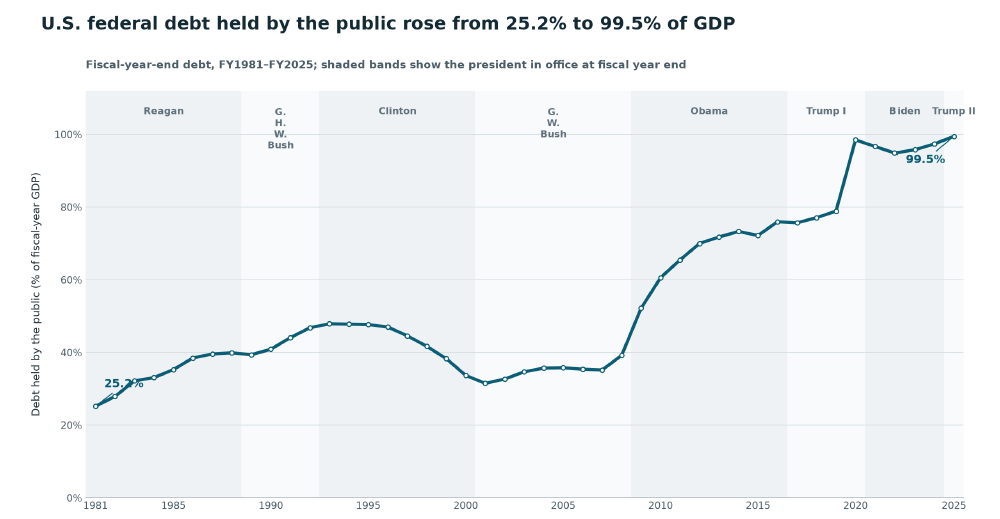
Figure 1. U.S. federal debt held by the public as a share of fiscal-year GDP. Source: Office of Management and Budget, Historical Tables, Table 7.1 (FY2027 release). Debt is measured at fiscal-year end. Administration bands identify the president in office on that date; they do not attribute causation.
The more useful lesson is not that a larger debt stock automatically produces prosperity. It is that, when private demand collapses, borrowing can prevent a deeper contraction. The Congressional Budget Office estimated that the major pandemic laws enacted in 2020 increased real GDP by 4.7% in 2020 and 3.1% in 2021, relative to an implied no-legislation baseline.
That is a concrete example of debt financing acting as a bridge: preserving household income, business liquidity and state and local services at a moment when the alternative was a sharper fall in economic activity.
But bridges must lead somewhere. CBO also projected that the additional debt would raise borrowing costs and reduce output and national income over the longer term. The point is not to celebrate the size of the U.S. debt pile. It is to recognise that borrowing can be a positive driver of growth when it is targeted at a productive investment or a defined emergency — and that its value erodes when cash flows, repayment capacity and the economic return are treated as afterthoughts.
The Beautiful Contradiction
Debt is a paradox, and that is precisely what makes it beautiful. It is simultaneously:
| Debt as… | For whom |
|---|---|
| An asset | The lender, bondholder or pension fund earning a contractual return. |
| A liability | The borrower who must service and ultimately repay it. |
| An engine of growth | The developer, founder or economy that applies it to a productive opportunity. |
| A source of crisis | Anyone who mistakes leverage for a substitute for fundamentals. |
The same instrument that funds a hospital can sink a household. The same leverage that lets a developer sell units before completion can, if mispriced, freeze an entire market. Debt does not care about intentions; it amplifies what is already there. Good projects can become great. Weak projects can fail faster. That amplification is the whole point.
The Revona Angle: Debt as Craft, Not Gamble
This is exactly where Revona operates, and why I find this space so compelling as a builder. If debt is a powerful but indifferent amplifier, the real value lies not in whether a client borrows, but in how the debt is engineered: the rate, the loan-to-value, the tenor, the covenants and the match between an asset’s cash flows and the facility that finances it.
Those are not cosmetic details. A lower headline rate can be a poor bargain if it comes with a refinancing date that arrives before the asset can reliably generate cash. A high loan-to-value ratio may look efficient until a change in valuations removes the borrower’s room for error. A fixed rate can buy time, but it does not eliminate the economics of refinancing.
That final distinction is becoming more important. The Federal Reserve reported in 2025 that long-term, fixed-rate liabilities had softened the initial pass-through of higher rates for large public companies. Yet about 15% of investment-grade bonds and 27% of high-yield bonds were due to mature within one to three years. The protection was real; it was also time-limited.
The OECD has similarly warned that, as higher long-term rates lead borrowers to issue at shorter maturities, near-term interest costs may fall while near-term refinancing risk rises.
At Revona, we treat financing as a craft. We map a client’s full balance sheet, identify untapped equity and structural inefficiencies, and match their profile against the lending criteria of more than sixty banks and institutions to find the optimal structure, not simply the fastest “yes.”
For developers, well-structured off-plan financing can mean buyers are pre-approved during construction, sales accelerate and project cash flow improves. Debt, structured properly, stops being merely a cost of doing business and becomes a competitive advantage.
The failures we associate with debt — the crashes, defaults and horror stories — are more often failures of structure and underwriting than evidence that debt is inherently flawed. They arise when there is too much leverage against too little cash flow; when short-term money funds long-term assets; when currency, revenue and debt-service obligations do not match; or when no one has stress-tested the downside.
The instrument gets blamed for the craftsmanship.
The Takeaway
Debt is usually framed as financial pressure and bankruptcy risk, but its role in the modern economy runs far deeper. It is a centuries-old technology for turning trust into growth, a nearly $353 trillion river of contractual claims, and a mirror that reflects the discipline — or indiscipline — of whoever wields it.
The world’s most sophisticated companies and governments do not avoid debt. They engineer it. As builders and investors, that should be our posture too: respect the contradiction, master the structure and let leverage do what it was invented to do — move the future forward.
AJ is a venture builder. Revona is a financing partner and portfolio manager providing institutional-grade credit and debt financing solutions for developers and corporates.


Global minimum tax is reshaping how companies are bought and sold in the UAE: Report

CABSAT and SATExpo 2026 head to new Expo City Dubai home with expanded focus on content, Mediatech & Pro AV and the commercial space economy
BATTERSEA POWER STATION WRITES NEXT CHAPTER OF 42-ACRE REGENERATION



-
News11 years ago
SENDQUICK (TALARIAX) INTRODUCES SQOOPE – THE BREAKTHROUGH IN MOBILE MESSAGING
-

 Trending11 months ago
OPPO A6 Pro 5G Review: Reliable Daily Driver
-

 Tech News2 years ago
Denodo Bolsters Executive Team by Hiring Christophe Culine as its Chief Revenue Officer
-
 VAR1 year ago
Microsoft Launches New Surface Copilot+ PCs for Business
-

 Automotive2 years ago
AGMC Launches the RIDDARA RD6 High Performance Fully Electric 4×4 Pickup
-
Tech Interviews3 years ago
Navigating the Cybersecurity Landscape in Hybrid Work Environments
-
 Tech News2 years ago
Toshiba Announces MG10-D Series of Enterprise HDDs with Capacities up to 10TB
-

 Tech News1 year ago
Nothing Launches flagship Nothing Phone (3) and Headphone (1) in theme with the Iconic Museum of the Future in Dubai