
 Have a question? +971 56 404 0503




Tech News
PNY announces arrival of the first NVIDIA DGX Spark unit in the Middle East at GITEX

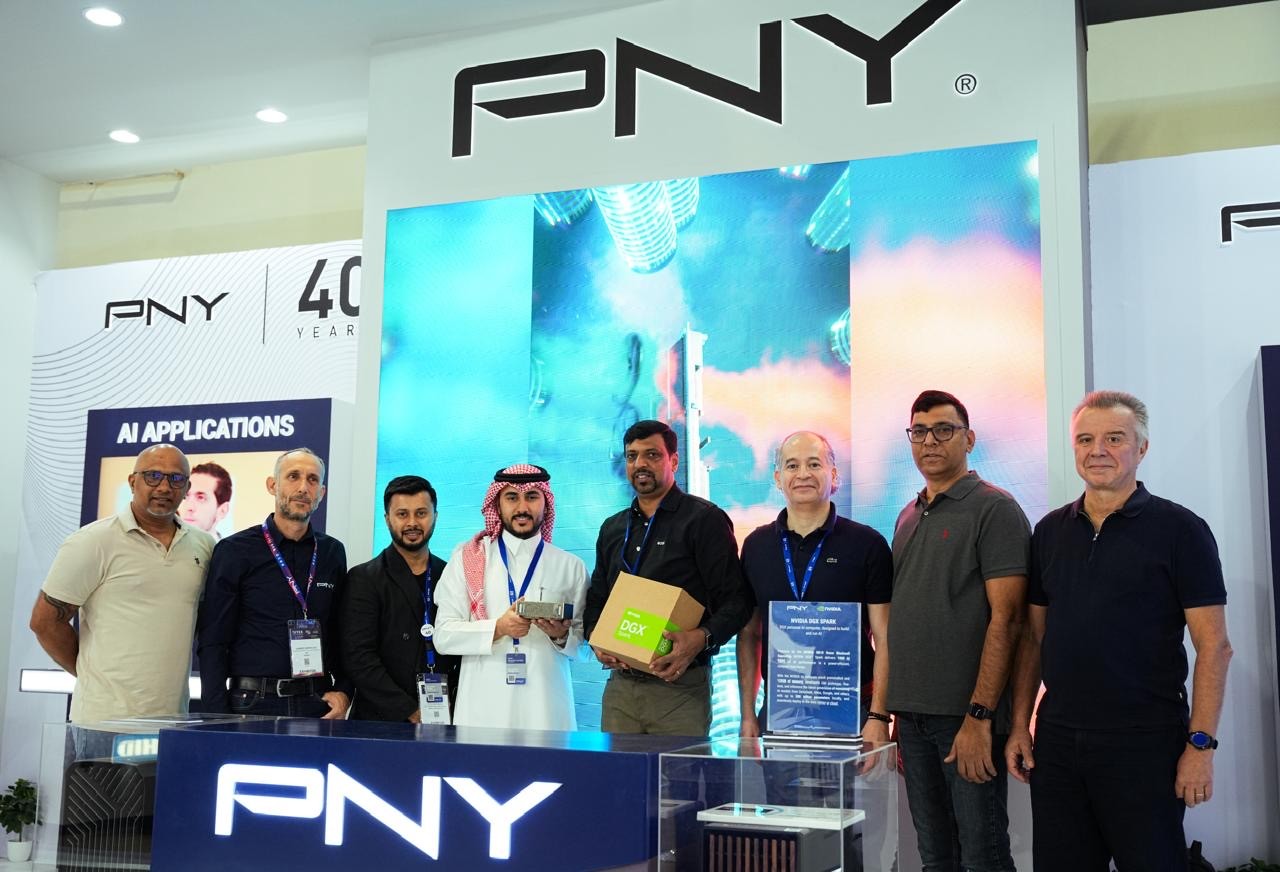
PNY Technologies is proud to announce that the first NVIDIA DGX Spark unit for the Middle East has been officially delivered at GITEX Global, marking a major milestone in the region’s AI innovation journey.
Engineered from the ground up for AI innovation, the NVIDIA DGX Spark, powered by NVIDIA AI and delivered by PNY, is a personal AI supercomputer purpose-built to accelerate the development and deployment of generative AI.
At its core lies the groundbreaking NVIDIA GB10 Superchip, paired with 128GB of unified system memory, enabling support for models with up to 200 billion parameters—or 405 billion when two systems are interconnected via NVIDIA ConnectX networking.
Built on the Grace Blackwell architecture and running NVIDIA DGX OS, the DGX Spark empowers researchers, developers, students, and data scientists to push the boundaries of what’s possible in AI — from concept to deployment.
PNY is pleased to announce that the NVIDIA DGX Spark is now available through its trusted regional partners: Infiniarc, Mbuzz and Redington.
“The arrival of the first DGX Spark unit in the Middle East underlines our commitment to empowering regional innovation with NVIDIA’s most advanced AI solutions,” said Jérôme Bélan, CEO at PNY EMEA, PNY. “With our strong local partner network, we are enabling customers to accelerate their journey into generative AI.”








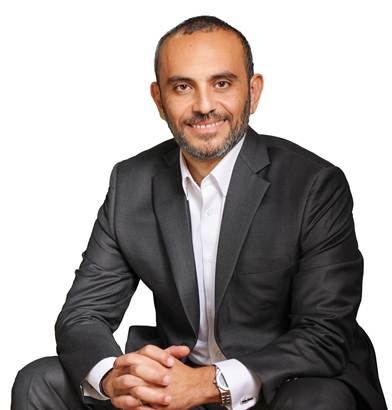
Liferay, a leading provider of Digital Experience Platforms (DXPs), today announced the general availability of Liferay CMS, a fully headless content management system (CMS) designed to help marketing, development, and IT teams create, manage, and deliver digital content across multiple channels from a centralized repository.
Built on the core architecture of Liferay DXP, Liferay CMS combines the agility of a decoupled system with the stability and governance required by enterprise organizations. Whether powering a native mobile app, a customer portal, or a complex web ecosystem, Liferay CMS ensures content remains consistent, reusable, and easily distributable.
“Today’s organizations need agility without losing control of their content operations,” said Julia Molano, Director of Product Management at Liferay. “Liferay CMS builds on Liferay’s decades of DXP leadership to deliver a fully headless offering. It allows developers to work with stable, well-documented APIs while empowering marketers and content creators to manage global content without heavy reliance on IT.”
Liferay CMS introduces Spaces, the platform’s primary organizational units for headless content management, enabling teams to structure asset repositories, manage access, and collaborate more efficiently across departments or projects. Each Space provides a dedicated environment for content creation and management, including support for advanced localization with AI-powered translation tools, making it easier for global organizations to manage multi-language content.
“Across the Middle East, enterprises are moving away from fragmented content systems to unified, centralized architectures that can support scale and speed simultaneously. Headless CMS is becoming a critical enabler in this shift, allowing enterprises to deliver consistent digital experiences across channels while maintaining control and governance. With Liferay’s intuitive CMS, teams can manage content centrally, reduce operational complexity, and accelerate time-to-market and deeper customer engagement’’, noted Moussalam Dalati, General Manager of Liferay Middle East, Africa, and France.
Key features of Liferay CMS include:
- Global Content Visibility: A single view to search, review, and reuse content across regions and brands, eliminating disconnected repositories.
- Headless Architecture: Combines the flexibility of headless deployments with the governance and control of a centralized system.
- Embedded Analytics: Performance metrics like views and downloads are displayed directly within Liferay CMS, allowing teams to validate asset performance at the point of work.
- AI-Assisted Workflows: Accelerates translation, localization, and content review.
- Multi-Site Management: Ideal for franchises or organizations with multiple digital properties, allowing for centralized control while granting team-specific access.
- Unified Collaboration: Dedicated ‘Shared with Me’ areas and advanced access controls ensure all stakeholders work from a single source of truth.
The launch of Liferay CMS reflects a modular platform approach designed for organizations that prioritize an API-first strategy. Because it is built on the same core architecture as Liferay DXP, organizations can start with a streamlined headless CMS today and seamlessly activate integrated capabilities like advanced commerce, page building, or AI-driven personalization as their digital requirements expand.
Tech News
CLOUDERA ADVANCES HYBRID DATA PLATFORM WITH LONG-TERM STABILITY, ELASTIC SCALE, AND OPEN DATA INTEROPERABILITY

Cloudera, the only company bringing AI to data anywhere, today announced significant advancements to its hybrid data and AI platform. These updates help enterprises modernize seamlessly, lower infrastructure costs, and accelerate analytics and AI across their entire data estate.
Enterprises face mounting pressure to modernize data platforms while managing cost and risk, creating significant operational strain. As AI investment accelerates, PwC projects that AI could add as much as $320 billion to the Middle East economy by 2030, with the UAE expected to experience the most significant relative uplift, contributing close to 14% of its GDP. Frequent upgrade cycles, rising infrastructure costs, and growing complexity hinder innovation and divert resources from high-value analytics and AI.
Cloudera addresses these challenges by providing long-term stability and a predictable foundation for enterprise data environments. With extended support until 2032 and a unified platform experience across cloud and data centers, organizations can reduce operational overhead and focus on advancing AI initiatives.
These advancements reinforce Cloudera’s position as the only platform to offer long-term stability, elastic scale across cloud and data centers, and open interoperability in a single architecture, without requiring data movement or disruptive migrations.
Key features include:
- Guaranteed operational stability: Offers a stable, secure foundation for enterprise data environments, allowing organizations to standardize mission-critical infrastructure, reduce risk, and eliminate costly upgrade cycles while aligning platform strategy with long-term investments.
- Modernize seamlessly: Provides simultaneous updates to on-premises and cloud deployments, ensuring consistency across the entire hybrid data estate. This enables organizations to boost performance and meet changing regulatory requirements without the expense of re-platforming.
The update introduces new capabilities to enhance performance, flexibility, and data collaboration across modern data architectures. Automated optimization of Apache Iceberg tables, powered by Cloudera Lakehouse Optimizer, accelerates query performance and reduces storage overhead with minimal manual effort. Organizations can also scale compute on demand with Cloudera Cloud Bursting, using cloud resources for peak workloads without moving data, improving utilization while maintaining security and governance. Expanded data sharing enables secure access to live Iceberg tables across external platforms without copying or duplicating data, reducing silos and preserving data integrity.
“Our customers no longer accept trade-offs,” said Leo Brunnick, Chief Product Officer at Cloudera. “They want the flexibility of the cloud, the control of the data center, and the ability to scale without disruption. This update delivers all three on a single, unified platform built for modern data and AI.”
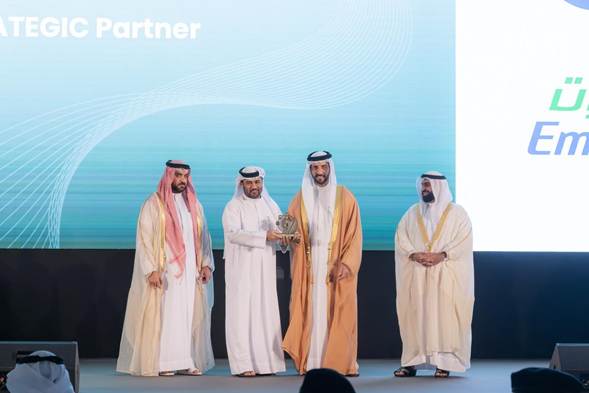
Emirates Petroleum Company PJSC (Emarat), a pioneer in the UAE’s oil and gas industry, is participating as Official Partner of HSE-Expo 2026, taking place on 1 and 2 April 2026 at Al Jawaher Reception and Convention Centre in Sharjah.
Organised by Sharjah National Oil Corporation and held under the patronage of His Highness Sheikh Sultan bin Ahmad Al Qasimi, Deputy Ruler of Sharjah, Chairman of the Petroleum Department and President of Sharjah National Oil Corporation, the event brings together industry leaders, specialists, researchers, and stakeholders to advance dialogue around health, safety and environmental priorities across the region.
Emarat’s participation reflects the company’s continued focus on strengthening workplace safety, supporting responsible environmental practices, and aligning its operations with recognised regional and international standards. It also reinforces the company’s view that health, safety, and environmental performance is integral to operational excellence, long term resilience and responsible growth across the energy value chain.
Burhan Al Hashemi, Chief Executive Officer of Emarat, said: “At Emarat, health, safety and environment is a leadership priority embedded across every level of the organization. It shapes how we operate, how we invest and how we build a culture of accountability and care. Across our fuel, aviation fuel, lubricants, LPG, and natural gas businesses, HSE is fundamental to operational discipline, business continuity and the trust our customers and partners place in us. Our participation in HSE Expo 2026 reflects our commitment to raising standards, supporting responsible industry practices, and contributing to a safer and more sustainable operating environment.”
Emarat applies health, safety, and environmental discipline across its operations as part of its broader commitment to operational excellence and responsible growth. From frontline safety practices and process discipline to environmental stewardship and continuous improvement, the company views HSE as a business imperative that supports resilience, strengthens trust, and underpins performance across its fuel, aviation fuel, lubricants, LPG and natural gas businesses.
Furthermore, HSE standards are central to every product category Emarat operates in, including LPG. As a provider of composite LPG cylinders, Emarat adheres to global HSE industry standards in this product category among all others, underscoring the company’s commitment to safety and environmental responsibility across all aspects of its business.
Ali AlAstad Alhammadi, Vice President, Health, Safety, Environment and Quality, Emarat, said: “HSE Expo provides an important platform for industry stakeholders to exchange practical insight, share best practice and strengthen collaboration around issues that are central to workforce safety and environmental stewardship. For Emarat, this is an opportunity to engage with the wider HSE community and support continued progress in standards, awareness, and performance across the sector. We are grateful to SNOC for organizing this important platform and we look forward to continued collaboration and future participation”
HSE Expo 2026 serves as an important regional platform for advancing dialogue on workplace safety, environmental responsibility, and industry best practice. By bringing together energy leaders, technical specialists, researchers and stakeholders, the event supports knowledge exchange around the standards and innovations shaping safer and more sustainable operations across the region.

SAVOUR MEDITERRANEAN FLAVOURS AT TIMO GOURMED SATURDAY BRUNCH
SUNDAYS DONE RIGHT WITH A BAVARIAN BRUNCH AT BRUNO’S BIERGARTEN

Nothing Phone (4a) Pro Review: Mid-Range Pricing, Flagship Ambitions

-
News10 years ago
SENDQUICK (TALARIAX) INTRODUCES SQOOPE – THE BREAKTHROUGH IN MOBILE MESSAGING
-

 Tech News2 years ago
Denodo Bolsters Executive Team by Hiring Christophe Culine as its Chief Revenue Officer
-
 VAR12 months ago
Microsoft Launches New Surface Copilot+ PCs for Business
-

 Trending5 months ago
OPPO A6 Pro 5G Review: Reliable Daily Driver
-

 Tech Interviews2 years ago
Navigating the Cybersecurity Landscape in Hybrid Work Environments
-

 Tech News9 months ago
Nothing Launches flagship Nothing Phone (3) and Headphone (1) in theme with the Iconic Museum of the Future in Dubai
-

 Automotive2 years ago
AGMC Launches the RIDDARA RD6 High Performance Fully Electric 4×4 Pickup
-

 VAR2 years ago
Samsung Galaxy Z Fold6 vs Google Pixel 9 Pro Fold: Clash Of The Folding Phenoms