
 Have a question? +971 56 404 0503




Automotive
2025 GEELY OKAVANGO FIRST-DRIVE REVIEW: THREE ROWS OF COMFORT

Amalsha VS
The Seven-Seater Specialist.
QUICK TAKE
A genuinely practical seven-seater SUV that prioritizes space and functionality over styling, making it a compelling choice for larger families.
Shiny Bits
- Genuinely impressive third-row space
- Comprehensive feature set.
- Smooth dual-clutch transmission
- Competitive pricing for a proper seven-seater.
Rough edges
- Somewhat generic exterior styling.
- Interior materials feel budget-conscious
- Apple CarPlay is wired only
- No Android Auto at all.
Founded in 1997 as a subsidiary of Zhejiang Geely Holding Group, Geely Auto has evolved from a small Chinese startup into a global automotive powerhouse that now owns Volvo, Lotus, and Polestar. Introduced to the UAE market through AGMC as the official distributor, Geely brings decades of automotive expertise and international partnerships to create vehicles that blend practical design with modern technology. The Okavango represents their vision of what a family-focused SUV should deliver in today’s market.
CONFIDENT DESIGN & PRACTICAL PROPORTIONS
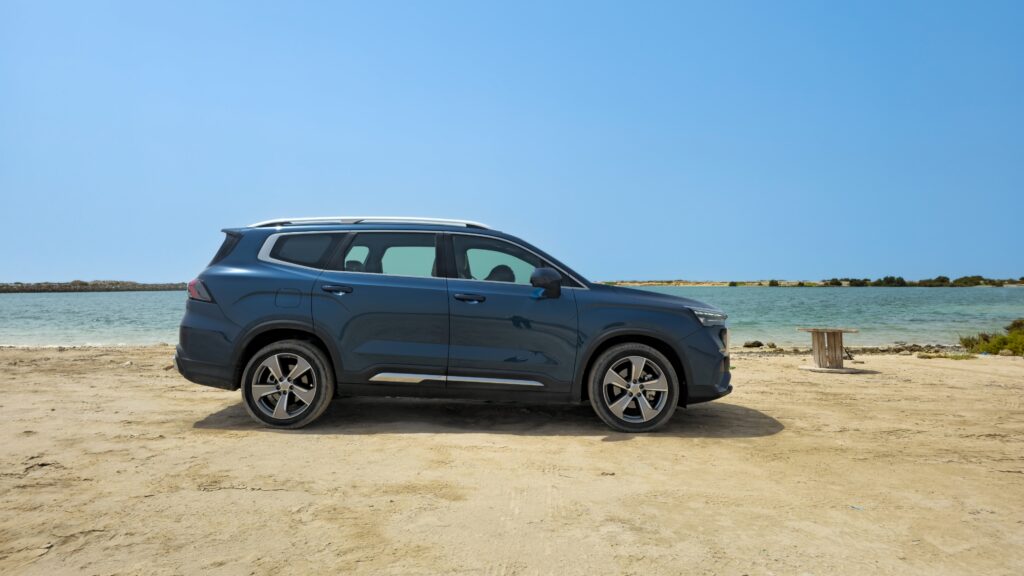
The Okavango is a vehicle designed from the ground up to maximize interior space rather than make a style statement.
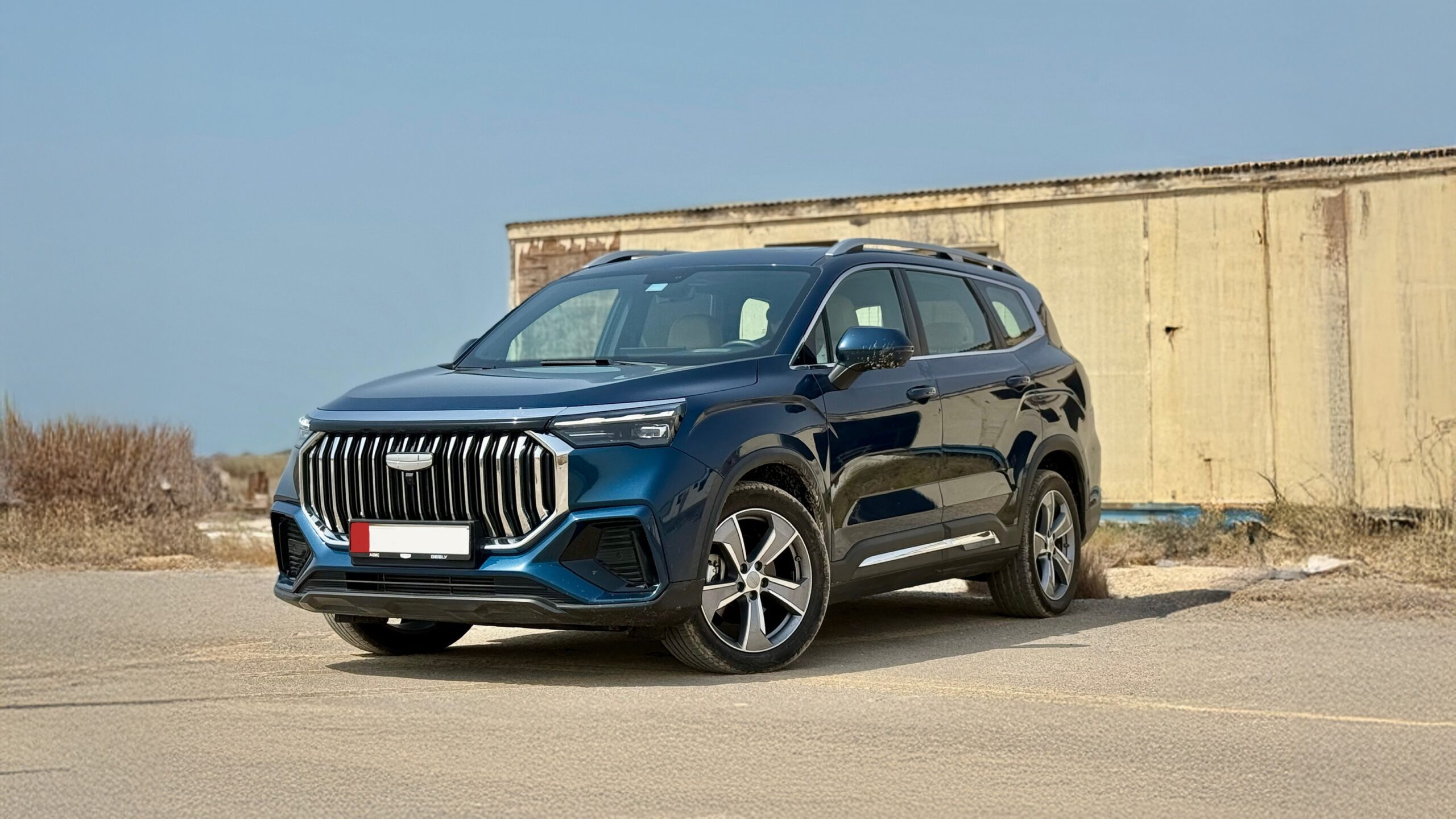
The Okavango presents a thoughtful approach to SUV design that prioritizes function over fashion. Its bold front grille creates a commanding road presence, while the clean lines and well-proportioned silhouette give it a confident stance without appearing dull. The LED lighting signatures add a contemporary touch that keeps the design current, though the overall aesthetic plays it safe within established SUV conventions.
What immediately strikes you about the Okavango is its substantial size – this is a vehicle designed from the ground up to maximize interior space rather than make a style statement. The result is a design that may not win beauty contests but clearly communicates its practical intentions to potential buyers seeking maximum utility.
CAPABLE POWERTRAIN & PUNCHY PERFORMANCE
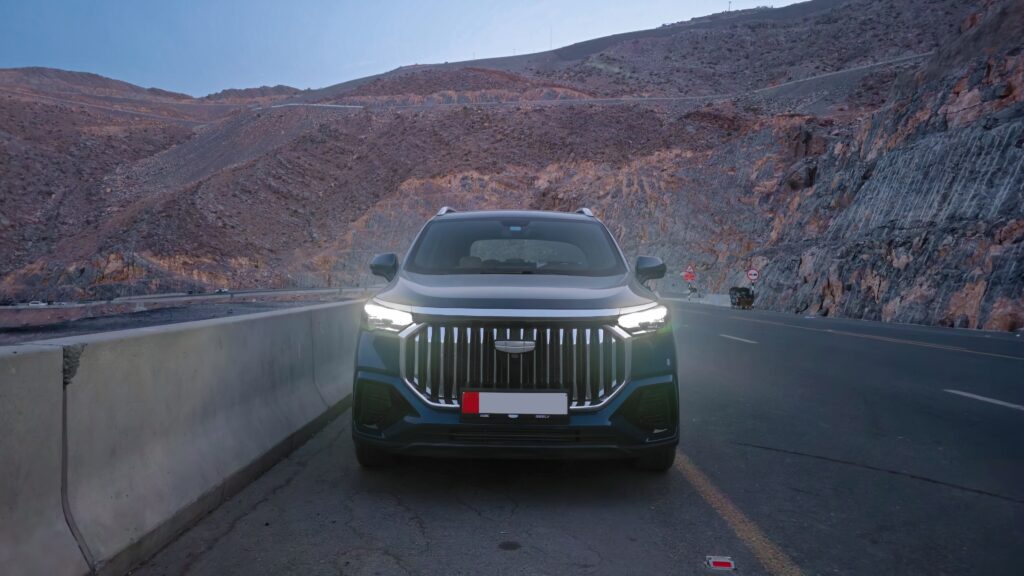
Slight body roll is inevitable in corners, but the Okavango is appreciably stable and manages to keep the passengers comfortable around curves.
Under the Okavango’s hood resides a 2.0-litre turbocharged four-cylinder motor pushing out 218 horsepower and 325 NM, paired with a 7-speed dual-clutch transmission. Acceleration is more than adequate: taking around 8 seconds to achieve a speed of 100 km/h, quick enough for confident overtakes on the UAE highways.
In Comfort mode, power delivery is smooth, while Sport mode noticeably sharpens engine response. Steering is tuned for lightness, good in city driving, but at higher speeds it could use a little more weight. Slight body roll is inevitable in corners, in a tall, three-row SUV, but the Okavango is appreciably stable and manages to keep the passengers comfortable around curves. Ride comfort is the focus: the suspension soaks up speed bumps and road imperfections with composure.
CONCEIVED AS A COMFY PEOPLE HAULER
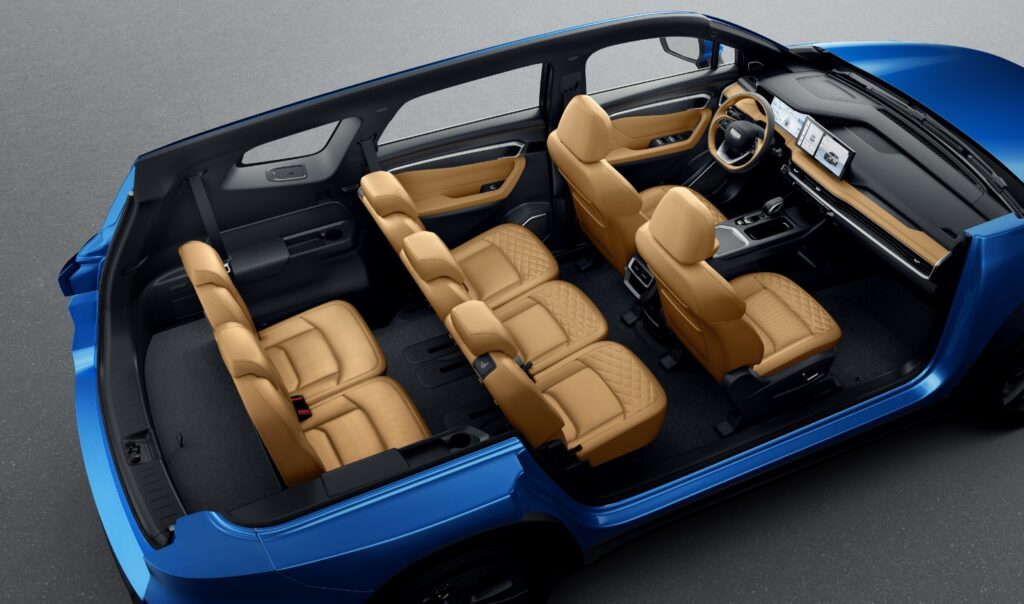
The second row featuring a triple captain’s chairs layout delivers superior comfort and easier access to the third row.
Interior materials strike a balance between cost-consciousness and perceived quality, with the 12.3-inch infotainment screen providing clear graphics and intuitive operation. However, Android Auto isn’t offered, which we consider an essential feature for a modern car of this time. Apple CarPlay is included but only a wired connection is supported.
The overall cabin design ranks functionality above luxury, which suits the vehicle’s practical mission perfectly. This is where the Okavango distinguishes itself. Its flexible seating configuration allows you to accommodate passengers or cargo as needed, with the second row featuring a triple captain’s chairs layout providing superior comfort and easier access to the third row. The second row sliding & reclining gives flexibility to balance passenger comfort between the second and third rows.
The highlight factor of the Okavango is that its third-row is genuinely usable. Unlike many other mid-size crossovers, the Okavango doesn’t simply provide a third-row for namesake which is too cramped for grown-ups. Two adults can be seated there with a reasonable amount of legroom and headroom for shorter journeys. The seats fold and recline; and although ingress/egress is still a bit less convenient than second row, is not too much of a hassle.
Air conditioning is adjustable in the rear rows well, which matters under UAE heat and strong sun. Even with all seven seats occupied, passengers wouldn’t feel cramped or compromised inside the Okavango; a rare achievement in this segment.
FINAL FIRST IMPRESSIONS
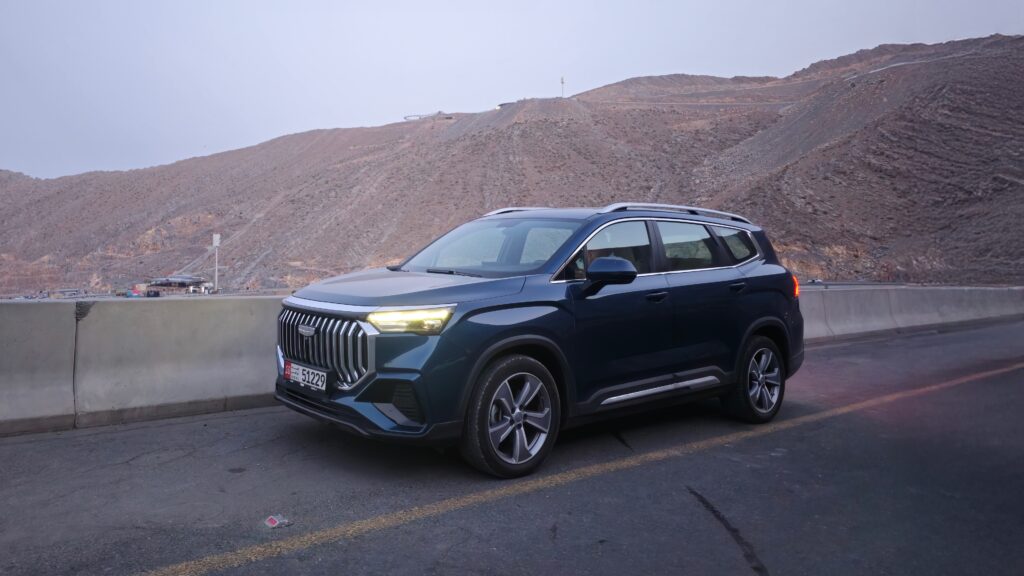
For families expecting space, functionality, and value for money, the Okavango is a desirable offering that’s difficult to ignore.
The Geely Okavango succeeds brilliantly in its primary mission – delivering genuine seven-seater capability at a competitive price point. It’s a vehicle that understands its target audience and delivers exactly what they need without trying to be something it’s not. The exceptional third-row space alone makes it worth considering for families who need to transport seven people regularly.
It may not excite enthusiasts or turn heads on the UAE roads laden with all kinds of fancy automobiles. But the Okavango represents exactly the kind of practical, well-executed family transport that many buyers are seeking. For families expecting space, functionality, and value for money, the Okavango is a desirable offering that’s difficult to ignore. It’s a vehicle that does the important things well, which is often more valuable than flashy shock-value-features that rarely get used.
FAQ
Yes, the Geely Okavango is available in the UAE through AGMC, the official distributor for Geely vehicles in the region.
The Geely Okavango is a seven-seater SUV with a flexible seating configuration featuring a second-row triple captain’s chairs layout and a genuinely usable third row.
The Okavango is powered by a 2.0-litre turbocharged four-cylinder engine producing 218 horsepower and 325 Nm of torque, paired with a 7-speed dual-clutch transmission.
The Geely Okavango accelerates from 0 to 100 km/h in approximately 8 seconds, providing adequate power for confident highway overtaking.
The Okavango features wired Apple CarPlay, but Android Auto is not available on this model.
Yes, unlike many mid-size SUVs, the Okavango’s third row offers genuine usability with reasonable legroom and headroom for two adults on shorter journeys.
The Geely Okavango offers competitive pricing for a proper seven-seater SUV in the UAE market, making it an attractive value proposition for families.














Autotech Ventures is expanding into the Gulf Cooperation Council (GCC) by establishing a presence in the United Arab Emirates (UAE). This move by the global venture capital firm focused exclusively on ground transport innovation is aimed at pursuing opportunities in the use of disruptive technologies that will further improve the region’s auto commerce ecosystem. To support this, Autotech Ventures has appointed Saud Abbasi as Regional Advisor and Rabih Haydar as Director of Partnerships EMEA (Europe, Middle East and Africa).
“The GCC is rapidly becoming one of the most dynamic automotive markets in the world,” said Quin Garcia, Autotech Ventures co-founder and managing director. “We expect sweeping digitization of the GCC’s auto commerce ecosystem over the coming decade.”
Founded in 2015, Autotech Ventures manages nearly $600 million globally and invests from pre-Seed through Series B in startups transforming ground transportation. The firm has backed more than 60 companies across auto commerce, autonomous systems, electrification, connectivity, fintech, supply chain and logistics and AI. Its portfolio includes Lyft (NASDAQ: LYFT), indie Semiconductor (NASDAQ: INDI), SpotHero (acquired by Uber) and Outdoorsy, along with early-stage companies, including Bumper, Fixico, GenLogs, Plug and Yendo.
Strategic Expansion
New competition from Chinese automakers and shifting government policies are forcing GCC corporations to rethink how they move vehicles, electrify fleets and manage distribution and aftersales. Autotech’s focus in the GCC spans AI-driven dealership operations, mobility fintech, connected fleet systems and aftermarket modernization.
Autotech Ventures will back early-stage founders building solutions to digitize GCC auto commerce, from franchise dealer groups and used car platforms to fleet operators, vehicle finance providers and aftermarket service centers.
Regional Presence
Saud Abbasi has been appointed regional advisor, guiding Autotech Ventures as it enters the new market. He brings a broad spectrum of experience across the automotive value chain, spanning captive finance, product marketing, sales and distribution leadership and multi-brand dealership management.
“The Gulf has capital and the ambition to redefine how mobility ecosystems are built,” Abbasi said. “This is a market where distribution models, electrification timelines and cross-border trade are evolving in parallel. Autotech’s disciplined investment approach can help channel that momentum into scalable, global companies.”
Rabih Haydar will lead Autotech’s on-the-ground engagement across the GCC, working with founders, corporates, VCs, sovereign investors and family offices. He will focus on sourcing investments, supporting portfolio market entry and helping GCC corporations discover and engage with startups driving the next wave of innovation.
Haydar brings over a decade of experience across mobility, automotive technology and financial services, and strong relationships across regional dealer groups and fleet operators. He previously held senior roles at CDK Global and Incadea, where he worked closely with automotive retailers on digital transformation initiatives. He also contributed to the early growth and expansion of Invygo across the UAE, KSA and Qatar.
Both CDK Global and Invygo have played key roles in the digital transformation of the region’s mobility sector. Through a first-of-its-kind subscription app in the region, Invygo has revolutionized how people can access car subscription and ownership without the hassle of paperwork. On the other hand, CDK Global’s world-class dealership software solutions have helped facilitate operational efficiencies among some of the region’s key automotive dealers.
“The GCC isn’t an emerging market anymore,” Haydar said. “Capital is flowing, operators are under real pressure to modernize, and now is the time for intense technology innovation. I’ve spent my career inside these businesses and know where the opportunities lie. Autotech’s platform gives regional founders access to global capital and proven playbooks, while giving GCC corporations a direct line to the startups reshaping the industry.”
“What’s happening in the GCC isn’t a cycle, it’s a reset,” Garcia said. “We’re here at the right time, with the right partners and intend to build something lasting. Saud and Rabih have spent decades inside the GCC, giving us a real advantage.”
Autotech’s model centers on connecting entrepreneurs, corporate operators and institutional investors to accelerate commercialization and scale. The firm works closely with its limited partners and portfolio companies, providing sector expertise and access to global markets.

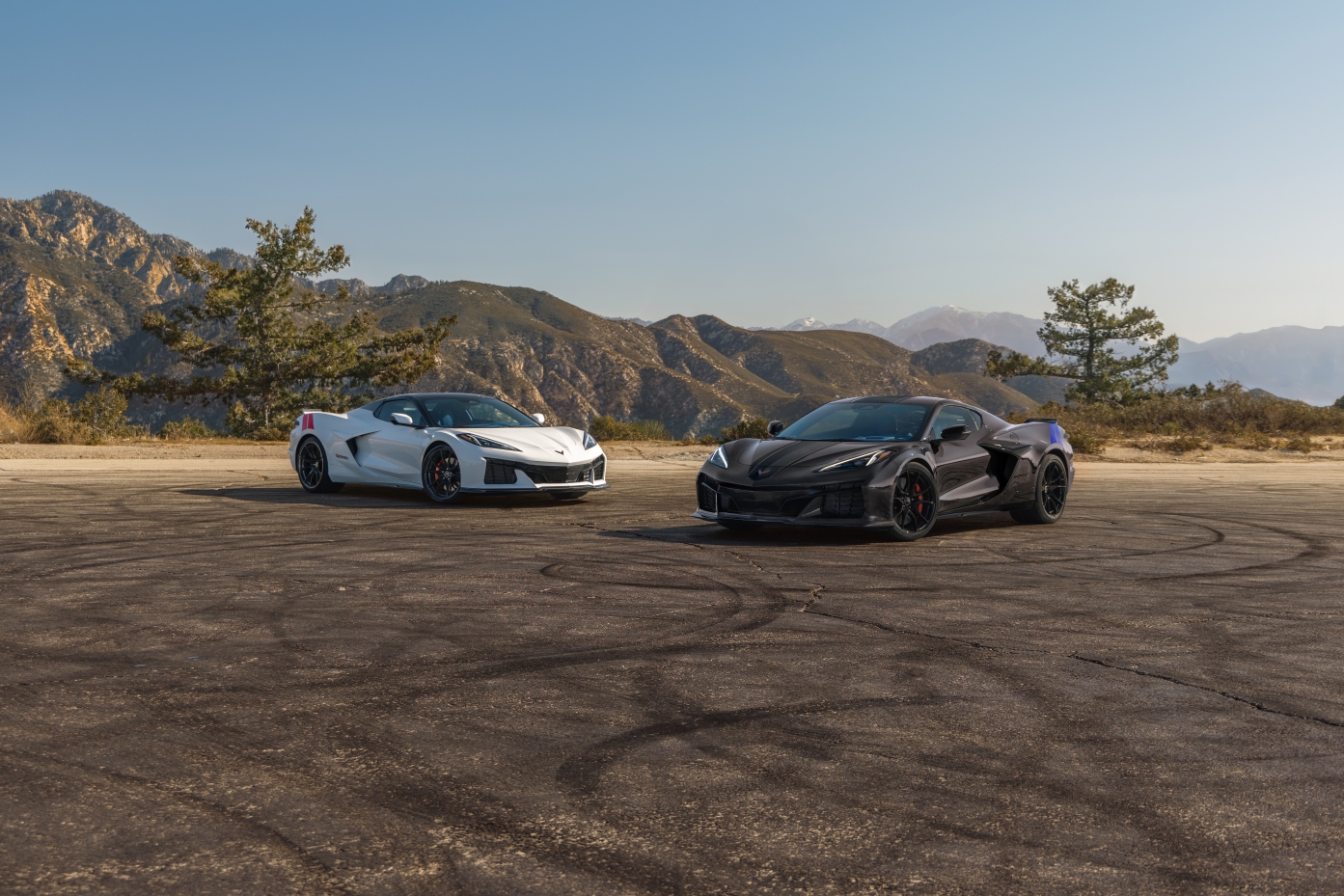
Chevrolet is reviving one of Corvette’s most storied racing names with the 2027 Corvette Grand Sport, and creating new legacy with the Grand Sport X. Both vehicles blend heritage-inspired design with next-generation V8 engine that produces more torque than any other naturally aspirated V8 before it. The duo delivers a modern take on Grand Sport’s traditional role as a sweet-spot in the lineup, blending visceral V8 performance, distinctive style and everyday drivability.
Born in the early 1960s as a limited run of five C2 race cars that competed at tracks like Sebring International Raceway, Grand Sport has long stood for lightweight, track-focused Corvettes that look as fast as they drive. Road-going Grand Sport models have added to the formula of the name every generation by pulling features from the fastest cars in each Corvette generation, while maintaining heritage colors, distinct striping, and signature fender hash-marks that once served as ways to tell the original race cars apart.
Today’s Grand Sport lineup reflects the best of what the eighth-generation Corvette has to offer, including a wide, planted mid-engine stance, an interior that elevates driver cockpit design, and the benefits of either a removable-roof coupe or hardtop convertible. Plus, standard Magnetic Ride Control, available Performance Traction Management, and so much more.
“Grand Sport has always been the Corvette for drivers who want the spirit of a race car in a package they can enjoy every day,” said Scott Bell, vice president of Global Chevrolet. “With the new Grand Sport and Grand Sport X, we’ve taken that formula into the mid-engine era, pairing a heritage-rich design with the most advanced Corvette technologies we’ve ever offered.” “The Grand Sport model has historically acted as a high-volume player in the Corvette lineup. We expect the Stingray and Grand Sport lineup combined to account for the vast majority of Corvette sales.”
Next Generation LS6 6.7L V8
At the core of every 2027 Corvette Grand Sport and Grand Sport X is the next-generation LS6 6.7L V8, which now becomes Corvette’s primary engine-powering the 2027 Stingray as well. Launching General Motors’ next generation of V8s, LS6 raises the bar for performance. Thanks to the engine architecture upgrades that will soon benefit other V8-powered Chevrolets.
Delivering 535 horsepower and 705 Nm (520 lb-ft) of torque, this naturally aspirated engine sees increase in power and torque across the rev band compared to its predecessor. A larger 6.7L (409 cu in) displacement and 13.0:1 compression ratio sharpen response, while a 95-mm throttle body and tunnel ram intake with high-velocity ports move more air to unlock additional power.
A new lubrication system, forged pistons and rods, and revised exhaust manifolds ensure durability in extended high-load, high-temperature environments. “There is no replacement for displacement! Our next generation LS6 engine pushes 409 cubic inches of jackhammer fury through the tailpipes,” said Mike Kociba, assistant chief engineer, Next Generation V8. “Combining large displacement, modern technology, and proven Small Block V8 heritage will deliver a bold new chapter in performance.”
An eight-speed dual-clutch transmission routs all this power to the wheels.
GM’s Flint Engine Operations in Flint, Michigan will assemble the LS6 with US and globally sourced parts, returning production to the city where the first Corvette V8s were built in 1955. Chevrolet’s unique capacity for advancing V8 technology has come with time and experience: LS6 represents the start of the sixth generation of Small Block V8s, extending a legacy more than 70 years in the making.
Corvette Grand Sport: Purist, Rear-Wheel-Drive Performance
The 2027 Corvette Grand Sport is engineered for the purist, blending classic naturally aspirated V8 character with rear-wheel-drive dynamics for a focused sports car experience. Its LS6 6.7L V8 delivers 535 horsepower and 705 Nm of torque with a deep, exhilarating exhaust note, amplified by an available quad center-exit exhaust– the first time a center exhaust has been offered on a pushrod V8 in the eighth generation of Corvette.
Grand Sport offers a broad spectrum of capability. Magnetic Ride Control is standard, paired with a Touring Suspension and Michelin Pilot Sport All season 4 tires that make the car as home crossing the country as it is carving a favorite back road. A new braking package is designed for low brake dust and a corrosion-resistant appearance, helping Grand Sport look as sharp as it drives.
For drivers seeking more edge, the available Z52 Sport Performance Package is tuned around a stiffer suspension, the Michelin Pilot Sport 4S summer tire1 and borrows high-performance J56 iron brakes from the Corvette Z06 for confident stopping power on road and track. The Z52 Track Performance Package goes further, mating carbon-ceramic J57 brakes and Michelin Pilot Sport Cup 2R tires with track-focused chassis tuning. Paired with a carbon-fiber splitter, dive planes, rockers and wing, plus underbody strakes, this is most track-capable Grand Sport to date.
Corvette Grand Sport X: Powerful, Poised, All-Wheel Drive
The Corvette Grand Sport X expands the Grand Sport formula with the addition of all-wheel drive, creating a chest-compressing 721-hp2 express. It pairs the LS6 V8 at the rear axle with a front-axle electric motor and compact battery pack from the record-setting Corvette ZR1X to create eAWD Corvette that is as confident in challenging weather as it is on a dry track.
Just as with ZR1 and ZR1X, the naming of Grand Sport and Grand Sport X will provide consistency and clarity in Corvette’s badging, with X being representative of eAWD.
Grand Sport X’s high-voltage battery is low and centered in the car to preserve the agility of the mid-engine platform. The addition of a front motor is performance enabler: Grand Sport X leaps from a stand-still with near-instant access to 196.6 Nm of torque on the front axle. And thanks to an intelligent controls system, the car combines the agility typical of a rear-wheel drive car with the corner-exiting traction only all-wheel drive can provide.
Similar to ZR1X, Grand Sport X puts the driver in control on track by letting them choose a strategy for how to use available power:
- Endurance – Engaging the Charge+ button adjusts the battery’s energy storage strategy for extended lapping and consistent eAWD output for a full tank of fuel
- Qualifying – Optimum power strategy for the ultimate lap time
- Push-to-Pass – Max available power on-demand
Magnetic Ride Control, carbon-ceramic brakes, and Michelin Pilot Sport All-season 4 tires are standard. The available Performance Package adds Michelin Pilot Sport 4S tires, benefiting track performance and backroad precision.
For moments that call for subtlety, Grand Sport X offers electric-only Stealth mode through 80 km/h and Shuttle mode for non-street use up to 37 km/h modes, allowing the car to move quietly on its front electric axle when needed, without engaging the V8.
Grand Sport Heritage, Modern Execution
The original C2 Grand Sports were purpose-built race cars, and the bold liveries and stripes they wore still influence today’s design. Signature Grand Sport hash marks, seen on the front fenders of C4, C6 and C7 models, now move to the rear of the car for the first time – a visual nod to the V8 engine’s position behind the cockpit in the current Corvette generation.
The color palette reaches into the archives by reviving Admiral Blue Metallic, a signature hue from the C4 era – enabling the iconic blue body, white center stripe and red hash Grand Sport appearance.
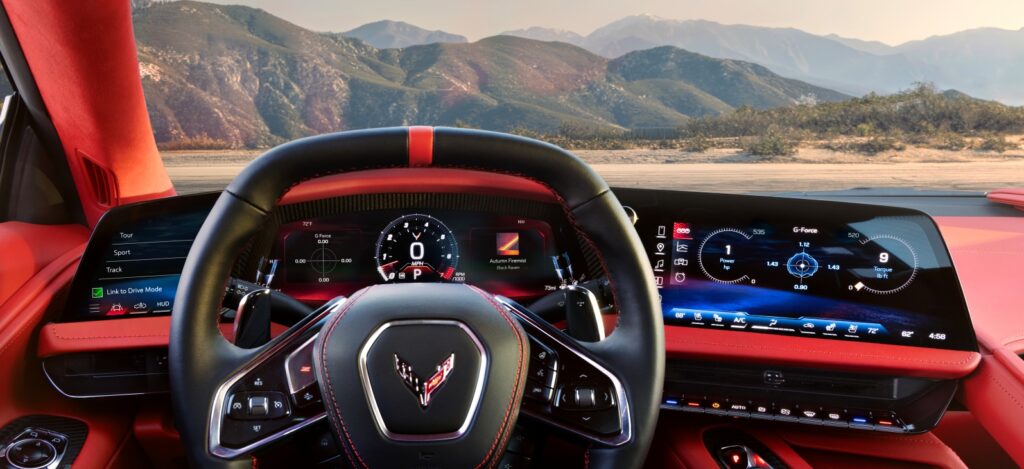
The 2027 Grand Sport lineup will feature a Launch Edition interior that is curated to feel like a one-of-one option for each owner. Launch Edition cars will receive a Santorini Blue-Dipped interior, where nearly every surface is Santorini with red stitching and accents. Headrests are embossed with a unique Grand Sport exterior plan view outline, also seen stitched into floor mats. The leather-wrapped hood over the driver information center receives special red accents down the center, lining up with the center mark on the steering wheel. A Launch Edition waterfall speaker plaque and a Grand Sport steering wheel badge complete the package, which is available with multiple exterior colors.
Hash marks and center stripes are available in a variety of colors and hundreds of combinations, allowing each owner to tailor their own track-inspired look.
10-spoke forged aluminum wheels are a clean, strong and lightweight design unique to the Grand Sport lineup, and are available in four finishes: Pearl Nickel, Gloss Black, Carbon Flash with Bright Polished Surfaces, and High Polished. Five-spoke carbon-fiber wheels are available in visible, Carbon Flash-painted, and visible with red stripe, and reduce mass at each corner.
Pitch Gray Metallic, a new dark gray exterior color, will be available alongside Admiral Blue Metallic for all 2027 Corvette models. Pitch Gray Metallic, a new dark gray exterior color, will be available alongside Admiral Blue Metallic for all 2027 Corvette models. An Asymmetrical Santorini Blue / Jet Black interior will be available as well, building on the introduction of the Asymmetrical Adrenaline Red / Jet Black interior in 2026.
Stingray Refreshed
In 2027, Corvette Stingray will upgrade to LS6, the most powerful standard engine ever offered on Corvette. Stingray buyers can also select an available center-exhaust for the first time in mid-engine era.
Engineers took this opportunity to integrate knowledge learned from more powerful variants back into Stingray. Updated calibrations for the available Magnetic Ride Control suspension provide better body control, optimizing performance. The track-capable Z51 Performance Package is enhanced with a shorter 5.56:1 final drive ratio for more immediacy on throttle, adjusted aerodynamics for performance, and the car sits on a newly developed Michelin Pilot Sport S 5 tire.
The Heart of the Lineup
Corvette Stingray is an everyday supercar. Both Corvette Grand Sport and Grand Sport X are driver’s cars first, whether the day calls for a long highway stretch, a favorite canyon road, or a session at the track. With the new Grand Sport lineup and the refreshed Stingray powered by a next-generation V8, the Corvette line-up’s most attainable models are stronger than ever.
GM’s Bowling Green Assembly will build the Stingray and Grand Sport lineup with US and globally sourced parts beginning this summer.
Regional Availability
The 2027 Corvette Grand Sport and Grand Sport X are expected to arrive across the region in Q4 2026. Specifications may vary by market, please visit www.chevroletarabia.com or contact your local Chevrolet showroom for more information.
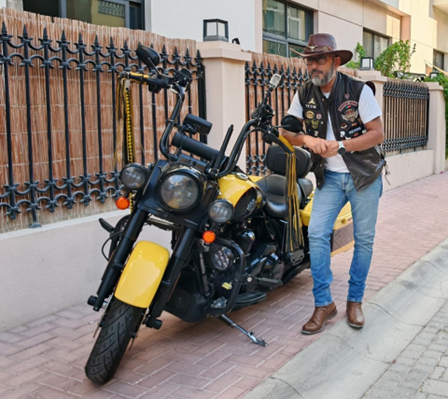
Exclusive interview with Victor King, Founder of World of Bikers
Long-distance riding is gaining tremendous traction in the Middle East. What factors are driving riders here to attempt endurance certifications like CLDR, and how is it changing the riding culture?
Long-distance riding certifications are a pure test of discipline, resilience, and planning. They’re a badge of honour earned through willpower and help form an unbreakable bond with fellow riders.
The manual documentation process, which was tedious for both riders and principals, has now been digitalized with The World of Bikers app. This has led to instant gratification for riders, who can now receive LDR certification in 90% less time after completing the ride than before, sparking powerful motivation to earn this globally recognized accomplishment.
What gaps in the UAE’s biking ecosystem are you trying to solve with this platform, and how do riders benefit from it on a day-to-day basis?
The World of Bikers (WoB) aims to create a unified, digital ecosystem with the core objective of building a global community where riders can SAIL together—Support, Advise, Inspire, and Learn from each other.
On a day-to-day basis, the platform extends these benefits further. Riders gain immediate access to the LDR Certification module, which digitalizes endurance documentation. Additionally, an integrated chat module connects riders instantly for planning rides or seeking advice, which directly supports our “Support” and “Advise” pillars.
Looking ahead, these benefits will be amplified by upcoming features like Who’s Riding, Marketplace, Rentals, Service, and Cafe. These additions will bring the community even closer together and give riders access to key services under one roof—services that are usually scattered. This evolution transforms riding from a mere activity into a connected, supported, and continuously enriching lifestyle. Ultimately, this directly fulfills our mission to unite riders and strengthen the bonds within our community.
The UAE attracts riders from over 150 nationalities. How does such diversity influence the riding community’s culture, safety practices, and the way group rides are organized?
Diversity is the greatest strength of the motorcycle riding culture and a direct reflection of the UAE’s national vision of tolerance and inclusion. For example, it is common to see riders from countries such as India, Germany, and South Africa sharing different safety practices and ride leadership traditions within the same group. The World of Bikers community creates a unique global melting pot culture on two wheels, where riding stories and traditions from every continent blend and merge.
The UAE’s motorcycling scene has evolved rapidly over the last decade. From your vantage point, what are the biggest cultural and behavioural shifts you’re seeing among riders in the region today?
A decade ago, Motorcycle riding was a hobby of a few, given the extremely hot climate and high-speed expressways of the region, which kept even enthusiasts away from motorcycles. And then came the era of delivery motorcycle riders, seen all over the road in summer and winter alike.
This rise in visible riding activity has, in turn, inspired many old- and new-generation riders to get on two wheels. Culturally, this increased presence of motorcyclists on the road has fostered a sense of community, encouraging social interaction, mentorship, and the exchange of riding traditions among diverse groups. Beyond these internal community effects, there has also been a broader societal impact: the normalization of motorcycling has contributed to greater acceptance of riders and their lifestyle across the general population. Public perceptions have gradually shifted, with motorcycles increasingly viewed as viable modes of transport and recreation rather than niche or risky pursuits. This shift has encouraged additional investment in rider-friendly infrastructure and collaboration between authorities and biking communities to promote road safety and awareness. With the region’s infrastructure, regulatory, and safety systems among the best in the world, riders can now enjoy their passion securely and confidently, further solidifying motorcycling as a respected and integral aspect of the region’s contemporary lifestyle.
Early-morning weekend rides have become a signature part of UAE biking culture. What draws hundreds of riders out at 3 or 4 AM every season, and what does that say about community behaviour here?
The pre-dawn ride is a brilliant cultural adaptation to the region’s unique environment and demographics. First, it’s a necessary adaptation to the extreme heat, offering the only safe, comfortable window for group rides year-round.
More importantly, this practice reveals the community’s maturity and conscientiousness. Given that the UAE has a largely expatriate population juggling work and family life, the early morning start is a disciplined and practical choice. It lets riders pursue their passion, return at the start of the day, and preserve precious weekend time for family.
Many enthusiasts say the UAE is where riders truly discover “group discipline.” From your experience, what makes structured group riding so central to the community’s identity?
Structured group discipline is the pillar of our identity. It’s a visible sign of respect for the law, an uncompromising safety-first practice that protects every rider, and the very foundation of our brotherhood on two wheels. By riding as one unit, we build trust, ensure harmony, and turn a group of individuals into a single, safe, and resilient community.
The UAE has seen an influx of first-time or returning riders post-pandemic. What advice do seasoned riders in the community typically share with newcomers joining the scene?
First, safety is not negotiable. Gear up, get trained, and know your limits. Second, respect the law—it protects us all. Above all, trust the brotherhood. Listen, learn, and lean on the group’s experience. Come ready to make friends and share the road. This is how we protect each other and ensure everyone can enjoy riding for years to come—and together, we uphold the spirit and unity that define our community.


Can Middle East Banks Reclaim Their Digital Leadership in the Age of AI?
Addressing Structural Gaps in Enterprise Backup Strategies

MOZN’s AI-Powered FOCAL Platform Earns Recognition in Forrester Financial Crime Landscape

-
News10 years ago
SENDQUICK (TALARIAX) INTRODUCES SQOOPE – THE BREAKTHROUGH IN MOBILE MESSAGING
-

 Tech News2 years ago
Denodo Bolsters Executive Team by Hiring Christophe Culine as its Chief Revenue Officer
-
 VAR12 months ago
Microsoft Launches New Surface Copilot+ PCs for Business
-

 Trending5 months ago
OPPO A6 Pro 5G Review: Reliable Daily Driver
-

 Tech Interviews2 years ago
Navigating the Cybersecurity Landscape in Hybrid Work Environments
-

 Tech News9 months ago
Nothing Launches flagship Nothing Phone (3) and Headphone (1) in theme with the Iconic Museum of the Future in Dubai
-

 Automotive2 years ago
AGMC Launches the RIDDARA RD6 High Performance Fully Electric 4×4 Pickup
-

 VAR2 years ago
Samsung Galaxy Z Fold6 vs Google Pixel 9 Pro Fold: Clash Of The Folding Phenoms