
 Have a question? +971 56 404 0503




Financial News
THE MIDDLE EAST’S PAYMENT REVOLUTION


By Amer Qavi, Founder & CEO, Swipe2B
The way we make payments is changing at an unprecedented pace. Understanding the recent advances and emerging trends in payment technology is crucial in our cashless society. Here are the latest developments in payment technology and their implications, with a particular focus on the Middle East, a region experiencing a rapid and transformative shift towards modern payment solutions.
The Digital Payment Revolution
The global digital payment ecosystem is undergoing a significant transformation. With the ubiquity of smartphones and internet access, digital payments have become more accessible and convenient than ever before. According to Statista, the global digital payments market is expected to reach a staggering $9.5 trillion in 2023, with projections suggesting this will increase to nearly $15 trillion by 2027.
Middle East’s Role in the Digital Payment Landscape
The Middle East is no exception to this global trend. Countries in the region are making substantial investments in digital infrastructure and fintech solutions. One standout example is the UAE, which has positioned itself as a leading hub for fintech innovation. According to the Dubai International Financial Centre (DIFC), the fintech sector in the UAE now contributes over 27% to the Centre’s growth, reflecting the rapid adoption of digital payment technologies.
Mobile Wallets & Contactless Payments
One of the most notable developments in payment technology is the widespread adoption of mobile wallets and contactless payments. These solutions allow users to make transactions with a simple tap or scan, enhancing both convenience and security.
In the Middle East, mobile wallet usage has surged. The UAE, for instance, witnessed a substantial increase in mobile wallet adoption, with over 50% of the population now using digital wallets for various transactions, as reported in a recent survey. Similarly, Saudi Arabia has seen impressive growth in the use of contactless payments, with 94% of all digital transactions taking place using contactless technology.
Blockchain & Cryptocurrencies
Blockchain technology and cryptocurrencies have also made significant inroads into the payment industry. While cryptocurrencies like Bitcoin and Ethereum are still considered volatile assets, the underlying blockchain technology is being embraced for its potential to enhance security, transparency and efficiency in payment processes.
The Middle East is recognizing the potential of blockchain and cryptocurrencies more and more. In the UAE, the government has launched various blockchain initiatives, including the Emirates Blockchain Strategy 2021, which aims to position the country as a global leader in blockchain adoption. The DIFC has also introduced a regulatory framework for cryptocurrencies, attracting blockchain startups and investments.
Biometric Authentication
Security remains a paramount concern in the world of payments. Traditional methods of authentication, such as PINs and passwords, are being complemented and, in some cases, replaced by biometric authentication methods. Biometrics, such as fingerprint recognition, facial recognition, and even iris scanning, offer a higher level of security while ensuring user convenience.
In the Middle East, biometric authentication is on the rise. GCC countries, including Saudi Arabia, the UAE and Qatar, have been at the forefront of implementing biometric authentication in financial services.
Peer-To-Peer (P2p) & Cross-Border Payments
The growth of P2P payment platforms has revolutionized how individuals transfer money to friends and family. Apps like PayPal, Venmo, and Cash App have become household names, simplifying the process of splitting bills or reimbursing friends. In the Middle East, local players are entering the P2P space, providing tailored solutions for the region’s unique needs.
Cross-border payments, too, are becoming more seamless thanks to advancements in payment technology. Traditional international money transfers are often costly, time-consuming or both.
B2B Payments
While all these trends are most widely visible in the B2C (Business-to-Consumer) space, such as e-commerce and online bill payments, the area undergoing the biggest transformation is B2B (Business-to Business) payments. The transaction volume of companies paying other companies (B2B payments) in any economy tends to be 4 to 5 times larger than B2C transactions, even though they may not be as visible.
Digital wallets, blockchain, biometric authentication, P2P payments, cross-border solutions and B2B payments are just a few examples of the exciting developments reshaping the payment landscape. While challenges persist, the opportunities for convenience, efficiency and financial inclusion are immense. Be prepared to adapt to these changes as they continue to reshape the way we pay and transact in an ever evolving digital world.
Financial
Standard Chartered Supports Pakistan’s First Panda Bond Issuance in Chinese Interbank Market

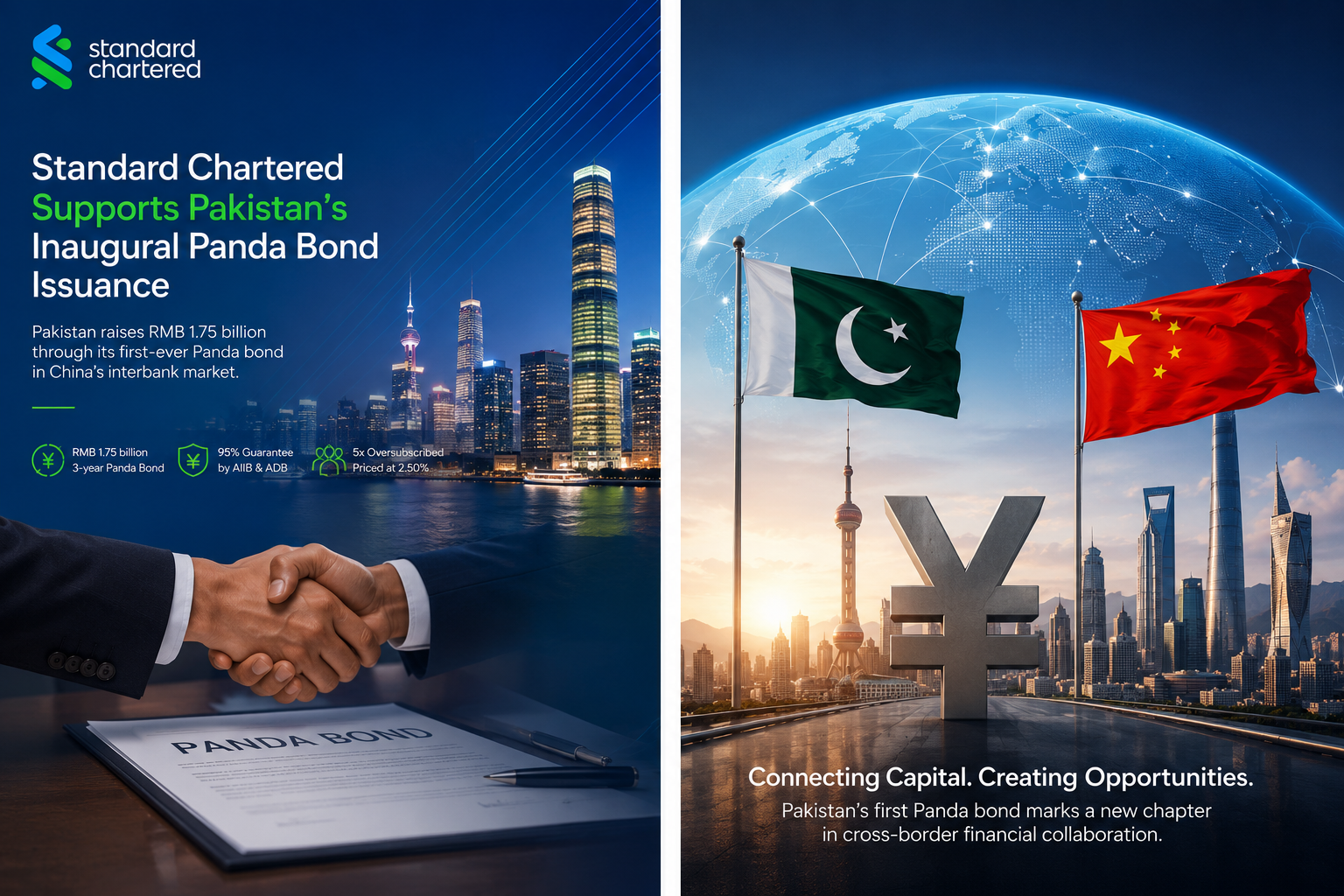
Pakistan has successfully completed its inaugural Panda bond issuance in China’s interbank bond market, raising RMB 1.75 billion through a three-year transaction that marks the country’s first direct entry into China’s capital markets.
Standard Chartered (China) Ltd. Co acted as the only foreign bank serving as joint lead underwriter and joint book runner for the transaction, supporting Pakistan in broadening its international financing channels while strengthening financial connectivity between regional capital markets.
The issuance received strong support from multilateral development institutions, including the Asian Infrastructure Investment Bank (AIIB) and the Asian Development Bank (ADB), which together guaranteed 95 per cent of the bond’s principal and interest payments. The structure helped attract significant demand from Chinese banks, securities houses, and international financial institutions.
The transaction was reportedly more than five times oversubscribed, allowing Pakistan to price the bond at 2.50 per cent, the tightest end of the indicated pricing range.
Salman Ansari, Global Head, Capital Markets, Standard Chartered, described the issuance as a strategically important transaction that expands Pakistan’s access to global liquidity pools while demonstrating the growing relevance of regional capital markets within the international funding landscape.
The transaction also reflects the broader evolution of the Renminbi within global financial markets, as China continues expanding the role of its currency beyond trade settlement into cross-border financing and sovereign funding structures.
Jerry Zhang, Global Head of Banks & Broker Dealers and Head of Coverage, Greater China and North Asia at Standard Chartered, said the transaction highlighted the bank’s role in connecting international issuers with China’s domestic capital markets while also reflecting the continued internationalisation of the Renminbi.
The Panda bond market has increasingly attracted a wider range of sovereign, supranational, and institutional issuers in recent years as regional economies explore diversified funding channels and deeper access to Chinese liquidity pools.
Financial
Standard Chartered appoints Michelle Swanepoel as Head of Financing and Securities Services Middle East and Africa
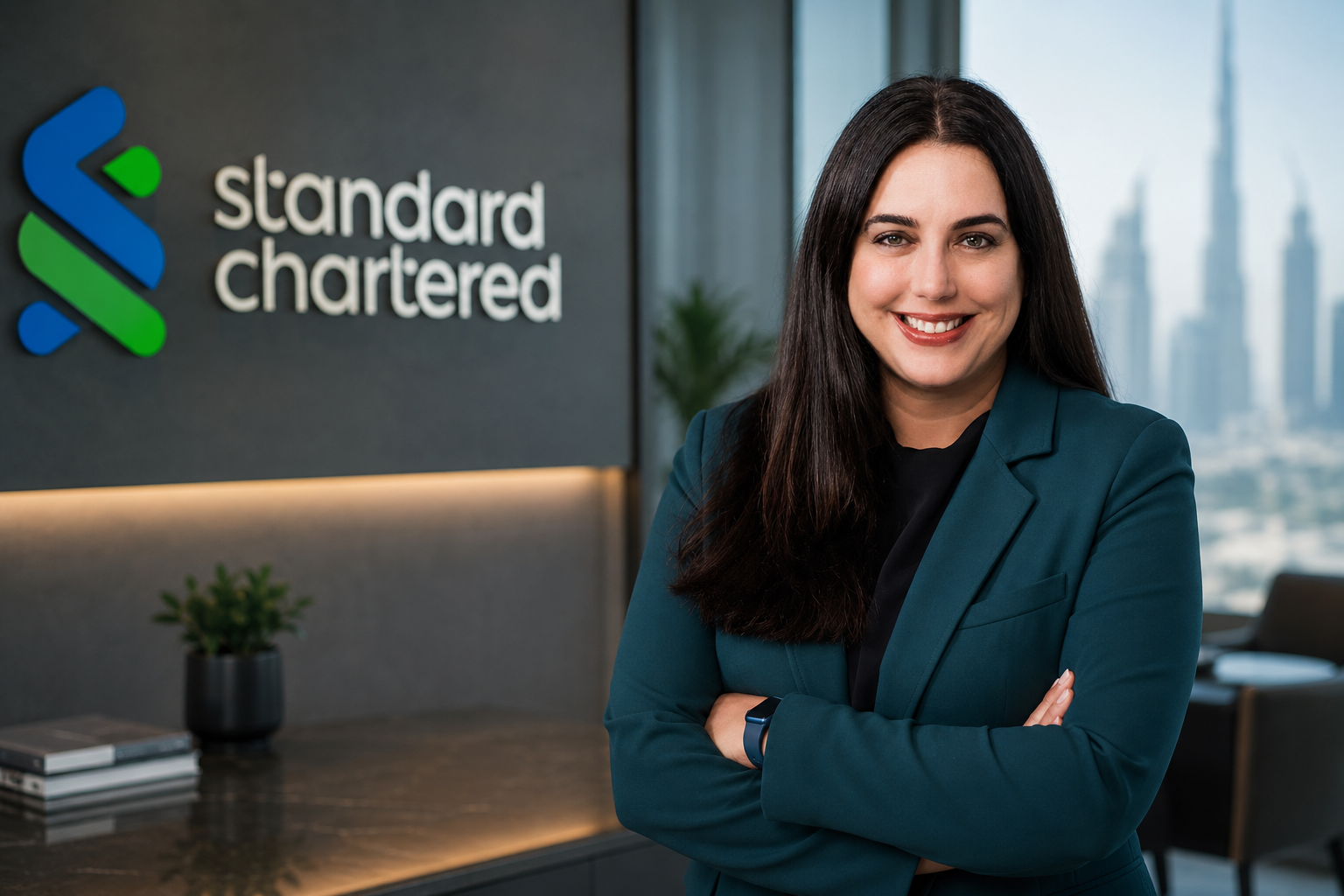
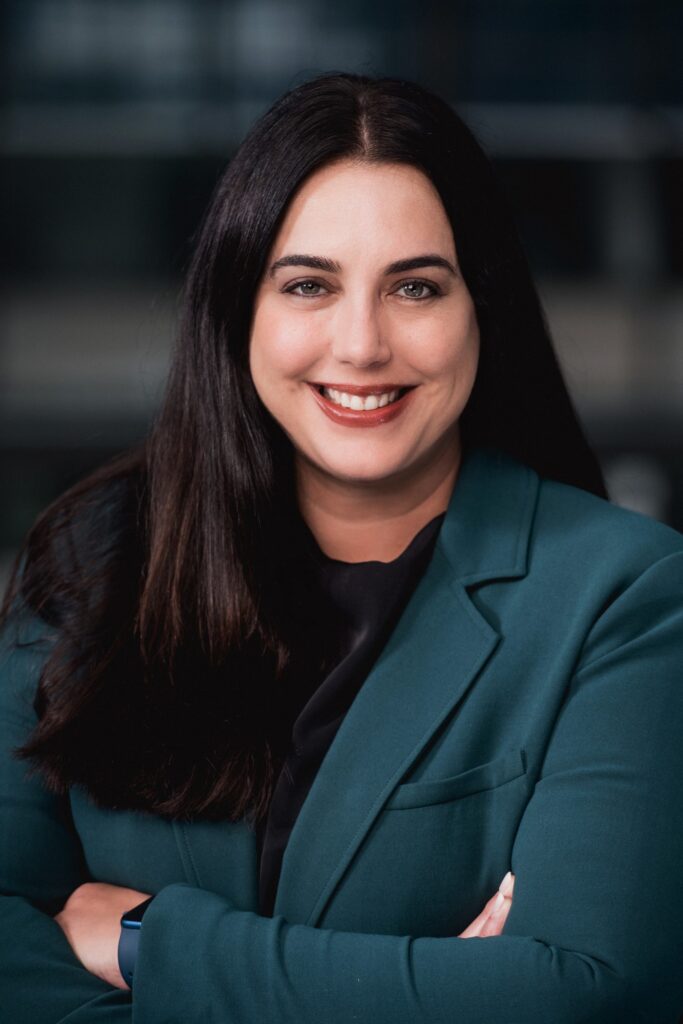
Standard Chartered today announced the appointment of Michelle Swanepoel as Head of Financing and Securities Services (FSS), Middle East and Africa. Based in Dubai, she will lead the business across the region effective 1 July 2026. Michelle succeeds Scott Dickinson, who will be retiring from the bank on 30 June after more than 40 years in financial services.
Michelle Swanepoel joined Standard Chartered in September 2017 as the Regional Head of Business Account Management for the Middle East and Africa and was appointed the Regional Head of Securities Services for Africa in May 2019. In September 2024, her role expanded to include Head of Markets for South Africa.
“Michelle has played a strong leadership role in the evolution of post‑trade servicing across Sub‑Saharan Africa, supporting capital market development, regulatory reform, enhanced investor access and market infrastructure, and is a recognised industry subject‑matter expert,” said Margaret Harwood-Jones, Global Head of FSS. “I have every confidence that Michelle will drive further momentum in the region, building on the solid foundation established by Scott.”
Scott Dickinson joined Standard Chartered in 2017 and he has led the Bank’s FSS franchise in MEA since 2019. During his tenure, he oversaw strong growth across the Middle East and Africa franchise, supported expansion into markets including Saudi Arabia and Egypt, and helped deliver the Bank’s first Digital Asset Custody capability in the Dubai International Financial Centre.
Financial
STAKE PARTNERS WITH ACE & COMPANY TO DEVELOP SECONDARY TRANSFER FACILITY FOR FRACTIONAL REAL ESTATE INVESTMENTS IN THE UAE

Stake, the MENA region’s leading digital real estate investment platform, and ACE & Company, a Swiss-headquartered global investment group focused on private markets, with more than $2.0 billion in assets under management, today announced a strategic partnership to support the development of liquidity solutions for investors in Stake products. The agreement will focus initially on the platform’s real estate portfolio in the UAE, held through Prescribed Companies, the equivalent of Special Purpose Vehicles (SPVs) in DIFC.
The initiative is intended to create a more liquid, transparent, and efficient marketplace for investors seeking exposure to fractional real estate opportunities through Stake’s platform. By combining Stake’s innovative access model with ACE & Company’s longstanding experience in private market investing and secondary transactions, the partnership aims to strengthen the investment ecosystem around fractional ownership structures in the UAE.
The joint venture reflects both firms’ confidence in the long-term fundamentals of the UAE. At a time of heightened regional uncertainty, the UAE continues to distinguish itself through economic resilience, political stability, high-quality infrastructure, and sustained global investor interest. These attributes have helped position the country as one of the region’s most compelling destinations for long-term real estate capital.
Through the planned secondary infrastructure framework, investors in Stake products are expected to benefit from greater flexibility in managing their holdings, improved visibility around market pricing, and clearer pathways to liquidity. In turn, the broader market stands to benefit from enhanced stability, stronger price discovery, and increased participation and confidence in fractional real estate as an investable asset class. The framework operates within Stake’s existing DFSA-approved regulatory permissions, providing investors with established oversight and regulatory clarity. Stake is regulated by the DFSA, the independent regulator for business conducted from or within DIFC.
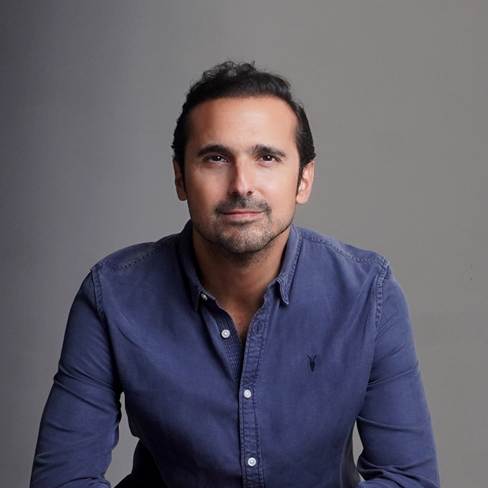
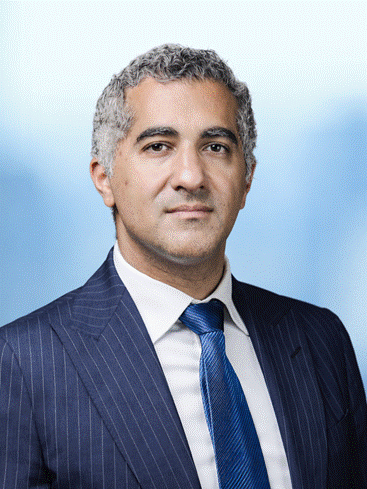
For Stake, the partnership marks an important step in the continued evolution of its platform, extending beyond access to ownership and toward the development of more mature market infrastructure. For ACE & Company, the collaboration draws on its extensive experience in private equity and secondaries to help unlock liquidity solutions in a fast-growing segment of the alternative investment landscape. The DIFC’s established private markets framework, and its Prescribed Company regulations in particular, have been central to enabling this model, providing the institutional and legal infrastructure on which this secondary transfer facility innovation is built.
Manar Mahmassani, Co-Founder and Co-CEO of Stake said:
“The UAE has always rewarded those who invest in it with conviction, and that’s exactly what this partnership represents. Stake was born in crisis. We launched during COVID, when global real estate markets were struggling and Dubai’s property industry was at its low point. What we saw was a market that is far from broken, but fundamentally sound, going through a temporary challenge. That conviction has never left us. Today, the world is watching the region, and we want to be unambiguous about where we stand: we are long Dubai, and we are long the UAE. This is not the moment to retreat: it’s the moment to build the institutional infrastructure this market deserves. That’s exactly what this partnership is all about – a mature, resilient market attracting institutional confidence and capital committed for the long run.”
Sherif El Halwagy, Partner and Co-Founder at ACE & Company said:
“Drawing on almost two decades of experience in offering liquidity to investors across private markets ecosystems via secondaries, we see a tremendous opportunity in real estate secondaries in the UAE. This partnership reflects our conviction in the country’s long-term fundamentals and our disciplined approach to capital deployment in high-quality assets. We look forward to further strengthening our relationships with investors and partners across the region.”
The partnership is designed to benefit all stakeholders across the ecosystem. Existing investors gain added optionality and transparency, prospective investors gain greater confidence in the structure, and the market benefits from stronger liquidity mechanisms, a scalable source of permanent/long-term capital and a more institutionalized framework for participation.
As fractional ownership continues to gain traction globally, Stake and ACE & Company believe that robust secondary infrastructure will play a critical role in supporting the sector’s long-term growth. The joint venture represents a shared commitment not only to product innovation, but also to building the underlying market architecture needed to support sustainable expansion in the UAE and beyond.


VAPIANO INTRODUCES BREAKFAST FOR THE FIRST TIME IN ITS HISTORY ACROSS UAE OUTLETS

REDEFINING AFFORDABLE LIFESTYLE HOSPITALITY IN DUBAI

HYBRID MOBILITY SEEN AS KEY TO GCC ELECTRIFICATION TRANSITION



-
News11 years ago
SENDQUICK (TALARIAX) INTRODUCES SQOOPE – THE BREAKTHROUGH IN MOBILE MESSAGING
-

 Tech News2 years ago
Denodo Bolsters Executive Team by Hiring Christophe Culine as its Chief Revenue Officer
-

 Trending7 months ago
OPPO A6 Pro 5G Review: Reliable Daily Driver
-
 VAR1 year ago
Microsoft Launches New Surface Copilot+ PCs for Business
-
Tech Interviews2 years ago
Navigating the Cybersecurity Landscape in Hybrid Work Environments
-

 Automotive2 years ago
AGMC Launches the RIDDARA RD6 High Performance Fully Electric 4×4 Pickup
-

 Tech News10 months ago
Nothing Launches flagship Nothing Phone (3) and Headphone (1) in theme with the Iconic Museum of the Future in Dubai
-

 VAR2 years ago
Samsung Galaxy Z Fold6 vs Google Pixel 9 Pro Fold: Clash Of The Folding Phenoms