
 Have a question? +971 56 404 0503




Cover Story
The Region’s Most Innovative E-Payment Company’s Take on Tech Advancements

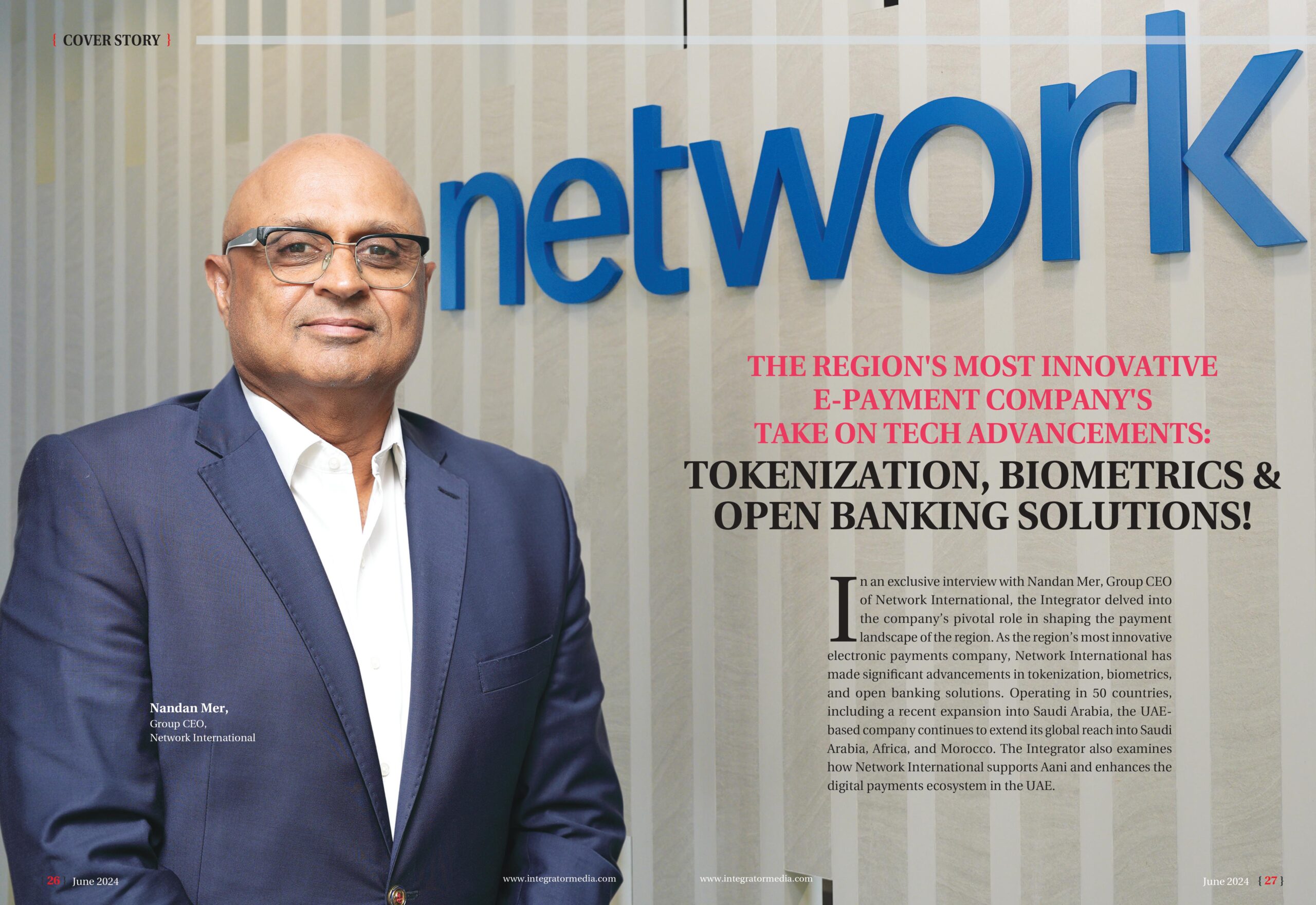
In an exclusive interview with Nandan Mer, Group CEO of Network International, the Integrator delved into the company’s pivotal role in shaping the payment landscape of the region. As the region’s most innovative electronic payments company, Network International has made significant advancements in tokenization, biometrics, and open banking solutions. Operating in 50 countries, including a recent expansion into Saudi Arabia, the UAE based company continues to extend its global reach into Saudi Arabia, Africa, and Morocco. The Integrator also examines how Network International supports Aani and enhances the digital payments ecosystem in the UAE.
How does Network International support banks and fintechs in improving their business operations and customer service through technology?
Our primary objective is to facilitate business success, encompassing banks, fintechs, merchants, and overall economic prosperity. Technology offers numerous benefits to banks and fintechs, helping them better serve their customers. This involves continuous innovation in product solutions, user experience (UX), and customer interaction. As their technology partners, we collaborate closely with them. With the 200 banks we partner with, we receive approximately 2,000 to 3,000 ideas to improve their businesses in various aspects.
Out of our team, about 1,000 members are dedicated technologists who work diligently to bring these ideas to fruition. They develop and implement technological solutions which are then provided back to the banks and fintechs. We take pride in the number of fintechs we have enabled to enter the market across the 50 markets we operate in. Fintechs are valuable to us because they bring fresh, innovative thinking and challenge the status quo in financial markets, enhancing how consumers are served by financial institutions.
Fintechs often face significant challenges with the initial investment in operations and technology. As entrepreneurs or young management teams, they must manage distribution, marketing, product quality, and more. We assist by handling the heavy lifting in operations and technology, providing these services on a per-transaction basis. This approach democratizes the cost of doing business for fintechs, enabling them to avoid substantial capital expenditure. Consequently, we have successfully onboarded numerous fintechs over the past three to five years.
How has Network International’s recent expansion into Saudi Arabia, along with the acquisition of payment companies in Africa, impacted your global operations and growth strategy?
We are a UAE-based global company currently operating in 50 countries. Our recent expansion includes a significant foray into Saudi Arabia. Until a couple of years ago, we had no business presence in Saudi Arabia. However, we have now started investing in the region, establishing our technology infrastructure locally, and creating a new company. We are proud to have a team led by talented Saudi nationals.
We have partnered with the central bank and Saudi Payments to deliver our services to Saudi banks and fintechs. Today, we have gained the trust of many Saudi fintechs and currently have 12 customers in Saudi Arabia. We are pleased with the rapid growth we have achieved. Additionally, we have been granted a direct acquiring license by the Saudi Central Bank (SAMA), making us the first foreign company to be fully licensed in the acquiring space in Saudi Arabia. This privilege and responsibility are significant, and we are committed to offering innovative services that better serve Saudi businesses and contribute to economic growth. Saudi Arabia has been a major focus, and we have invested heavily in this market.
In the past two and a half years, we have also acquired major payment companies in South Africa and Kenya, namely DPO and Payfast. Post[1]acquisition, we have scaled these companies by investing significantly in their growth and expanding them into new markets in Africa. Our latest venture is into Morocco, an exciting new market for us. Although we have been servicing Moroccan banks from outside Morocco, they have encouraged us to establish a local presence to better support their technology needs. Consequently, we have recently established our office in Morocco and are expanding our operations there in response to our ongoing discussions with Moroccan banks.
What role does Network International play in supporting Aani and enhancing the digital payments ecosystem in the UAE?
We commend the foresight and investment made by the Central Bank of the UAE in enabling capabilities such as Aani. Enabling faster payments is a crucial new service that complements card transactions, bank-to-bank payments, and more. Aani represents a significant technological advancement, and we fully embrace it. As one of the first companies in the UAE to connect to the domestic switch, we are also among the pioneers in accepting Aani at our point-of sale terminals. We highly regard this initiative, recognizing its vital role in enhancing the digital payments ecosystem in the UAE. At Network, we are committed to supporting the success of Aani in every possible way.
How does Network International utilize biometrics, such as fingerprints on terminals, and artificial intelligence to enhance security and efficiency in transactions?
The hallmark of Network International is our forward-thinking approach. We continually push the boundaries to enable faster, cheaper, and more secure technology. Biometrics play a crucial role in enhancing security. By reducing fraud in transactions, we instill greater confidence in consumers and merchants regarding electronic transaction flows. We are pleased to report that fraud levels are relatively low in the markets where we operate, thanks in part to the effective fraud prevention tools employed by ecosystem players and our continuous enhancement of these tools. Artificial intelligence significantly contributes to this effort. The role of new technologies and capabilities in making the electronic payments ecosystem more efficient cannot be overstated.
As a leader in the payment’s ecosystem in the Middle East and Africa, processing approximately $100 billion in transactions across 20 million credentials and over 100,000 merchants, we recognize our responsibility to demonstrate the value of advanced technologies. We rigorously evaluate these technologies before their launch to ensure they enhance the ecosystem’s security. However, not all technologies are adopted as expected by merchants or consumers, and it is only through experimentation and pushing boundaries that we can drive innovation. We are committed to continually experimenting and advancing the field, ensuring that we remain at the forefront of the industry.
How do you envision collaborating on blockchain technology with other companies, particularly in the realms of B2B payment solutions and SME lending solutions?
We are pleased to inform your readers that we have recently been granted the stored value license by the Central Bank of the UAE. This license enables us to offer the solutions you mentioned, which would not have been possible otherwise. This development opens new opportunities for us. In anticipation of receiving this license, we have been developing technologies and capabilities.
We are particularly excited about B2B payments, which, in terms of volume, represent a significantly larger market than B2C payments or consumer-to-institution and consumer-to-merchant transactions. These B2B payment flows are ideal for enhancements in efficiency, security, and speed. We possess the technological capabilities and the necessary experience, with many of our team members having backgrounds in B2B payments. Now that we have the required Central Bank licenses, we are fully prepared to advance in this area.
What are your thoughts on open banking with the new regulations coming in?
Open banking represents a natural progression of the efforts made by fintechs and technology disruptors. It reduces the friction in launching new products in the market. We appreciate the evolving mindset of bankers who are now embracing open banking. While a framework and technology are necessary to facilitate open banking, the core of open banking lies in forging partnerships between banks and companies. These partnerships leverage the banks’ data, historical insights, and balance sheets in meaningful ways.
The value of open banking has been demonstrated in various parts of the world. I am confident that over time, open banking will bring similar advancements in our markets, comparable to what has been achieved in Europe and parts of the US. We are learning from these markets’ experiences and tailoring our approach accordingly. We are also developing technologies to support companies leveraging open banking, enabling them to go to the market faster with better user experience (UX) and customer experience (CX) at reasonable costs. This cost-effectiveness is crucial for achieving scale, which is a key factor in the success of these initiatives











Automotive
Chinese Cars Are Reshaping the GCC Market, but Resale Value Could Be the Next Battleground

The GCC automotive market is undergoing a significant transformation. Chinese manufacturers are expanding their presence, established brands are navigating supply chain disruptions, and consumers are reassessing the economics of vehicle ownership.

At Keyloop Fusion Live Dubai, Srijith KN, spoke with Nour Abu-Safe, Head of Insights & Analytics at AutoData Middle East, about the changing competitive landscape, the impact of regional logistics challenges, and the opportunities emerging for automotive retailers.
Drawing on market intelligence, vehicle valuation data and industry research, she explains why technology alone may not guarantee long-term customer loyalty, why hybrids currently offer stronger residual value, and why the next major opportunity for dealerships could lie in pre-owned Chinese SUVs.
How are disruptions around the Strait of Hormuz affecting established automotive brands, and could the market changes become permanent?
Initially, many believed the disruption would be temporary. However, the data is beginning to show that market conditions are solidifying and businesses are adapting.
Traditional manufacturers, particularly Japanese brands such as Toyota, Nissan and Lexus, are experiencing challenges getting inventory into the region.
Chinese manufacturers have been more agile because several operate their own vehicle carrier fleets and logistics networks. This has allowed them to establish alternative routes into the GCC.
We have seen a 90% reduction in Japanese vehicle imports into the region, linked to the disruption around the Strait of Hormuz.
Alternative routes through ports outside the Gulf and via the Red Sea and Saudi Arabia are increasingly being used. However, these arrangements are creating delays, with vehicles now taking approximately six to eight weeks to reach showrooms.
The important development is that the market is adapting. Some of the alternative logistics routes established during this period could remain in use for years to come.
Are Chinese automotive brands attracting an entirely new generation of buyers, or are they winning customers away from established manufacturers?
It is a combination of both.
Younger consumers, particularly those between 19 and 30, are increasingly attracted to Chinese vehicles because of their styling, advanced technology, competitive pricing and safety features.
For younger families, especially those entering parenthood, these features can be important purchasing considerations.
Chinese vehicles also tend to offer attractive warranty and servicing packages, making them appealing to consumers who want to reduce their overall ownership costs.
Older buyers, particularly those in their 40s and 50s, generally demonstrate stronger loyalty towards established manufacturers and premium brands.
However, Chinese manufacturers are increasingly entering the premium segment as well, and we are beginning to see them capture some of that market share.
These demographic observations are also supported by consumer research, including studies published by YouGov, which we reference in our market analysis.
Chinese vehicles are becoming increasingly sophisticated. But can manufacturers sustain customer loyalty when technology evolves so quickly?
This is one of the most interesting challenges facing Chinese manufacturers.
Advanced technology is a powerful selling point. It looks attractive in marketing materials and helps manufacturers differentiate their vehicles.
However, rapid technological advancement also accelerates depreciation.
When a manufacturer introduces a significantly improved model within a short period, previous model-year vehicles can quickly appear outdated. That creates challenges for residual values and the used-car market.
For dealerships, the opportunity is to identify vehicles that offer a balance between modern technology and proven, practical features.
Hybrid vehicles are an interesting example because they combine improved efficiency with familiar internal combustion technology.
A vehicle that balances innovation with long-term usability may be better positioned to retain customers over five to ten years than one that depends primarily on the latest technology.
Chinese manufacturers are doing many things well, but the next few years will reveal how effectively they manage this challenge.
With affordability becoming increasingly important, how are vehicle financing and leasing models evolving across the GCC?
Vehicle demand remains present, and manufacturers have found ways to maintain supply despite the disruptions.
However, we could see greater pressure on consumer finances over the coming year.
That creates opportunities for financing and leasing providers.
Financing offers with zero down payment are becoming particularly relevant for buyers who may not have sufficient funds available for a substantial upfront payment.
On the leasing side, some operators are reporting demand increases of approximately 30% to 35%.
Consumers still need vehicles for everyday mobility, but some are becoming more reluctant to take on the financial commitment and risk associated with outright ownership.
Leasing offers an alternative that can address those concerns.
What is the biggest opportunity dealerships may be overlooking today that could become particularly important in 2027?
Used Chinese SUVs.
SUVs represent the largest vehicle body-type segment in the region, and the growing population of Chinese SUVs creates a significant opportunity for dealerships.
The first owner typically absorbs much of the vehicle’s depreciation during the initial two to three years. In some cases, that depreciation could be around 50%.
For dealerships, this creates an opportunity to develop certified pre-owned programmes around relatively young Chinese SUVs.
A three-year-old vehicle may still be in excellent condition and covered by its original warranty or service package.
If dealerships can price these vehicles correctly, they can attract buyers who cannot afford a brand-new SUV but still want a modern, well-equipped vehicle.
This could become an important growth segment for the automotive retail industry.
For consumers considering a vehicle purchase today, which offers the strongest proposition: petrol, hybrid, electric or a competitively priced Chinese vehicle?
There is no single answer because the decision depends on individual priorities.
However, when we compare petrol, hybrid and electric vehicles, our current data indicates that hybrids retain their value best.
They offer fuel efficiency while maintaining the familiarity and convenience of an internal combustion engine.
For buyers concerned about long-term value, that makes hybrids particularly attractive.
Chinese manufacturers, meanwhile, are becoming increasingly competitive on design, pricing and technology.
Vehicles such as the ROX 01 and Jetour G700 demonstrate how Chinese brands are entering segments traditionally dominated by established SUVs such as the Toyota Land Cruiser and Nissan Patrol.
The competitive landscape is changing considerably.
One particularly interesting insight from our latest data is that 48% of the new 2027-model vehicles arriving in the UAE are Chinese brands.
That tells us how aggressively these manufacturers are planning their product introductions, expanding supply and positioning themselves to attract both new and existing automotive customers.
The next few years will be particularly interesting as these changes reshape the balance between established manufacturers and emerging competitors.

As artificial intelligence becomes embedded in higher education, universities face a growing challenge: ensuring that students develop independent thinking rather than simply producing polished AI-assisted work. From rethinking assessments to preserving the value of intellectual effort, the conversation is shifting towards what Turnitin calls learning integrity.
In this interview with Amal Dimashki – Regional Director, MENAT & Pakistan, Turnitin explores how institutions can balance AI adoption with critical thinking, meaningful assessment and the development of essential learning skills.

Students are becoming increasingly comfortable prompting AI, but how can universities ensure they are still developing independent reasoning and critical thinking rather than simply producing better AI-assisted answers?
Prompting is becoming an important skill, but being able to write a sophisticated prompt is not the same as being able to think critically.
AI can be a very effective learning partner. It can help students brainstorm, explore different perspectives, challenge an argument or receive feedback on something they have written. But students still need to do the cognitive heavy lifting. If they simply prompt AI for an answer and then refine that answer until it looks better, we may improve the quality of the output without necessarily developing the student’s thinking.
This is why AI literacy needs to go beyond teaching students how to prompt. Students need to learn how to critically evaluate AI-generated content, verify information and sources, question what they are given and make their own judgments about the output. Turnitin’s guidance on responsible prompting encourages students to engage with AI iteratively and interrogate its responses rather than simply accepting what it produces.
We want students to use AI as a learning partner while remaining actively engaged in the learning process and taking ownership of the work they produce. Turnitin’s guidance to students reinforces this by encouraging them to ensure that the majority of their work remains their original thinking.
Universities therefore need to develop AI literacy alongside critical thinking and independent judgment, so that becoming better at using AI does not come at the expense of developing the skills students are there to learn.
What should a modern assessment look like if institutions want to measure a student’s actual understanding rather than just the quality of the final submitted work?
In an AI-enabled environment, assessing only the final product gives us a limited view of whether learning actually took place. A polished final submission does not necessarily tell us how the student arrived there.
This is where a process-based approach to assessment becomes increasingly important. Educators can build meaningful checkpoints into the learning journey through outlines, drafts, formative feedback, revisions and reflection. This allows them to see how the student’s thinking developed, how they responded to feedback and where they may need additional support. Turnitin’s multipart assignments, for example, are designed around structured checkpoints for guidance and reflection throughout the writing process.
At Turnitin, we refer to the broader framework behind this as learning integrity. It expands traditional academic integrity by placing greater emphasis on the integrity of the learning process and ensuring that students are doing the work necessary to learn and develop.
It brings us back to a familiar principle: “show your work.” Greater visibility into drafts, revisions and the development of ideas gives educators richer evidence of how a student approached the assignment rather than relying on a single snapshot at the end. Turnitin Clarity, for example, provides visibility into how students develop their work from ideation through to final submission.
This does not mean making every assessment more complicated. It means designing assessment around the learning objective and creating opportunities for students to demonstrate that they have developed the skills being assessed.
The final submission will continue to matter, but it can be considered alongside evidence of the learning process that produced it.
AI makes it possible to get answers, summaries and explanations almost instantly. Do you worry that this could reduce students’ ability to sustain attention, read deeply and work through difficult material without immediate assistance?
There is certainly a risk, and students themselves recognise it. Turnitin’s research found that 64% of students are concerned that the use of AI in education may be shortcutting their learning.
Learning should not become a completely frictionless process. Researching a subject, developing a point of view, articulating ideas with evidence, editing and working through something difficult all require effort, and some of that effort is where learning happens.
Turnitin refers to this through the concept of “productive struggle.” Cognitive growth and long-term retention require students to engage with difficulty rather than having every challenge immediately removed for them.
That does not mean students should struggle without support. AI can provide guidance and feedback throughout the learning process. Turnitin Clarity’s AI Assistant, for example, is designed to prompt reflection and support students throughout their writing without generating the full response for them.
As AI becomes more capable, preserving productive struggle will become increasingly important. We want students to benefit from the support AI can provide without removing the effort involved in developing knowledge and skills.
4. Looking ahead, how do you see the role of academic integrity evolving as AI becomes embedded in writing, research and learning, and what will universities need to change over the next few years?
Academic integrity will remain fundamental, but its role is expanding as AI becomes embedded in learning.
At Turnitin, we describe this evolution through learning integrity, a proactive expansion of traditional academic integrity that places greater emphasis on the integrity of the learning process. It reflects the need to understand how students are developing their work and ensure they are developing the skills their education is intended to build.
Over the next few years, universities will need to translate this into practice. AI governance needs to provide educators with clear guidance, while recognising that responsible AI use will not look the same across every subject or assessment. Turnitin’s learning integrity framework recognises a spectrum ranging from no AI in some contexts to defined AI use cases and more open use in others.
Educators will also need greater agency over how AI is introduced into teaching and assessment. Turnitin’s latest Learning Integrity Insights found that AI decision-making is moving closer to faculty and teaching and learning leaders, while educators are asking for education-specific AI that is flexible enough to reflect how they actually teach and design assignments.
Technology therefore needs to adapt to pedagogy, rather than pedagogy adapting to the technology. This is the principle behind Turnitin Clarity’s configurable AI settings, which allow educators to determine the level and type of AI support appropriate for an individual assignment.
Over the next few years, universities will need to bring these pieces together: clear AI governance, greater educator agency, assessment practices that support learning integrity, and technology designed around the needs of teaching and learning.

What could follow the December deadline is an assessment cycle, not a filing cycle.
By Manish Bansal, Associate Partner, Dhruva Advisors, A Ryan Affiliate, Saudi Arabia
For most of the past five years, inter-alia, one of the major topics of tax conversation in Saudi boardrooms has been e-invoicing. Are we on the Fatoora platform? Which wave are we in? Has the ERP been configured or do we go with a third-party e-invoicing solution? Will we make the deadline?
Those were the right questions for the period we have just left. They are not necessarily the right questions for the period we are entering.

On 29 June 2026, the Zakat, Tax and Customs Authority (“ZATCA”), acting on a decision of the Minister of Finance, extended the Cancellation of Fines and Exemption of Financial Penalties initiative for a further six months, running from 1 July to 31 December 2026. It covers excise tax, value added tax, real estate transaction tax, withholding tax and corporate income tax. That much has been widely reported.
Less widely noticed is a condition set out in the accompanying guideline. If the Authority extends the initiative again past December, that further extension will not reach returns that fell due after 30 June 2026.
The Authority has not simply granted more time. It has informed the market, in advance, where the relief eventually stops. Whatever is announced in December, the clean-up window for historical positions is being drawn shut. For a tax administration, that is about as clear a statement as one can give.
What the regulator already sees
The reason this matters now, rather than in some indeterminate future, is that the Authority’s information position has changed fundamentally.
Wave 24 of the e-invoicing Integration Phase closed on 30 June 2026. Announced in September 2025, it captured every taxpayer whose VAT-subject revenues exceeded SAR 375,000 in 2022, 2023 or 2024. That figure is not arbitrary: it is the mandatory VAT registration threshold. In effect, the wave brought the entire registered population into scope.
And the direction has not stopped there. On 24 July 2026 – ZATCA published the criteria for Wave 25, halving the threshold to SAR 187,500 of VAT-subject revenue in 2022, 2023, 2024 or 2025, with integration required by 1 February 2027.
Under the Integration Phase, standard business-to-business invoices are cleared by ZATCA before they reach the buyer, and simplified business-to-consumer invoices are reported within twenty-four hours. Invoices must be issued in a prescribed structured format, carrying a cryptographic stamp and a unique identifier.
The Authority is therefore no longer reliant on what appears in a filed return. It holds the underlying transactional record, in structured form, close to real time, across the whole economy.
This is the shift most finance functions have not yet absorbed. For years, the Saudi assessment process began with an information request. In an environment of structured, near-live data, it begins instead with an anomaly the system has already identified. The taxpayer’s first substantive contact with the process is not a request for documents. It is a proposition to be answered.
Key exposure areas to be mindful of
In our experience, the following key areas could be more visible and exposed to assessment risk in the Kingdom once transactional data can be cross matched against declarations.
The first is permanent establishment risk arising from project delivery. Groups routinely deploy technical staff, secondees and subcontracted specialists into Saudi projects while treating the arrangement as an offshore supply. Given that most KSA government portals are inter-linked, careful monitoring of in-Kingdom presence is critical, in particular, employees of non-resident companies undertaking fly-in/fly-out assignments in the Kingdom. It is worth noting that the current tax law has no de minimis threshold for the creation of a permanent establishment. Accordingly, even a single day of presence in the Kingdom could potentially give rise to a permanent establishment, although in practice, the ZATCA may apply a more facts-based approach when assessing whether a permanent establishment exists.
Second is related-party pricing, and here a change that took effect two years ago is still under-appreciated. Following amendments to the Transfer Pricing By-Laws, the transfer pricing provisions apply to zakat payers as well as taxpayers for financial years beginning on or after 1 January 2024, and Advance Pricing Agreements became available to both. For a Saudi family group with decades of intercompany arrangements built for operational convenience rather than for documentation, this is a material change in obligation, and one that many such groups have not yet worked through.
Lastly, needless to state that VAT audits are likely to get much more sophisticated with real time data and the data analytics and AI tools available.
What the amnesty covers, and what it does not
Many companies are counting on this window. It is worth being precise about what it covers.
The initiative covers late registration, late payment and late filing fines, penalties on the amendment or correction of a VAT return, and other financial fines imposed under Article 45 of the VAT Law, including field detection and e-invoicing violations. To benefit, a taxpayer must register where registration is required, submit the outstanding returns, and either pay the amounts due or obtain ZATCA’s approval for an instalment plan.
Two limits deserve emphasis. The initiative does not extend to penalties relating to tax evasion violations. And it operates on fines for returns falling due up to 30 June 2026.
There is also a point that no guideline states because it does not need to. The initiative waives penalties. It does not validate a technical position. A voluntary disclosure that corrects an arithmetic omission is a straightforward matter. A voluntary disclosure that reveals a contestable tax treatment is a different exercise entirely, because it puts a position on the record that will be read. The analysis must come before the filing, not after it.
Fewer than four months
For most groups, what remains to be done before 31 December is a short list. It is also, notably, not a systems exercise. The e-invoicing platforms are already built and connected. The work now is reviewing the positions those systems have been reporting all along.
Reconcile first. Take VAT/ Tax/ Zakat returns, customs declarations, withholding tax filings and audited financial statements for the open years and reconcile them against one another before ZATCA’s systems do it. Where the numbers do not tie, understand why, and document the reason contemporaneously rather than reconstructing it under assessment.
Then sort. Separate the genuine errors, which the current window is designed to resolve, from the judgement positions, which need to be assessed on their merits and defended with evidence that pre-dates the query.
Finally, treat documentation as a deliverable with a deadline. Substantiation assembled after an assessment notice arrives carries markedly less weight than substantiation prepared when the transaction occurred.
A regulator that publishes wave criteria six months ahead, that notifies taxpayers directly, that issues guidance with worked examples, and that tells the market in advance where relief will end, is behaving like the administration of a mature investment destination. That predictability is an asset for serious businesses, and it is what long-term capital looks for.
But predictability runs in both directions. The Kingdom has been clear about what it expects and when. The businesses that will move through the coming assessment cycle with least disruption are those that use the next few months to answer the questions before they are asked.
Disclaimer: This article is intended for general information only and does not constitute tax, legal, accounting or other professional advice. It reflects the tax rules in force as of the publication date, and the described regulatory landscape continues to develop. Readers should obtain professional advice appropriate to their own facts and circumstances before acting on any matter discussed.


Submer to Address the Infrastructure Challenges Behind Sovereign AI at DCD Connect | MENA 2026
Terrace Dining, Oktoberfest, and Beach Days Return to InterContinental Abu Dhabi This October

THE STORIES BEHIND THE MATERIALS SHAPING UAE INTERIORS



-

 Trending12 months ago
OPPO A6 Pro 5G Review: Reliable Daily Driver
-

 Tech News2 years ago
Denodo Bolsters Executive Team by Hiring Christophe Culine as its Chief Revenue Officer
-
 VAR2 years ago
Microsoft Launches New Surface Copilot+ PCs for Business
-

 Automotive2 years ago
AGMC Launches the RIDDARA RD6 High Performance Fully Electric 4×4 Pickup
-
Tech Interviews3 years ago
Navigating the Cybersecurity Landscape in Hybrid Work Environments
-

 Hospitality2 years ago
Gulfood 2025 30th Edition Kicks Off Today, Setting New Benchmarks in F&B Growth and Innovation
-

 VAR11 months ago
Huawei Nova 14 Pro Review: Where Camera Excellence Meets Ecosystem Evolution
-

 Tech News1 year ago
Nothing Launches flagship Nothing Phone (3) and Headphone (1) in theme with the Iconic Museum of the Future in Dubai