
 Have a question? +971 56 404 0503




Tech News
Google’s “Willow” and Its Potential Disruption of Technology and Security


Google has unveiled its latest innovation in quantum computing: a chip named “Willow”, which the company claims can solve complex problems in under five minutes—challenges that would take the world’s fastest supercomputers an astonishing 10 septillion years to complete. This development is a significant milestone in the field of quantum computing, which leverages the principles of particle physics to create machines of unprecedented computational power.
Google describes the chip as incorporating “exponential error suppression,” a breakthrough that paves the way toward practical, large-scale quantum computing. However, experts caution that Willow remains an experimental device, with widespread real-world applications still years—and billions of dollars—away.
The Security Disruption: A Quantum Threat to Cryptography
Quantum computing’s potential to disrupt security paradigms has sparked conversations about its implications for cryptocurrency, online privacy, and the banking industry.
“Quantum computers like Willow could pose a long-term risk to digital security,” says Andreas Hassellöf, CEO of Ombori. “Many cryptocurrencies and online security systems rely on cryptographic algorithms such as RSA or ECC to ensure privacy and protect transactions. If quantum computers eventually solve these algorithms efficiently, they could make current security systems vulnerable, including crypto wallets and banking systems.”
Hassellöf notes that much of the modern world’s digital security depends on encryption methods that quantum computing might outpace. This raises concerns about personal privacy, financial data protection, and even national security.
A Crisis Deferred: No Immediate Danger
Despite the potential risks, Hassellöf emphasizes that these fears remain a long-term concern. “While the threat is real, it is not immediate. Practical quantum computers capable of breaking current cryptographic algorithms are still years, if not decades, away,” he explains.
The industry is not standing still. Efforts to develop quantum-resistant cryptographic standards are already underway. For example, the National Institute of Standards and Technology (NIST) is working on post-quantum cryptography. Furthermore, blockchain systems like Bitcoin can theoretically adapt through mechanisms such as soft or hard forks to incorporate quantum-resistant security measures.
“The crypto community has the time and ability to innovate and stay ahead of quantum threats,” adds Hassellöf.
Advancing AI and the Path Toward AGI
Beyond security, Willow’s breakthroughs could revolutionize artificial intelligence (AI) and accelerate progress toward artificial general intelligence (AGI).
“Quantum computing has the potential to dramatically enhance AI capabilities,” says Hassellöf. “It could exponentially accelerate the speed at which AI models learn and process data, enabling solutions to complex problems in areas like pattern recognition and machine learning optimization.”
This computational leap could also bring humanity closer to AGI—machines capable of performing intellectual tasks at a human level. While this presents immense opportunities, it also raises ethical considerations, regulatory challenges, and societal implications, including the impact on employment and decision-making processes.
Quantum Horizons
Google’s Willow chip demonstrates rapid advancements in quantum computing, hinting at a future where these machines might address challenges deemed insurmountable today. However, experts like Hassellöf stress the importance of vigilance and proactive innovation to mitigate potential risks while harnessing the transformative power of this technology.
As quantum computing edges closer to practical applications, its implications—both promising and concerning—will continue to shape the conversation around technology and its role in our lives.












Tech Features
TrendAI™Expands Vision One with New Security Capabilities for AI Agents and Application Development

TrendAI™, the global AI security leader and enterprise business unit of Trend Micro Incorporated (TYO: 4704; TSE: 4704), has announced new capabilities for TrendAI Vision One™. These include the private preview of Autonomous Vulnerability Discovery and expanded support for Claude’s Compliance API, which now covers Claude Code and Cowork sessions. Together, these services help enterprises identify exploitable vulnerabilities in source code before attackers do, investigate how AI agents operate, and maintain oversight as AI adoption scales.
The need for this oversight is growing rapidly across the region. According to research conducted by The Harris Poll for Dataiku, 62% of UAE chief information officers believe their organisation have more than 50 AI agents running in production, yet only 18% have a fully unified view of agents across platforms, data environments, and business applications. At the same time, AI is accelerating both how quickly code is written and how quickly attackers can identify flaws. Security teams therefore need to keep pace with AI adoption without losing visibility into what is happening across their environments.
The new capabilities extend TrendAI Vision One™ across both software development and AI agent activity. TrendAI Vision One™ Autonomous Vulnerability Discovery is powered by AESIR, TrendAI’s agentic exploit-remediation engine, which identifies and validates vulnerabilities, including zero-days. It also verifies fixes in customer source code. The engine uses purpose-built, multi-model AI architecture that relies primarily on Anthropic models and has outperformed single-model and agentic system scores on the CyberGym Leaderboard. Every finding is validated by experts from the TrendAI™ Zero-Day Initiative™ (ZDI), the world’s largest vendor-agnostic bug bounty programme. The Autonomous Vulnerability Discovery is deployed and operated on Amazon Bedrock from Amazon Web Services (AWS), enabling the full workflow to run within the customer’s AWS environment
In parallel, the expanded Claude Compliance API integration brings Claude Code and Cowork session records from Claude Enterprise into TrendAI Vision One™. These records include prompts, responses, and tool calls, each tied to a verified user. It enables security teams to investigate AI activity in context, correlate it with endpoint, identity, cloud and network signals, and build custom detections for relevant agent behaviour.
Commenting on the announcement, Salah Suleiman, Managing Director, South Gulf, TrendAI™, said, “AI is changing both how software is built and how work gets done across the enterprise. Code is being written faster than ever, while AI agents are increasingly able to access systems, call tools and act on behalf of users. As organisations across the UAE and the wider region scale AI at pace, their security teams need to identify vulnerabilities early while maintaining clear visibility into what AI systems are doing and whether their actions align with organisational policies. With these additions to TrendAI Vision One™, we are helping organisations move faster with AI while maintaining the context, oversight and control needed to do so securely.”
TrendAI Vision One™ also continues to ingest activity logs from Claude Enterprise, covering user logins, administrative actions and configuration changes, as well as from Claude Platform, covering administrative, system and resource events. Autonomous Vulnerability Discovery is now available in private preview to select enterprise customers running on AWS, while Claude’s Compliance API integration in TrendAI Vision One™ is available to TrendAI Vision One™ customers using Claude Enterprise.
Tech News
ZWSOFT and Logicom Saudi Arabia Partner to Expand Access to Professional CAD Solutions in the Kingdom

The Strategic distribution partnership aims to accelerate digital transformation across Saudi Arabia’s architecture, engineering and construction sector
ZWSOFT, a global provider of engineering design software, has appointed Logicom Saudi Arabia as their distributor in the Kingdom, strengthening access to professional computer-aided design (CAD) solutions for local businesses.
The partnership combines ZWSOFT’s engineering software expertise with Logicom’s established distribution capabilities and local partner network to support Saudi Arabia’s architecture, engineering and construction (AEC) sector. The collaboration aims to help businesses improve productivity and modernise workflows through accessible, high-performance and cost-efficient design technologies.
At the heart of the offering is ZWCAD, ZWSOFT’s flagship CAD solution, featuring DWG compatibility, a familiar design environment and cost-efficient licensing. The partnership will help resellers, system integrators and end customers access these solutions and address evolving project requirements, supporting the Kingdom’s wider digital transformation ambitions under Vision 2030.
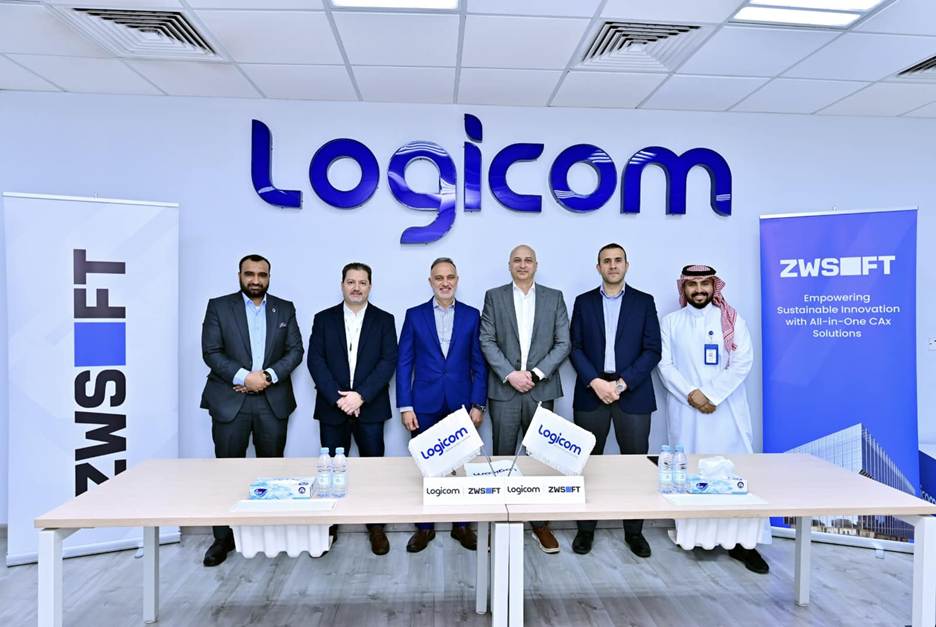
Naim AlHammami, Country Manager, ZWSOFT Saudi Arabia, said: “With the surging demand for advanced tech solutions in Saudi Arabia, ZWSOFT set out to find a proven, high-caliber distribution partner. Logicom Saudi Arabia is uniquely qualified to drive this expansion, backed by a strong product ecosystem and an established track record in enterprise hardware and software distribution.”
Fadi Karzon, General Manager of Logicom Saudi Arabia, said: “We are pleased to partner with ZWSOFT to bring innovative and cost-effective CAD solutions closer to businesses across Saudi Arabia. By combining ZWSOFT’s technology with Logicom’s local market expertise and strong partner ecosystem, we aim to empower our partners and customers with the tools they need to enhance productivity, drive innovation and support the Kingdom’s digital transformation goals.”
Through this partnership, ZWSOFT and Logicom aim to expand the availability of professional design software across Saudi Arabia and strengthen support for the country’s growing engineering and construction industries.
Tech News
PlanRadar Research Highlights Project Delivery Risks for UAE Construction Teams Ahead of 2027

PlanRadar, a leading platform for digital documentation, communication and reporting in construction and real estate projects, has highlighted key project delivery risks facing construction teams as activity across the UAE continues to grow.
PlanRadar’s Construction Survey Report 2026: Managing Project Changes in the Age of AI surveyed 1,728 construction professionals responsible for on-time and on-budget delivery across 14 countries in Europe, the Middle East and Asia-Pacific, including the UAE and Saudi Arabia. The findings were also explored in PlanRadar’s webinar, Managing Mid-Project Changes in the Age of AI.
The research comes as UAE construction output is projected to reach US$130.8 billion by 2029, up from a record US$107.2 billion in 2024, according to Knight Frank. As project volumes and stakeholder complexity increase, the ability to manage changes, approvals and project records efficiently will remain central to delivery performance.
One of the clearest concerns identified in PlanRadar’s research is the impact of delayed approvals and slow responses. These were the most common pain points reported in the management of mid-project changes, including RFIs, change orders and variation requests. Nearly three-quarters of respondents said approvals are often received after agreed timeframes, while one in four estimated that delayed approvals typically add more than a month to project timelines.
Among teams where approvals are almost always late, month-long project delays were more than twice as likely as among those where late approvals are rare.
Ibrahim Imam, Co-Founder and Co-CEO of PlanRadar, said: “In a market delivering projects at the UAE’s current pace, small delays in decision-making can quickly become much larger delivery problems. Going into 2027, companies need clearer ownership, predefined approval routes and faster access to the information decision-makers need. The aim is not to eliminate change—change is inevitable—but to ensure every change is visible, traceable and acted on before it affects programme or cost.”
PlanRadar’s findings also show the financial impact of unmanaged changes. Two in three respondents said that mid-project changes lead to budget overruns in many or most of their projects. However, the research indicates that stronger process control can improve outcomes: four in five respondents using a central digital tool to track changes reported an improved ability to control costs or protect project margins.
Information fragmentation is another challenge. Nearly eight in ten respondents said that at least half of their project documentation is spread across unconsolidated channels, including emails, messages, phone calls and verbal instructions. Among those who could easily locate documentation, 70% felt confident that their records clearly showed responsibility for delays and cost impacts—double the proportion among those who found documentation difficult to locate.
Administrative workload compounds these pressures. Nearly half of respondents reported spending 11 or more hours each week on administrative tasks. Among those using a central digital tool with integrated AI functionality, two in three said they save at least two hours per week, per project, on administration and coordination.
Andrey Belogortsev, Regional Manager for MENA and APAC at PlanRadar, said: “The immediate opportunity for construction teams is to build reliable, connected workflows around the information already being generated on site. When changes, approvals and supporting evidence are captured in one accessible record, teams can identify issues earlier, engage the right people faster and maintain accountability throughout the project lifecycle.”
“AI can add real value when it is applied to repetitive, time-consuming work within those controlled workflows. It should support professional judgement—not replace it—by giving project teams more time to focus on decisions, risks and exceptions that require their expertise.”
The survey found that 58% of respondents believe AI can reduce workload across their biggest day-to-day challenges, while 65% believe it can streamline major administrative tasks.
Building on this need, PlanRadar has introduced AI Agents, allowing customers to create agents in plain language or use ready-made options to complete defined actions. Each action is logged, attributed and limited to the permissions of the user who created the agent, enabling teams to automate routine work while retaining oversight and control.

A REIMAGINED PRIME68 RETURNS TO JW MARRIOTT MARQUIS DUBAI ALONGSIDE ION, A NEW “NEIGHBOURHOOD IN THE SKY”
Radisson Blu Hotel Dubai Deira Creek Invites Guests to Celebrate Diwali with Family, Flavour and Festive Stays
Trust Is the New Speed – AI, Lexis+ with Protégé and the future of legal work in the Middle East



-

 Trending12 months ago
OPPO A6 Pro 5G Review: Reliable Daily Driver
-

 Tech News2 years ago
Denodo Bolsters Executive Team by Hiring Christophe Culine as its Chief Revenue Officer
-
 VAR2 years ago
Microsoft Launches New Surface Copilot+ PCs for Business
-

 Automotive2 years ago
AGMC Launches the RIDDARA RD6 High Performance Fully Electric 4×4 Pickup
-
Tech Interviews3 years ago
Navigating the Cybersecurity Landscape in Hybrid Work Environments
-

 Hospitality2 years ago
Gulfood 2025 30th Edition Kicks Off Today, Setting New Benchmarks in F&B Growth and Innovation
-

 VAR10 months ago
Huawei Nova 14 Pro Review: Where Camera Excellence Meets Ecosystem Evolution
-

 Tech News1 year ago
Nothing Launches flagship Nothing Phone (3) and Headphone (1) in theme with the Iconic Museum of the Future in Dubai