
 Have a question? +971 56 404 0503




Financial
MultiBank Group and Khabib Nurmagomedov Launch an Exclusive Worldwide Multi-Billion-Dollar Joint Venture to Build the World’s First Regulated Tokenized Sports Ecosystem

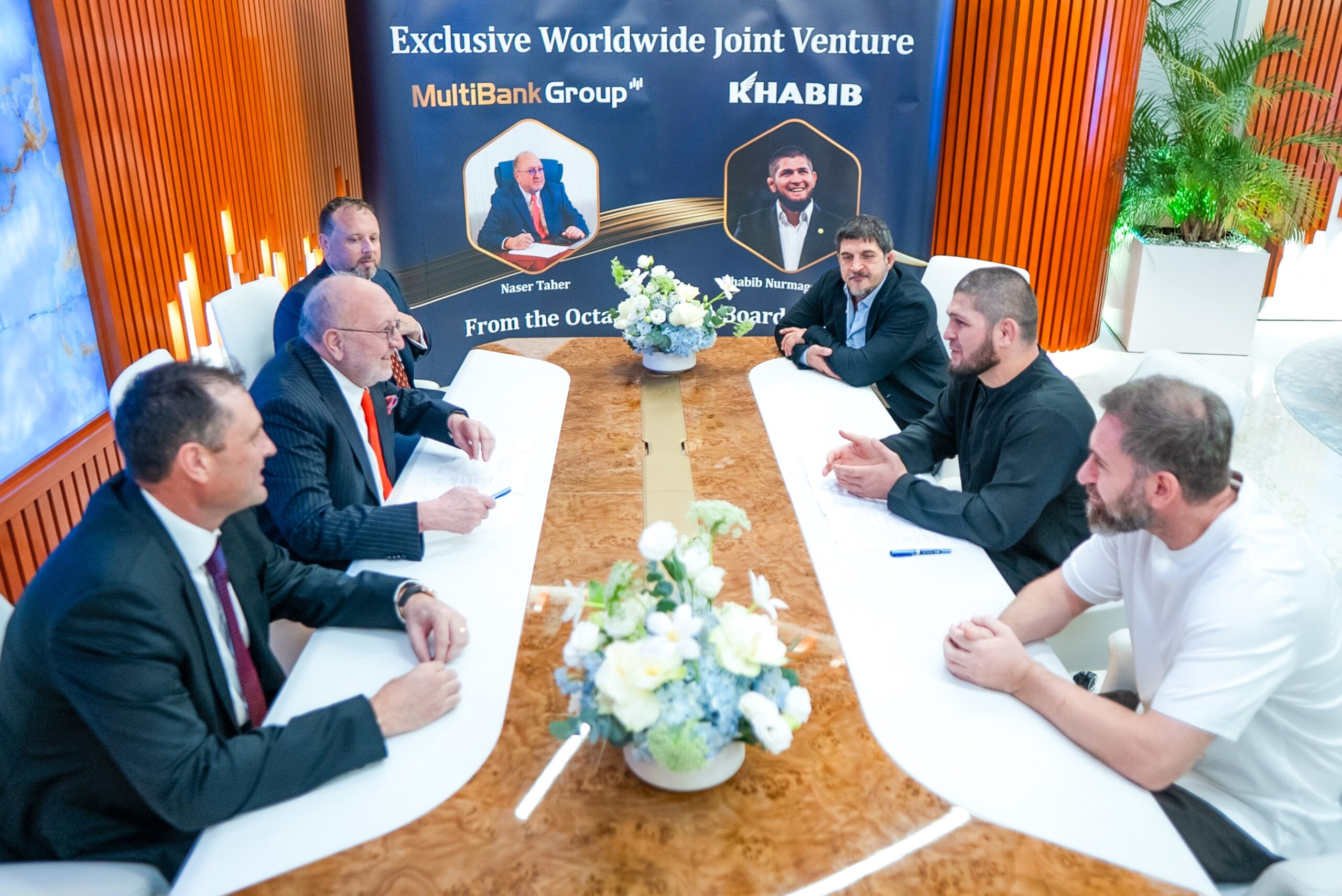
Multibank Group, the financial derivatives institution, has entered into an exclusive worldwide multi-billion-dollar joint venture with global sports icon and undefeated UFC champion Khabib Nurmagomedov (29-0) to create a first-of-its-kind regulated ecosystem connecting global finance, sports and technology.
The partnership will culminate in the creation of a multi-billion-dollar joint venture, MultiBank Khabib LLC, uniting two global powerhouses: MultiBank Group, a leader in regulated financial excellence, and Khabib Nurmagomedov, undefeated in the octagon and whose influence extends far beyond sport. The company will operate from MultiBank Group’s headquarters in Dubai, building a worldwide network of high-end sports ventures and real-world digital assets. This structure fulfills the vision of MultiBank Group Founder and Chairman, Naser Taher, for an exclusive global joint venture, granting MultiBank exclusive rights to develop and promote projects under the Khabib Nurmagomedov brand name, including the development of 30 state of the art Khabib gyms, Gameplan and Eagle FC brands.
The entire venture is backed by MultiBank Group’s regulated digital ecosystem and powered by its cornerstone $MBG Token being the driving force behind its expanding portfolio of real-world-asset (RWA) technologies and initiatives.
Naser Taher, Founder and Chairman of MultiBank Group, stated: “From the UAE, we are shaping a new blueprint for the business of sport through the regulated tokenization of real-world sports assets (RWSA). Together with Khabib Nurmagomedov, and powered by our ecosystem token, $MBG, we are uniting finance and athletics into a single transparent, technology-driven ecosystem — one built on trust, innovation, and the strength of the MultiBank framework. This initiative proudly aligns with the UAE’s vision of becoming a global hub for digital asset innovation and world-class sports.”
Khabib Nurmagomedov added: “This partnership with MultiBank Group is built on shared values of strength, respect, and discipline. Together with Multibank, we are building real global opportunities that go beyond sport, empowering athletes, and fans through a regulated and innovative digital ecosystem. This is only the beginning.”



Qashio, the UAE’s leading spend management platform, has partnered with NEXA AI Lab, the AI division of NEXA, one of MENA’s leading digital growth agencies, to help accelerate AI adoption across finance teams in the UAE through automation and AI-powered financial workflows.
As part of the partnership, Qashio and NEXA AI Lab will work together to support businesses in adopting AI tools that improve spend visibility, streamline manual processes, and make finance operations more efficient. The partnership will also include a free AI audit to help finance teams identify where AI can deliver immediate operational value and support broader adoption across the business. Both companies say the initiative is designed to move businesses from AI awareness to implementation, in line with the UAE’s national AI strategy targeting full public sector AI integration by 2031.
Amit Vyas, CEO of NEXA, comments: “AI delivers value when it is embedded directly into day-to-day workflows, rather than treated as a standalone concept. Finance is one of the clearest areas where this shift is already taking place, with businesses under increasing pressure to improve real-time decision-making. Through our partnership with Qashio, our goal is to help organisations identify where AI can be applied in practical, high-impact ways across financial operations.”
Armin Moradi, CEO of Qashio, said: “A global industry survey shows that 81% of financial institutions expect AI to be embedded in their core operations by 2030, and the UAE is one of the fastest-growing AI markets globally, setting a new baseline for competitiveness across the private sector. Our partnership with NEXA AI Lab is built to help close the gap between AI adoption plans and real execution, enabling enterprises and SMEs in the UAE to compete with the best in the world.”
Qashio has already integrated AI into its own financial workflows through features such as AI-powered receipt capture, which automatically extracts key information, including TRN, vendor names, and transaction data. The technology helps finance teams reduce manual data entry, save more than 4 hours each week, and maintain cleaner, more reliable financial records.
NEXA brings deep expertise in digital transformation and AI implementation across industries. Together, the two companies are focused on making AI accessible and measurable for businesses in the UAE. Both companies are already using tools like ConvoAI to improve access to data and provide instant support outside of working hours. Qashio is already leveraging NEXA AI Lab’s product offering. This reflects a broader shift towards always-on, AI-enabled operations.
Financial
Standard Chartered Supports Pakistan’s First Panda Bond Issuance in Chinese Interbank Market
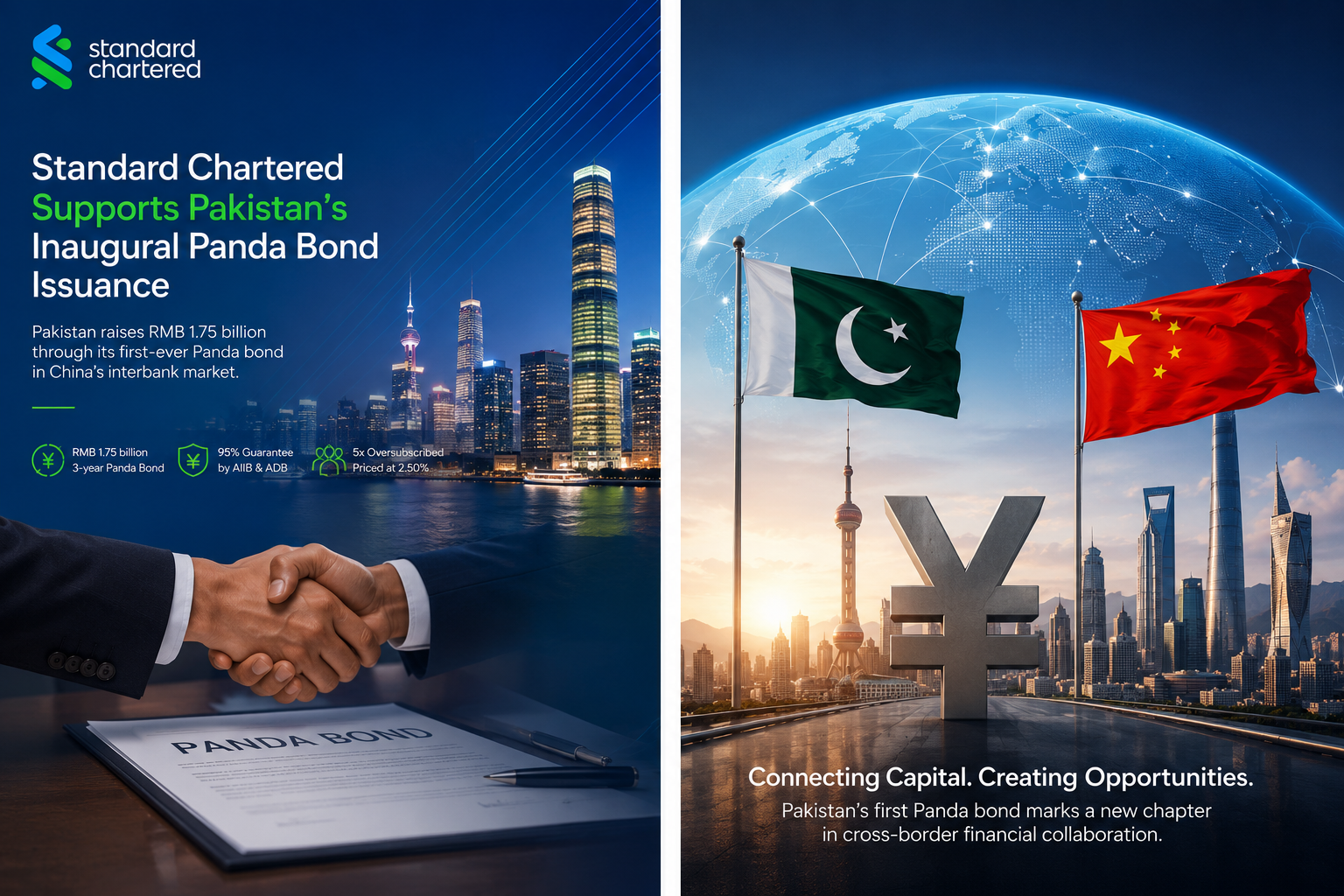
Pakistan has successfully completed its inaugural Panda bond issuance in China’s interbank bond market, raising RMB 1.75 billion through a three-year transaction that marks the country’s first direct entry into China’s capital markets.
Standard Chartered (China) Ltd. Co acted as the only foreign bank serving as joint lead underwriter and joint book runner for the transaction, supporting Pakistan in broadening its international financing channels while strengthening financial connectivity between regional capital markets.
The issuance received strong support from multilateral development institutions, including the Asian Infrastructure Investment Bank (AIIB) and the Asian Development Bank (ADB), which together guaranteed 95 per cent of the bond’s principal and interest payments. The structure helped attract significant demand from Chinese banks, securities houses, and international financial institutions.
The transaction was reportedly more than five times oversubscribed, allowing Pakistan to price the bond at 2.50 per cent, the tightest end of the indicated pricing range.
Salman Ansari, Global Head, Capital Markets, Standard Chartered, described the issuance as a strategically important transaction that expands Pakistan’s access to global liquidity pools while demonstrating the growing relevance of regional capital markets within the international funding landscape.
The transaction also reflects the broader evolution of the Renminbi within global financial markets, as China continues expanding the role of its currency beyond trade settlement into cross-border financing and sovereign funding structures.
Jerry Zhang, Global Head of Banks & Broker Dealers and Head of Coverage, Greater China and North Asia at Standard Chartered, said the transaction highlighted the bank’s role in connecting international issuers with China’s domestic capital markets while also reflecting the continued internationalisation of the Renminbi.
The Panda bond market has increasingly attracted a wider range of sovereign, supranational, and institutional issuers in recent years as regional economies explore diversified funding channels and deeper access to Chinese liquidity pools.

By Nazneen Abbas, Founder, Ma’an
Families with wealth across borders are already used to complexity. They live with different legal systems, different inheritance regimes, and different tax realities, often all at once. That part is not new. What has changed is the speed at which the environment around those structures is moving. The geopolitical backdrop is no longer something families can treat as distant noise. It is beginning to alter the conditions in which wealth is held, transferred, and protected.
That is becoming visible in the questions families are now asking. Across the GCC, many who already have Wills, trusts, foundations, and succession structures in place are no longer asking whether they have planned. They are asking whether what they put in place still holds. The conversation is shifting away from documents and toward durability, resilience, and relevance over time.
The issue is not complexity, it is movement
Cross-border planning has always required care. What feels different now is the sense that the regulatory environment may be entering a period of faster movement. Tax agreements that were once taken as given could come under review. Reporting standards may tighten further. Frameworks in some jurisdictions may no longer offer the same level of certainty that families have relied on.
That does not automatically make an existing plan ineffective. It does mean the assumptions on which it was built may no longer be fully reliable. A structure that made sense five or seven years ago may still be valid on paper, but it may now interact differently with another jurisdiction’s rules. That difference is where risk begins to accumulate.
Many families are not dealing with poor planning. They are dealing with planning built for a slower-moving environment. A framework can be professionally drafted and entirely appropriate for its time, yet still require review because the conditions around it have changed. The gap, in many cases, is one of timing rather than quality.
Families do not experience risk as corporations do
Public discussion around geopolitical risk is usually framed in corporate language – market access, supply chains, revenue exposure. But geopolitical literacy is no longer just a corporate issue.
The same forces that alter corporate decision-making also alter the legal and tax environment in which private wealth sits. The difference is that families encounter those forces at far more personal moments. A business responds through compliance and restructuring. A family may discover, during a bereavement or a generational transition, that a structure meant to preserve stability is now sitting between conflicting legal systems or newly expanded obligations. The cost of outdated planning is rarely just technical. It is emotional, and it often surfaces when a family is least equipped to navigate it.
What a meaningful review actually covers
Families and family offices in the GCC with assets or obligations across multiple jurisdictions need to review their planning as a connected system. The question is not whether the Will is signed or the foundation properly established. It is whether those elements continue to work together under current conditions.
Do existing Wills still align with the succession laws of each jurisdiction involved? Do trust or foundation structures still operate as intended alongside local inheritance frameworks, reporting obligations, and tax treatment? The review also needs to reach instruments often created with care and then left untouched. Private Placement Life Insurance (PPLI), for example, may still be appropriate, but its treatment can vary depending on where the family is resident, where beneficiaries sit, and how international agreements evolve. Dynasty Trusts and Irrevocable Life Insurance Trusts (ILITs), especially when governed by US law, deserve renewed scrutiny where family circumstances or legal interpretation have materially changed.
This is not about alarm. It is about alignment. Cross-border structures fail less often because a single instrument is flawed, and more often because the instruments stop speaking to one another.
The plan may hold. Does it still fit?
A plan can remain legally intact and still fall behind. Families change. Children grow up. New dependents enter the picture. Businesses expand into new jurisdictions. Property is acquired in places never part of the original conversation.
If a structure no longer reflects the family’s wishes, responsibilities, or values, it is no longer doing its full job. The real test is not whether it remains untouched, but whether it continues to reflect the life it is meant to support. That matters especially in this region, where families operate across borders almost by default.
The strongest plans are not always the most elaborate. They are the ones revisited honestly and adjusted before pressure forces the issue. Families often treat estate planning as something to complete and put away, which is understandable.
Cross-border wealth planning across jurisdictions cannot remain static. It requires ongoing stewardship. Families that pause to review their structures now are doing what good planning has always required: ensuring the framework continues to reflect not just the world it operates in, but the family it is there to serve.


65% OF ANALYSTS SAY AI WORKS BEST WHEN THE LOGIC IS MANAGED AT THE BUSINESS LEVEL, ALTERYX RESEARCH FINDS

COMMUNITY MESSAGES COME TO LIFE AT YAS MALL’S TREE OF GRATITUDE REVEAL
AT.MOSPHERE AT BURJ KHALIFA: FOUR MOMENTS, ABOVE THE ORDINARY



-
News11 years ago
SENDQUICK (TALARIAX) INTRODUCES SQOOPE – THE BREAKTHROUGH IN MOBILE MESSAGING
-

 Tech News2 years ago
Denodo Bolsters Executive Team by Hiring Christophe Culine as its Chief Revenue Officer
-

 Trending7 months ago
OPPO A6 Pro 5G Review: Reliable Daily Driver
-
 VAR1 year ago
Microsoft Launches New Surface Copilot+ PCs for Business
-
Tech Interviews2 years ago
Navigating the Cybersecurity Landscape in Hybrid Work Environments
-

 Automotive2 years ago
AGMC Launches the RIDDARA RD6 High Performance Fully Electric 4×4 Pickup
-

 Tech News10 months ago
Nothing Launches flagship Nothing Phone (3) and Headphone (1) in theme with the Iconic Museum of the Future in Dubai
-

 VAR2 years ago
Samsung Galaxy Z Fold6 vs Google Pixel 9 Pro Fold: Clash Of The Folding Phenoms