
 Have a question? +971 56 404 0503




Tech News
Alteryx Launches AI Insights Agent on Google Cloud Marketplace, Bringing Reliable, Repeatable AI Answers into Gemini Enterprise

Alteryx, Inc., an AI-ready data and analytics company, today announced the launch of the Alteryx AI Insights Agent, now available on Google Cloud Marketplace, bringing governed analytics directly into Gemini Enterprise. As companies increasingly turn to AI to drive decisions, a critical gap has emerged between speed and trust. While generative AI is reshaping how work gets done, most approaches still fall short in enterprise environments where accuracy, governance, and control are essential. AI-generated responses are often inconsistent with business metrics, difficult to validate, and not aligned with how organisations actually operate. Nearly half of leaders cite high-quality, accessible, and well-governed data as the top factor for agentic AI to reach its full potential, underscoring the gap between AI capability and enterprise readiness.
“At the core of enterprise AI is trust,” said Ben Canning, Chief Product Officer at Alteryx. “When it comes to decisions like pricing, operations, or compliance, accuracy isn’t optional. AI doesn’t just need data — it needs to understand how the business actually works. That means applying defined logic, rules, and context that the people closest to the work understand and continuously evolve. With the AI Insights Agent, we’re bringing that logic directly into Gemini Enterprise, so every answer is consistent, explainable, and ready to drive action.”
The Alteryx AI Insights Agent allows information workers to define governed datasets and business logic within Alteryx One that are executed in response to user queries in Gemini Enterprise. Instead of generating answers from raw or unstructured data, the agent leverages in-place analytics to run predefined workflows directly on data platforms such as BigQuery, ensuring outputs align with business metrics without the need for data movement or manual effort.
With the Alteryx AI Insights Agent, organizations can:
- Deliver trusted insights at scale: Consistent answers grounded in enterprise data
- Enable seamless user experience: Information workers to access insights directly within Gemini Enterprise
- Encode analyst-driven control: With business logic, definitions, and guardrails into every interaction
- Maintain enterprise governance: Including auditability, predictability, and control across AI-driven decision-making
“Bringing AI Insights Agent to Google Cloud Marketplace will help customers quickly deploy, manage, and grow the agent on Google Cloud’s trusted, global infrastructure,” said Dai Vu, Managing Director, Marketplace & ISV GTM Programs at Google Cloud. “Alteryx can now securely scale and support customers on their digital transformation journeys.”
The Alteryx AI Insights Agent delivers faster, more trusted answers within the tools employees love to use. For business analysts and operations teams, it extends the value of their Alteryx investments into AI-driven experiences for everyday decision-making. For IT and data leaders, it provides a path to accelerate AI adoption without compromising trust.
This release builds on Alteryx’s expanding collaboration with Google Cloud, following the introduction of in-place analytics on BigQuery earlier this year. With the addition of the AI Insights Agent for Gemini Enterprise, Alteryx is extending its platform from governed data and workflows into AI-driven environments, with further innovations—including the new Alteryx One: Google Edition, planned for later this year.
Tech News
HONOR Announces Participation at LEAP 2026, Showcasing the World’s First Robot Phone and Its AI Ecosystem Vision

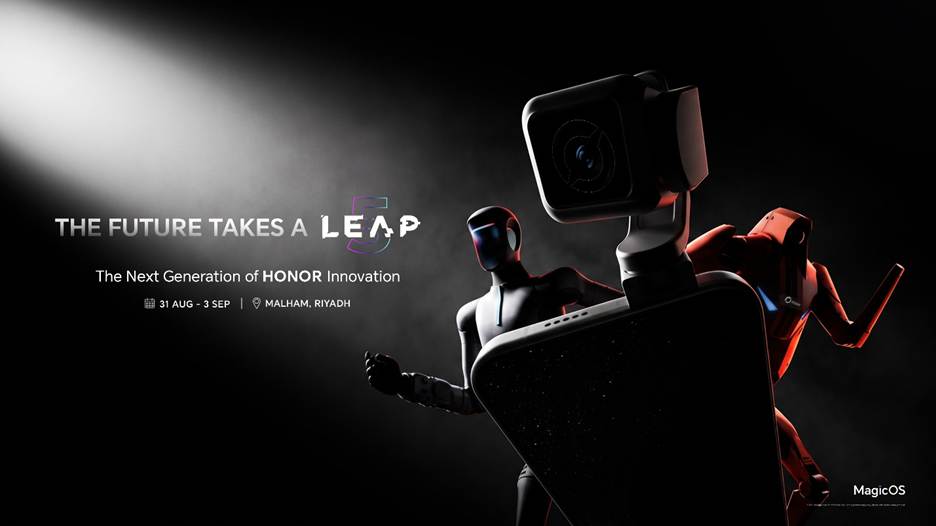
Global leading AI device ecosystem company HONOR today announced its participation in LEAP 2026, taking place from 31 August to 3 September in Riyadh, under the theme “Alpha Plan: From Vision to Reality.” The participation highlights HONOR’s commitment to bringing its AI ecosystem closer to families across the Kingdom and demonstrating how intelligent, connected technologies can enhance everyday experiences.
A key highlight of HONOR’s presence will be the world’s first Robot Phone, a groundbreaking AI device and a defining milestone in the HONOR Alpha Plan, representing a new step forward in the evolution of intelligent devices.
Visitors will have the opportunity to discover explore HONOR Robot Phone, discover new products, innovative technologies and immersive experiences, with HONOR’s growing ecosystem brought to life through a range of real-life scenarios that demonstrate how connected devices can work together to enhance everyday life.
As part of HONOR’s participation, HONOR Regional CMO Lei Kunming will deliver a keynote speech on the LEAP mainstage titled “HONOR Alpha Plan: From Vision to Reality,” sharing HONOR’s vision for the future of AI and how the company is working to bring its AI ecosystem into everyday life.
Discover What’s Next from HONOR
At LEAP, HONOR will showcase new products and technologies, giving visitors a first look at the latest innovations shaping the brand’s expanding ecosystem.
The HONOR booth will bring this vision to life through real-life scenarios, demonstrating how smartphones, tablets, wearables and other smart devices can work together to deliver more seamless, intelligent and connected experiences.
Beyond product showcases, visitors will also have the opportunity to explore interactive demonstrations and engagement activities, providing a closer look at HONOR’s latest technologies and the experiences they enable.
LEAP: A Global Hub for Technology and Innovation
HONOR’s participation underscores the importance of Saudi Arabia as a growing global hub for technology and digital innovation. For HONOR, LEAP provides an important platform to connect with consumers, technology enthusiasts and industry leaders while showcasing its vision for a more connected, intelligent and human-centric technology ecosystem.
As HONOR continues to expand its presence and ecosystem across the region, its return to LEAP reflects the company’s commitment to bringing meaningful innovation closer to consumers and the technology community. Through its latest technologies, connected experiences and the world’s first Robot Phone, HONOR will give visitors a closer look at how its AI ecosystem
-END-
About HONOR
HONOR is a global leading AI device ecosystem company. It is committed to revolutionizing human-to-device interactions to bridge the AI ecosystem with all consumers in the agentic AI era and beyond. The company endeavors to open industrial boundaries through open, seamless collaboration to co-create a value-sharing ecosystem with industry partners. With an innovative product portfolio spanning intelligent phones, AI PCs, tablets, wearables and more, HONOR aims to empower every human, enabling everyone to embrace the new intelligent world.
Tech News
Redington Brings 400 Technology Leaders to Singapore as a Technology Ecosystem Orchestrator

Redington Limited, a technology ecosystem orchestrator, today announced Global NEXT 2026, its flagship, invitation-only leadership summit, taking place from 2–4 September 2026 in Singapore.
The three-day forum will bring together approximately 400 leaders representing global technology companies, channel partners, enterprise customers, independent software vendors, innovators and policymakers from across Asia, the Middle East and Africa.
More than a technology conference, Global NEXT is designed as a working ecosystem-connecting the organisations creating breakthrough technologies with the partners who can localise and implement them, the enterprises seeking measurable outcomes, and the leaders shaping the future of high-growth markets.
The summit comes at a pivotal moment for artificial intelligence. Enterprises, SMBs and Public Sector are moving beyond experimentation and asking a more consequential question: how can AI be deployed securely, governed responsibly and scaled to deliver meaningful business, economic and societal impact?
At the centre of the programme will be the Global NEXT AI Summit, addressing sovereign AI, national technology infrastructure, data governance, cybersecurity, enterprise adoption and the partnerships required to build locally relevant technology capabilities at scale.
From Fragmented Innovation to Orchestrated Outcomes
The next phase of AI adoption will require much more than access to individual technologies. Infrastructure, cloud, data, cybersecurity, applications, skills, services, financing and implementation capabilities must work together around clearly defined outcomes.
Redington’s role as a Technology Ecosystem Orchestrator is to make those connections work-linking global innovation with local market intelligence, specialised capabilities, partner reach and execution across more than 40 markets.
V.S. Hariharan, Managing Director and Group CEO, Redington Limited, said:
“The next chapter of technology will not be shaped by one product, one platform or one company. It will be built by ecosystems.
“Customers need infrastructure, cloud, cybersecurity, software, data, skills and specialised partners to come together around the outcomes they want to achieve. Redington’s role is to orchestrate these capabilities-reducing complexity, connecting global innovation with local execution and creating a clearer path from possibility to adoption.
“This is especially important across high-growth markets, where ambition is immense but access to technology, capabilities and skills can remain fragmented. Global NEXT brings the ecosystem together to turn that ambition into secure, scalable and measurable progress.”
Participants will experience this orchestration model through technology demonstrations, enterprise use cases, leadership exchanges and visits to centres of excellence in Singapore, including the Redington AI Launchpad.
The programme will also showcase emerging technology companies and specialist ISVs across AI, cloud, cybersecurity, data infrastructure and enterprise applications. Redington’s wider ecosystem-including its AI Exchange, digital platforms, skilling capabilities and partner enablement programmes-will demonstrate how innovation can be discovered, evaluated, localised and taken to market more rapidly.
Creating New Pathways to Growth
For global technology companies, Global NEXT provides direct access to enterprise priorities, partner capability and growth opportunities across diverse markets.
For partners and ISVs, it creates pathways to new technologies, skills, use cases, customers and routes to market.
For enterprises and governments, it brings together an ecosystem through which complex technologies can be evaluated, secured, financed, implemented and scaled.
Puneet Chadha, Global Chief Marketing Officer, Redington Limited, said:
“Global NEXT is where global innovation meets local ambition. It puts the people shaping technology, building capability and solving real-world problems in the same room.
“The measure of this platform will not simply be the conversations it hosts, but the partnerships it starts, the use cases it advances and the opportunities it unlocks. We want participants to leave Singapore with more than inspiration-with new connections, actionable possibilities and a clearer path to what comes next.”
The Global NEXT programme will combine strategic conversations with practical engagement, including technology demonstrations, enterprise success stories, ecosystem panels, leadership exchanges and visits to technology centres of excellence.
Discussions will span artificial intelligence, hybrid cloud, cybersecurity, software-led business models, responsible technology adoption and the evolution of routes to market. Together, these sessions will explore how the technology industry can move from selling individual solutions to orchestrating integrated outcomes.
With operations across more than 40 markets, relationships with 450+ technology brands and a network of over 70,000 channel partners, Redington sits at the intersection of global technology innovation and local execution.
Through Global NEXT 2026, Redington aims to strengthen that intersection-creating a platform where technology providers, partners, innovators, enterprises and policymakers can collectively shape the next phase of technology adoption across Asia, the Middle East and Africa.
Tech News
NETSCOUT EXTENDS ADAPTIVE DDOS DEFENSE PROTECTION TO ADDRESS THE RISING BUSINESS COST OF WEAPONIZED BROADBAND AND IOT DEVICES

NETSCOUT® (NASDAQ: NTCT), a leading provider of observability, AIOps, cybersecurity, and DDoS attack protection solutions, today announced an extension of its Adaptive DDoS Protection (ADP) solution enabling service providers to automatically detect and mitigate outbound DDoS attack traffic. By extending protection from the attack target towards its source, NETSCOUT helps operators prevent compromised subscriber devices from disrupting their own networks, consuming costly capacity and attacking customers and organizations across the internet.
Consumer broadband routers, cameras and other IoT devices are increasingly being weaponized by Turbo-Mirai class botnets capable of generating multi-terabit attacks. These outbound attacks have already caused costly service outages, reputational damage and customer loss, and damage to peering relationships risking a large increase in transit costs at service providers around the world. By detecting and mitigating malicious traffic generated by compromised device populations before it leaves their networks, service providers can reduce abuse complaints and infrastructure costs while protecting their own networks and services and helping lower subscriber churn and regulatory risk.
“The combination of higher-speed broadband connectivity and vulnerable IoT devices has been weaponized by a new class of massive DDoS botnets,” said Patrick Donegan, founder and principal analyst, HardenStance. “Source-side mitigation, or attack suppression as it’s sometimes known, is a critical part of the equation. NETSCOUT’s approach, backed by its ATLAS Intelligence Feed (AIF) and ASERT analysts, gives service providers the tools they need to detect and stop attacks before they have an impact, protecting their customers and the broader internet from the large-scale DDoS attacks we have seen.”
Using AI-powered threat intelligence and automated detection and mitigation, NETSCOUT’s ADP solution, an addition to its Arbor Sightline and Arbor Threat Mitigation System:
- Automatically detects and mitigates ever evolving attacks through dynamic detection, intelligent redirection and adaptive mitigation.
- Extends these capabilities to outbound traffic, combining enhanced, customized detection with comprehensive threat intelligence tailored for each ISP.
- Uses NETSCOUT’s proprietary AI/ML-powered DDoS detection to analyze massive volumes of outbound internet traffic to uncover attacks designed to hide within legitimate flows.
- Draws on unique global real-time intelligence of DDoS activity covering approximately half of all internet traffic to rapidly detect and mitigate DDoS attacks and pinpoint the responsible, compromised devices.
“We are extending DDoS defense from the target to the source,” stated Darren Anstee, CTO, Security, NETSCOUT. “By using our internet-scale visibility to derive localized threat intelligence for our customers, NETSCOUT can identify and precisely suppress attacks at their origin, before they cause problems locally or at their target. This capability gives our customers a new level of comprehensive defense across their peering, transit, cloud and customer edges.”
This expansion of capabilities demonstrates how NETSCOUT is applying its global threat visibility and proven ADP solution to meet emerging service provider challenges. By extending an established inbound DDoS workflow to outbound and cross-bound threats, NETSCOUT enables operators to improve network-resilience, cost-controls and revenue protection through its proven Arbor Sightline and Arbor TMS solutions.


Baseus PicoGo AC22 Review: How Much Power Can Fit in Your Pocket?

Baseus Inspire XH1 Review: A Dependable Daily Driver That Just Keeps Going

EYWA Way of Water to be EMFIS® Certified for Low-Electromagnetic Environment in Dubai’s Business Bay



-
News11 years ago
SENDQUICK (TALARIAX) INTRODUCES SQOOPE – THE BREAKTHROUGH IN MOBILE MESSAGING
-

 Trending10 months ago
OPPO A6 Pro 5G Review: Reliable Daily Driver
-

 Tech News2 years ago
Denodo Bolsters Executive Team by Hiring Christophe Culine as its Chief Revenue Officer
-
 VAR1 year ago
Microsoft Launches New Surface Copilot+ PCs for Business
-

 Automotive2 years ago
AGMC Launches the RIDDARA RD6 High Performance Fully Electric 4×4 Pickup
-
Tech Interviews2 years ago
Navigating the Cybersecurity Landscape in Hybrid Work Environments
-

 Tech News1 year ago
Nothing Launches flagship Nothing Phone (3) and Headphone (1) in theme with the Iconic Museum of the Future in Dubai
-

 VAR2 years ago
Samsung Galaxy Z Fold6 vs Google Pixel 9 Pro Fold: Clash Of The Folding Phenoms