
 Have a question? +971 56 404 0503




Tech Features
The Future of Work-Integrated Learning: Embedding HR Tech Practices in Higher Education


Professor Fiona Robson, Head of the School of Social Sciences and Edinburgh Business School, Heriot-Watt University Dubai

Universities have a responsibility to prepare students for their future career in terms of both skills and knowledge. In an increasingly technological world, managers of the future need to understand the capabilities of HR tech as well as being able to use it.
Exposing students to HR tech platforms can help to prepare them for their future career in HR in terms of skills but also understanding what is going on in the HR space – understanding the priorities and why use of technology is growing. Being familiar and comfortable with HR tech might help them to stand out in the graduate marketplace and from an employer’s perspective could help them hit the ground running. Being able to analyse data to inform organisational decisions is critical and HR tech gives them the ability to get good data and then learn how to use it to make appropriate data-driven decisions.
Real play rather than role play is particularly helpful for students as the learning is more meaningful, and they can visualise what would happen in the workplace. Therefore, using software which is being used in real organisations will add great value to their learning experience and what their future role might involve. Where University academics have strong relationships with industry, they may be able to use real data so that the students get a realistic experience and understand the complexity of what organisations have to contend with.
Where the HR tech has the capability to provide commentary based on the student performance in using it, this is a further source of information of formative feedback which helps students with their academic and personal development. Developing students’ confidence in using tech should not be underestimated as if they have the knowledge but are afraid to use it, their impact will be limited. Ideally, organisations are looking for graduates who are comfortable in learning to use new programmes and understand some of the teething troubles that can emerge when introducing new tech.
Involving HR professionals within the classroom adds significant value to students and helps them to understand the diverse nature of working in an HR team. Therefore where learning to use the HR tech platform can be married with having an HR professional to talk them through how it can be used and the impact of using it, this would further strengthen their learning and experience. There can also be benefits for HR professionals, as they can gain perspectives from students that may differ from those they encounter in the workplace—particularly if they are interested in potential generational differences. Sharing their own knowledge and skills and presenting to University students can also be very beneficial to the personal and professional development of the HR professional.
Organisations are ideally looking for graduates who are confident in using technology and open to trying new systems and ideas, and therefore, if they have been exposed to different types of tech, this could give them an advantage. They can also learn about some of the wider things about technology implementation – for example, issues around ethics as well as the data protection and legal implications of having access to sensitive and confidential information.
Opening Doors with Internships
Internship programmes provide great insights into the industry and allow students to see the links between theory and practice. It also enables them to see all of the different internal and external factors which can have an impact on organisations, and this can be very eye-opening for them. Understanding the roles of different stakeholders is usually one of the key learning points from internships.
In the classroom, we can teach students the theory about organisational culture and individual and team dynamics; however, an internship is where they can see what this actually looks like. Being able to observe how different departments collaborate may help them to make sense of some of the topics they have studied as part of their degree programme.
We shouldn’t underestimate the importance of learning to build relationships in the workplace and to recognise and respond to issues like organisational politics. For some students, exposure to an internship can help cement their career aspirations in identifying which areas of business they find most interesting, and for some students they will be attracted to roles that they may previously not have been aware of.
As most businesses now have an international aspect, it is also valuable for interns to learn about the different angles of internationalisation and what this means for people in their day-to-day activities. Typically they may recognise it is common for organisations to have international customers but may not have considered international supply chains and the complexities of having employees in different countries which operate under different jurisdictions. It may also reiterate the importance of developing the cross cultural skills that they are taught by their lecturers.
If students’ internships are successful and they are identified as being potential talent of the future, the organisation may begin a longer-term relationship with them. For example, they may allow them to focus their dissertation within the organisation or offering them a job once they graduate.











Kayvan Karim, Programme Director of MSc Software Engineering, School of Mathematical and Computer Sciences, Heriot-Watt University Dubai
For the past few years, the AI infrastructure race has largely been measured in scale: more GPUs, larger data centres and greater power capacity. That expansion is continuing, but the economics are beginning to change. Competitive advantage may increasingly depend not only on securing additional power, but on extracting more useful AI work from the power already available. Part of the reason is a change like AI demand. We are moving from relatively simple prompt-and-response systems towards agents that can reason across multiple steps, call tools, inspect results, revise plans and continue working autonomously. Anthropic’s latest Economic Index notes that Claude usage is increasingly shifting towards long-running agentic tasks and that more computationally intensive conversations tend to be associated with higher-value outputs.
This transition could have significant implications for infrastructure demand. A chatbot might generate one answer to one prompt. An agent performing a software-development, research or business task may invoke a model dozens of times, maintain a large context, call external tools and generate many intermediate reasoning steps before producing an outcome. Demand may therefore grow in two ways: more people using AI and more inference, model calls, and tokens processed for each task. Major AI laboratories are already working on this efficiency problem. OpenAI says one of its primary inference objectives is to serve more tokens from the same hardware, using techniques including scheduling, caching, kernel optimisation and improved model implementation. It also describes GPT-5.6 as being trained to accomplish more work per token. Google DeepMind is pursuing a similar direction: its Gemini 3.6 Flash was designed for scaled agentic workloads and uses fewer output tokens than its predecessor on several evaluations. In contrast, its recent agentic video system reduced token consumption by up to 88% for that workload.
Other approaches address efficiency at the model architecture level. DeepSeek-V3, for example, uses a Mixture-of-Experts design with 671 billion total parameters but activates 37 billion per token, so only part of the network is used for each computation. Meta has similarly worked on inference efficiency through grouped-query attention and more efficient tokenisation; the Llama 3 tokeniser was reported to require up to 15% fewer tokens than Llama 2 for equivalent text. Taken together, these approaches show that model capability is increasingly being developed alongside the cost of delivering it.
Model-level efficiency, however, is unlikely to remove the infrastructure constraint on its own. Global data-centre electricity consumption was approximately 415 TWh in 2024, according to the International Energy Agency, and its base case projects this to reach around 945 TWh by 2030. AI is expected to drive most of that growth. Efficiency is therefore improving while aggregate demand continues to rise. One reason is the Jevons, or rebound, effect: efficiency improvements reduce the resources required for each unit of work, but lower costs can also encourage greater overall use. If agents become much cheaper to operate, organisations may respond by deploying more of them, running them for longer, or applying them to tasks that were previously uneconomic. Efficiency can reduce the compute required for an individual task while still increasing total demand.
That increased demand meets infrastructure that cannot expand as quickly. Models and software can improve quickly, but grids, substations, transformers and power-generation infrastructure usually have much longer development cycles. The IEA notes that while a data centre can sometimes be developed within two or three years, the broader energy infrastructure required to support it often involves longer planning and construction periods. Where grid capacity is constrained, each available megawatt becomes a more valuable production resource. The amount of power available remains important, but so does the amount of useful computation that can be produced within that power envelope.
That changes how we should understand capacity. Improvements in accelerator performance, model architecture, workload scheduling, caching, utilisation and inference software can increase computational output without increasing a site’s electrical connection. OpenAI’s recently reported Jalapeño inference hardware illustrates the direction of travel: the company says the chip can deliver more AI work per unit of power while increasing throughput and reducing latency. Efficiency can therefore act as a form of virtual capacity. If two operators each control 100 MW, but one can consistently deliver substantially more useful AI work within that power envelope, their nominal capacity may be identical while their productive capacity is not.
The same constraint applies to physical space and cooling. AI systems are concentrating more computational power into individual racks, increasing both power density and heat output. Packing more accelerators into the same building only creates useful capacity if the electrical and thermal infrastructure can support them. This is one reason liquid cooling is moving from a specialist technology towards a more central part of AI data-centre design. Microsoft, for example, has introduced a closed-loop chip-level cooling architecture that it says eliminates evaporative water consumption for cooling and could avoid more than 125 million litres of water annually per data centre. The example also shows why power, cooling, water use and rack density cannot be treated independently.
The same shift creates a measurement problem. Power Usage Effectiveness, or PUE, has been valuable for showing how much facility energy is required beyond the electricity IT equipment consumes. It does not, however, measure whether that IT equipment is producing useful work efficiently. Uptime Institute’s 2025 survey placed average PUE at around 1.54 and noted that the headline industry figure had changed little for six years. Uptime has consequently argued for productivity measures that relate computational work to energy consumption. For AI inference, tokens per kilowatt-hour might offer one operational measure. Still, even that is incomplete: an efficient model that solves a task in 1,000 tokens may be more valuable than one generating 10,000. A more useful long-term measure may therefore be useful AI work per unit of energy, water and infrastructure.
Capacity will remain essential. The AI industry will continue to build larger data centres, secure new power supplies and deploy large quantities of computing hardware. As agentic systems create more persistent inference demand and physical resources become harder to expand, however, efficiency may increasingly determine the productive value of that capacity. Operators that can support more useful computation within the same power, cooling, water, and space constraints can accommodate more workloads without waiting for equivalent growth in physical infrastructure.
For AI infrastructure, installed megawatts will remain a headline measure. The more consequential measure may increasingly be how much useful AI work those megawatts can support.
Tech Features
TrendAI™Expands Vision One with New Security Capabilities for AI Agents and Application Development


TrendAI™, the global AI security leader and enterprise business unit of Trend Micro Incorporated (TYO: 4704; TSE: 4704), has announced new capabilities for TrendAI Vision One™. These include the private preview of Autonomous Vulnerability Discovery and expanded support for Claude’s Compliance API, which now covers Claude Code and Cowork sessions. Together, these services help enterprises identify exploitable vulnerabilities in source code before attackers do, investigate how AI agents operate, and maintain oversight as AI adoption scales.
The need for this oversight is growing rapidly across the region. According to research conducted by The Harris Poll for Dataiku, 62% of UAE chief information officers believe their organisation have more than 50 AI agents running in production, yet only 18% have a fully unified view of agents across platforms, data environments, and business applications. At the same time, AI is accelerating both how quickly code is written and how quickly attackers can identify flaws. Security teams therefore need to keep pace with AI adoption without losing visibility into what is happening across their environments.
The new capabilities extend TrendAI Vision One™ across both software development and AI agent activity. TrendAI Vision One™ Autonomous Vulnerability Discovery is powered by AESIR, TrendAI’s agentic exploit-remediation engine, which identifies and validates vulnerabilities, including zero-days. It also verifies fixes in customer source code. The engine uses purpose-built, multi-model AI architecture that relies primarily on Anthropic models and has outperformed single-model and agentic system scores on the CyberGym Leaderboard. Every finding is validated by experts from the TrendAI™ Zero-Day Initiative™ (ZDI), the world’s largest vendor-agnostic bug bounty programme. The Autonomous Vulnerability Discovery is deployed and operated on Amazon Bedrock from Amazon Web Services (AWS), enabling the full workflow to run within the customer’s AWS environment
In parallel, the expanded Claude Compliance API integration brings Claude Code and Cowork session records from Claude Enterprise into TrendAI Vision One™. These records include prompts, responses, and tool calls, each tied to a verified user. It enables security teams to investigate AI activity in context, correlate it with endpoint, identity, cloud and network signals, and build custom detections for relevant agent behaviour.
Commenting on the announcement, Salah Suleiman, Managing Director, South Gulf, TrendAI™, said, “AI is changing both how software is built and how work gets done across the enterprise. Code is being written faster than ever, while AI agents are increasingly able to access systems, call tools and act on behalf of users. As organisations across the UAE and the wider region scale AI at pace, their security teams need to identify vulnerabilities early while maintaining clear visibility into what AI systems are doing and whether their actions align with organisational policies. With these additions to TrendAI Vision One™, we are helping organisations move faster with AI while maintaining the context, oversight and control needed to do so securely.”
TrendAI Vision One™ also continues to ingest activity logs from Claude Enterprise, covering user logins, administrative actions and configuration changes, as well as from Claude Platform, covering administrative, system and resource events. Autonomous Vulnerability Discovery is now available in private preview to select enterprise customers running on AWS, while Claude’s Compliance API integration in TrendAI Vision One™ is available to TrendAI Vision One™ customers using Claude Enterprise.
Dr Ryad Soobhany, Deputy Academic Head of School of Mathematical & Computer Sciences, Heriot-Watt University Dubai

Camera systems, such as CCTV, are mainly used for video surveillance within organisations. Passive video surveillance has been part of the security ecosystem for years, providing organisations with the ability to monitor different areas simultaneously, while recorded footage can be inspected after an event occurs.
The evolution of computer chips and increased processing power has led to improved image quality, including better performance in low-light conditions, particularly at night. The advent of edge computing, with processing performed on edge devices within a network, has made object and scene recognition more readily accessible. This evolution has led to more active video surveillance through video analytics, where events can be identified and addressed in real time. Examples include number plate recognition systems and facial recognition for access control.
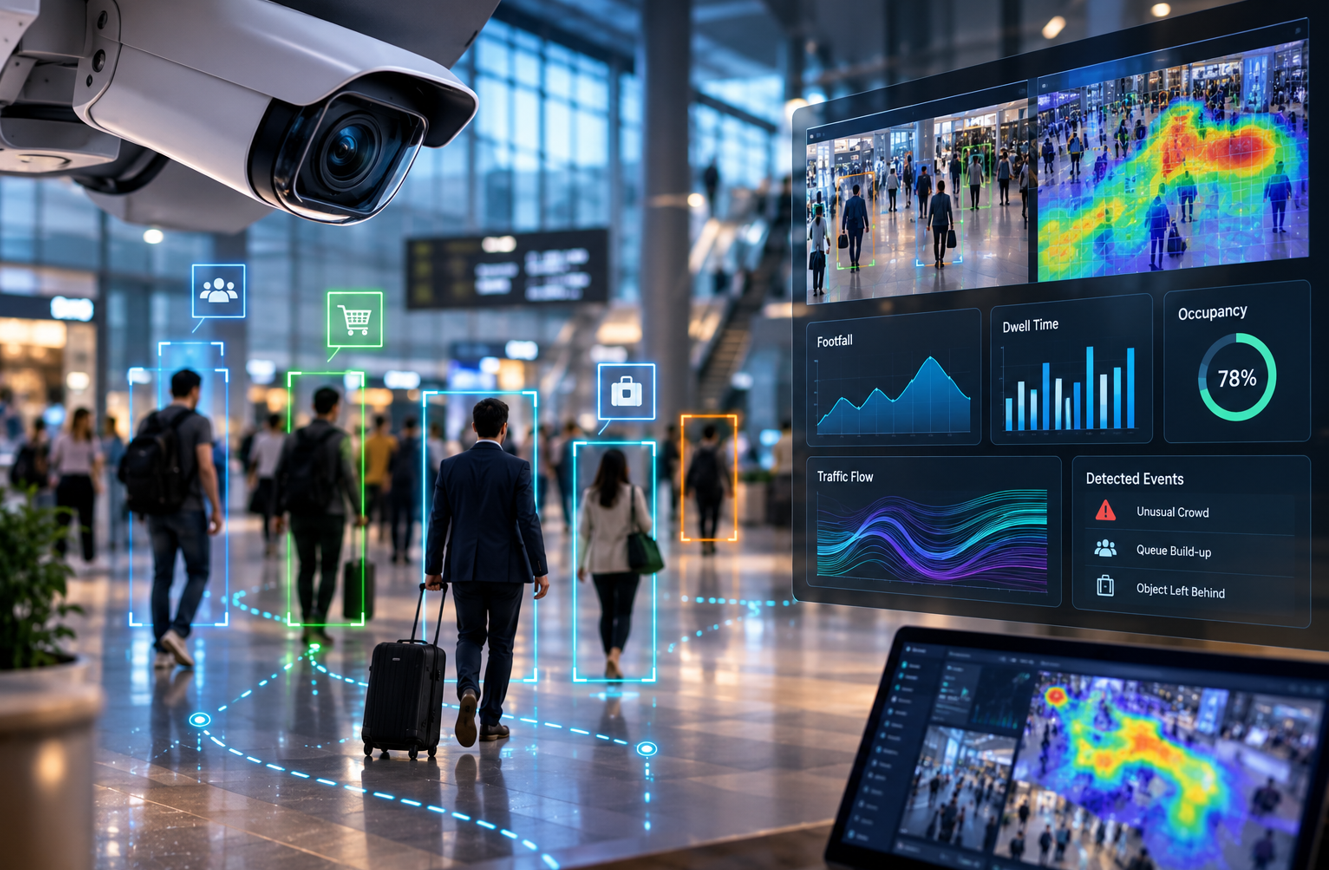
With the combination of AI and video data, computer vision can be integrated with business analytics to transform video surveillance from a security infrastructure into a business intelligence tool. Video surveillance is moving from passively recording events to sensing what is happening in the environment. This helps to answer questions such as which areas are congested, how customers are moving, how long they dwell in particular areas, and whether unusual events are occurring. Businesses can use this data to optimise their operations, such as improving the customer checkout process, monitoring asset or staff movement, and managing crowds or traffic flows. Organisations can also incorporate contextual business information to enhance the analytics by combining behavioural data with CRM or IoT data, providing additional context and insights for decision-making and improving the customer or visitor experience.
Video surveillance can be used to optimise operations, improve customer experiences, and support strategic decision-making across industries. Video itself does not create business intelligence; rather, its value increases when visual information is combined with other operational and contextual data, while computer vision is used to understand and enhance business operations. The pipeline from video to business intelligence can be represented as obtaining data from video sources such as fixed cameras, IoT-enabled cameras, or robots. Computer vision is then applied to the video to detect or track people, objects of interest, or activities. Behavioural data are taken into account, such as customer dwell time in particular product areas, occupancy of rooms or halls, movement of people across a building, and anomalies in behaviour. At this stage, operational data are also considered. The final stage is the business intelligence stage, where trends are identified and insights are inferred. At this stage, data visualisation plays an important role, with dashboards and data storytelling displaying correlations, predictions, and infographics that provide more than simple visual summaries of surveillance data. The camera becomes an operational sensor for the organisation. The important transformation occurs when visual data are combined with business data, such as sales, operational, and IoT data, to convert visual observations into business knowledge that informs operational, tactical, and strategic decision-making within an organisation.
The levels of business intelligence can be viewed as three analytical capabilities: descriptive intelligence, diagnostic intelligence, and combined predictive and prescriptive intelligence. Descriptive intelligence usually addresses what is happening. Visual analytics can identify footfall, occupancy, queue length, waiting time, dwell time, traffic flow, movement patterns, and detected events. Visualisation dashboards can present these indicators in real time or over historical periods, allowing managers to understand the current state of an operation. For example, a museum dashboard can show heat maps of visitor numbers, dwell time, and movement across different exhibition areas, while analysing visitor behaviour and providing insights into the optimal placement of exhibitions. An airport dashboard could display passenger volumes and queue lengths across terminals.


SUGEE GROUP & WYNDHAM HOTELS & RESORTS PARTNERS TO DEVELOP THE WORLD’S FIRST VIENNA HOUSE RESIDENCES BY WYNDHAM ON AL MARJAN ISLANDS, RAK
RECHITTA SURPASSES 100,000 MINUTES OF REAL-WORLD USE AS IT LAUNCHES NEXT-GENERATION V2 PLATFORM
Above the City with CRANK at Level 43



-

 Trending12 months ago
OPPO A6 Pro 5G Review: Reliable Daily Driver
-

 Tech News2 years ago
Denodo Bolsters Executive Team by Hiring Christophe Culine as its Chief Revenue Officer
-
 VAR2 years ago
Microsoft Launches New Surface Copilot+ PCs for Business
-

 Automotive2 years ago
AGMC Launches the RIDDARA RD6 High Performance Fully Electric 4×4 Pickup
-
Tech Interviews3 years ago
Navigating the Cybersecurity Landscape in Hybrid Work Environments
-

 Hospitality2 years ago
Gulfood 2025 30th Edition Kicks Off Today, Setting New Benchmarks in F&B Growth and Innovation
-

 VAR11 months ago
Huawei Nova 14 Pro Review: Where Camera Excellence Meets Ecosystem Evolution
-

 Tech News1 year ago
Nothing Launches flagship Nothing Phone (3) and Headphone (1) in theme with the Iconic Museum of the Future in Dubai